Page 227 of 482
Driver-Selectable Surround Sound (DSS) – If
Equipped
Press and release the MENU button until “Surround
Sound” displays in the EVIC. The EVIC provides infor-
mation on the current surround mode.
•Stereo
•Video Surround
•Audio Surround
While in the Surround Sound menu, press the FUNC-
TION SELECT button to change surround modes. The
Video Surround Mode will only be available for video
media sources (DVDs, Video CDs, or other video media
supported by the radio).
System Warnings (Customer Information
Features)
Press and release the MENU button until “SYSTEM
WARNINGS” displays in the EVIC. Then, press the
SCROLL button to display anyone of the following
choices.
•Oil Temperature
Shows the actual oil temperature.
•Oil Pressure
Shows the actual oil pressure.
•Tire Pressure
Shows the actual tire pressure for each tire (EXCLUDING
THE SPARE TIRE).
UNDERSTANDING YOUR INSTRUMENT PANEL 225
4
Page 306 of 482

Over-Temperature Mode
The transmission electronics constantly monitor the trans-
mission oil temperature. If the transmission exceeds nor-
mal operating temperature, the transmission will change
the way it shifts to help control the condition. This may
result in a slightly different feeling or response during
normal operation in DRIVE position. After the transmis-
sion cools down, it will return to normal operation.
Brake/Transmission Shift Interlock System
This vehicle is equipped with a Brake Transmission Shift
Interlock System (BTSI) that holds the shift lever in the
PARK position when the ignition switch is in the LOCK
position. To move the shift lever out of the PARK
position, the ignition switch must be turned to the ON
position, and the brake pedal must be depressed.
BTSI Override
There is an override for the BTSI that allows you to move
the shift lever out of the PARK position if an electricalsystem malfunction occurs (i.e., dead battery). To access
the override, remove the rubber tray from the storage bin
located to the right of the shift lever. The override access
port is at the top of the bin to the right of the shift lever
gate.
Brake Interlock Override
304 STARTING AND OPERATING
Page 316 of 482

CAUTION!
•Driving through standing water may cause dam-
age to your vehicle’s drivetrain components. Al-
ways inspect your vehicle’s fluids (i.e., engine oil,
transmission, axle, etc.) for signs of contamination
(i.e., fluid that is milky or foamy in appearance)
after driving through standing water. Do not con-
tinue to operate the vehicle if any fluid appears
contaminated, as this may result in further dam-
age. Such damage is not covered by the New
Vehicle Limited Warranty.
•Getting water inside your vehicle’s engine can
cause it to lock up and stall out, and cause serious
internal damage to the engine. Such damage is not
covered by the New Vehicle Limited Warranty.
WARNING!
•Driving through standing water limits your vehi-
cle’s traction capabilities. Do not exceed 5 mph (8
km/h) when driving through standing water.
•Driving through standing water limits your vehi-
cle’s braking capabilities, which increases stop-
ping distances. Therefore, after driving through
standing water, drive slowly and lightly press on
the brake pedal several times to dry the brakes.
•Getting water inside your vehicle’s engine can
cause it to lock up and stall out, and leave you
stranded.
•Failure to follow these warnings may result in
injuries that are serious or fatal to you, your
passengers, and others around you.
314 STARTING AND OPERATING
Page 343 of 482
These indicators are molded into the bottom of the tread
grooves. They will appear as bands when the tread depth
becomes 1/16 in (2 mm). When the tread is worn to the
tread wear indicators, the tire should be replaced.
Many states have laws requiring tire replacement at this
point.
Life of Tire
The service life of a tire is dependent upon varying
factors including, but not limited to:
•Driving style
•Tire pressure
•Distance driven
WARNING!
Tires and the spare tire should be replaced after six
years, regardless of the remaining tread. Failure to
follow this warning can result in sudden tire failure.
You could lose control and have an accident resulting
in serious injury or death.
Keep dismounted tires in a cool, dry place with as little
exposure to light as possible. Protect tires from contact
with oil, grease, and gasoline.
STARTING AND OPERATING 341
5
Page 374 of 482
WARNING!
A hot engine cooling system is dangerous. You or
others could be badly burned by steam or boiling
coolant. You may want to call a service center if your
vehicle overheats. If you decide to look under the
hood yourself, refer to Section 7 and follow the
warnings under the Cooling System Pressure Cap
paragraph.
TIREFIT TIRE REPAIR
Small punctures, particularly those in the tread, can be
sealed with TIREFIT. Foreign objects (e.g., screws or
nails) should not be removed from the tire. TIREFIT can
be used in outside temperatures down to approximately
-4°F (-20°C).The TIREFIT system is located under an access panel in
the trunk.
TIREFIT Location
372 WHAT TO DO IN EMERGENCIES
Page 385 of 482
MAINTAINING YOUR VEHICLE
CONTENTS
�6.1L Engine Compartment................386
�Onboard Diagnostic System — OBD II........387
▫Loose Fuel Filler Cap..................387
�Emissions Inspection And Maintenance
Programs............................388
�Replacement Parts......................389
�Authorized Dealer Service................390
�Maintenance Procedures..................390
▫Engine Oil..........................391▫Engine Oil Filter......................393
▫Drive Belts — Check Condition And Tension . . 393
▫Spark Plugs.........................394
▫Engine Air Cleaner Filter................394
▫Fuel Filter..........................395
▫Catalytic Converter....................395
▫Maintenance-Free Battery................397
▫Air Conditioner Maintenance.............399
▫A/C Air Filter — If Equipped............400
7
Page 388 of 482
6.1L ENGINE COMPARTMENT
1 — Remote Jump-Start Positive Battery Post 6 — Power Steering Fluid
2 — Fuses (Front Power Distribution Center) 7 — Air Cleaner Filter
3 — Coolant Pressure Cap 8 — Engine Oil Fill
4 — Brake Fluid Reservoir Access Cover 9 — Engine Oil Dipstick
5 — Coolant Bottle 10 — Washer Fluid Bottle 386 MAINTAINING YOUR VEHICLE
Page 393 of 482
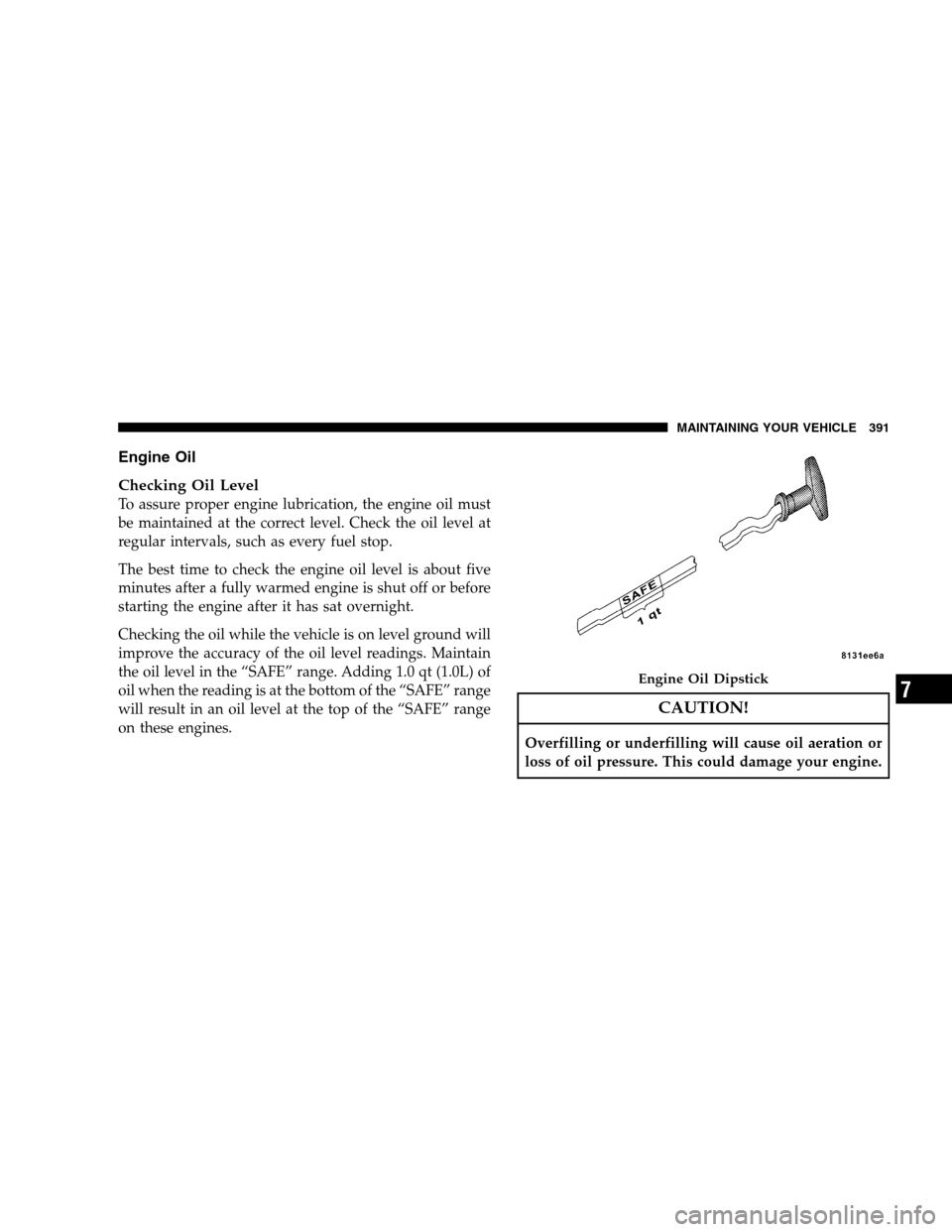
Engine Oil
Checking Oil Level
To assure proper engine lubrication, the engine oil must
be maintained at the correct level. Check the oil level at
regular intervals, such as every fuel stop.
The best time to check the engine oil level is about five
minutes after a fully warmed engine is shut off or before
starting the engine after it has sat overnight.
Checking the oil while the vehicle is on level ground will
improve the accuracy of the oil level readings. Maintain
the oil level in the “SAFE” range. Adding 1.0 qt (1.0L) of
oil when the reading is at the bottom of the “SAFE” range
will result in an oil level at the top of the “SAFE” range
on these engines.
CAUTION!
Overfilling or underfilling will cause oil aeration or
loss of oil pressure. This could damage your engine.
Engine Oil Dipstick
MAINTAINING YOUR VEHICLE 391
7