Page 412 of 519

▫Air Conditioner Maintenance.............430
▫A/C Air Filter — If Equipped............431
▫Power Steering — Fluid Check............432
▫Front & Rear Suspension Ball Joints........432
▫Steering Linkage......................433
▫Body Lubrication.....................433
▫Windshield Wiper Blades................433
▫Windshield Washers/Headlight Washers —
If Equipped.........................434
▫Exhaust System......................434
▫Cooling System.......................435
▫Hoses And Vacuum/Vapor Harnesses.......440
▫Fuel System.........................441▫Brake System........................441
▫Automatic Transmission................444
▫All Wheel Drive (AWD) — If Equipped.....445
▫Front And Rear Wheel Bearings...........446
▫Appearance Care And Protection From
Corrosion...........................446
▫Cleaning The Center Console Cup Holders . . . 450
�Fuses (Power Distribution Centers)..........451
▫Fuses (Front Power Distribution Center).....451
▫Fuses (Rear Power Distribution Center)......453
�Vehicle Storage........................458
�Replacement Bulbs......................459
�Bulb Replacement......................460
412 MAINTAINING YOUR VEHICLE
Page 430 of 519
CAUTION!
•It is essential when replacing the cables on the
battery that the positive cable is attached to the
positive post and the negative cable is attached to
the negative post. Battery posts are marked posi-
tive (+) and negative (-) and identified on the
battery case. Cable clamps should be tight on the
terminal posts and free of corrosion.
•If a “fast charger” is used while battery is in
vehicle, disconnect both vehicle battery cables
before connecting the charger to battery. Do not
use a “fast charger” to provide starting voltage.
Air Conditioner Maintenance
For best possible performance, your air conditioner
should be checked and serviced by an Authorized Dealer
at the start of each warm season. This service should
include cleaning of the condenser fins and a performance
test. Drive belt tension should also be checked at this
time.
430 MAINTAINING YOUR VEHICLE
Page 431 of 519

WARNING!
•Use only refrigerants and compressor lubricants
approved by the manufacturer for your air condi-
tioning system. Some unapproved refrigerants are
flammable and can explode, injuring you. Other
unapproved refrigerants or lubricants can cause
the system to fail, requiring costly repairs. Refer to
Section 3 of the Warranty Information book for
further warranty information.
•The air conditioning system contains refrigerant
under high pressure. To avoid risk of personal
injury or damage to the system, adding refrigerant
or any repair requiring lines to be disconnected
should be done by an experienced technician.
Refrigerant Recovery and Recycling
R-134a Air Conditioning Refrigerant is a hydrofluorocar-
bon (HFC) that is endorsed by the Environmental Pro-
tection Agency and is an ozone-saving product. How-
ever, the manufacturer recommends that air conditioning
service be performed by dealers or other service facilities
using recovery and recycling equipment.
NOTE:Use only manufacturer approved A/C System
Sealers, Stop Leak Products, Seal Conditioners, Compres-
sor Oil, and Refrigerants.
A/C Air Filter — If Equipped
The filter is located in the fresh air inlet under the hood,
behind a removable panel in the cowl on the passenger
side of the vehicle, next to the windshield wipers. When
installing a new filter, ensure its proper orientation. To
replace the filter remove the access door in the cowl
screen by pressing the retaining clips. Slide the lid on the
filter adapter forward and down and remove used filter.
MAINTAINING YOUR VEHICLE 431
7
Page 432 of 519

Install new filter with arrows pointing in the direction of
airflow, which is toward the rear of the vehicle (text and
arrows on the filter indicate this).
Refer to the “Maintenance Schedule” in Section 8 of
this manual for the recommended air conditioning
filter replacement intervals.
Power Steering — Fluid Check
Checking the power steering fluid level at a defined
service interval is not required. The fluid should only be
checked if a leak is suspected, abnormal noises are
apparent, and/or the system is not functioning as antici-
pated. Coordinate inspection efforts through a certified
DaimlerChrysler Dealership.
WARNING!
Fluid level should be checked on a level surface and
with the engine off to prevent injury from moving
parts and to insure accurate fluid level reading. Do
not overfill. Use only manufacturer’s recommended
power steering fluid.
If necessary, add fluid to restore to the proper indicated
level. With a clean cloth, wipe any spilled fluid from all
surfaces. Refer to “Fluids, Lubricants, and Genuine
Parts” in this section for the correct fluid type.
Front & Rear Suspension Ball Joints
The suspension ball joints should be inspected for exter-
nal leakage or damage when other maintenance is per-
formed.
432 MAINTAINING YOUR VEHICLE
Page 440 of 519

•Do not overfill the coolant recovery bottle.
•Check coolant freeze point in the radiator and in the
coolant recovery bottle. If antifreeze needs to be
added, contents of coolant recovery bottle must also be
protected against freezing.
•If frequent coolant additions are required, or if the
level in the coolant recovery bottle does not drop when
the engine cools, the cooling system should be pres-
sure tested for leaks.
•Maintain coolant concentration at 50% HOAT engine
coolant (minimum) and distilled water for proper
corrosion protection of your engine, which contains
aluminum components.
•Make sure that the radiator and coolant recovery
bottle overflow hoses are not kinked or obstructed.
•Keep the front of the radiator clean. If your vehicle is
equipped with air conditioning, keep the front of the
condenser clean, also.
•Do not change the thermostat for summer or winter
operation. If replacement is ever necessary, install
ONLY the correct type thermostat. Other designs may
result in unsatisfactory coolant performance, poor gas
mileage, and increased emissions.
Hoses and Vacuum/Vapor Harnesses
Inspect surfaces of hoses and nylon tubing for evidence
of heat and mechanical damage. Hard or soft spots,
brittle rubber, cracking, tears, cuts, abrasions, and exces-
sive swelling indicate deterioration of the rubber.
Pay particular attention to those hoses nearest to high
heat sources such as the exhaust manifold. Inspect hose
routing to be sure hoses do not come in contact with any
heat source or moving component, which may cause heat
damage or mechanical wear.
440 MAINTAINING YOUR VEHICLE
Page 458 of 519
CAUTION!
•When installing the Power Distribution Center
cover, it is important to ensure the cover is prop-
erly positioned and fully latched. Failure to do so
may allow water to get into the Power Distribution
Center, and possibly result in an electrical system
failure.
•When replacing a blown fuse, it is important to
use only a fuse having the correct amperage rating.
The use of a fuse with a rating other than indicated
may result in a dangerous electrical system over-
load. If a properly rated fuse continues to blow, it
indicates a problem in the circuit that must be
corrected.
VEHICLE STORAGE
If you are leaving your vehicle dormant for more than 21
days, you may want to take steps to protect your battery.
You may:
•Disconnect the negative cable from the battery.
•Anytime you store your vehicle, or keep it out of
service (i.e. vacation) for two weeks or more, run the
air conditioning system at idle for about five minutes
in the fresh air and high blower setting. This will
insure adequate system lubrication to minimize the
possibility of compressor damage when the system is
started again.
458 MAINTAINING YOUR VEHICLE
Page 478 of 519
EMISSION CONTROL SYSTEM MAINTENANCE
The “Scheduled” maintenance services, listed inbold
typemust be done at the times or mileages specified to
assure the continued proper functioning of the emission
control system. These, and all other maintenance services
included in this manual, should be done to provide best
vehicle performance and reliability. More frequent main-
tenance may be needed for vehicles in severe operating
conditions such as dusty areas and very short trip
driving.
Inspection and service also should be done any time a
malfunction is suspected.
NOTE:Maintenance, replacement, or repair of the emis-
sion control devices and systems on your vehicle may be
performed by any automotive repair establishment or
individual using any automotive part, which has been
certified pursuant to U.S. EPA or, in the State of Califor-
nia, California Air Resources Board regulations.
MAINTENANCE SCHEDULE
The oil change indicator system will remind you that it is
time to take your vehicle in for scheduled maintenance.
On Electronic Vehicle Information Center (EVIC)
equipped vehicles, “Oil Change Required” will be dis-
played in the EVIC and a single chime will sound,
indicating that an oil change is necessary.
On Non-EVIC equipped vehicles, “Change Oil” will flash
in the instrument cluster odometer and a single chime
will sound, indicating that an oil change is necessary.
Based on engine operation conditions the oil change
indicator message will illuminate, this means that service
is required for your vehicle. Have your vehicle serviced
as soon as possible, within the next 500 miles (805 km).
NOTE:
•The oil change indicator message will not monitor the
time since the last oil change. Change your vehicles oil
478 MAINTENANCE SCHEDULES
8
M
A
I
N
T
E
N
A
N
C
E
S
C
H
E
D
U
L
E
S
Page 481 of 519
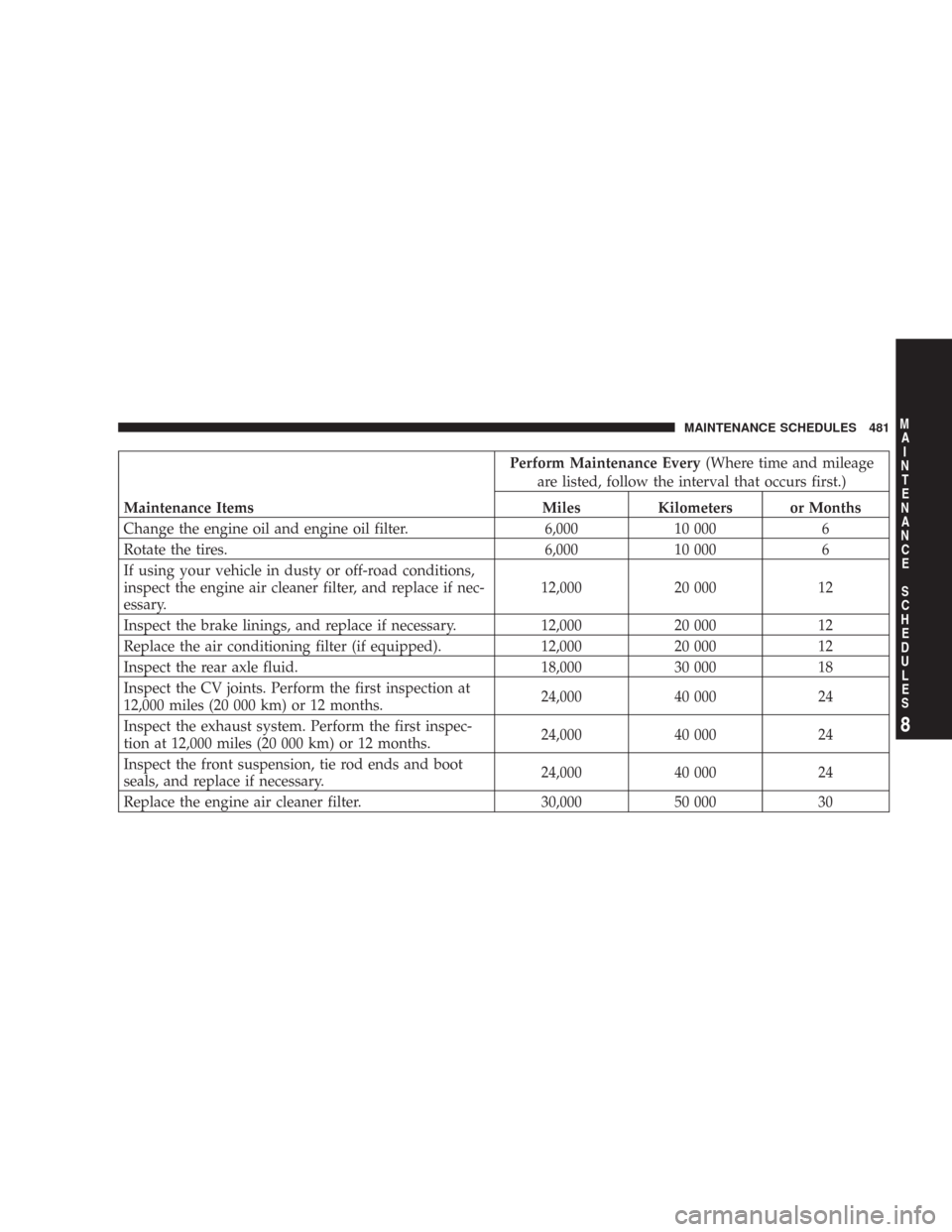
Perform Maintenance Every(Where time and mileage
are listed, follow the interval that occurs first.)
Maintenance Items Miles Kilometers or Months
Change the engine oil and engine oil filter. 6,000 10 000 6
Rotate the tires. 6,000 10 000 6
If using your vehicle in dusty or off-road conditions,
inspect the engine air cleaner filter, and replace if nec-
essary.12,000 20 000 12
Inspect the brake linings, and replace if necessary. 12,000 20 000 12
Replace the air conditioning filter (if equipped). 12,000 20 000 12
Inspect the rear axle fluid. 18,000 30 000 18
Inspect the CV joints. Perform the first inspection at
12,000 miles (20 000 km) or 12 months.24,000 40 000 24
Inspect the exhaust system. Perform the first inspec-
tion at 12,000 miles (20 000 km) or 12 months.24,000 40 000 24
Inspect the front suspension, tie rod ends and boot
seals, and replace if necessary.24,000 40 000 24
Replace the engine air cleaner filter. 30,000 50 000 30
MAINTENANCE SCHEDULES 481
8
M
A
I
N
T
E
N
A
N
C
E
S
C
H
E
D
U
L
E
S