Page 349 of 519
original equipped tire on the front or rear axle of your
vehicle, but it is not. Installation of this limited use spare
tire affects vehicle handling. Since it is not the same tire,
replace (or repair) the original tire and reinstall on the
vehicle at the first opportunity.
WARNING!
The limited use spare tires are for emergency use
only. Installation of this limited use spare tire affects
vehicle handling. With this tire, do not drive more
than 60 mph (100 km/h). Keep inflated to the cold tire
inflation pressure listed on either your tire placard or
limited use spare tire and wheel assembly. Replace
(or repair) the original tire at the first opportunity
and reinstall it on your vehicle. Failure to do so could
result in loss of vehicle control.
Tire Spinning
When stuck in mud, sand, snow, or ice conditions, do not
spin your vehicle’s wheels faster than 30 mph (48 km/h)
or for longer than 30 seconds continuously without
stopping when you are stuck.
Refer to “Freeing A Stuck Vehicle” in Section 6 of this
manual for additional information.
WARNING!
Fast spinning tires can be dangerous. Forces gener-
ated by excessive wheel speeds may cause tire dam-
age or failure. A tire could explode and injure some-
one. Do not spin your vehicle’s wheels faster than 30
mph (48 km/h) or for more than 30 seconds continu-
ously when you are stuck, and don’t let anyone near
a spinning wheel, no matter what the speed.
STARTING AND OPERATING 349
5
Page 353 of 519

Improper alignment will not cause vehicle vibration.
Vibration may be a result of tire and wheel out-of-
balance. Proper balancing will reduce vibration and
avoid tire cupping and spotty wear.
SELF-SEALING TIRES — IF EQUIPPED
A non-hardening viscous sealant applied to the inner
liner of each tire fills punctures up to 0.19 in. (5 mm) to
minimize the loss of air pressure. This contributes to the
safety of the vehicle by significantly reducing the prob-
ability of a roadside stop due to a flat tire.
TIRE CHAINS
Use only compact chains, or other traction aids that meet
SAE type “Class S” specifications. Chains must be the
proper size for the vehicle, as recommended by the chain
manufacturer. In addition, only install tire chains on
P215/65 R17 and P225/60 R18 size tires. The P245/45 R20
size tires do not provide adequate clearance for tire chains.
NOTE:Do not use tire chains on a compact spare tire.
CAUTION!
To avoid damage to your vehicle or tires, observe the following
precautions:
•Because of restricted chain clearance between tires and other
suspension components, it is important that only chains in
good condition are used. Broken chains can cause serious
damage. Stop the vehicle immediately if noise occurs that
could indicate chain breakage. Remove the damaged parts of
the chain before further use.
•Install chains on the rear wheels as tightly as possible and
then retighten after driving about
12mile (0.8 km).
•Do not exceed 30 mph (48 km/h).
•Drive cautiously and avoid severe turns and large bumps,
especially with a loaded vehicle.
•Use on Rear Wheels only.
•Do not drive for prolonged period on dry pavement.
•Observe the tire chain manufacturer’s instructions on the
method of installation, operating speed, and conditions for
use. Always use the lower suggested operating speed of the
chain manufacturer if different from the speed recommended
by the manufacture.
STARTING AND OPERATING 353
5
Page 364 of 519

Light will remain ON and a chime will sound. In
addition, the graphic in the EVIC will still display a
flashing pressure value.
3. After driving the vehicle for up to 10 minutes above 15
mph (25 km/h), the TPM Telltale Light will flash on and
off for 75 seconds and then remain on solid. In addition,
the EVIC will display a�CHECK TPM SYSTEM�message
for 3 seconds and then display dashes (- -) in place of the
pressure value.
4.
For each subsequent ignition key cycle, a chime will
sound, the TPM Telltale Light will flash on and off for 75
seconds and then remain on solid, and the EVIC will
display a�CHECK TPM SYSTEM�message for 3 seconds
and then display dashes (- -) in place of the pressure value.
5. Once you repair or replace the original road tire, and
reinstall it on the vehicle in place of the compact spare,
the TPMS will update automatically. In addition, the
TPM Telltale Light will turn OFF and the graphic in the
EVIC will display a new pressure value instead of dashes(- -), as long as no tire pressure is below the low-pressure
warning limit in any of the four active road tires. The
vehicle may need to be driven for up to 10 minutes above
15 mph (25 km/h) in order for the TPMS to receive this
information.
General Information
This device complies with part 15 of the FCC rules and
RSS 210 of Industry Canada. Operation is subject to the
following conditions:
•This device may not cause harmful interference.
•This device must accept any interference received,
including interference that may cause undesired op-
eration.
The tire pressure sensors are covered under one of the
following licenses:
United States.....................KR5S120123
Canada........................2671-S120123
364 STARTING AND OPERATING
Page 367 of 519
manufacturer. While MTBE is an oxygenate made from
Methanol, it does not have the negative effects of Metha-
nol.
MMT In Gasoline
MMT is a manganese containing metallic additive that is
blended into some gasoline to increase octane. Gasoline
blended with MMT provides no performance advantage
beyond gasoline of the same octane number without
MMT. Gasoline blended with MMT reduces spark plug
life and reduces emission system performance in some
vehicles. The manufacturer recommends that gasoline
without MMT be used in your vehicle. The MMT content
of gasoline may not be indicated on the gasoline pump;
therefore, you should ask your gasoline retailer whether
his/her gasoline contains MMT. It is even more impor-
tant to look for gasolines without MMT in Canada,
because MMT can be used at levels higher than those
allowed in the United States. MMT is prohibited in
Federal and California reformulated gasoline.
Materials Added to Fuel
All gasoline sold in the United States is required to
contain effective detergent additives. Use of additional
detergents or other additives is not needed under normal
conditions and they would result in additional cost.
Therefore, you should not have to add anything to the
fuel.
Fuel System Cautions
CAUTION!
Follow these guidelines to maintain your vehicle’s
performance:
•The use of leaded gas is prohibited by Federal law.
Using leaded gasoline can impair engine performance,
and damage the emission control system.
STARTING AND OPERATING 367
5
Page 369 of 519
•Guard against carbon monoxide with proper mainte-
nance. Have the exhaust system inspected every time
the vehicle is raised. Have any abnormal conditions
repaired promptly. Until repaired, drive with all side
windows fully open.
•Keep the trunk closed when driving your vehicle to
prevent carbon monoxide and other poisonous ex-
haust gases from entering the vehicle.
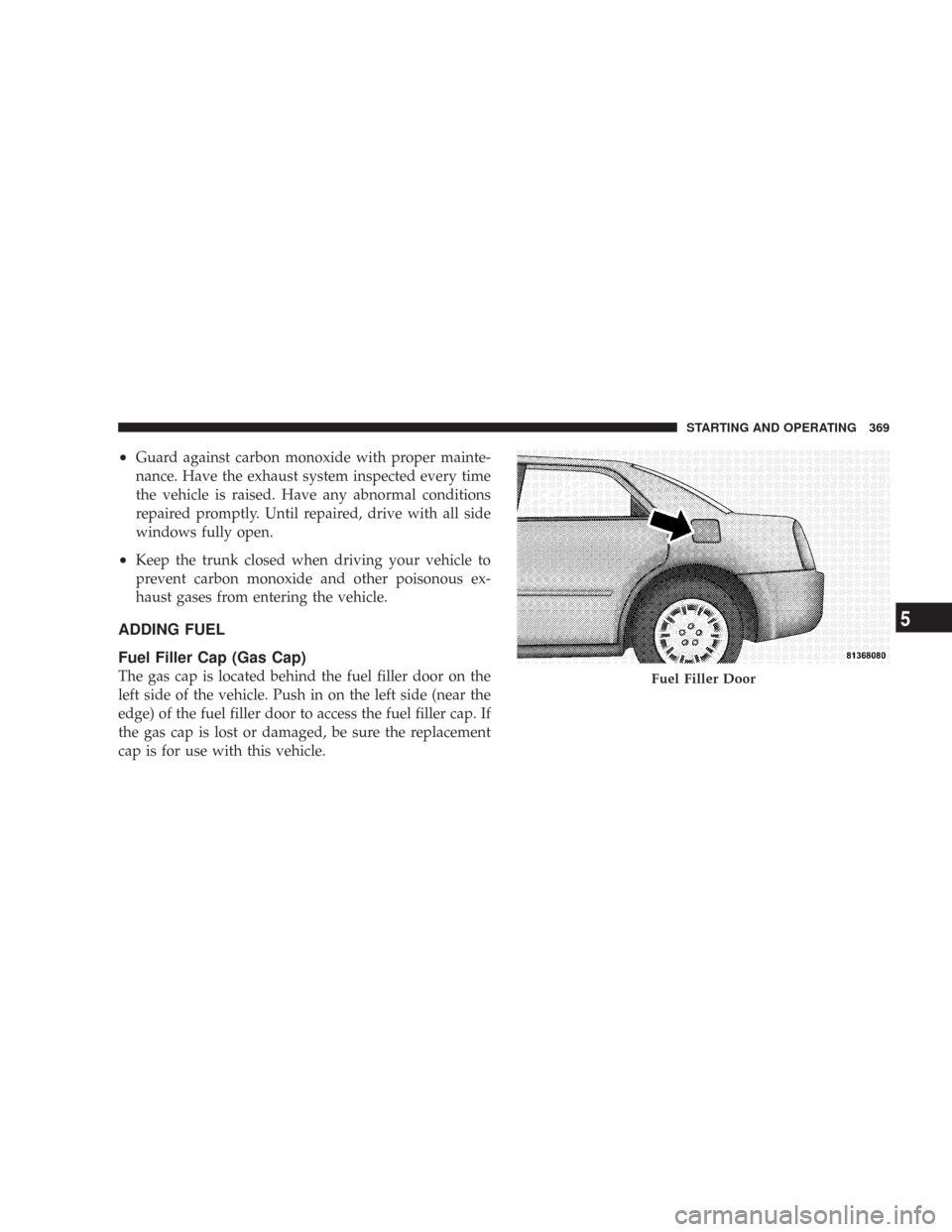
ADDING FUEL
Fuel Filler Cap (Gas Cap)
The gas cap is located behind the fuel filler door on the
left side of the vehicle. Push in on the left side (near the
edge) of the fuel filler door to access the fuel filler cap. If
the gas cap is lost or damaged, be sure the replacement
cap is for use with this vehicle.Fuel Filler Door
STARTING AND OPERATING 369
5
Page 389 of 519
Extended driving at high RPM should be avoided to
prevent excess heat generation. A reduction in vehicle
speed may be required to avoid extended driving at
high RPM. Return to a higher gear range or vehicle
speed when road conditions and RPM level allows.
Towing Tips — Cooling System
To reduce potential for engine and transmission over-
heating, take the following actions:
City Driving
When stopped for short periods, put transmission in “N”
(Neutral) and increase engine idle speed.
Highway Driving
Reduce speed.
Air Conditioning
Turn off temporarily.
Refer to “Cooling System” under “Maintenance Pro-
cedures” in Section 7 of this manual for more informa-
tion.
RECREATIONAL TOWING (BEHIND
MOTORHOME, ETC.)
TOWING THIS VEHICLE BEHIND ANOTHER
VEHICLE (Flat towing with all four wheels on the
ground)
Recreational towing for this vehicle is not recommended.
NOTE:If the vehicle requires towing, make sure all four
wheels are off the ground.
STARTING AND OPERATING 389
5
Page 393 of 519

IF YOUR ENGINE OVERHEATS
In any of the following situations, you can reduce the
potential for overheating by taking the appropriate ac-
tion.
•On the highways — Slow down.
•In city traffic — While stopped, put transmission in
“N” (Neutral), but do not increase engine idle speed.
NOTE:There are steps that you can take to slow down
an impending overheat condition. If your air conditioner
is on, turn it off. The air conditioning system adds heat to
the engine cooling system and turning off the A/C
removes this heat. You can also turn the Temperature
control to maximum heat, the Mode control to floor, and
the fan control to HI. This allows the heater core to act as
a supplement to the radiator and aids in removing heat
from the engine cooling system.
CAUTION!
Driving with a hot cooling system could damage
your vehicle. If temperature gauge reads “H,” pull
over and stop the vehicle. Idle the vehicle with the air
conditioner turned off until the pointer drops back
into the normal range. If the pointer remains on the
“H,” turn the engine off immediately, and call for
service.
WHAT TO DO IN EMERGENCIES 393
6
Page 411 of 519
MAINTAINING YOUR VEHICLE
CONTENTS
�2.7L Engine Compartment................414
�3.5L Engine Compartment................415
�5.7L Engine Compartment................416
�Onboard Diagnostic System — OBD II........417
▫Loose Fuel Filler Cap..................417
�Emissions Inspection And Maintenance
Programs............................418
�Replacement Parts......................419
�Dealer Service.........................420�Maintenance Procedures..................420
▫Engine Oil..........................421
▫Engine Oil Filter......................425
▫Drive Belts — Check Condition And Tension . . 425
▫Spark Plugs.........................426
▫Engine Air Cleaner Filter................426
▫Fuel Filter..........................426
▫Catalytic Converter....................427
▫Maintenance-Free Battery................428
7