Page 326 of 519

WARNING!
•The Anti-Lock Brake System contains sophisticated electronic
equipment that may be susceptible to interference caused by
improperly installed or high output radio transmitting equip-
ment. This interference can cause possible loss of anti-lock
braking capability. Installation of such equipment should be
performed by qualified professionals.
•Pumping of the Anti-Lock Brakes will diminish their effective-
ness and may lead to an accident. Pumping makes the stopping
distance longer. Just press firmly on your brake pedal when you
need to slow down or stop.
•Anti-lock system (ABS) cannot prevent the natural laws of
physics from acting on the vehicle, nor can it increase braking or
steering efficiency beyond that afforded by the condition of the
vehicle brakes and tires or the traction afforded.
•The ABS cannot prevent accidents, including those resulting
from excessive speed in turns, following another vehicle too
closely, or hydroplaning. Only a safe, attentive, and skillful
driver can prevent accidents.
•The capabilities of an ABS equipped vehicle must never be
exploited in a reckless or dangerous manner, which could jeop-
ardize the user’s safety or the safety of others.
All vehicle wheels and tires must be the same size and
type and tires must be properly inflated to produce
accurate signals for the computer.
Anti-Lock Brake Light
The ABS light monitors the Anti-Lock Brake Sys-
tem. The light will come on when the ignition
switch is turned to the ON position and may stay on for
as long as four seconds.
If the ABS light remains on or comes on while driving, it
indicates that the Anti-Lock portion of the brake system
is not functioning and that service is required. However,
the conventional brake system will continue to operate
normally if the BRAKE warning light is not on.
If the ABS light is on, the brake system should be serviced
as soon as possible to restore the benefits of Anti-Lock
brakes. If the ABS light does not come on when the
Ignition switch is turned to the ON position, have the
bulb repaired as soon as possible.
326 STARTING AND OPERATING
Page 327 of 519
If both the Brake Warning Light and the ABS Light
remain on, the Anti-Lock brakes (ABS) and Electronic
Brake Force Distribution (EBD) systems are not function-
ing. Immediate repair to the ABS system is required.
POWER STEERING
The standard power steering system will give you good
vehicle response and increased ease of maneuverability
in tight spaces. The system will provide mechanical
steering capability if power assist is lost.
If for some reason the power assist is interrupted, it will
still be possible to steer your vehicle. Under these condi-
tions, you will observe a substantial increase in steering
effort, especially at very low vehicle speeds and during
parking maneuvers.NOTE:Increased noise levels at the end of the steering
wheel travel are considered normal and do not indicate
that there is a problem with the power steering system.
Upon initial start-up in cold weather, the power steering
pump may make noise for a short amount of time. This is
due to the cold, thick fluid in the steering system. This
noise should be considered normal, and it does not in any
way damage the steering system.
WARNING!
Continued operation with reduced power steering
assist could pose a safety risk to yourself and others.
Service should be obtained as soon as possible.
STARTING AND OPERATING 327
5
Page 328 of 519
CAUTION!
Prolonged operation of the steering system at the end
of the steering wheel travel will increase the steering
fluid temperature and it should be avoided when
possible. Damage to the power steering pump may
occur.
MULTI DISPLACEMENT SYSTEM (MDS) — 5.7L
Engine Only
This feature offers improved fuel economy by shutting
off four of the engine’s eight cylinders during light load
and cruise conditions. The system is automatic with no
driver inputs or additional driving skills required.
NOTE:The MDS system may take some time to return
to full functionality after a battery disconnect.
TRACTION CONTROL SYSTEM (TCS) — IF
EQUIPPED
WARNING!
The Traction Control System (TCS) cannot prevent
the natural laws of physics from acting on the ve-
hicle, nor can it increase the traction afforded. The
TCS cannot prevent accidents, including those result-
ing from excessive speed in turns, or hydroplaning.
Only a safe, attentive, and skillful driver can prevent
accidents. The capabilities of a TCS-equipped ve-
hicle must never be exploited in a reckless or dan-
gerous manner, which could jeopardize the user’s
safety or the safety of others.
The Traction Control System (TCS) is standard on ve-
hicles equipped with Electronic Stability Program (ESP).
328 STARTING AND OPERATING
Page 329 of 519

The TCS monitors the amount of wheel spin of each
driven wheel. If wheel spin is detected, brake pressure is
applied to the slipping wheel(s) and engine power is
reduced to provide enhanced acceleration and stability.
The ESP/TCS indicator light, located in the
instrument cluster, starts to flash as soon as the
tires lose traction and the ESP system becomes
active. The indicator light also flashes when the
TCS is active. If the indicator light begins to flash during
acceleration, ease up on the accelerator and apply as little
throttle as possible. Be sure to adapt your speed and
driving to the prevailing road conditions.
When the TCS is switched off, the torque reduction
feature is cancelled. However, a feature of the system
remains active. This feature controls wheel spin across an
axle quite similarly to a limited slip differential. If one
wheel on an axle is spinning faster than the other, the
system will apply the brake of the spinning wheel andallow more engine torque to be applied to the wheel that
is not spinning. This wheel slip control is active up to 50
mph (80 km/h).
CAUTION!
When the ESP/TCS indicator light is illuminated
continuously, the ESP is switched off. Avoid spin-
ning one drive wheel. This may cause serious dam-
age to the drive train.
NOTE:
•The Traction Control System comes on each time the
ignition switch is turned ON. This will occur even if
you used the ESP OFF button to turn OFF the system.
•The Traction Control System will make buzzing or
clicking sounds when in operation.
STARTING AND OPERATING 329
5
Page 332 of 519
The ESP/TCS indicator light, located in the
instrument cluster, starts to flash as soon as the
tires lose traction and the ESP system becomes
active. The indicator light also flashes when the
TCS is active. If the indicator light begins to flash during
acceleration, ease up on the accelerator and apply as little
throttle as possible. Be sure to adapt your speed and
driving to the prevailing road conditions.
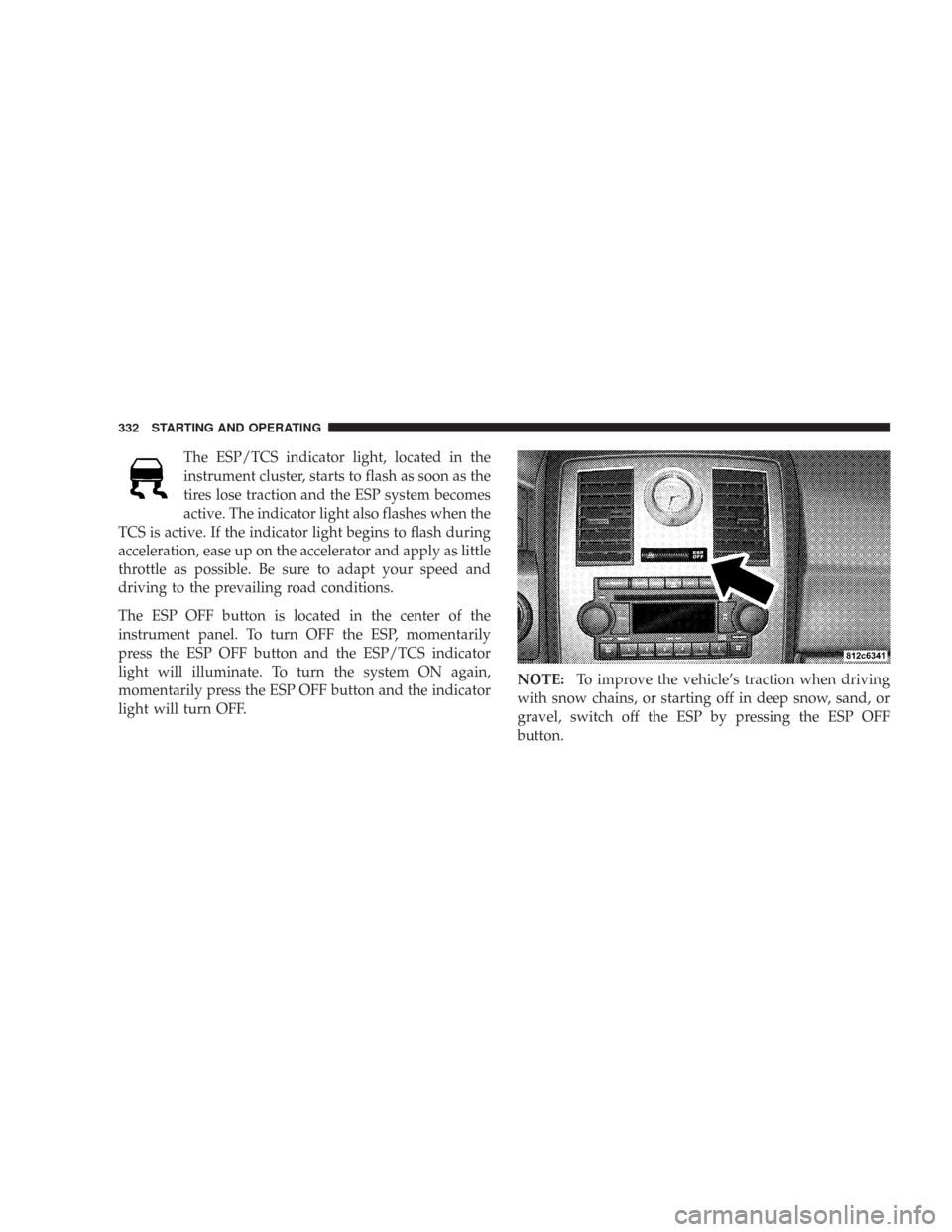
The ESP OFF button is located in the center of the
instrument panel. To turn OFF the ESP, momentarily
press the ESP OFF button and the ESP/TCS indicator
light will illuminate. To turn the system ON again,
momentarily press the ESP OFF button and the indicator
light will turn OFF.NOTE:To improve the vehicle’s traction when driving
with snow chains, or starting off in deep snow, sand, or
gravel, switch off the ESP by pressing the ESP OFF
button.
332 STARTING AND OPERATING
Page 333 of 519

CAUTION!
When the ESP/TCS indicator light is illuminated
continuously, the ESP is switched off. Avoid spin-
ning one drive wheel. This may cause serious dam-
age to the drive train.
CAUTION!
If the vehicle is towed with the front axle raised, the
engine must be shut off (key in the ignition switch to
the LOCK or ACC position). Otherwise, the ESP will
immediately be engaged and it will apply the rear
wheel brakes.
Synchronizing ESP
The malfunction indicator light for the ESP is
combined with BAS indicator. If the power
supply is interrupted (battery disconnected or
discharged), the ESP/BAS malfunction indica-
tor light may illuminate with the engine running. If this
should occur, turn the steering wheel completely to the
left and then to the right. The ESP/BAS malfunction
indicator light should go out. However, if the light
remains on, have the ESP and BAS checked at your
authorized dealer as soon as possible.
ESP/BAS Malfunction Indicator and ESP/TCS
Indicator Lights
The malfunction indicator light for the ESP is
combined with the BAS indicator. The yellow
ESP/BAS malfunction indicator light and the
STARTING AND OPERATING 333
5
Page 334 of 519
yellow ESP/TCS indicator light in the instrument cluster
both come on when the ignition switch is turned to the
“ON” position. They should go out with the engine
running.
The system will turn the ESP/BAS malfunction indicator
light on continuously while the engine running if it
detects a malfunction in either the ESP or the BAS or
both. If the light remains on after several ignition cycles,
and you have driven the vehicle several miles at speeds
greater than 30 mph (48 km/h), and the ESP is synchro-
nized (refer to Synchronizing ESP), see your authorized
dealer as soon as possible to have the problem diagnosed
and corrected.TIRE SAFETY INFORMATION
Tire Markings
NOTE:
•P (Passenger)-Metric tire sizing is based on U.S. design
standards. P-Metric tires have the letter “P” molded
into the sidewall preceding the size designation. Ex-
ample: P215/65R15 95H.
334 STARTING AND OPERATING
Page 335 of 519
•European Metric tire sizing is based on European
design standards. Tires designed to this standard have
the tire size molded into the sidewall beginning with
the section width. The letter�P�is absent from this tire
size designation. Example: 215/65R15 96H
•LT (Light Truck)-Metric tire sizing is based on U.S.
design standards. The size designation for LT-Metric
tires is the same as for P-Metric tires except for the
letters “LT” that are molded into the sidewall preced-
ing the size designation. Example: LT235/85R16.
•Temporary Spare tires are high-pressure compact
spares designed for temporary emergency use only.
Tires designed to this standard have the letter “T”
molded into the sidewall preceding the size designa-
tion. Example: T145/80D18 103M.
•High Flotation tire sizing is based on U.S. design
standards and it begins with the tire diameter molded
into the sidewall. Example: 31x10.5 R15 LT.
STARTING AND OPERATING 335
5