Page 372 of 519

A loose, improperly installed, or damaged fuel filler cap
may also turn on the Malfunction Indicator Light (MIL).
Refer to “Onboard Diagnostic System” in Section 7 of this
manual for more information.
VEHICLE LOADING
The load carrying capacity of your vehicle is shown on
the “Vehicle Certification Label.” This information
should be used for passenger and luggage loading as
indicated.
If the seatbacks are folded for carrying cargo, do not
exceed the specified GVWR and GAWR.
Vehicle Certification Label
Your vehicle has a certification label attached to the rear
of the driver’s door.
The label contains the following information:
•Name of manufacturer
•Month and year of manufacture
•Gross Vehicle Weight Rating (GVWR)
•Gross Axle Weight Rating (GAWR) front
•Gross Axle Weight Rating (GAWR) rear
•Vehicle Identification Number (VIN)
•Type of Vehicle
•Month Day and Hour of Manufacture (MDH)
The bar code allows a computer scanner to read the
Vehicle Identification Number (VIN).
Gross Vehicle Weight Rating (GVWR)
The GVWR is the total allowable weight of your vehicle.
This includes driver, passengers, and cargo. The total
load must be limited so that you do not exceed the
GVWR.
372 STARTING AND OPERATING
Page 379 of 519
Trailer Hitch Classification
Your vehicle may be factory equipped for safe towing of
trailers weighing over 2,000 lbs (907 kg) with the optional
Trailer Tow Prep Package. See your authorized dealer for
package content.The following chart provides the industry standard for
the maximum trailer weight a given trailer hitch class can
tow and should be used to assist you in selecting the
correct trailer hitch for your intended towing condition.
Refer to the “Trailer Towing Weights (Maximum Trailer
Weight Ratings)” chart for the Max. GTW towable for
your given drivetrain.
Trailer Hitch Classification
Class Max. GTW
(Gross Trailer Wt.)
Class I - Light Duty 2,000 lbs (907 kg)
Class II - Medium
Duty3,500 lbs (1587 kg)
Class III - Heavy Duty 5,000 lbs (2268 kg)
Class IV - Extra
Heavy Duty10,000 lbs (4540 kg)
All trailer hitches should be professionally installed on
your vehicle.
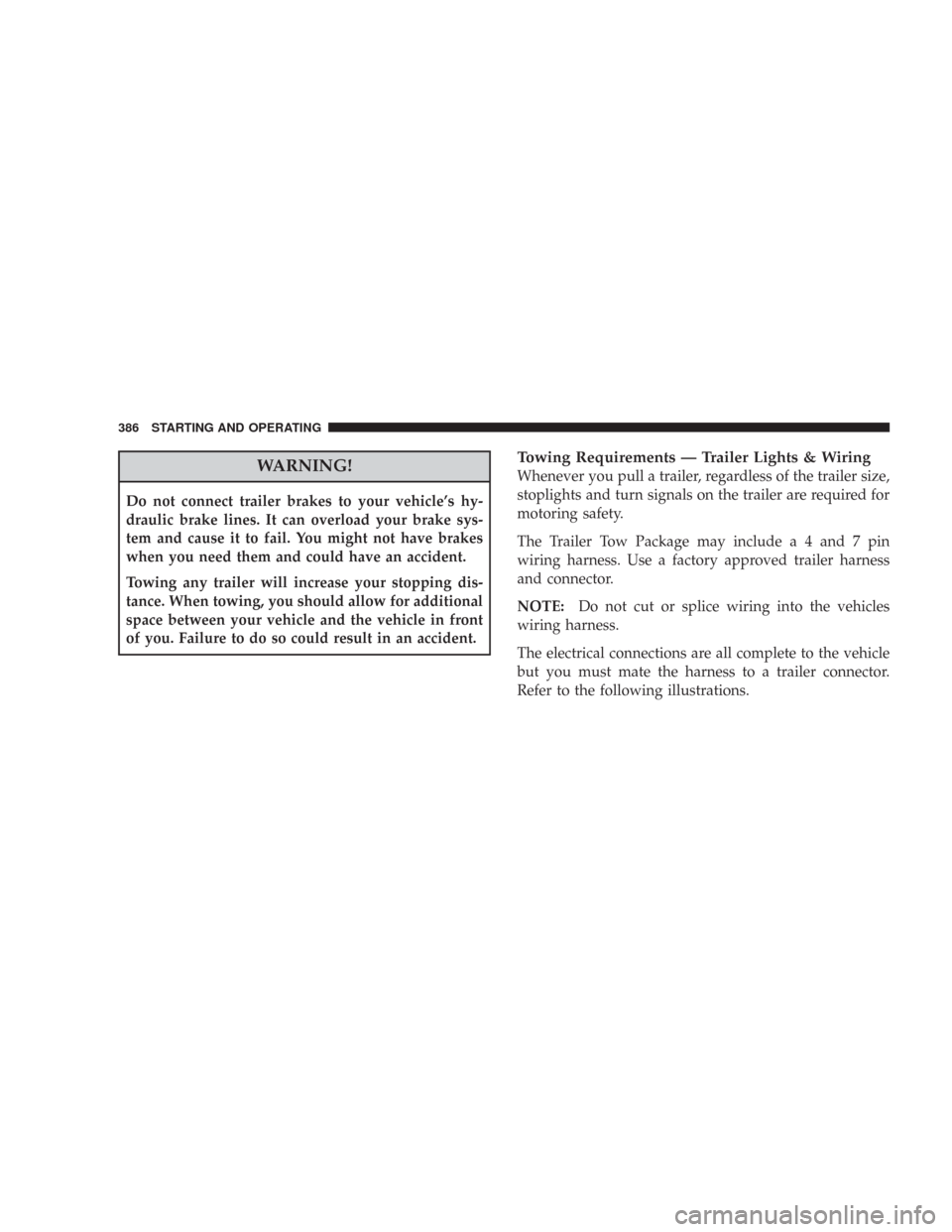
Improper Adjustment of Weight Distributing System
STARTING AND OPERATING 379
5
Page 386 of 519
WARNING!
Do not connect trailer brakes to your vehicle’s hy-
draulic brake lines. It can overload your brake sys-
tem and cause it to fail. You might not have brakes
when you need them and could have an accident.
Towing any trailer will increase your stopping dis-
tance. When towing, you should allow for additional
space between your vehicle and the vehicle in front
of you. Failure to do so could result in an accident.
Towing Requirements — Trailer Lights & Wiring
Whenever you pull a trailer, regardless of the trailer size,
stoplights and turn signals on the trailer are required for
motoring safety.
The Trailer Tow Package may includea4and7pin
wiring harness. Use a factory approved trailer harness
and connector.
NOTE:Do not cut or splice wiring into the vehicles
wiring harness.
The electrical connections are all complete to the vehicle
but you must mate the harness to a trailer connector.
Refer to the following illustrations.
386 STARTING AND OPERATING
Page 388 of 519
Towing Tips
Before setting out on a trip, practice turning, stopping,
and backing the trailer in an area located away from
heavy traffic.
Towing Tips — Automatic Transmission
The “D” range can be selected when towing. However, if
frequent shifting occurs while in this range, the “3” range
should be selected.
NOTE:Using the “3” range while operating the vehicle
under heavy operating conditions will improve perfor-
mance and extend transmission life by reducing exces-
sive shifting and heat build up. This action will also
provide better engine braking.
If you REGULARLY tow a trailer for more than 45
minutes of continuous operation, then change the auto-
matic transamission fluid and filter according to the
interval specified for “police, taxi, fleet, or frequent trailer
towing” in the “Maintenance Schedule” in this manual.
Towing Tips — Electronic Speed Control (If
Equipped)
Don’t use in hilly terrain or with heavy loads.
When using the speed control, if you experience speed
drops greater than 10 mph (16 km/h), disengage until
you can get back to cruising speed.
Use speed control in flat terrain and with light loads to
maximize fuel efficiency.
Towing Tips — Autostick�(If Equipped)
For vehicles equipped with Autostick.�By using the
Autostick�modes, and selecting a specific gear range,
frequent shifting can be avoided. The highest gear
range should be selected that allows for adequate
performance. For example, choose “4” if the desired
speed can be maintained. Choose “3” or “2” if needed
to maintain the desired speed.
388 STARTING AND OPERATING
Page 401 of 519

6. Raise the vehicle just enough to remove the flat tire
and install the spare tire.
WARNING!
Raising the vehicle higher than necessary can make
the vehicle less stable. It could slip off the jack and
hurt someone near it. Raise the vehicle only enough
to remove the tire.
7. Remove the lug nuts, wheel cover (if equipped), and
tire. Remove the cover by hand. Do not pry it off.
8. Mount the spare tire.
NOTE:For vehicles so equipped, do not attempt to
install a center cap or wheel cover on the compact spare.
However, when reinstalling the road tire, follow the
procedure under “Wheel Cover or Center Cap Installa-
tion” in place of the remaining steps in this procedure.9. Install the lug nuts with the cone shaped end of the
nut toward the wheel. Lightly tighten the lug nuts. To
avoid the risk of forcing the vehicle off the jack, do not
tighten the lug nuts fully until the vehicle is lowered to
the ground.
10. Lower the vehicle to the ground by turning the jack
handle counter-clockwise.
11. Finish tightening the lug nuts. Push down on the
wrench while tightening for increased leverage. Alternate
lug nuts until each nut has been tightened twice. The
correct tightness of each lug nut is 100 ft/lb. (135 N. m).
If in doubt about the correct tightness, have them
checked with a torque wrench by your dealer or at a
service station.
12. Stow the jack, tools, and flat tire. Make sure the base
of the jack faces the rear of the vehicle before tightening
down the fastener.
WHAT TO DO IN EMERGENCIES 401
6
Page 403 of 519

1. Mount the road tire on the axle. For vehicles equipped
with wheel covers, perform Steps 2 and 3. For vehicles
equipped with center caps, proceed to Step 4.
2. Install two lug nuts on the mounting studs, which are
on each side of the stud that is in alignment with the
valve stem. Install the lug nuts with the cone shaped end
of the nut toward the wheel. Lightly tighten the lug nuts.To avoid the risk of forcing the vehicle off the jack, do not
tighten the lug nuts fully until the vehicle is lowered to
the ground.
3. Align the valve notch in the wheel cover with the
valve stem on the wheel. Install the cover by hand,
snapping the cover over the two lug nuts. Do not use a
hammer or excessive force to install the cover.
4. Install the remaining lug nuts with the cone shaped
end of the nut toward the wheel. Lightly tighten the lug
nuts. To avoid the risk of forcing the vehicle off the jack,
do not tighten the lug nuts fully until the vehicle is
lowered to the ground.
5. Lower the vehicle to the ground by turning the jack
handle counter-clockwise.
6. Finish tightening the lug nuts. Push down on the
wrench while tightening for increased leverage. Alternate
lug nuts until each nut has been tightened twice. The
WHAT TO DO IN EMERGENCIES 403
6
Page 407 of 519

NOTE:For vehicles equipped with ESP, refer to�Syn-
chronizing ESP�under�Electronic Stability Program�in
Section 5 of this manual if the ESP/BAS light (in the
instrument cluster) remains on continuously after start-
ing the engine of the vehicle with the discharged battery.
8. When removing the jumper cables, reverse the above
sequence exactly. Be careful of the moving belts and fan.
WARNING!
Any procedure other than above could result in:
1. Personal injury caused by electrolyte squirting out
the battery vent;
2. Personal injury or property damage due to battery
explosion;
3. Damage to charging system of booster vehicle or
of immobilized vehicle.
FREEING A STUCK VEHICLE
If your vehicle becomes stuck in mud, sand, or snow, it
can often be moved by a rocking motion. Turn your
steering wheel right and left to clear the area around the
front wheels. Then shift back and forth between Reverse
and Drive. Usually the least accelerator pedal pressure to
maintain the rocking motion without spinning the
wheels is most effective.
NOTE:Turn off the Electronic Stability Program (ESP)
— if equipped, or Traction Control System (TCS) — if
equipped before rocking the vehicle. For details, refer to
“Electronic Stability Program” or “Traction Control Sys-
tem” in this manual.
WHAT TO DO IN EMERGENCIES 407
6
Page 412 of 519

▫Air Conditioner Maintenance.............430
▫A/C Air Filter — If Equipped............431
▫Power Steering — Fluid Check............432
▫Front & Rear Suspension Ball Joints........432
▫Steering Linkage......................433
▫Body Lubrication.....................433
▫Windshield Wiper Blades................433
▫Windshield Washers/Headlight Washers —
If Equipped.........................434
▫Exhaust System......................434
▫Cooling System.......................435
▫Hoses And Vacuum/Vapor Harnesses.......440
▫Fuel System.........................441▫Brake System........................441
▫Automatic Transmission................444
▫All Wheel Drive (AWD) — If Equipped.....445
▫Front And Rear Wheel Bearings...........446
▫Appearance Care And Protection From
Corrosion...........................446
▫Cleaning The Center Console Cup Holders . . . 450
�Fuses (Power Distribution Centers)..........451
▫Fuses (Front Power Distribution Center).....451
▫Fuses (Rear Power Distribution Center)......453
�Vehicle Storage........................458
�Replacement Bulbs......................459
�Bulb Replacement......................460
412 MAINTAINING YOUR VEHICLE