2008 CHEVROLET HHR manual transmission
[x] Cancel search: manual transmissionPage 79 of 430
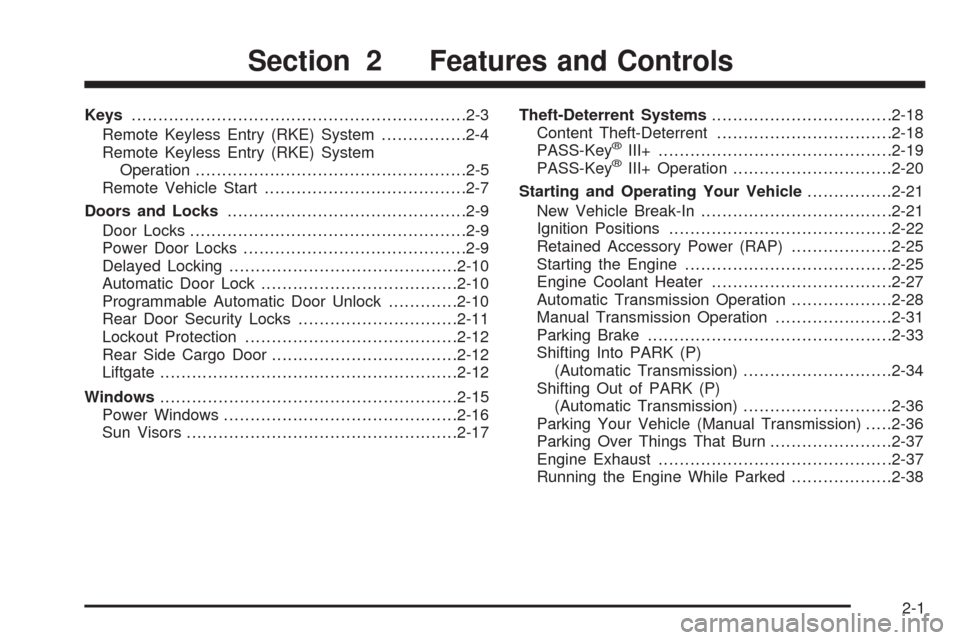
Keys...............................................................2-3
Remote Keyless Entry (RKE) System................2-4
Remote Keyless Entry (RKE) System
Operation...................................................2-5
Remote Vehicle Start......................................2-7
Doors and Locks.............................................2-9
Door Locks....................................................2-9
Power Door Locks..........................................2-9
Delayed Locking...........................................2-10
Automatic Door Lock.....................................2-10
Programmable Automatic Door Unlock.............2-10
Rear Door Security Locks..............................2-11
Lockout Protection........................................2-12
Rear Side Cargo Door...................................2-12
Liftgate........................................................2-12
Windows........................................................2-15
Power Windows............................................2-16
Sun Visors...................................................2-17Theft-Deterrent Systems..................................2-18
Content Theft-Deterrent.................................2-18
PASS-Key
®III+............................................2-19
PASS-Key®III+ Operation..............................2-20
Starting and Operating Your Vehicle................2-21
New Vehicle Break-In....................................2-21
Ignition Positions..........................................2-22
Retained Accessory Power (RAP)...................2-25
Starting the Engine.......................................2-25
Engine Coolant Heater..................................2-27
Automatic Transmission Operation...................2-28
Manual Transmission Operation......................2-31
Parking Brake..............................................2-33
Shifting Into PARK (P)
(Automatic Transmission)............................2-34
Shifting Out of PARK (P)
(Automatic Transmission)............................2-36
Parking Your Vehicle (Manual Transmission).....2-36
Parking Over Things That Burn.......................2-37
Engine Exhaust............................................2-37
Running the Engine While Parked...................2-38
Section 2 Features and Controls
2-1
Page 88 of 430
Delayed Locking
This feature will delay the actual locking of the doors
and liftgate when the power door lock switch or remote
keyless entry transmitter is used to lock the vehicle.
If any door is open when locking the vehicle, three
chimes will sound signaling that the delayed locking
feature is active. Five seconds after the last door
is closed, all of the doors and liftgate will lock. The turn
signal lamps will ash to indicate that the doors have
been locked. To cancel the delay and lock the
doors immediately, press the lock button a second time.
If the key is in the ignition this feature will not lock
the doors.
If your vehicle has a Driver Information Center (DIC),
you can disable this function. SeeDIC Vehicle
Personalization on page 3-54.
Automatic Door Lock
If your vehicle has power door locks, the doors will
automatically lock when the shift lever is moved out of
PARK (P) for a vehicle with an automatic transmission.
For a vehicle with a manual transmission, the speed
must be greater than 5 mph (8 km/h).
The automatic door locking feature cannot be disabled.
Programmable Automatic Door
Unlock
Your vehicle will automatically unlock all doors when the
shift lever is moved into PARK (P) for a vehicle with
an automatic transaxle, and when the ignition is turned
off for a vehicle with a manual transaxle.
If your vehicle has a Driver Information Center (DIC),
the doors can be programmed to automatically
unlock several ways for vehicles with an automatic
transaxle. SeeDIC Vehicle Personalization on
page 3-54for more information.
2-10
Page 100 of 430
Ignition Positions
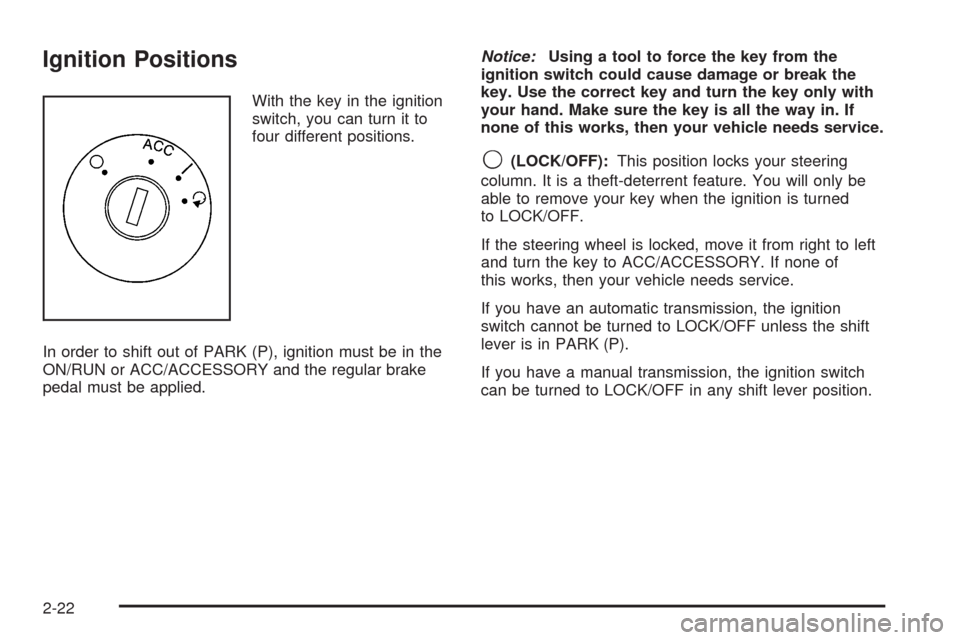
With the key in the ignition
switch, you can turn it to
four different positions.
In order to shift out of PARK (P), ignition must be in the
ON/RUN or ACC/ACCESSORY and the regular brake
pedal must be applied.Notice:Using a tool to force the key from the
ignition switch could cause damage or break the
key. Use the correct key and turn the key only with
your hand. Make sure the key is all the way in. If
none of this works, then your vehicle needs service.
9(LOCK/OFF):This position locks your steering
column. It is a theft-deterrent feature. You will only be
able to remove your key when the ignition is turned
to LOCK/OFF.
If the steering wheel is locked, move it from right to left
and turn the key to ACC/ACCESSORY. If none of
this works, then your vehicle needs service.
If you have an automatic transmission, the ignition
switch cannot be turned to LOCK/OFF unless the shift
lever is in PARK (P).
If you have a manual transmission, the ignition switch
can be turned to LOCK/OFF in any shift lever position.
2-22
Page 101 of 430
{CAUTION:
If you have a manual transmission removing
the key from the ignition switch will lock the
steering column and result in a loss of ability
to steer the vehicle. This could cause a
collision. If you need to turn the engine off
while the vehicle is moving, turn the key to
ACC/ACCESSORY.
ACC (ACC/ACCESSORY):This position operates
some of your electrical accessories. It unlocks the
steering wheel and ignition.
R(ON/RUN):This is the position the switch returns to
after you start your engine and release the switch.
The switch stays in the ON/RUN position when
the engine is running. But even when the ignition is not
running, you can use ON/RUN to operate your
electrical accessories and to display some warning and
indicator lights.The battery could be drained if you leave the key in the
ACC/ACCESSORY or ON/RUN position with the engine
off. You may not be able to start your vehicle if the battery
is allowed to drain for an extended period of time.
/(START):This position starts the engine. When the
engine starts, release the key. The ignition switch
will return to ON/RUN for normal driving.
A warning tone will sound if you open the driver’s door
while in LOCK/OFF or ACC/ACCESSORY, when
the key has not been removed from the ignition.
Key In the Ignition
Never leave your vehicle with the keys inside, as it is an
easy target for joy riders or thieves. If you leave the
key in the ignition and park your vehicle, a chime
will sound, when you open the driver’s door. Always
remember to remove your key from the ignition and take
it with you. This will lock your ignition and transmission.
Also, always remember to lock the doors.
The battery could be drained if you leave the key in the
ignition while your vehicle is parked. You may not be
able to start your vehicle after it has been parked for an
extended period of time.
2-23
Page 103 of 430
Retained Accessory Power (RAP)
These vehicle accessories may be used for up to
10 minutes after the engine is turned off.
Audio System
Power Windows
Sunroof
The power windows and sunroof will continue to work
for up to 10 minutes or until any door is opened.
The radio will work when the key is in ON/RUN or
ACC/ACCESSORY. Once the key is turned from
ON/RUN to OFF/LOCK, the radio will continue to work
for 10 minutes or until the driver’s door is opened.
Starting the Engine
Place the transmission in the proper gear.
Automatic Transmission
Move the shift lever to PARK (P) or NEUTRAL (N). The
engine will not start in any other position -- this is a
safety feature. To restart when you are already moving,
use NEUTRAL (N) only.
Notice:Do not try to shift to PARK (P) if your
vehicle is moving. If you do, you could damage the
transmission. Shift to PARK (P) only when your
vehicle is stopped.
Manual Transmission
The shift lever should be in neutral position and the
parking brake engaged. Hold the clutch pedal down to
the oor and start the engine. Your vehicle will not
start if the clutch pedal is not all the way down. That is
a safety feature.
2-25
Page 106 of 430
Automatic Transmission Operation
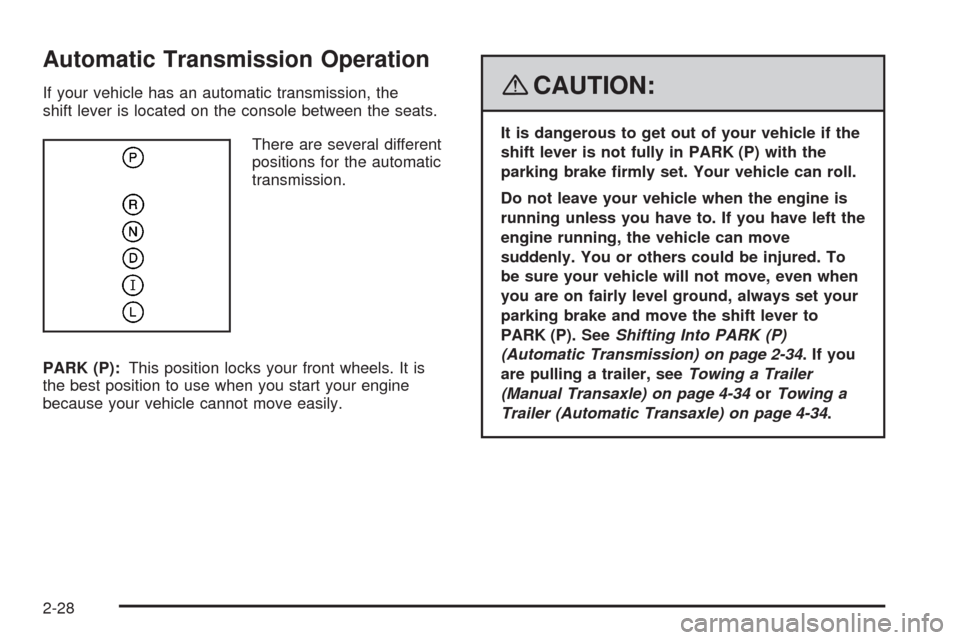
If your vehicle has an automatic transmission, the
shift lever is located on the console between the seats.
There are several different
positions for the automatic
transmission.
PARK (P):This position locks your front wheels. It is
the best position to use when you start your engine
because your vehicle cannot move easily.{CAUTION:
It is dangerous to get out of your vehicle if the
shift lever is not fully in PARK (P) with the
parking brake rmly set. Your vehicle can roll.
Do not leave your vehicle when the engine is
running unless you have to. If you have left the
engine running, the vehicle can move
suddenly. You or others could be injured. To
be sure your vehicle will not move, even when
you are on fairly level ground, always set your
parking brake and move the shift lever to
PARK (P). SeeShifting Into PARK (P)
(Automatic Transmission) on page 2-34.Ifyou
are pulling a trailer, seeTowing a Trailer
(Manual Transaxle) on page 4-34orTowing a
Trailer (Automatic Transaxle) on page 4-34.
2-28
Page 109 of 430
Manual Transmission Operation
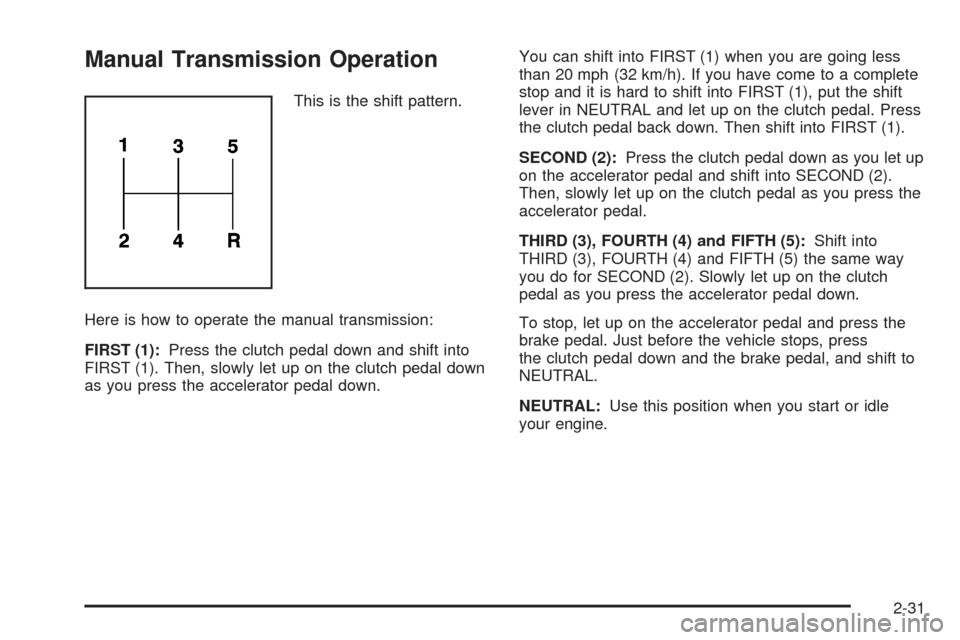
This is the shift pattern.
Here is how to operate the manual transmission:
FIRST (1):Press the clutch pedal down and shift into
FIRST (1). Then, slowly let up on the clutch pedal down
as you press the accelerator pedal down.You can shift into FIRST (1) when you are going less
than 20 mph (32 km/h). If you have come to a complete
stop and it is hard to shift into FIRST (1), put the shift
lever in NEUTRAL and let up on the clutch pedal. Press
the clutch pedal back down. Then shift into FIRST (1).
SECOND (2):Press the clutch pedal down as you let up
on the accelerator pedal and shift into SECOND (2).
Then, slowly let up on the clutch pedal as you press the
accelerator pedal.
THIRD (3), FOURTH (4) and FIFTH (5):Shift into
THIRD (3), FOURTH (4) and FIFTH (5) the same way
you do for SECOND (2). Slowly let up on the clutch
pedal as you press the accelerator pedal down.
To stop, let up on the accelerator pedal and press the
brake pedal. Just before the vehicle stops, press
the clutch pedal down and the brake pedal, and shift to
NEUTRAL.
NEUTRAL:Use this position when you start or idle
your engine.
2-31
Page 110 of 430
REVERSE (R):To back up, press down the clutch
pedal and shift into REVERSE (R). Let up on the clutch
pedal slowly while pressing the accelerator pedal.
Notice:Shifting to REVERSE (R) while your vehicle
is moving forward could damage the transmission.
The repairs would not be covered by your warranty.
Shift to REVERSE (R) only after your vehicle is
stopped.
Also, use REVERSE (R), along with the parking brake,
for parking your vehicle.
Shift Speeds
{CAUTION:
If you skip a gear when you downshift, you
could lose control of your vehicle. You could
injure yourself or others. Do not shift down
more than one gear at a time when you
downshift.
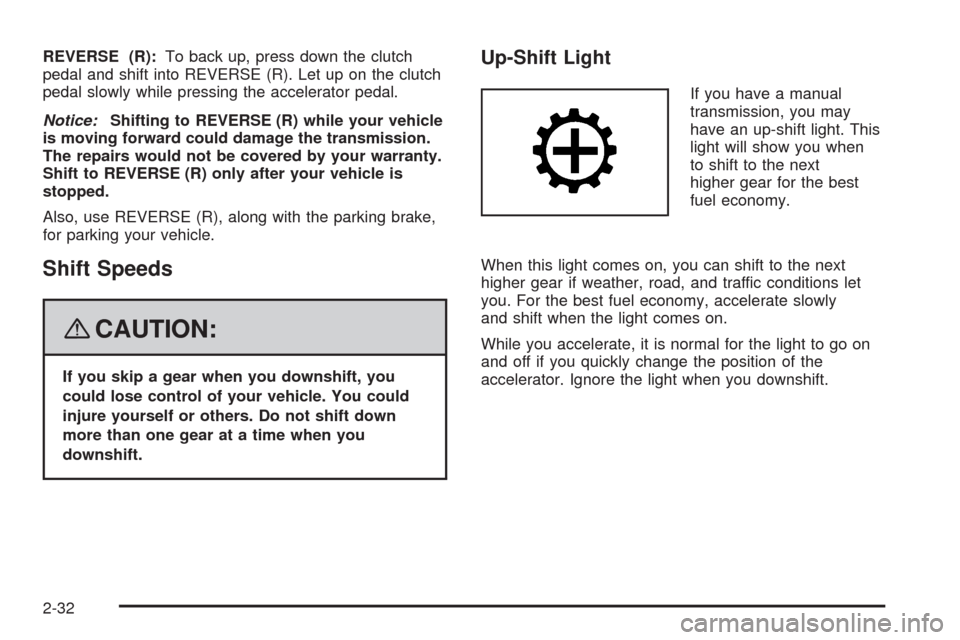
Up-Shift Light
If you have a manual
transmission, you may
have an up-shift light. This
light will show you when
to shift to the next
higher gear for the best
fuel economy.
When this light comes on, you can shift to the next
higher gear if weather, road, and traffic conditions let
you. For the best fuel economy, accelerate slowly
and shift when the light comes on.
While you accelerate, it is normal for the light to go on
and off if you quickly change the position of the
accelerator. Ignore the light when you downshift.
2-32