2008 CHEVROLET EQUINOX ESP
[x] Cancel search: ESPPage 20 of 436
Questions and Answers About
Safety Belts
Q:Will I be trapped in the vehicle after a crash if
I am wearing a safety belt?
A:Youcouldbe — whether you are wearing a safety
belt or not. But your chance of being conscious
during and after an accident, so youcanunbuckle
and get out, ismuchgreater if you are belted.
And you can unbuckle a safety belt, even if you
are upside down.
Q:If my vehicle has airbags, why should I have
to wear safety belts?
A:Airbags are supplemental systems only; so they
workwithsafety belts — not instead of them.
Whether or not an airbag is provided, all occupants
still have to buckle up to get the most protection.
That is true not only in frontal collisions, but
especially in side and other collisions.
Q:If I am a good driver, and I never drive far from
home, why should I wear safety belts?
A:You may be an excellent driver, but if you are in
a crash — even one that is not your fault — you
and your passenger(s) can be hurt. Being a
good driver does not protect you from things
beyond your control, such as bad drivers.
Most accidents occur within 25 miles (40 km)
of home. And the greatest number of serious
injuries and deaths occur at speeds of less than
40 mph (65 km/h).
Safety belts are for everyone.
1-16
Page 88 of 436
Remote Start Ready
If your vehicle does not have the remote vehicle start
feature, it may have the remote start ready feature.
This feature allows your dealer/retailer to add the
manufacturer’s remote vehicle start feature.
If your vehicle has the remote start ready feature,
your RKE transmitter will have extended range that
will allow you to lock or unlock your vehicle from
approximately 195 feet (60 m) away.
See your dealer/retailer if you would like to add
the manufacturer’s remote vehicle start feature
to your vehicle.
Doors and Locks
Door Locks
{CAUTION:
Unlocked doors can be dangerous.
Passengers, especially children, can easily
open the doors and fall out of a moving
vehicle. When a door is locked, the handle
will not open it. You increase the chance
of being thrown out of the vehicle in a
crash if the doors are not locked. So, wear
safety belts properly and lock the doors
whenever you drive.
Young children who get into unlocked
vehicles may be unable to get out. A child
can be overcome by extreme heat and can
suffer permanent injuries or even death
from heat stroke. Always lock your vehicle
whenever you leave it.
Outsiders can easily enter through an
unlocked door when you slow down or
stop your vehicle. Locking your doors
can help prevent this from happening.
2-10
Page 93 of 436
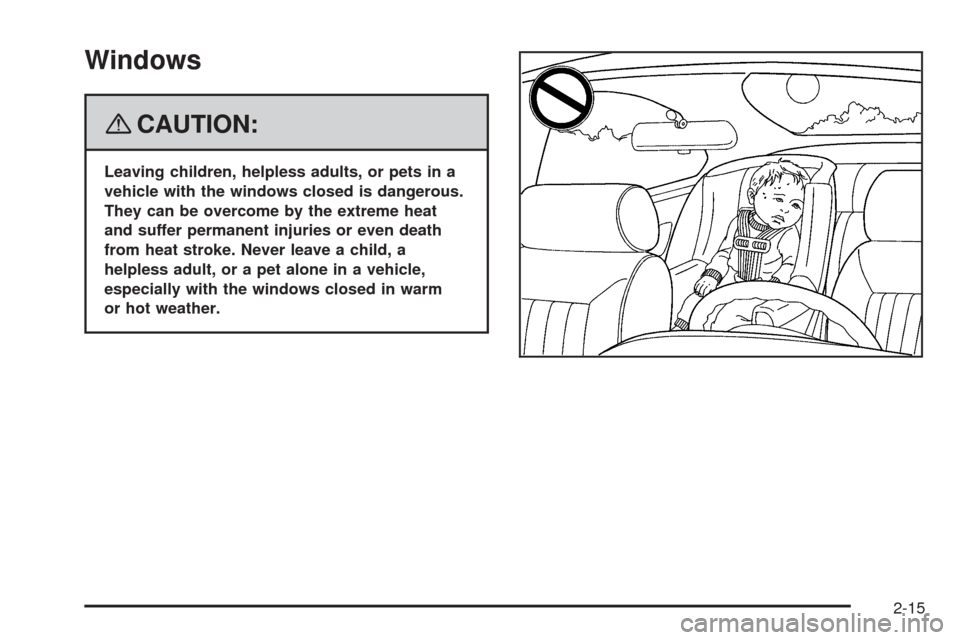
Windows
{CAUTION:
Leaving children, helpless adults, or pets in a
vehicle with the windows closed is dangerous.
They can be overcome by the extreme heat
and suffer permanent injuries or even death
from heat stroke. Never leave a child, a
helpless adult, or a pet alone in a vehicle,
especially with the windows closed in warm
or hot weather.
2-15
Page 95 of 436
To stop the window while it is lowering, press and
release the top of the switch.
Window Lockout
o
(Window Lockout):Your vehicle has a lockout
feature to prevent rear seat passengers from operating
the windows. Press the lockout button, located with
the power window switches, to turn the feature on and
off. The window switch has a light that will come on
when the switch is active.
Sun Visors
To block out glare, swing the sun visor down. You
can also detach the driver’s sun visor from the center
mount and slide it along the rod from side-to-side
for greater coverage.
Visor Vanity Mirrors
Your vehicle has covered visor vanity mirrors on
both the driver’s and passenger’s side.
Theft-Deterrent Systems
Vehicle theft is big business, especially in some cities.
Although your vehicle has a number of theft-deterrent
features, we know that nothing we put on it can make
it impossible to steal.
Content Theft-Deterrent
Your vehicle has a content theft-deterrent alarm system.
To activate the theft-deterrent system:
1. Open the door.
2. Lock the door with the power door lock switch
or the Remote Keyless Entry (RKE) transmitter.
If you are using the RKE transmitter, the door
does not need to be open.
3. Close all doors.
The key must be removed from the ignition to
arm the system.
If the theft-deterrent system is activated and a door or
the liftgate is opened without using the RKE transmitter,
a 10 second pre-alarm will occur, and the security light
will ash. The horn will sound rapidly for 10 seconds.
If you do not press unlock on the RKE transmitter or
insert the key in the ignition and turn if from the LOCK/
OFF position, the alarm will go off. The horn will sound
and the headlamps will ash for 30 seconds.
After the alarm has sounded for 30 seconds,
the system will re-arm itself automatically.
To disarm the theft-deterrent system, do one of
the following:
1. Unlock the doors with the RKE transmitter.
2. Insert the key in the ignition and turn it from
the LOCK/OFF position.
2-17
Page 100 of 436
Starting the Engine
Move your shift lever to PARK (P) or NEUTRAL (N).
Your engine will not start in any other position – this
is a safety feature. To restart when you are already
moving, use NEUTRAL (N) only.
Notice:Do not try to shift to PARK (P) if your
vehicle is moving. If you do, you could damage
the transmission. Shift to PARK (P) only when
your vehicle is stopped.
Starting Procedure
1. With your foot off the accelerator pedal, turn the
ignition key to START. When the engine starts,
let go of the key. The idle speed will go down as
your engine gets warm. Do not race the engine
immediately after starting it. Operate the engine
and transmission gently to allow the oil to warm
up and lubricate all moving parts.
Your vehicle has a Computer-Controlled Cranking
System. This feature assists in starting the
engine and protects components. If the ignition
key is turned to the START position, and then
released when the engine begins cranking, the
engine will continue cranking for a few seconds
or until the vehicle starts. If the engine does not start
and the key is held in START for many seconds,cranking will be stopped after 15 seconds to prevent
cranking motor damage. To prevent gear damage,
this system also prevents cranking if the engine
is already running. Engine cranking can be stopped
by turning the ignition switch to the
ACC/ACCESSORY or LOCK/OFF position.
Notice:Cranking the engine for long periods of
time, by returning the key to the START position
immediately after cranking has ended, can overheat
and damage the cranking motor, and drain the
battery. Wait at least 15 seconds between each try,
to let the cranking motor cool down.
2. If the engine does not start after 5-10 seconds,
especially in very cold weather (below 0°F
or−18°C), it could be ooded with too much
gasoline. Try pushing the accelerator pedal all
the way to the oor and holding it there as you
hold the key in START for up to a maximum
of 15 seconds. Wait at least 15 seconds between
each try, to allow the cranking motor to cool
down. When the engine starts, let go of the key
and accelerator. If the vehicle starts briey but
then stops again, do the same thing. This clears
the extra gasoline from the engine. Do not race the
engine immediately after starting it. Operate the
engine and transmission gently until the oil warms
up and lubricates all moving parts.
2-22
Page 108 of 436
In manual shift mode all six forward gears can be
selected.
While using the MSM feature the vehicle will have
operation similar to a manual transmission. You can
use this for sport driving or when driving hilly roads to
stay in gear longer or to downshift for more power
or engine braking.
The transmission will only allow you to shift into gears
appropriate for the vehicle speed:
The transmission will not automatically shift to the
next higher gear without moving the shift lever.
The transmission will not allow shifting to the next
lower gear if the vehicle speed is too high.
If the vehicle does not respond to a gear change,
or detects a problem with the transmission, the range
of gears may be reduced and the Malfunction Indicator
Lamp will come on. SeeMalfunction Indicator Lamp
on page 3-34.
Transmission Overheating
If the transmission uid temperature rises above
270°F (132°C) or rises rapidly, the Engine Coolant
Temperature Warning Light will ash. SeeEngine
Coolant Temperature Warning Light on page 3-33for
more information. When the transmission overheats
it will go into a protection mode and will default into a
different shift sequence to help cool the transmission
uid. This shift sequence is the same for both DRIVE (D)
position and manual mode. Continue driving the
vehicle in either position depending on the required
vehicle speed and load. Once the uid temperature
lowers to the normal temperature range, the
transmission will return to the normal shift patterns.
Towing or driving on long hills can cause the
transmission uid temperature to be higher than
normal. If the transmission uid temperature will
not cool, you may need to pull over and check the
transmission uid level. You should also check
the engine coolant temperature. If it is hot, see
Engine Overheating on page 5-24.
2-30
Page 116 of 436
Outside Power Mirrors
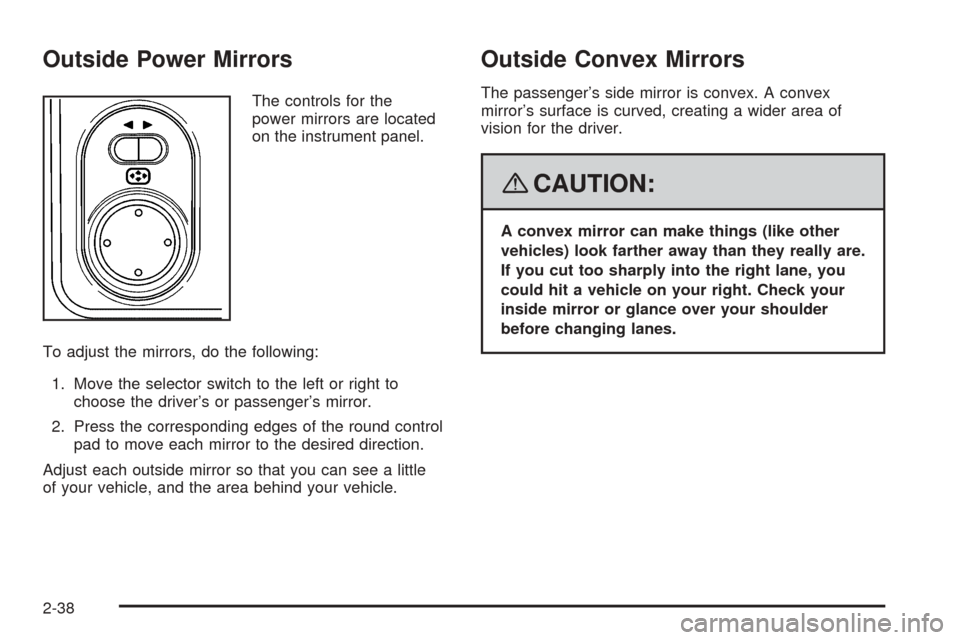
The controls for the
power mirrors are located
on the instrument panel.
To adjust the mirrors, do the following:
1. Move the selector switch to the left or right to
choose the driver’s or passenger’s mirror.
2. Press the corresponding edges of the round control
pad to move each mirror to the desired direction.
Adjust each outside mirror so that you can see a little
of your vehicle, and the area behind your vehicle.
Outside Convex Mirrors
The passenger’s side mirror is convex. A convex
mirror’s surface is curved, creating a wider area of
vision for the driver.
{CAUTION:
A convex mirror can make things (like other
vehicles) look farther away than they really are.
If you cut too sharply into the right lane, you
could hit a vehicle on your right. Check your
inside mirror or glance over your shoulder
before changing lanes.
2-38
Page 120 of 436
Your vehicle must have a working electrical system
(including adequate battery power) for the OnStar
equipment to operate. There are other problems OnStar
cannot control that may prevent OnStar from providing
OnStar service to you at any particular time or place.
Some examples are damage to important parts of your
vehicle in an accident, hills, tall buildings, tunnels,
weather or wireless phone network congestion.
Your Responsibility
Increase the radio volume if you cannot hear the
OnStar advisor. If the light next to the OnStar buttons
is red, this means that your system is not functioning
properly and should be checked by your dealer/retailer.
If the light appears clear (no light is appearing),
your OnStar subscription has expired. You can
always press the OnStar button to conrm that
your OnStar equipment is active.
Storage Areas
Glove Box
To open the glove box, pull the handle to the left
and pull the glove box door down until it stops and
is fully open.
Cupholder(s)
There are two cupholders located at the lower front of
the center console armrest and a molded cupholder
on the oor of the center console. To use the cupholders
on the armrest, pull the tray forward. There are two
cupholders located at the rear of the center console.
Pull downward on the lid to use the cupholders.
Center Console Storage
Your vehicle may have a center console armrest with
storage area. Use the lever on the front of the console
to open it.
2-42