2008 CHEVROLET AVEO tow
[x] Cancel search: towPage 307 of 384
Aluminum Wheels
Notice:If you use strong soaps, chemicals,
abrasive polishes, cleaners, brushes, or cleaners
that contain acid on aluminum or chrome-plated
wheels, you could damage the surface of the
wheel(s). The repairs would not be covered by your
warranty. Use only approved cleaners on aluminum
or chrome-plated wheels.
Keep the wheels clean using a soft clean cloth with mild
soap and water. Rinse with clean water. After rinsing
thoroughly, dry with a soft clean towel. A wax may then
be applied.
Notice:Using chrome polish on aluminum wheels
could damage the wheels. The repairs would not
be covered by your warranty. Use chrome polish
on chrome wheels only.
The surface of these wheels is similar to the painted
surface of the vehicle. Do not use strong soaps,
chemicals, abrasive polishes, abrasive cleaners,
cleaners with acid, or abrasive cleaning brushes
on them because the surface could be damaged.
Do not use chrome polish on aluminum wheels.Notice:If you drive your vehicle through an
automatic car wash that has silicone carbide tire
cleaning brushes, you could damage the aluminum
or chrome-plated wheels. The repairs would not
be covered by your warranty. Never drive a vehicle
equipped with aluminum or chrome-plated wheels
through an automatic car wash that uses silicone
carbide tire cleaning brushes.
Tires
To clean the tires, use a stiff brush with tire cleaner.
Notice:Using petroleum-based tire dressing
products on your vehicle may damage the paint
nish and/or tires. When applying a tire dressing,
always wipe off any overspray from all painted
surfaces on your vehicle.
Sheet Metal Damage
If the vehicle is damaged and requires sheet metal
repair or replacement, make sure the body repair shop
applies anti-corrosion material to parts repaired or
replaced to restore corrosion protection.
Original manufacturer replacement parts will provide the
corrosion protection while maintaining the warranty.
5-85
Page 358 of 384
Roadside Assistance Program
For vehicles purchased in the U.S.,
call1-800-CHEV-USA (1-800-243-8872);
(Text telephone (TTY): 1-888-889-2438).
For vehicles purchased in Canada,
call1-800-268-6800.
Service is available 24 hours a day,
365 days a year.
As the owner of a new Chevrolet vehicle,
you are automatically enrolled in the Chevrolet
Roadside Assistance program.
Who is Covered?
Roadside Assistance coverage is for the vehicle
operator, regardless of ownership. In Canada,
a person driving this vehicle without the consent
of the owner is not eligible for coverage.
Services Provided
The following services are provided in the U.S. and
Canada up to 5 years/100,000 miles (160 000 km),
whichever occurs first, and, in Canada only, up
to a maximum coverage of $100.
•Fuel Delivery:Delivery of enough fuel for the vehicle
to get to the nearest service station (approximately
$5 in Canada). In Canada, service to provide diesel
may be restricted. For safety reasons, propane and
other alternative fuels will not be provided through
this service.
•Lock-out Service:Lock-out service will be covered
at no charge if you are unable to gain entry into
your vehicle. A remote unlock may be available
if you have an active OnStar
®subscription.
To ensure security, the driver must present personal
identification before lock-out service is provided.
In Canada, the vehicle registration is also required.
•Emergency Tow From a Public Roadway or
Highway:Tow to the nearest dealership for warranty
service or in the event of a vehicle-disabling crash.
Winch-out assistance is provided when the vehicle
is mired in sand, mud, or snow.
7-8
Page 360 of 384

Calling for Assistance
For prompt and efficient assistance when calling,
please provide the following to the Roadside
Assistance Representative:
•Your name, home address, and home
telephone number
•Telephone number of your location
•Location of the vehicle
•Model, year, color, and license plate number
of the vehicle
•Odometer reading, Vehicle Identification
Number (VIN), and delivery date of the vehicle
•Description of the problem
Towing and Road Service Exclusions
Specifically excluded from Roadside Assistance
coverage are towing or services for vehicles operated
on a non-public roadway or highway, fines, impound
towing caused by a violation of local, Municipal, State,
Provincial, or Federal law, and mounting, dismounting or
changing of snow tires, chains, or other traction devices.Roadside Assistance is not part of or included in the
coverage provided by the New Vehicle Limited Warranty.
Chevrolet and General Motors of Canada Limited
reserve the right to make any changes or discontinue
the Roadside Assistance program at any time without
notification.
Scheduling Service Appointments
When your vehicle requires warranty service, contact
your dealer/retailer and request an appointment.
By scheduling a service appointment and advising your
service consultant of your transportation needs, your
dealer/retailer can help minimize your inconvenience.
If your vehicle cannot be scheduled into the service
department immediately, keep driving it until it can be
scheduled for service, unless, of course, the problem is
safety-related. If it is, please call your dealership/retailer,
let them know this, and ask for instructions.
If the dealer/retailer requests that you simply drop the
vehicle off for service, you are urged to do so as early in
the work day as possible to allow for the same day repair.
7-10
Page 365 of 384
•If your vehicle cannot be driven, know where the
towing service will be taking it. Get a card from
the tow truck operator or write down the driver’s
name, the service’s name, and the phone number.
•Remove any valuables from your vehicle before it is
towed away. Make sure this includes your insurance
information and registration if you keep these
items in your vehicle.
•Gather the important information you will need from
the other driver. Things like name, address, phone
number, driver’s license number, vehicle license
plate, vehicle make, model and model year, Vehicle
Identification Number (VIN), insurance company
and policy number, and a general description of the
damage to the other vehicle.
•If possible, call your insurance company from
the scene of the crash. They will walk you through
the information they will need. If they ask for a
police report, phone or go to the police departmentheadquarters the next day and you can get a
copy of the report for a nominal fee. In some
states/provinces with “no fault” insurance laws,
a report may not be necessary. This is especially
true if there are no injuries and both vehicles
are driveable.
•Choose a reputable collision repair facility for your
vehicle. Whether you select a dealer/retailer or a
private collision repair facility to fix the damage,
make sure you are comfortable with them.
Remember, you will have to feel comfortable with
their work for a long time.
•Once you have an estimate, read it carefully and
make sure you understand what work will be
performed on your vehicle. If you have a question,
ask for an explanation. Reputable shops welcome
this opportunity.
7-15
Page 366 of 384
Managing the Vehicle Damage
Repair Process
In the event that your vehicle requires damage repairs,
GM recommends that you take an active role in its
repair. If you have a pre-determined repair facility of
choice, take your vehicle there, or have it towed there.
Specify to the facility that any required replacement
collision parts be original equipment parts, either new
Genuine GM parts or recycled original GM parts.
Remember, recycled parts will not be covered by your
GM vehicle warranty.
Insurance pays the bill for the repair, but you must live
with the repair. Depending on your policy limits, your
insurance company may initially value the repair
using aftermarket parts. Discuss this with your repair
professional, and insist on Genuine GM parts. Remember
if your vehicle is leased you may be obligated to have
the vehicle repaired with Genuine GM parts, even if your
insurance coverage does not pay the full cost.
If another party’s insurance company is paying for
the repairs, you are not obligated to accept a repair
valuation based on that insurance company’s collision
policy repair limits, as you have no contractual limits
with that company. In such cases, you can have control
of the repair and parts choices as long as cost stays
within reasonable limits.
Reporting Safety Defects
Reporting Safety Defects to the
United States Government
If you believe that your vehicle has a defect which
could cause a crash or could cause injury or
death, you should immediately inform the National
Highway Traffic Safety Administration (NHTSA),
in addition to notifying General Motors.
If NHTSA receives similar complaints, it may open
an investigation, and if it finds that a safety defect
exists in a group of vehicles, it may order a recall
and remedy campaign. However, NHTSA cannot
become involved in individual problems between
you, your dealer/retailer, or General Motors.
To contact NHTSA, you may call the Vehicle
Safety Hotline toll-free at 1-888-327-4236
(TTY: 1-800-424-9153); go to
http://www.safercar.gov; or write to:
Administrator, NHTSA
400 Seventh Street, SW.
Washington D.C., 20590
You can also obtain other information about motor
vehicle safety from http://www.safercar.gov.
7-16
Page 380 of 384
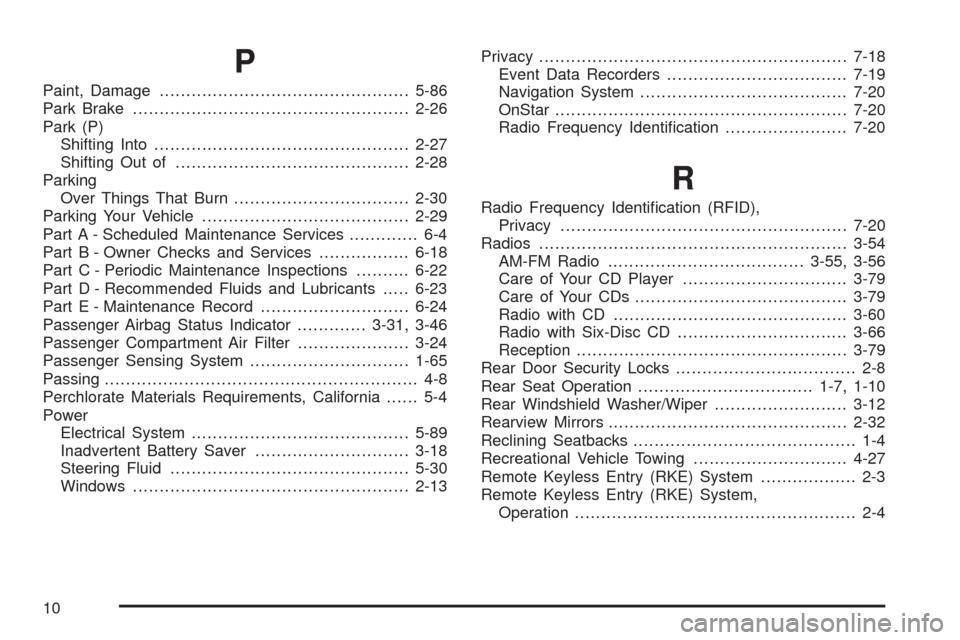
P
Paint, Damage...............................................5-86
Park Brake....................................................2-26
Park (P)
Shifting Into................................................2-27
Shifting Out of............................................2-28
Parking
Over Things That Burn.................................2-30
Parking Your Vehicle.......................................2-29
Part A - Scheduled Maintenance Services............. 6-4
Part B - Owner Checks and Services.................6-18
Part C - Periodic Maintenance Inspections..........6-22
Part D - Recommended Fluids and Lubricants.....6-23
Part E - Maintenance Record............................6-24
Passenger Airbag Status Indicator.............3-31, 3-46
Passenger Compartment Air Filter.....................3-24
Passenger Sensing System..............................1-65
Passing........................................................... 4-8
Perchlorate Materials Requirements, California...... 5-4
Power
Electrical System.........................................5-89
Inadvertent Battery Saver.............................3-18
Steering Fluid.............................................5-30
Windows....................................................2-13Privacy..........................................................7-18
Event Data Recorders..................................7-19
Navigation System.......................................7-20
OnStar.......................................................7-20
Radio Frequency Identification.......................7-20
R
Radio Frequency Identification (RFID),
Privacy......................................................7-20
Radios..........................................................3-54
AM-FM Radio.....................................3-55, 3-56
Care of Your CD Player...............................3-79
Care of Your CDs........................................3-79
Radio with CD............................................3-60
Radio with Six-Disc CD................................3-66
Reception...................................................3-79
Rear Door Security Locks.................................. 2-8
Rear Seat Operation.................................1-7, 1-10
Rear Windshield Washer/Wiper.........................3-12
Rearview Mirrors.............................................2-32
Reclining Seatbacks.......................................... 1-4
Recreational Vehicle Towing.............................4-27
Remote Keyless Entry (RKE) System.................. 2-3
Remote Keyless Entry (RKE) System,
Operation..................................................... 2-4
10
Page 383 of 384
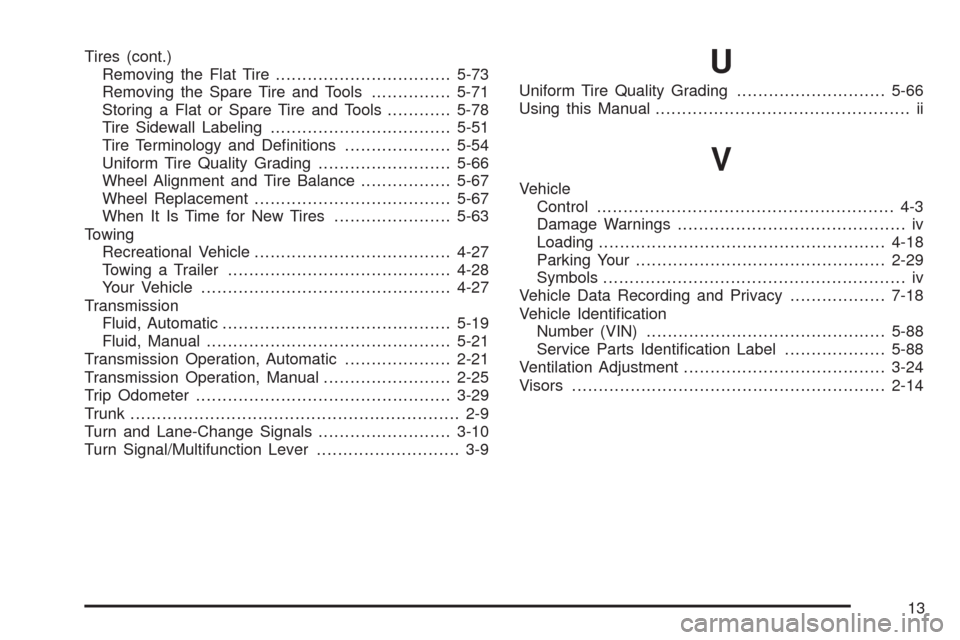
Tires (cont.)
Removing the Flat Tire.................................5-73
Removing the Spare Tire and Tools...............5-71
Storing a Flat or Spare Tire and Tools............5-78
Tire Sidewall Labeling..................................5-51
Tire Terminology and Definitions....................5-54
Uniform Tire Quality Grading.........................5-66
Wheel Alignment and Tire Balance.................5-67
Wheel Replacement.....................................5-67
When It Is Time for New Tires......................5-63
Towing
Recreational Vehicle.....................................4-27
Towing a Trailer..........................................4-28
Your Vehicle...............................................4-27
Transmission
Fluid, Automatic...........................................5-19
Fluid, Manual..............................................5-21
Transmission Operation, Automatic....................2-21
Transmission Operation, Manual........................2-25
Trip Odometer................................................3-29
Trunk.............................................................. 2-9
Turn and Lane-Change Signals.........................3-10
Turn Signal/Multifunction Lever........................... 3-9U
Uniform Tire Quality Grading............................5-66
Using this Manual................................................ ii
V
Vehicle
Control........................................................ 4-3
Damage Warnings........................................... iv
Loading......................................................4-18
Parking Your...............................................2-29
Symbols......................................................... iv
Vehicle Data Recording and Privacy..................7-18
Vehicle Identification
Number (VIN).............................................5-88
Service Parts Identification Label...................5-88
Ventilation Adjustment......................................3-24
Visors...........................................................2-14
13