2008 CHEVROLET AVEO tow
[x] Cancel search: towPage 211 of 384

Then, shut the engine off and close the window almost
all the way to preserve the heat. Start the engine again
and repeat this only when you feel really uncomfortable
from the cold. But do it as little as possible. Preserve the
fuel as long as you can. To help keep warm, you can get
out of the vehicle and do some fairly vigorous exercises
every half hour or so until help comes.
If Your Vehicle is Stuck in Sand,
Mud, Ice, or Snow
Slowly and cautiously spin the wheels to free your
vehicle when stuck in sand, mud, ice, or snow. See
Rocking Your Vehicle to Get It Out on page 4-17.
{CAUTION:
If you let your vehicle’s tires spin at high
speed, they can explode, and you or others
could be injured. The vehicle can overheat,
causing an engine compartment re or other
damage. Spin the wheels as little as possible
and avoid going above 35 mph (55 km/h) as
shown on the speedometer.
For information about using tire chains on your vehicle,
seeTire Chains on page 5-69.
Rocking Your Vehicle to Get It Out
First, turn the steering wheel left and right to clear
the area around the front wheels. Then shift back
and forth between REVERSE (R) and a forward gear,
or with a manual transmission, between FIRST (1)
or SECOND (2) and REVERSE (R), spinning the wheels
as little as possible. To prevent transmission wear,
wait until the wheels stop spinning before shifting gears.
Release the accelerator pedal while you shift, and
press lightly on the accelerator pedal when the
transmission is in gear. By slowly spinning the wheels
in the forward and reverse directions, you will cause
a rocking motion that could free your vehicle. If that
does not get your vehicle out after a few tries, it might
need to be towed out. If your vehicle does need to
be towed out, seeTowing Your Vehicle on page 4-27.
4-17
Page 213 of 384
The Tire and Loading Information label also shows
the tire size of the original equipment tires (C) and
the recommended cold tire inflation pressures (D).
For more information on tires and inflation see
Tires on page 5-50andInflation - Tire Pressure
on page 5-57.
There is also important loading information on
the Certification label. See “Certification Label”
later in this section.
Steps for Determining Correct Load Limit
1.Locate the statement The combined weight
of occupants and cargo should never exceed
XXX kg or XXX lbs on your vehicle’s placard.
2.Determine the combined weight of the driver
and passengers that will be riding in your
vehicle.
3.Subtract the combined weight of the driver
and passengers from XXX kg or XXX lbs.
4.The resulting figure equals the available
amount of cargo and luggage load capacity.
For example, if the “XXX” amount equals
1400 lbs and there will be five 150 lb
passengers in your vehicle, the amount of
available cargo and luggage load capacity
is 650 lbs (1400 - 750 (5 x 150) = 650 lbs).
5.Determine the combined weight of luggage
and cargo being loaded on the vehicle.
That weight may not safely exceed the
available cargo and luggage load capacity
calculated in Step 4.
6.If your vehicle will be towing a trailer, the load
from your trailer will be transferred to your
vehicle. Consult this manual to determine how
this reduces the available cargo and luggage
load capacity of your vehicle.
Your vehicle is neither designed nor intended to
tow a trailer.
4-19
Page 217 of 384
4.The resulting figure equals the available
amount of cargo and luggage load capacity.
For example, if the Maximum Load amount
equals 1400 lbs (635 kg) and there will be
five 150 lb (68 kg) passengers in your vehicle,
the amount of available cargo and luggage
load capacity is 650 lbs (295 kg).
5.Determine the combined weight of luggage
and cargo being loaded on the vehicle.
That weight may not safely exceed the
available cargo and luggage load capacity
calculated in Step 4.
6.If your vehicle will be towing a trailer, the
load from your trailer will be transferred
to your vehicle. Consult this manual to
determine how this reduces the available
cargo and luggage load capacity of
your vehicle.
Your vehicle is not designed nor intended
to tow a trailer.Item Description Total
AVehicle Capacity
Weight or Maximum
Load, for Example 1=1,000 lbs (453 kg)
BSubtract Occupant
Weight 150 lbs
(68 kg)×2=300 lbs (136 kg)
CAvailable Occupant
and Cargo Weight=700 lbs (317 kg)
Example 1
4-23
Page 221 of 384
Towing
Towing Your Vehicle
Consult your dealer/retailer or a professional towing
service if you need to have your disabled vehicle towed.
SeeRoadside Assistance Program on page 7-8.
If you want to tow your vehicle behind another vehicle
for recreational purposes (such as behind a motorhome),
see “Recreational Vehicle Towing” following.
Recreational Vehicle Towing
Recreational vehicle towing means towing your
vehicle behind another vehicle, such as behind a
motorhome. The two most common types of recreational
vehicle towing are known as “dinghy towing” (towing
your vehicle with all four wheels on the ground)
and “dolly towing” (towing your vehicle with two wheels
on the ground and two wheels up on a device known
as a “dolly”).
With the proper preparation and equipment, many
vehicles can be towed in these ways. See “Dinghy
Towing” and “Dolly Towing,” following.Here are some important things to consider before you
do recreational vehicle towing:
•What is the towing capacity of the towing vehicle?
Be sure you read the tow vehicle manufacturer’s
recommendations.
•How far will you tow? Some vehicles have
restrictions on how far and how long they can tow.
•Do you have the proper towing equipment?
See your dealer/retailer or trailering professional for
additional advice and equipment recommendations.
•Is your vehicle ready to be towed? Just as you
would prepare your vehicle for a long trip, you
will want to make sure your vehicle is prepared to
be towed. SeeBefore Leaving on a Long Trip
on page 4-12.
Dinghy Towing
Notice:If you tow your vehicle with all four wheels
on the ground, the drivetrain components could
be damaged. The repairs would not be covered
by your warranty. Do not tow your vehicle with all
four wheels on the ground.
Your vehicle was not designed to be towed with all
four wheels on the ground. If your vehicle must
be towed, you should use a dolly. See “Dolly Towing”
that follows for more information.
4-27
Page 222 of 384
Dolly Towing
Notice:Towing your vehicle from the rear with the
front wheels on the ground could cause transmission
damage. Do not tow the vehicle from the rear with
the front wheels on the road.
Your vehicle can be towed using a dolly. To tow your
vehicle using a dolly, follow these steps:
1. Put the front wheels on a dolly.
2. Put an automatic transmission in PARK (P)
or a manual transmission in NEUTRAL (N).3. Set the parking brake and remove the key.
4. For an automatic transmission, insert the key
into the shift-lock release slot. SeeShifting
Out of PARK (P) on page 2-28.
5. Shift to NEUTRAL (N).
6. Clamp the steering wheel in a straight-ahead
position.
7. Release the parking brake.
Towing a Trailer
Do not use your vehicle to tow a trailer. The vehicle
is not designed or intended for such a use. Towing
a trailer can adversely affect handling, durability
and fuel economy.
4-28
Page 236 of 384
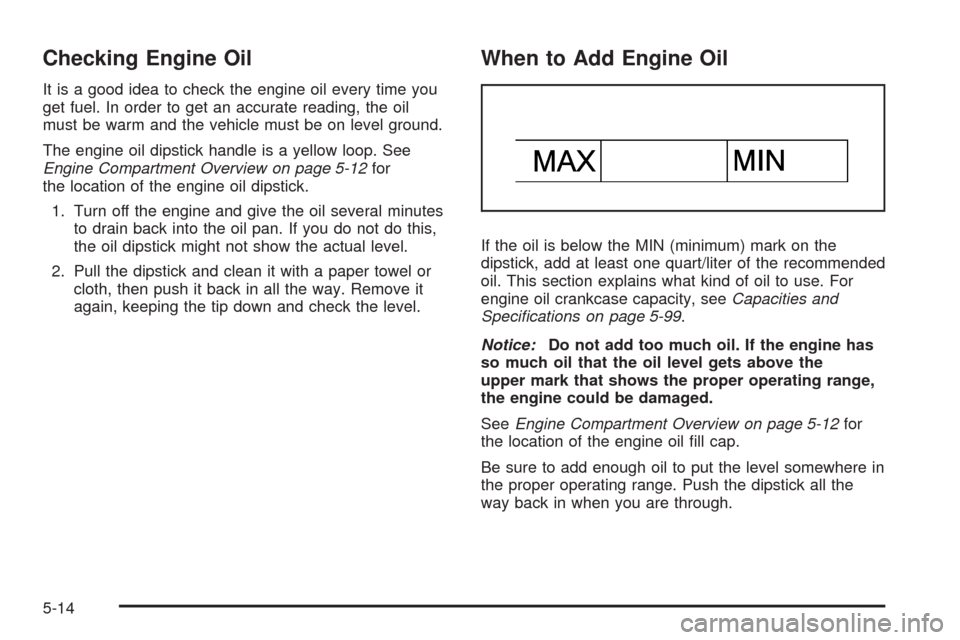
Checking Engine Oil
It is a good idea to check the engine oil every time you
get fuel. In order to get an accurate reading, the oil
must be warm and the vehicle must be on level ground.
The engine oil dipstick handle is a yellow loop. See
Engine Compartment Overview on page 5-12for
the location of the engine oil dipstick.
1. Turn off the engine and give the oil several minutes
to drain back into the oil pan. If you do not do this,
the oil dipstick might not show the actual level.
2. Pull the dipstick and clean it with a paper towel or
cloth, then push it back in all the way. Remove it
again, keeping the tip down and check the level.
When to Add Engine Oil
If the oil is below the MIN (minimum) mark on the
dipstick, add at least one quart/liter of the recommended
oil. This section explains what kind of oil to use. For
engine oil crankcase capacity, seeCapacities and
Specifications on page 5-99.
Notice:Do not add too much oil. If the engine has
so much oil that the oil level gets above the
upper mark that shows the proper operating range,
the engine could be damaged.
SeeEngine Compartment Overview on page 5-12for
the location of the engine oil fill cap.
Be sure to add enough oil to put the level somewhere in
the proper operating range. Push the dipstick all the
way back in when you are through.
5-14
Page 242 of 384
Checking the Fluid Level
Prepare your vehicle as follows:
1. Park your vehicle on a level place. Keep the engine
running.
2. With the parking brake applied, place the shift lever
in PARK (P).
3. With your foot on the brake pedal, move the shift
lever through each gear range, pausing for about
three seconds in each range. Then, position
the shift lever in PARK (P).
4. Let the engine run at idle for three to five minutes.
Then, without shutting off the engine, follow these steps:
The automatic transmission dipstick is located toward
the front of the engine compartment, near the power
steering fluid reservoir. SeeEngine Compartment
Overview on page 5-12for more information on location.
1. Pull out the dipstick and wipe it with a clean rag
or paper towel.
2. Push the dipstick back in all the way, wait three
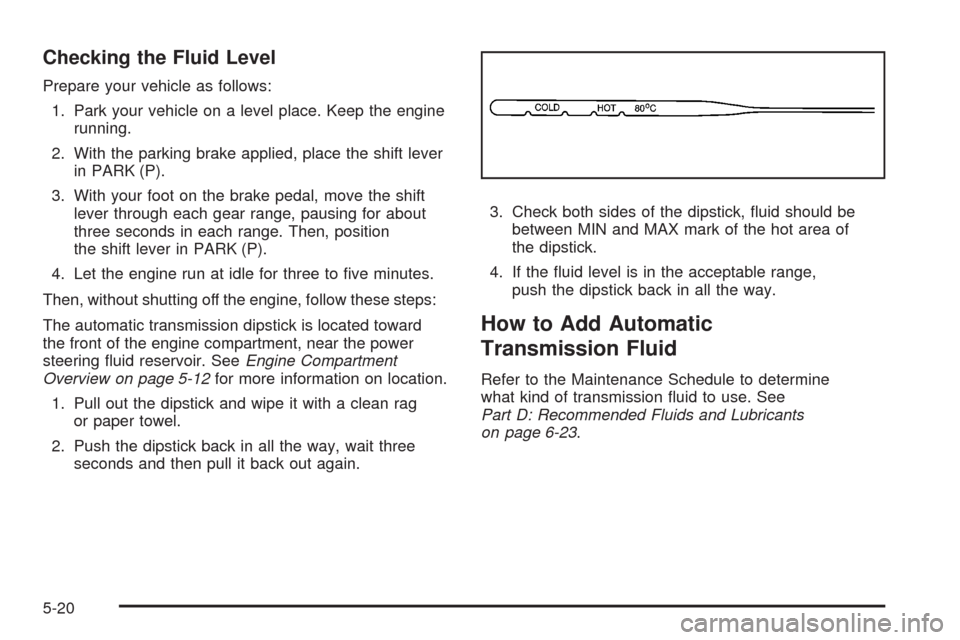
seconds and then pull it back out again.3. Check both sides of the dipstick, fluid should be
between MIN and MAX mark of the hot area of
the dipstick.
4. If the fluid level is in the acceptable range,
push the dipstick back in all the way.
How to Add Automatic
Transmission Fluid
Refer to the Maintenance Schedule to determine
what kind of transmission fluid to use. See
Part D: Recommended Fluids and Lubricants
on page 6-23.
5-20
Page 252 of 384
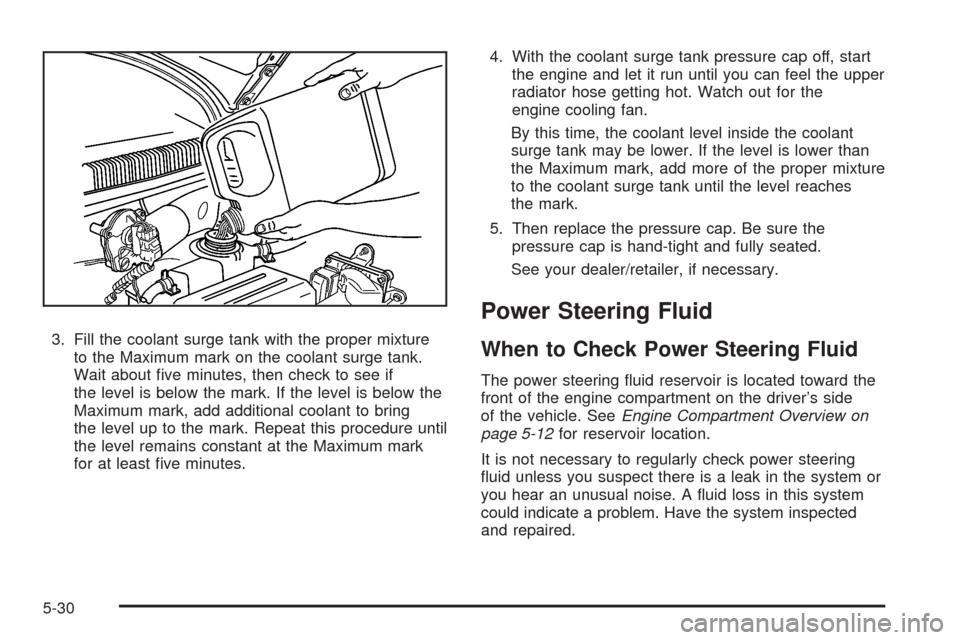
3. Fill the coolant surge tank with the proper mixture
to the Maximum mark on the coolant surge tank.
Wait about five minutes, then check to see if
the level is below the mark. If the level is below the
Maximum mark, add additional coolant to bring
the level up to the mark. Repeat this procedure until
the level remains constant at the Maximum mark
for at least five minutes.4. With the coolant surge tank pressure cap off, start
the engine and let it run until you can feel the upper
radiator hose getting hot. Watch out for the
engine cooling fan.
By this time, the coolant level inside the coolant
surge tank may be lower. If the level is lower than
the Maximum mark, add more of the proper mixture
to the coolant surge tank until the level reaches
the mark.
5. Then replace the pressure cap. Be sure the
pressure cap is hand-tight and fully seated.
See your dealer/retailer, if necessary.
Power Steering Fluid
When to Check Power Steering Fluid
The power steering fluid reservoir is located toward the
front of the engine compartment on the driver’s side
of the vehicle. SeeEngine Compartment Overview on
page 5-12for reservoir location.
It is not necessary to regularly check power steering
fluid unless you suspect there is a leak in the system or
you hear an unusual noise. A fluid loss in this system
could indicate a problem. Have the system inspected
and repaired.
5-30