2008 AUDI TT ROADSTER ECU
[x] Cancel search: ECUPage 145 of 316
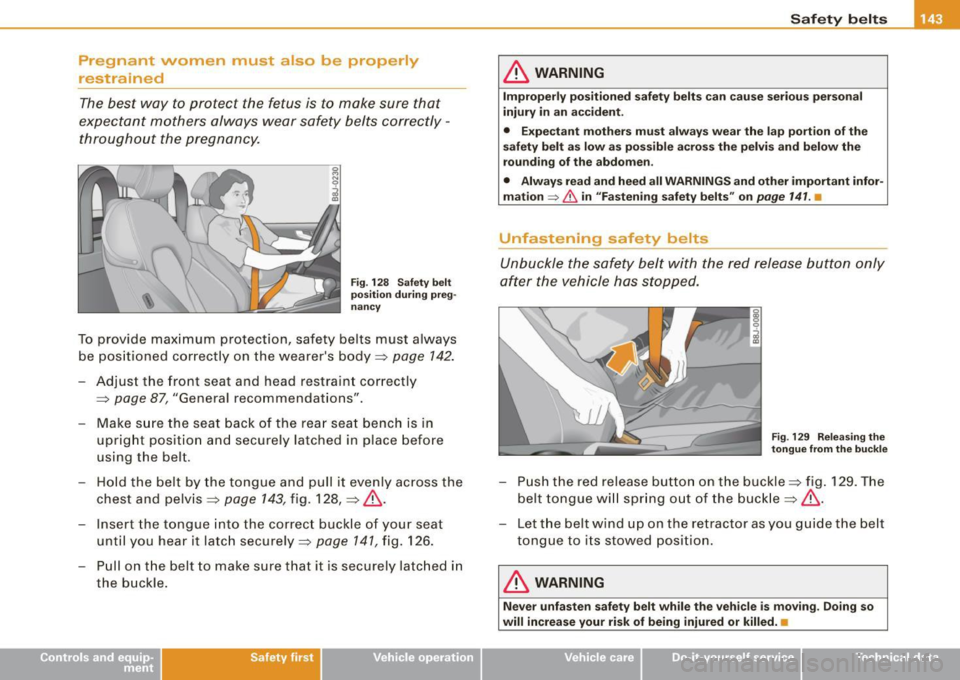
Pregnant women must also be properly
restrained The best way to protect the fetus is to make sure that
expectant mothers always wear safety belts correctly -
throughout the pregnancy.
Fig . 128 Safety belt
position during preg
nancy
To provide maximum protection, safety belts must always
be positioned correctly on the wearer's body=>
page 142.
-Adjust the front seat and head restraint correctly
=> page 87, "General recommendations".
- Make sure the seat back of the rear seat bench is in
upright position and securely latched in place before
using the belt.
- Hold the belt by the tongue and pull it evenly across the
chest and pelvis::::,
page 143, fig. 128, => &.
- Insert the tongue into the correct buckle of your seat
until you hear it latch securely =>
page 141, fig. 126.
- Pull on the belt to make sure that it is securely latched in
the buckle.
Safety first
Safety belts
& WARNING
Improperly positioned safety belts can cause serious personal
injury in an accident.
• Expectant mothers must always wear the lap portion of the
safety belt as low as possible across the pelvis and below the
rounding of the abdomen.
• Always read and heed all WARNINGS and other important infor
mation ~
& in "Fastening safety belts" on page 141. •
Unfastening safety belts
Unbuckle the safety belt with the red release button only
after the vehicle has stopped.
Fig . 129 Releasing the
tongue from the buckle
- Push the red release button on the buckle=> fig. 129. The
belt tongue will spring out of the buckle =>
&.
- Let the belt wind up on the retractor as you guide the belt
tongue to its stowed position.
& WARNING
Never unfasten safety belt while the vehicle is moving . Doing so
will increase your risk of being injured or killed .•
Vehicle care
I I irechnical data
Page 179 of 316
& WARNING !continued)
• If the PASSENGER AIR BAG OFF light does not come on and stay
on whenever the ignition is switched on the inflating airbag will
hit the child safety seat or infant carrier with great force and will
smash the child safety seat and child against the backrest, door or
roof. Have the airbag system inspected immediately by your Audi
dealer.
• Always read and heed all WARNINGS whenever using a child
restrained in a vehicle is being used=>
page 137, "Safety belts",
=>
page 146, "Airbag system" and=> page 168, "Important things
to know". •
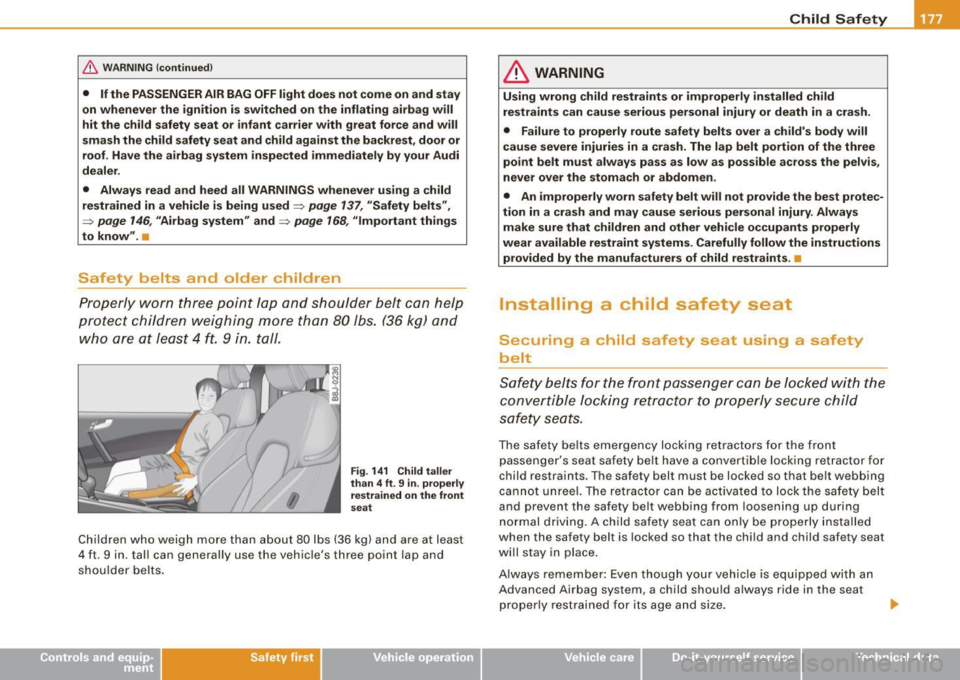
Safety belts and older children
Properly worn three point lap and shoulder belt can help
protect children weighing more than 80 lbs. (36 kg) and
who are at least 4 ft. 9 in. tall.
I
Fig. 141 Child taller
than 4 ft. 9 in. properly
restrained on the front
seat
Children who weigh more than about 80 lbs (36 kg) and are at least
4 ft . 9 in . tall can generally use the vehicle's three point lap and
shoulder belts.
Safety first
Child Safety
& WARNING
Using wrong child restraints or improperly installed child
restraints can cause serious personal injury or death in a crash.
• Failure to properly route safety belts over a child's body will
cause severe injuries in a crash. The lap belt portion of the three
point belt must always pass as low as possible across the pelvis,
never over the stomach or abdomen.
• An improperly worn safety belt will not provide the best protec
tion in a crash and may cause serious personal injury. Always
make sure that children and other vehicle occupants properly
wear available restraint systems. Carefully follow the instructions provided by the manufacturers of child restraints. •
Installing a child safety seat
Securing a child safety seat using a safety
belt
Safety belts for the front passenger can be locked with the
convertible locking retractor to properly secure child
safety seats.
The safety belts emergency locking retractors for the front
passenger's seat safety belt have a convertible locking retractor for
child restraints. The safety belt must be locked so that belt webbing
cannot unreel. The retractor can be activated to lock the safety belt
and prevent the safety belt webbing from loosening up during
normal driving. A child safety seat can only be properly installed
when the safety belt is locked so that the child and child safety seat
will stay in place.
Always remember: Even though your vehicle is equipped with an
Advanced Airbag system, a child should always ride in the seat properly restrained for its age and size. .,_
Vehicle care
I I irechnical data
Page 181 of 316

_______________________________________________ C_h _ i_ld _ S_ a_ f_ e_ t..,:c y __ __
& WARNING
Rearward-facing child restraints:
• A child in a rearward-facing child safety seat installed on the
front passenger seat will be seriously injured and can be killed if
the front airbag inflates -even with an Advanced Airbag System.
• The inflating airbag will hit the child safety seat or infant
carrier with great force and will smash the child safety seat and
child against the backrest, door or roof.
• Always be especially careful if you must install a rearward
facing child safety seat on the front passenger seat in exceptional
circumstances.
• Make sure that the PASSENGER AIR BAG OFF light comes on
and stays on all the time whenever the ignition is switched on.
• Never install a rearward facing child safety seat on the front
passenger seat unless the PASSENGER AIR BAG OFF light comes
on and stays on. If the PASSENGER AIR BAG OFF light does not
come on and stay on have the airbag system inspected immedi
ately by your Audi dealer. •
Activating the convertible locking retractor
Use the convertible locking retractor to secure a child
restraint.
Always heed the child safety seat manufacturer's instruc
tions when installing a child restraint in your vehicle . To
activate the convertible locking retractor:
- Place the child restraint on a seat .
- Slowly pull the belt
all the way out.
- Route it around or through the child restraint belt path
~& -
Controls and equip
ment Safety first
Vehicle operation
-Push the child safety seat down with your full weight to
get the safety belt really tight.
- Insert the belt tongue into the buckle for that seating
position .
- Guide the safety belt back into the retractor unt il the belt
lies flat and snug on the child safety seat.
- You should hear a "clicking" noise as the belt winds back
into the inertia reel. Test the convertible locking retractor
by pul ling on the belt. You should no longer be able to
pull the belt out of the retractor. The convertible locking
retractor is now activated .
- Make sure that the red release button is facing away from
the child restraint so that it can be unbuckled quickly.
- Pull on the belt to make sure the safety belt is properly
tight and fastened so that the seat cannot move forward
or sideways more than one inch (2.5 cm).
& WARNING
Using the wrong child restraint or an improperly installed child
restraint can cause serious personal injury or death in a crash.
• Always make sure that the safety belt retractor is locked when
installing a child safety seat. An unlocked safety belt retractor
cannot hold the child safety seat in place during normal driving or
in a crash.
• Always buckle the child safety seat firmly in place even if a
child is not sitting in it. A loose child safety seat can fly around
during a sudden stop or in a crash.
• Always make sure the seat backrest to which the child restraint
is installed is in an upright position. Otherwise, the seat back with
the child safety seat attached to it could fly forward in the event of
an accident or other emergency situation. ..,
Vehicle care Do-it-yourself service Technical data
Page 222 of 316

-~_C_ h_e _c _ k_ i_n ...:::g::;...._ a_n_ d_ f_ i_ll _in -'g:::;.._ ___________________________________________ _
Closing the engine hood
- Pull the hood down until the pressure from the struts is
reduced.
- Let the hood
drop down and latch in place. Do not try to
push it shut;
it may fail to engage~& .
& WARNING
A hood that is not completely latched could fly up and block your
view while driving.
• When you close the engine hood, check it to make sure the
safety catch has properly engaged. The hood should be flush with
the surrounding vehicle body parts.
• If you notice while driving that the hood is not secured prop
erly, stop at once and close it. •
Working in the engine compartment
Be especially careful whenever you work in the engine
compartment!
Whenever you must perform any work in the engine compartment,
for example checking and filling the different fluids, there is a risk of injury, burns and accidents. To prevent personal injury always
observe the following WARNINGS. The engine compartment of any
vehicle is a hazardous area!
=> &
& WARNING
To help avoid injury, before you check anything under the hood :
• Switch off the engine.
• Remove the ignition key.
• Apply the parking brake.
& WARNING (continued)
• Move selector lever of automatic transmission to "P" {Park);
put manual transmission in Neutral.
• Always let the engine cool down. Hot components will burn
skin on contact.
• To reduce the risk of being burned, never open the hood if you
see or hear steam or coolant escaping from the engine compart
ment. Wait until no steam or coolant can be seen or heard before
carefully opening the hood .
• Keep children away from the engine compartment.
• Never spill fluids on hot engine components. They can cause a
fire.
• Never touch the radiator fan. The auxiliary electric fan is
temperature controlled and can switch on suddenly.
• Never open the coolant reservoir cap when the engine is still
warm. The coolant system is pressurized and hot coolant could
spray out.
• Protect your face, hands and arm from steam or hot engine
coolant by placing a thick rag over the cap when you open the
coolant reservoir.
• If work on the fuel system or the electrical system is necessary:
- Always disconnect the battery .
- Never smoke or work near heaters or open flames. Fluids in
the engine compartment could start a fire.
- Keep an approved fire extinguisher immediately available.
• To avoid electrical shock and personal injury while the engine
is running or being started, never touch :
- Ignition cables
- Other components of the high voltage electronic ignition
system.
• If you must perform a check or repair with the engine running: .,_
Page 234 of 316

-Ch
ecking and filling ---=-----=----------------
We recommend that you use maintenance -free or cyc le- resis
tant /leak -pr oof
batteries according to the standards TL 825 06 (from
December 1997) and VW 7 50 73 (from Augus t 2001 ).
Replacing the battery should be carried by a qualified workshop.
P lease follow the instructions on the battery cover.
0 Note
• All work on the battery requires technical knowledge. Please
contact an Audi dealership or another authorized facility for ques
tions about the battery- danger of acid bu rns and explosion hazard!
• The battery must not be opened! Do not try to change the
battery's liquid level, otherwise detonat ing gas wil l escape from the
battery - explosion ha zard!
• The AGM battery in the luggage compartment cannot leak,
because the electrolyte for this battery is absorbed into a special
g lass mat . This leak-proof battery must not be rep lace with a
conventiona l battery .
• Make sure the ventilation hose on the side of the battery is
connected, otherwise fumes or battery acid can leak out.
• Battery holde r and terminals always have to be secured correctly .
• Before al l wo rk on the battery follow the
warning s below :::> & in
" Working on the battery" on page
232.
~ For the sake of the environment
Because of the problem of proper d isposal of a battery, we recom
mend your authorized Audi dea ler change the battery fo r you.
Batteries contain sulfur ic acid and lead and must always be
disposed of properly in compliance with all environmental regula
t ions . Di sposing of vehicle batteries i mproper ly is very dangerous to
the environment. Make sure that the removed battery cannot over
ba lance, otherwise sulfur ic acid migh t escape!
[ i ] Tips
If your ve hic le is left standing for several weeks at extremely low
temperatures, the vehicle battery should be removed and stored
where it will no t free ze. This will preven t it from being damaged and
having to be replaced. •
Working on the battery
Be especially care ful w hen wor king o n or nea r the
battery!
Fig . 156 Luggag e
co mp artment : AGM
batte ry
The batte ry is loca ted in the lu g ga ge compartmen t.
- Sw ing up t he luggage compartmen t floo r.
Remove the cover p late b y tu rning the t humbw heel.
The positive (+) battery term ina l is protected by a pla stic cover . This
cover must be removed to access the positive( +) terminal when
connecting jumper cab les to start the engine.
Always heed the
safety w arnings , when working on the vehicle
battery or the vehicle electrical system to prevent injury.
Page 248 of 316
-~_T_ ir_e_ s_ a_ n_d _ w_ h_ e_e _l_s _________________________________________________ _
& WARN ING (continued )
• Driving with underinflated tires bend more , letting them get
too hot re sulting in t read separation , sudden t ire failure and loss
of control.
• Excessive speed and /overloading can cau se heat bu ild-up ,
sudden tire failure and lo ss of control.
• If the tire pressure is too low or too high , the tires will wear
prematurely and the vehicle will not handle well .
• If the tire is not flat and you do not have to change a wheel
immediately, drive at reduced speed to the nearest service station
to che ck the tire pres sure and add air as required .
0 Note
Driving without valve stem caps can cause damage to the tire
va lves. To prevent this, always ma ke sure that fact ory insta lled valve
stem caps on all whee ls are securely mounted on the valve .
<£> For the sake of the environment
Underinflated tires will also increase the fue l consumption. •
Tires and vehicle load limits
There are limits to the amount of load or weight that any vehicle and
any tire can carry. A vehicle that is overloaded will not handle well
and is more difficu lt to stop. Overload ing can not only lead to loss
of vehicle contro l, but can a lso damage important parts of the
veh ic le an d ca n lead to sudden t ire fa ilu re , inc lud ing a bl owout a nd
sudden deflation that can cause the vehicle to crash.
Yo ur saf ety a nd that of you r passenge rs also de pends on making
sure that load limits are not exceeded . Vehicle load includes every
body and eve ryt hing in and on the vehic le . Th ese load limi ts are technica
lly referred to as the vehicle's
Gross Vehicle We ight Rating
("GVWR").
Th e "GVWR" includes the weight of the basic vehicle, all factory
insta lled accessories, a ful l tank of fuel, oil, coolant and other f luids
p lus max imum load. The ma ximu m load inc ludes the numbe r of
passengers that the vehicle is intended to carry ("seating capacity")
w it h an assu med we ight o f 150 lbs (68 kg) for eac h pass enger at a
designated seating position and the total weight of any luggage in
t he vehicle.
T he
Gross Axle Weight Rating ("GAWR"l is the maximum load that
can be a pplied a t eac h of the vehic le's two a xles .
T he Gross Veh icle Weigh t Rat ing a nd the Gross A xle We igh t R ating
are listed on the safety comp liance stic ker label located on the
dr iver's s ide B -p illar . You r Aud i has 2 sea ting pos it io n s. Eac h seating
posit ion has a safety belt=>
page 137, "Safety belts".
T he fact that the re is a n up per lim it to yo ur vehicle's G ross Veh ic le
We ig ht Rating means that the to tal we ight o f what ev e r is be ing
ca rried in the ve hicle is lim ited. The mo re pas se ngers in the vehic le
or passe ngers w ho ar e heav ier t han th e sta ndard weights assumed
mean that less weight can be carried as luggage.
T he ti re p ress ure labe l on yo ur Aud i al so list s the maxi mum
combined weight of a ll of the occupants and luggage or other cargo
th at the vehicle can car ry. F or the lo ca tio n of t he label =>
page 242,
fig . 160.
& WARNING
Overloading a vehicle can cause loss of vehicle control , a crash or
other accident, serious personal injury , and even death .
• Carrying more weight than your vehicle was des igned to carry
will prevent the vehicle from handling properly and increase the risk of the loss of vehi cle control .
• The brakes on a vehicle that has been overloaded may not be
able to stop the vehicle within a safe distance. .,_
Page 258 of 316

_L_T~ir ~e :..:s~ a~n~ d~ w~ h ~e~e~ l~ s '.,_ ______________________________________________ _
Wheel bolts
W heel b olts mus t al wa ys be tigh te n ed to t he cor rect
to rqu e.
The design of wheel bolts is matched to the factory instal led rims . If
d ifferen t rims are fitted, the co rrect w heel bo lts wit h th e rig ht length
and correctly shaped bolt heads m ust be used. This ensures that
w hee ls are fitt ed s ecure ly a nd th at t he brake sys te m funct ions
correctly .
I n certain circums tances, yo u may no t use w heel b olts fr om a
differ ent vehicle -even if it is the same model::::;,
page 296.
&_ WARNING
Improperly tightened or maintained wheel bolts can become loose
causing loss of control , a collision and serious personal injury.
• Always keep the wheel bolts and the threads in the wheel hubs
clean so the wheel bolts can turn easily and be properly tightened.
• Never grease or oil the wheel bolts and the threads in the wheel
hubs. They can become loose while driving if greased or oiled,
even if tightened to the specified torque .
• Only use wheel bolts that belong to the rim being installed.
• Never use different wheels bolts on your vehicle.
• Always maintain the correct tightening torque for the wheel
bolts to reduce the risk of a wheel loss. If the tightening torque of
the wheel bolts is too low , they can loosen and come out when the
vehicle is moving . If the tightening torque is too high, the wheel
bolts and th reads can be damaged and the wheel can become
loose .
0 Note
The specified torque for the wheel bolts is 90 ft lb (120 Nm) with a
t ole ranc e of ± 7,4 ft lb(± 1 0 Nm). To rque whee l bolts diag onally.
After changing a wheel, the torque must be checked as soon as possible with a to
rque wrench -preferab ly by an authorized Audi
dea ler o r qu alif ied wo rksh op.•
Low aspect ratio tires
Yo ur Audi is fac tory-equip ped wi th l ow asp ect rati o tires. Th ese tires
have been thorough ly tested and been selected specifically for your
mod el for thei r su per b p erfo rma nce, road feel an d handl in g u nder
a variety of driving conditions . Ask your author ized Aud i dea ler for
mo re deta ils.
T he low aspec t ra tio o f th ese t ires is ind icate d by a numera l o f 55 or
less in the t ire's size designation. The numera l represents the ratio
of the ti re's s idewa ll height in re la ti on to its tread w idth e xpress ed
in percentage. Conventiona l tires have a height/width ratio of 60 or
mo re .
The performan ce of low -aspect -ratio t ires is part icularly sensitive to
improper inflation pressure . It is therefore important that low
aspect ratio tires are inflated to the specified pressure and that the
inflation pressure is regularly checked and maintained. Tire pres
sures should be checked at least once a month and alway s before a
long trip::::;,
page 244, "Checking tire p ressure".
What you can do to a void tire and rim damage
L ow a spect ratio tires can be damaged more easi ly by impact with
potho les, curbs, gull ies or ridges on the road, particularly if the t ire
is underinflated.
In orde r to minimi ze the occurrence o f im pact da mage to th e tire s
of your vehicle, we recommend that you observe the fo llowing
p reca utions:
• Always ma intain reco mm ende d inflat io n pressu res . C heck your
tire p ressure every 2, 000 miles (3 ,000 km) and add ai r if neces sary .
• D rive car eful ly on roads with potholes, deep gullies or ridges.
Th e impact from d riving th ro ugh o r ove r such o bstac les can
dama ge you r tires . Impact w ith a curb may also cause da mage to
your tires . .,_
Page 272 of 316
1111...__W_ h_ a _ t_d_ o_ l _d _o_ n_ o_ w_ ? ______________________________________________ _
& WARNING
• You or your passengers could be injured while changing a
wheel if you do not follow safety precautions:
-Mounting the jack under the vehicle at any other place than
indicated above may damage the vehicle or may result in
personal injuries.
- A soft or unstable surface under the jack may cause the
vehicle to slip off the jack. Always provide a firm base for the
jack on the ground.
If necessary, use a sturdy board under the
jack.
- On hard, slippery surface (such as tiles) use a rubber mat or
similar to prevent the jack from slipping.
• To help prevent injury to yourself and your passengers: -Do not raise the vehicle until you are sure the jack is securely
engaged.
- Passengers must not remain in the vehicle when it is jacked
up.
- Make sure that passengers wait in a safe place away from
the vehicle and well away from the roadway and traffic.
- Make sure jack position is correct, adjust as necessary and
then continue to raise the jack.
0 Note
A floor jack or the pads on the hoist arms must not be positioned at
the points shown~
page 269, fig . 174 -arrows -. •
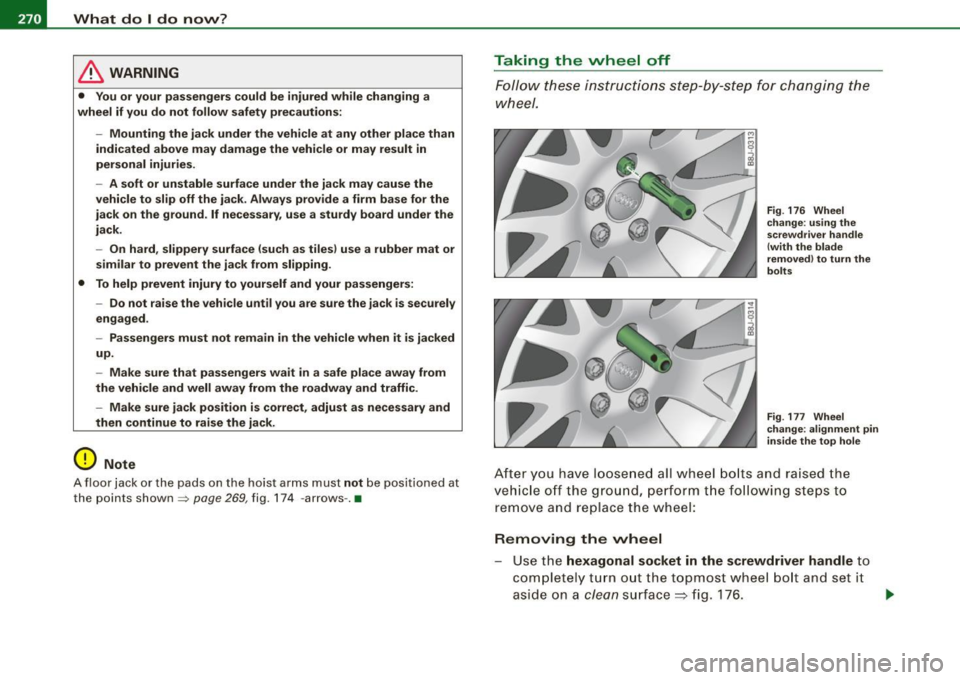
Taking the wheel off
Follow these instructions step-by-step for changing the
wheel.
Fig . 176 Wheel
change : using the
screwdriver handle
(with the blade
removed) to turn the
bolts
Fig. 177 Wheel
change : alignment pin
inside the top hole
After you have loosened all wheel bolts and raised the
vehicle off the ground, perform the following steps to
remove and replace the wheel:
Removing the wheel Use the hexagonal socket in the screwdriver handle to
completely turn out the topmost wheel bolt and set it
as ide on a
clean surface => fig. 176. ~