2008 AUDI TT ROADSTER ABS
[x] Cancel search: ABSPage 192 of 316
--~ln~t~ e~ l~ li ~g ~e~ n~ t~ te ~ c~h ~n ~ o~ l'..!: o ~g~ yL ________________________________________ _
(ABS control range). In order for ABS to be ab le to operate optima lly
in th is range, you m ust keep the brake pe dal depressed -do not
"pump the brakes" .
Brake ass istant
T he brake power assist unit increases the pressure that you
ge nera te wi th the brake pedal. I t wo rks only whe n the e ngine is
running .
Automatic full braking
This function al lows fu ll braking in spite of high brake pedal forces
(e .g. whe n the b rakes are seve rely s tresse d beca use the veh ic le is
ful ly loaded). The driver notices this function through a reduction of
pedal force a nd i ncrease d pe dal trave l. W hen the brake peda l is
released, fu ll braking assist switches off again automatically .
If there is an ABS fail ure , the brake assistant and automatic fu ll
brak in g ass ist are not ava ilable.
& WARNING
• ABS cannot suspend the la ws of physics . You should keep this
in mind in particular on an icy or wet road . If ABS control of braking
intervenes , you should adjust your speed immediately to road and
traffic condit ions. Do not be tempted by the increased safety
provided to t ake risks -danger of an accident.
• Please keep in mind that the risk of an accident is increased by
dri ving too fast, pa rticularly in bends and on icy or wet roads , and
by driving too close to the vehicle ahead . The increased risk of an
accident cannot be reduced by the brake as sistant - danger of an
accident .
[ i ] Tips
If a ma lfunction occurs in the ABS, this is signa lled by an indicator
lig ht, see
=> page 20. •
Electro-mechanical power assist
-----
The e lec tro -m ec han ical pow er as sis t h el ps th e dri ver
w he n steering.
T he degree of power assist is electronically matched to vehic le
sp eed .
Th e power steering system ass ists the driver so that he can steer the
ve hicle wi th re duced phy sica l eff ort .
P ower steer ing w ill not wo rk if the engine is o ff. As a result, the
steering wheel wi ll be hard to turn.
& WARNING
If the system develops a problem, you must seek qualified profes
sional assistance .
0 Note
If there is an electronic ma lfunction , servotronic will still funct ion
l ike a conventional power stee ring system, providing a constant
steer in g suppo rt fo rce t hat is no lon ge r proportionate to t he veh icle
speed . This is most noticeable when turning the steering wheel at
lo w spe eds (fo r examp le w hen park ing), -mo re effor t will be
required than usual.
• B e awa re of the d iffer ent than usua l ste ering response and
adjust your steering force accordingly.
• H ave the problem chec ked and set ri ght by an authorized Audi
dea ler as soon as possible .
• I f a steering ma lfunct ion occurs, this is signaled with the~ or.
@ in d ica to r ligh ts and a war ning tone, see . ._
Page 210 of 316
., __ C_ le_ a _ n_i_n ~g _ a_ n_ d __ p_r _o _t _e _c_ t_ i_o _n ___________________________________________ _
& WARN ING (c o ntinu ed )
• Do not apply additional und ercoating or ru stpr oofing on or
near the e xhaust man ifold , ex h aust p ipe s, ca talyt ic con verte r or
heat sh ields . W hile driving , the sub stan ce used for underco atin g
c ould overh eat and cause a fire .
• Alw ays read and heed all WARNINGS and oth er inform ation
~ p ag e200 .•
Care of interior
Aluminum trim
Use on ly neutral -pH products to remove spots and deposits from
a luminum surfaces. Chrome care products and alka line cleaners
wi ll attack aluminum surfaces and can damage them over t ime.
& WARNING
Alway s read and heed all WARNIN GS and the inform ation
~ page 200 . •
Fabrics and fabric coverings
Fabrics and fabric coverings (e .g. seats, door trim pane ls, etc.)
should be cleaned at regu lar intervals with a vacuum cleaner. This
removes surface dirt particles which could become embedded in
the fabric through use . Steam c leaners should not be used, because
the steam tends to push the dirt deeper into the fabric and lock it
there .
Norm al c leanin g
Generally, we recommend using a so ft sponge or a l int -free
microfiber cloth to the clean fabric. Brushes should only be used for carpets and floor mats, since other fabric surfaces could be harmed
b
y brushes .
Normal surface stains can be cleaned using a commercially avail
able foam cleaner . Spread the foam on the surface of the fabric with
a soft sponge and work it in gently. Do not saturate the fabric. Then
pat the foam dry using absorbent, dry cloths (e.g. microfiber c loth)
and vacuum it af ter it has dried complete ly .
C leaning st ains
Stains caused by beverages (e.g . coffee, fruit juice, etc.) can be
treated with a mild detergent solution. Apply the detergent so lution
with a sponge . In the case of stubborn stains, a de tergent paste can
be applied directly to the stain and worked into the fabric. After
wa rds, use copious amounts of clean wa ter to remove the
remaining detergent . App ly the water with a damp cloth or sponge
and pat the fabric dry w ith an absorbent, dry c lo th.
Stains from choco late or makeup shou ld have detergent paste (e .g.
ox -gall soap) rubbed into them . Afterwards, remove the soap with
water (damp sponge).
Alcoho l can be used to treat stains from grease, oi l, lipstick or a ba ll
point pen . Melted grease or dye must be patted off using absorbe nt
material. It may be necessary to retreat the areas with detergent
p aste and wa ter.
I n the case of general soiling of the upholstery and cover material,
we recommend hiring a specialist that has the equipment to clean
the seat covers and other fabr ic surfaces by shampooing and spray
extraction.
& WARNING
Alway s read and heed all WARNINGS and the information
~ page 200 .
Page 212 of 316
___ C_ le_ a _ n_i_n ~g _ a_ n_ d __ p_r _o _t _e _c_ t_ i_o _n ___________________________________________ _
clothing materials can discolor leather seats (especially if such
clothing is damp and was not dyed correctly). Dust and dirt particles
in pores, folds, and seams can have an abrasive effect and can
damage the leather surface as well as weaken seams.
The leather should be cleaned regularly as needed. After having
been used for a relatively long time, your leather seats will acquire
a rich aged finish. This is a characteristic of natural leather and a
sign of true quality.
In order to maintain the value of this natural product over the life of
your vehicle, you should follow the recommendations below:
0 Note
• To keep your leather from bleaching out, do not allow it to be
exposed to bright sunlight for long periods of time. If you have to
leave the vehicle parked outside for long periods, cover the leather
to protect it from direct exposure to sunlight.
• Sharp objects on clothing, such as zippers, rivets or sharp pieces
on belts can leave permanent scratches or scrape marks on the
surface of the leather.
[ i J Tips
• After each time you clean the leather and at regular intervals, use
a leather preservative creme that contains UV -blockers and that
works into the leather. This creme will nourish and moisturize the leather, helping it to breathe and stay supple. It also helps to build
up a protective coating on the surface.
• Clean the leather every 2 -3 months, and clean any areas that get
soiled.
• Remove fresh marks made by ballpoint pens, ink, lipstick, shoe
polish, etc. as soon as possible.
• Preserve the color of the leather as needed by using a special
colored leather care creme to touch up areas of uneven color. •
Applies to vehicles: w ith natu ral leather
Cleaning and caring for leather upholstery
and trim
Natural leather requires special care and attention.
Normal cleaning
-Clean soiled areas with a slightly moistened cotton or
woolen cloth.
More stubborn dirt
- More stubborn dirt can be removed using a cloth satu
rated with a mild soap solution (2 tablespoons mild
liquid soap).
- Never allow the soap solution to saturate the leather, and
make certain that no water soaks into the seams.
Wipe off the soap solution with a soft, dry cloth.
Cleaning spots
-Remove fresh water-based spots (such as coffee, tea,
juices, blood) with an absorbent cloth or paper towel.
- Remove fresh
grease or oil-based spots (such as butter,
mayonnaise, chocolate) with an absorbent cloth or paper
towel, or use the cleaner from the leather care kit if the
spot has not yet penetrated into the surface of the
leather.
- Use an oil/grease dissolving spray, if
oil/grease spots
have dried on.
- Remove specific kinds of spots (ballpoint pen, felt
marker, fingernail polish, water-based paint, shoe polish,
etc.) with a spot remover specifically formulated for leather. ..,_
Page 232 of 316

___ C_h_ e_ c_k _in --== g'-- a_n _d_ f_il _li _n ..:::g:::..- ___________________________________________ _
& WARNING (continued)
• The auxiliary electric fan is temperature controlled and can
switch on suddenly even when the engine is not running.
• The auxiliary radiator fan switches on automatically when the
engine coolant reaches a certain temperature and will continue to
run until the coolant temperature drops. •
Brake fluid
Checking brake fluid level
The brake fluid level can be checked with a quick glance.
Fig. 155 Engine
compartment: brake
fluid reservoir
Before you check anything in the engine compartment,
always read and heed all WARNINGS =>
& in "Working in
the engine compartment" on
page 220.
- Read the brake fluid level from the brake fluid reservoir
~ fig. 155. The brake fluid level must be between the
"MIN" and "MAX" markings.
The brake fluid reservoir is located behind the rear partition of the
engine compartment on the left side~
page 221 .
The fluid level may drop slightly after some time due to the auto
matic adjustment of the brake pads. This is not cause for alarm.
If the brake fluid level falls
considerably below the "MIN" mark, the
brake warning/indicator light (U .S. models:
BRAKE , Canadian models:
ill) will come on~ page 20 and~ page 32. Do not continue to
operate the vehicle . The complete brake system should be thor
oughly checked by an authorized Audi dealer or other qualified
facility and the cause corrected. If the brake fluid level is too low, the
brake warning/indicator light will illuminate. Contact an authorized
Audi dealer
immediately .•
Changing brake fluid
Have the brake fluid changed by an experienced techni
cian.
Brake fluid absorbs moisture from the air. If the water content in the
brake fluid is too high, corrosion in the brake system may result
after a period of time. The boiling point of the brake fluid will als o
decrease considerably and decrease braking performance.
Therefore, the brake fluid must be changed
every two years. Always
use new brake fluid which conforms to Federal Motor Vehicle Stan
dard "FMVSS 116 DOT 4".
The brake fluid reservoir can be difficult to reach, therefore, we
recommend that you have the brake fluid changed by your autho
rized
Audi dealer . Your dealer has the correct tools, the right brake
fluid and the know -how to do this for you.
& WARNING
• Brake fluid is poisonous. It must be stored only in the closed
original container out of the reach of children!
• Brake failure can result from old or inappropriate brake fluid.
Observe these precautions : .,,_
Page 233 of 316

Checkin g and fillin g ---------------~-!':WIii
•
& WARN ING (co ntinued)
- Use only br ake flu id th at m eet s SAE spec ificati on J 1703 and
c onf orms to F ed eral Motor Vehi cle St and ard 11 6. Always ch ec k
w ith your a uthori zed A ud i de aler to m ake sure you are u sin g
the corre ct brake fluid . Th e co rrect typ e of br ake fluid i s also
indic ate d on the br ake fluid res ervo ir .
- The br ake fluid mu st be ne w. Heavy u se of the br ake s c an
c au se a vapor lo ck if the brake fluid i s left in the s yste m too
long. Thi s ca n seriou sly affe ct the eff iciency of the brake s as
w ell as your safety . This could resu lt in an a ccident .
0 Note
Brake fluid wi ll damage the paint of your vehicle.
t he special too ls required and the necessary expertise, we recom
mend that you have the brake f luid changed by your authorized Audi
dea ler .•
Battery
General information
Your vehicle is equipped with a specia l battery, an AGM battery. This
battery is located in the luggage compartment and must be
replaced with an origina l equipment battery. Under normal oper
ating conditions, the battery is
maintenan ce-free .
Have the battery checked when you take your vehicle in for service.
You a re we ll advised to replace a battery that is olde r th an 5 years .
Disc onn ectin g th e batt ery t erm inal s
Some vehic le functions (power window regulators, for e xample) are
lost if the battery terminals are disconnected. These functions have
to be relearned after the batte ry term inals are connected again. To
prevent this, the battery should only be disconnected from the
vehicle electrical system when abso lutely necessary for repairs.
V ehi cle s not dri ven for long period s
If you are going to le t your vehicle stand for a long t ime a nd not
drive it, you should remember there are electrica l components
which are still functioning and they will draw energy from the
battery and drain it, for examp le, the engine immob ilizer. To prevent
this, you can either charge the battery occasionally to keep it in
good working condition or you can d isconnect the negative cab le
on the battery.
W inter op era ti on
During the winter months, battery capacity tends to decrease as
temperatures drop. This is because more power is a lso consumed
while starting, and the headlights, rear window defogger, etc., are
used more often .
Avoid unnecessary power consumption, particularly in city traffic or
when trave ling on ly shor t distances . Let your au thorized Audi dea ler
check the capacity of the vehicle battery before winter sets in
=>
page 235 . A well charged battery will not on ly prevent start ing
p rob lems when the weather is cold , but wi ll a lso last longer .
Replacing battery
The new battery must h ave the same capacity, voltage (12 volts},
amperage, construction and p lug sea ling, as the origina l battery.
Specifications are l isted on the battery hous ing. Batteries specially
developed by Audi fulfill the ma intenance, output, and safety
requirements.
When installing the battery, make sure the ignition and all electrical consumers are switched off=>
0. .,_
Vehicle care I t •
Page 234 of 316

-Ch
ecking and filling ---=-----=----------------
We recommend that you use maintenance -free or cyc le- resis
tant /leak -pr oof
batteries according to the standards TL 825 06 (from
December 1997) and VW 7 50 73 (from Augus t 2001 ).
Replacing the battery should be carried by a qualified workshop.
P lease follow the instructions on the battery cover.
0 Note
• All work on the battery requires technical knowledge. Please
contact an Audi dealership or another authorized facility for ques
tions about the battery- danger of acid bu rns and explosion hazard!
• The battery must not be opened! Do not try to change the
battery's liquid level, otherwise detonat ing gas wil l escape from the
battery - explosion ha zard!
• The AGM battery in the luggage compartment cannot leak,
because the electrolyte for this battery is absorbed into a special
g lass mat . This leak-proof battery must not be rep lace with a
conventiona l battery .
• Make sure the ventilation hose on the side of the battery is
connected, otherwise fumes or battery acid can leak out.
• Battery holde r and terminals always have to be secured correctly .
• Before al l wo rk on the battery follow the
warning s below :::> & in
" Working on the battery" on page
232.
~ For the sake of the environment
Because of the problem of proper d isposal of a battery, we recom
mend your authorized Audi dea ler change the battery fo r you.
Batteries contain sulfur ic acid and lead and must always be
disposed of properly in compliance with all environmental regula
t ions . Di sposing of vehicle batteries i mproper ly is very dangerous to
the environment. Make sure that the removed battery cannot over
ba lance, otherwise sulfur ic acid migh t escape!
[ i ] Tips
If your ve hic le is left standing for several weeks at extremely low
temperatures, the vehicle battery should be removed and stored
where it will no t free ze. This will preven t it from being damaged and
having to be replaced. •
Working on the battery
Be especially care ful w hen wor king o n or nea r the
battery!
Fig . 156 Luggag e
co mp artment : AGM
batte ry
The batte ry is loca ted in the lu g ga ge compartmen t.
- Sw ing up t he luggage compartmen t floo r.
Remove the cover p late b y tu rning the t humbw heel.
The positive (+) battery term ina l is protected by a pla stic cover . This
cover must be removed to access the positive( +) terminal when
connecting jumper cab les to start the engine.
Always heed the
safety w arnings , when working on the vehicle
battery or the vehicle electrical system to prevent injury.
Page 277 of 316

Fuses and bulbs -
----------------
Equipment No. Equipment
Amps
Engine relay, fuel tank control unit, Airbag Off
16 A/C system (control unit) 10
1
light, light switch (switch illumination), diagnos-10
tic connector
17 Tire pressure monitoring system (control unit) 5
18
Not used
ABS, ASR, ESP, brake light switch
5 19
Not used
3 AFS headlight (left) 5
Not used
Oil level sensor (extended maintenance interval)
(WIV), tire pressure monitoring system, switch
21 Fuel injectors (gasoline engine) 10
4 for Electronic Stability Program (ESP), AFS head-5 Wind deflector (Roadster) 30
lights (control unit), A/C system (pressure sen -23 Horn 20 sorl, backup light switch
Automatic headlight range control, AFS head-
24 Transmission (control unit) 15
5
light (right)/ manual headlight range control, 5/10
25 Heater rear window Coupe/heated rear window 30/20
halogen headlights Roadster
Control unit for CAN data transfer (gateway),
26 Driver's side power window 30
6 electromechanical steering, automatic transmis-5
27 Passenger's side power window 30
sion shift gate
28 Not used
Acoustic Park Assist, automatic dipping interior
rear view mirror, garage door opener, heatable
29 Washer pump 15
7
windshield washer nozzles, washer pump, wind 5
30 Cigarette lighter 20
deflector relay (Roadster)
31 Starter 40
8
Haldex clutch 5 32 Steering column module 5
9
Control unit Audi magnetic ride 5 33
Instrument cluster 5
Airbag control unit 5 34 Radio navigation system, radio 15
1 1 Mass airflow sensor, crankcase heating 5/10
35
Audio amplifier 30
12 Door control unit (central locking driver/passen-10
36 Engine (control unit) 10 ger)
13 Diagnostic connector 10 37 CAN (Gateway) 5
Rain sensor, automatic transmission shift gate 5 38 Not used
15 Roof
light (interior lighting) 5 39 Not used
• Do-it
-yourself service
Page 284 of 316
IIJ!I Emergency situations L-----=----!.___;:_;_:_=..::..:..:.=~------------------------
When it is no longer needed, unscrew the towline eye and put it
back into the on -board toolkit. Make sure to have the towline eye
stored in the vehicle at all times.
When installing the grill for the air duct, be sure that the tabs on the grill are first inserted into their guides on the vehicle. Then push the
grill into position.
& WARNING
If the towing loop is not screwed in as far as it will go, the thread
can pull out when the vehicle is towed -potential risk of an
accident. •
Rear towing loop
Do not install the rear towing loop until it is needed.
Fig. 186 Rear bumper :
screwing in the towing
loop
On the right side under the rear bumper there is a threaded
hole for the towing loop. The threaded hole is protected by
a cover.
Remove the towing loop from the vehicle toolkit
=:> page 262.
-Remove the cover. -
Screw the towing loop tightly into the threaded hole as
far as it will go.
When it is no longer needed, unscrew the towing loop and put it
back into the vehicle toolkit . Be sure to have the towing loop stored
in the vehicle at all times.
& WARNING
If the towing loop is not screwed in as far as it will go, the thread
can pull out when the vehicle is towed -potential risk of an
accident. •
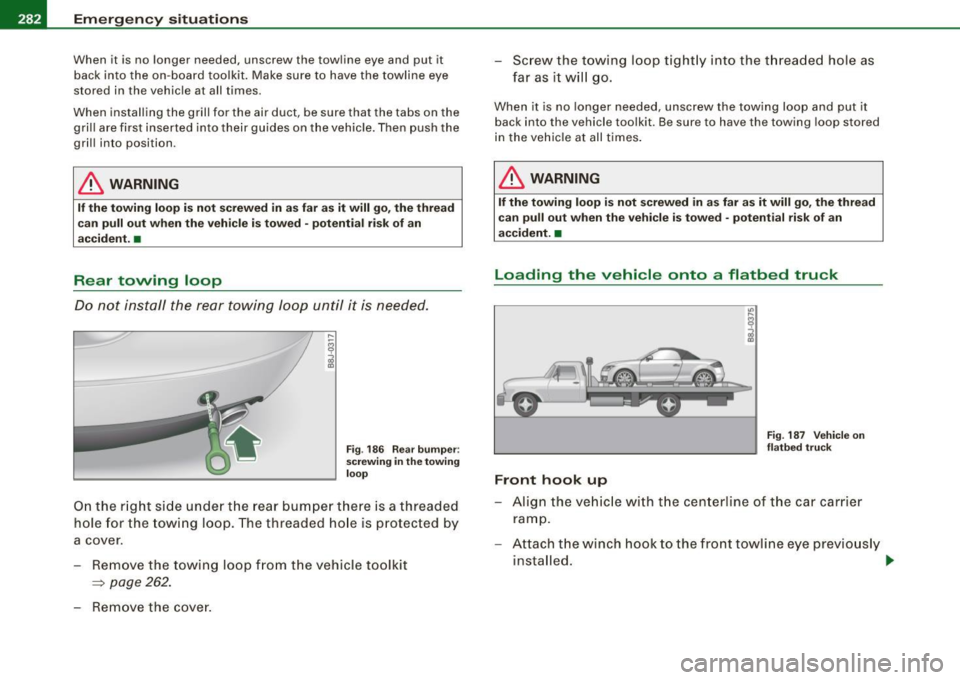
Loading the vehicle onto a flatbed truck
Front hook up
Fig. 187 Vehicle on
flatbed truck
- Align the vehicle with the centerline of the car carrier
ramp.
- Attach the winch hook to the front towline eye previously
installed. .,,_