2008 AUDI TT ROADSTER wheel size
[x] Cancel search: wheel sizePage 171 of 316

_____________________________________________ C_ h _ il_d _S_ a _ fe_t.....: y'----""
& WARNING
If , in e xceptional circum sta n ce s, y ou mu st in stall a forward -fa cing
c hild re straint on the front pa ssenger' s seat:
• Always m ake sure the forw ard-f acing se at has b een de signed
and cert ified by it s manufa cturer for use on a front seat with a
p ass eng er fro nt and side airbag .
• Alwa ys follow the manufacturer' s instruc tion s provided with
the child s afet y seat or carrier .
• Alway s move the p assenger sea t into it s rearmo st po sition in
the seat's fore and aft adjustme nt r ange , as far a way from the
airbag as po ssible before in stalling the child restraint. The ba ck
rest must be adju sted to an upr ight p osition .
• Alway s m ake sure th at the PASSEN GER AIR BA G OFF l ight
c ome s on and stay s on all the time wheneve r the ignition is
s witched on. •
Advanced front airbag system and children
Your vehicle is equipped with a dual-stage front "Advanced Airbag
System" in comp liance with United States Federal Motor Vehicle
Safety Standard (F MVSS) 208 as applicab le at the t ime your vehic le
was manufactured .
The Advanced Airbag sys tem in yo ur vehicle has been cer tified to
meet the "low -risk" requirements for 3 and 6 year -old children on
the passenger side and small adults on the d river side. The low risk
deployment criteria are intended to reduce the risk of injury through
interaction with the airbag that can occur, for examp le, by being too
close to the steering wheel and instrument pane l when the airbag
inflates . In addition, the system has been certified to comp ly with
the "suppression" requirements of the Safety Standa rd, to turn off
the front airbag for infants up to 12 months who are restrained on
the front passenger sea t in child restraints that are listed in the
Standard .
Controls and equip
ment Safety first Vehicle operation
Even though your vehicle is equipped with an Advanced Airbag
system, a child should always ride in theseat pr operly restrained for
its age and size. The airbag on the passenger side makes the front
seat a potentially dangerous place for a child to ride. The front seat
is not the safest place for a child in a forward -facing child safety
seat . It can be a very dangerous p lace for an infant or a larger child
in a rearward -facing seat. •
Advanced Airbags and the weight -sensing
mat in the front seat
The Advanced A irbag System in your vehicle detects the presence
of an infan t or child in a chi ld rest rain t on the front passenger seat
using the weight -sensing mat in the seat cushion and the sensor
below the safety belt latch on the front passenger seat that
measures the tension on the sa fety belt.
The weight -sensing mat measures total weight of the child and the
child safety seat and a chi ld blanke t on the front passenger seat . The
weight on the front passenger seat is related to the design of the
child res tra int a nd i ts "footprin t", the size and shape o f the b ottom
of the child restraint as it sits on the seat . T he weight of a child
restra in t and its " footprint" va ry for different kinds of ch ild
restraints and for the different models of the same kind of chi ld
restraint offered by child restraint manufacturers .
The weight ranges for the ind ividual types, makes and models of
child restraints that the NHTSA has specified in the Safety Standard
t ogether with the weight ranges of typical infan ts and typica l 1 year
old chi ld have been stored in the control unit of the Advanced
Airbag Sys tem. When a child res traint is being used on the front
passenger seat with a typical 1 year-old chi ld, the Advanced Airbag
System compares the weight measured by the we ight sensing ma t
with the information stored in the e lectronic control unit.
The electronic contro l unit also registers the tension on the front
passenger safe ty bel t. The tension on the safety be lt for the front
passenger seat will be different for an adult who is properly using •
Vehicle care Do-it-yourself service Technical data
Page 241 of 316
________________________________________________ T_ i _r_e _s_ a_n_ d_ w_ h_ e_e _ l_s __ l'III
•
& W ARNING (continu ed )
crashes and serious personal in jur ies . Have worn or da maged t ires
replaced immediately .
• Tires age even if they are not being u sed and can fail suddenly ,
especially at high speeds. T ires that are more than 6 years old can
only be used in an emergency and then w ith special care and at
low speed.
Glossary of tire and loading terminology
Accessory weight
means the co mbined we ig ht ( in excess o f those sta nda rd items
which may be rep laced) of automatic transmission, power steering,
power brakes, power w indows, powe r seats, rad io, a nd heater, to
the extent that these items are avai lab le as factory-installed equip
m ent (w hether insta lled or not).
Aspect ratio means t he ratio o f th e height to t he w idt h of the tire in perce nt.
N umbers of 55 or lower indicate a low sidewa ll for improved
steer ing respo nse and b ette r overall ha ndl ing on dry pave ment.
Bead
means the part of the tire that is made of stee l wires, wrapped or
reinforced by ply cords and that is shaped to fit the rim.
Bead separation
means a breakdow n of the bond be tween co mponents i n the bead.
Cord
m eans the strands fo rmi ng the plies in the ti re.
& W ARNING (continued )
• Never mount used tires on your vehicle if you are not sure of
their "previous history. " Old used t ire s may ha ve been damaged
even though the damage cannot be seen that can lead to sudden
tire failure and lo ss of vehicle control.
• If you noti ce unusual vibration or if the vehicle pulls to one side
when driving , always stop as soon as it is safe to do so and check
the wheels and tires for damage . •
Cold tire inflation pressure
mea ns t he ti re pressure reco mm ended by the ve hicle ma nufacturer
for a tire of a designated size that has not been d riven for more tha n
a cou ple o f miles (k ilometers) at low speeds in t he t hre e ho ur per iod
before the tire pressure is measured or ad justed .
Curb weight
means the weight of a moto r vehic le with standard equipment
i nc lud ing the max imu m capac ity o f fue l, o il, and coola nt, a ir c ond i
tioning and additiona l weight of optional equipment.
Extra load tire
means a tire designed to ope rate at higher loads and at higher infla
tion pressures than the corresponding standard tire. Extra load tires
my be identified as "XL", "xi", "EX TRA LOAD", or "RF" on the side
wa ll.
Gross Axle Weight Rating ("GAWR ")
means the load -carrying capacity of a sing le ax le system, measured
at the ti re -ground interfaces.
Gross Vehicle Weight Rating ("GVWR "l
mea ns the ma ximum tot al l oade d weigh t of the vehicle.
Vehicle care
I t •
Page 242 of 316
-~_T_ ir_e_ s_ a_ n_d _ w_ h_ e_e _l_s _________________________________________________ _
Groove
means the space between two adjacent tread ribs.
Load rating (code)
means the maximum load that a tire is rated to carry for a given
inflation pressure . You may not find this information on all tires
because it is not required by law.
Maximum load rating
means the load rating for a tire at the maximum permissible infla
tion pressure for that tire.
Maximum loaded vehicle weight
means the sum of:
(a) Curb weight
(b) Accessory weight
(c) Vehicle capacity weight, and
(d) Production options weight
Maximum (permissible) inflation pressure
means the maximum cold inflation pressure to which a tire may be
in flated. Also called "maximum inflation pressure ."
Normal occupant weight
means 150 lbs. (68 kilograms) times the number of occupants
seated in the vehicle up to the total seating capacity of your vehicle.
Occupant distribution
means distribution of occupants in a vehicle .
Outer diameter
means the overall diameter of an inflated new tire.
Overall width
means the linear distance between the exteriors of the sidewalls of
an inflated tire, including elevations due to labeling, decorations, or
protective bands or ribs .
Ply
means a layer of rubber -coated parallel cords.
Production options weight
means the combined weight of those installed regular production
options weighing over 5 lbs. (2.3 kg) in excess of those standard
items which they replace, not previously considered in curb weight
or accessory weight, including heavy duty brakes, ride levelers,
heavy duty battery, and special trim.
Radial ply tire
means a pneumatic tire in which the ply cords that extend to the
beads are laid at substantially 90 degrees to the centerline of the
tread.
Recommended inflation pressure
see =:> page 239, "Cold tire inflation pressure".
Reinforced tire
means a tire designed to operate at higher loads and at higher infla
tion pressures than the corresponding standard tire. Reinforced
tires my be identified as "XL", "xi", "EXTRA LOAD", or "RF" on the
sidewall.
Rim
means a metal support for a tire or a tire and tube assembly upon
which the tire beads are seated .
Rim diameter
means nominal diameter of the bead seat. If you change your wheel
size, you will have to purchase new tires to match the new rim diam
eter.
Rim size designation
means rim diameter and width.
Rim width
means nominal distance between rim flanges .
Page 245 of 316
__________________________________________________ T_ ir_e_ s_ a_ n_d _ w_ h_ e_ e_l_s __ __
•
ating the vehicle at ma ximum load , you must increase the t ire pre s
sures to those specified for maximum vehi cle load
~ & .
Bear in mind that the t ire pressure mo nitoring system can only
monitor the tire pressures you have stored . The system does not
reco gnize the load cond itio n of your vehicle.
T he effectiveness of the tire pressure monitoring system will be
impaire d if you stor e nor mal loa d pressures but then operate the
vehic le at its maximum load~&. See the
illustration~ page 242, fig. 160 for the location of the label
on driver's si de B -pillar (co lor of the ac tual label a nd exact loca tion
on the veh ic le will vary slightly).
N ote that the following tab le is accu rate at the time of going to
press and is subject to cha nge . In t he event o f discrepancies, the t ire
pressure label (on driver's side B -pillar) a lways takes precedence .
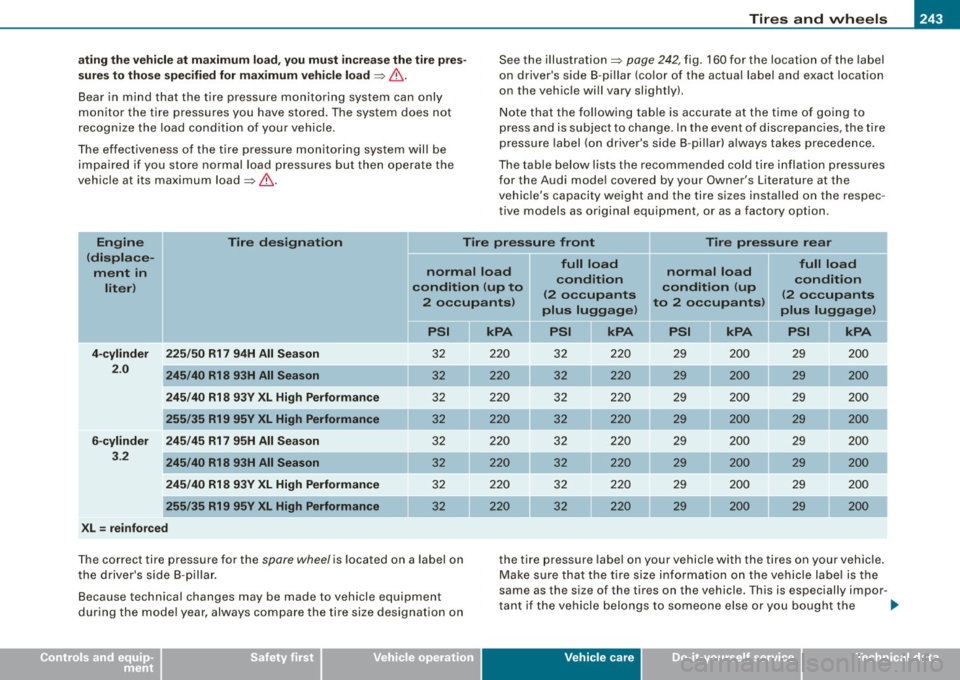
The table belo w lists t he r ecom mend ed cold tire i nflatio n pressures
for the Audi mode l covered by your Owner's Literature at the
vehic le' s capacity weigh t and the tire size s insta lled o n the respec
tive models as original equipment , or as a factory option .
Engine Tire designation
Tire pressure front II Tire pressure rear
(displace -
= " full load full load
ment in normal load
condition normal
load
condition
liter ) condition
(up to condition (up
( 2 oc cupants (2 occupants
2 o ccupants ) to 2 occupants)
plus luggage) plus luggage)
I
PSI II kPA PSI II kPA II PSI II kPA
PSI I[ kPA I
I
4-cylinder
225/50 R17 94H All Season 32 220 3 2 220 29 200 29 200
2.0
245/40 R18 93H All Season 32 220 32 220 29 200 29 200
245 /40 R18 93Y XL High Performance 32 220 32 220 29 200 29 200
255 /35 R19 95Y XL High Performance 32 220 32 220 29 200 29 200
6 -cylinder 245/45 R17 95H All Season 3 2 220 32 2 20 29 200 29 2 00
3.2
245/40 R18 93H All Season 32 220 32 220 29 200 29 200
245 /40 R18 93V XL High Performance 32 220 3 2 220 29 200 29 200
255/35 R19 95V XL High Performance 32 2 20 32 220 29 200 29 200
XL = reinforced
T he correct tire pressure for the spare wheel is located on a label on the tire p ressure label on your vehicle with the tires on your vehic le.
t he d river's s ide B -pilla r. Make sure that the tire s ize inf ormat ion on t he veh icle labe l is t he
Because technical changes may be made to vehicle equipment same as the si
ze of the tires on the vehicle. This is especially impor -
t ant if the ve hicle belongs to so meo ne else or you bought the
dur ing th e mode l year, always co mpare the tire size designa tion on
Vehicle care
I t •
.,
Page 251 of 316
__________________________________________________ T_ ir_e _ s_ a_ n _ d_ w_ h_ e_ e_ls _ ____. 111111
Unbalanced wheels must be rebalanced to avoid excessive wear on
steering, suspension and tires. A wheel must also be rebalanced
when a new tire is installed.
Incorrect wheel alignment
Incorr ect wheel alignment can cause excessive tire wear, impairing
the safety of the vehicle. If tires show excessive wear, have the
wheel alignment checked by an authorized Audi dealer or qualified
workshop.
All Wheel Drive
Vehicles with quattro ® must always have tires of the same size,
construction and tread type. For details see
=> page 191.
& WARNING
Sudden tire failure can lead to loss of control, a crash and serious
personal injury!
• Never drive a vehicle when the tread on any tire is worn down
to the wear indicators .
• Worn tires are a safety hazard, they do not grip well on wet
roads and increase your risk of "hydroplaning" and loss of control .
• Always keep chemicals that can cause tire damage, such as
grease, oil, gasoline and brake fluid away from tires .
• Tires age even if they are not being used and can fail suddenly,
especially at high speeds . Tires that are more than 6 years old can
only be used in an emergency and then with special care and at
lower speeds.
• Never mount used tires on your vehicle if you are not sure of
their "previous history ." Old used tires may have been damaged
even though the damage cannot be seen that can lead to sudden
tire failure and loss of vehicle control. •
New tires and replacing tires and wheels
New tires and wheels have to be broken in.
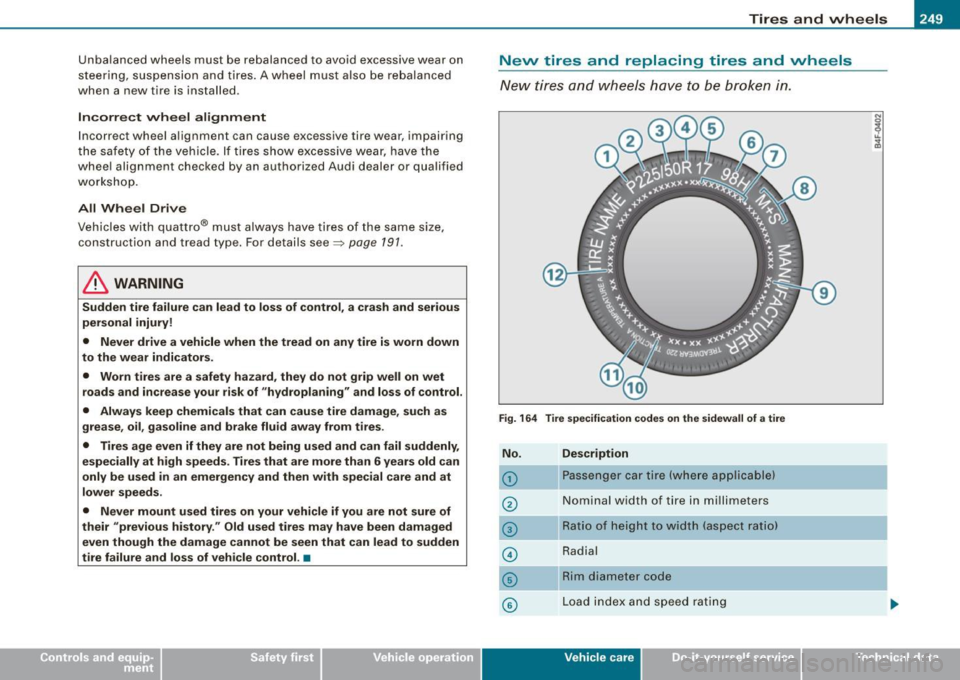
Fig. 164 Tire specification codes on the sidewall of a tire
No.
©
0
©
©
©
©
Description
Passenger car tire (where app licable)
Nominal width of tire in mi llimeters
Ratio of height to width (aspect ratio)
Radial
ii Rim diameter code
Load index and speed rating
Vehic le care
I I irechnical data
Page 254 of 316

-Tires and wheels
P'tr:1-------------------
will not work prope rly . In this case, the tire pressure monitoring
s ys tem would n ot b e ab le to mon itor the tire p ressure or wa rn yo u
if it is necessary .
• The battery inside of the tire pressure sensor has a limited
se rvice life .
• Always d rive with the valve stem caps sec urely mounted . We
recommend using factory insta lled valve stem caps . Ask your au tho
rized Audi dealer to replace lost va lve stem cap s.
The installation o f rep laceme nt tire s wi th steel cor d body p lies in
the tire sidewal l may cause malfunction of the tire pressure moni
t or ing sys tem, a nd is no t re com mended (cord mater ial i nformat ion
in molded on the tire sidewa ll) .
A lw ays check your tire p ressure monito rin g s ystem i ndicator afte r
replacing o ne or mor e tir es o n you r vehi cle. If th e tire p ressu re
monito ring syste m indicat or flashes, o r is on, you r sy stem is not
wo rk in g pr oper ly. Your rep lac em ent ti re mig ht be i nco mpat ibl e wi th
your tir e pressure monitoring syst em , or som e component o f th e
tir e pr ess ure monito ring syste m may be da mag ed.
& WARNING
• Using incorrect or unmatched tires and/ or wheels or improper
tire and wheel combinations can lead to loss of control, collision
and serious personal injury .
• Always use tires , rims and wheel bolts that meet the specifica
tions of original factory -installed tires or other combinations that
have been spe cifically approved by the vehicle manufacturer.
• Tires age even if they are not being used and can fail suddenly ,
especially at high speeds . Tires that are more than 6 years old can
only be used in an emergency and then with special care and at
lower speeds .
• Never mount used tires on your vehi cle if you are not sure of
their "previous history. " Old used tires may have been damaged
even though the damage cannot be seen that can lead to sudden
tire failure and loss of vehi cle control.
& WARNING (continued)
• All four wheels must be fitted with radial tires of the same type,
size (rolling circumference ) and the same tread pattern. Driving
with different tires reduces vehicle handling and can lead to a loss
of control.
• If the spare tire is not the same as the tires that are mounted
on the vehicle -for e xample with winter tires -only use the spare
tire for a short period of time and drive with extra care . Refit the
normal road wheel as soon as safely possible.
• Never drive faster than the maximum speed for which the tires
on your vehicle are rated because tires that are driven faste r than
their rated speed can fail suddenly .
• Overloading tires cause heat build-up , sudden tire failure ,
including a blowout and sudden deflation and loss of control .
• Temperature grades apply to tires that are properly inflated and
not over or underinflated .
• For te chnical reasons it is not always possible to use wheels
from other vehicles -in some cases not even wheels from the
same vehicle model.
• If you install wheel trim discs on the vehicle wheels, make sure
that the air flow to the brakes is not blocked. Redu ced airflow to
the brakes can them to overheat , increasing stopping distances
and causing a collision.
• Run flat tires may only be used on vehicles that were equipped
with them at the fa ctory . The vehicle must have a chassis designed
for run flat tires and a factory -installed tire pressure monitoring
system that indi cate s a loss of tire pressure . Incorre ct use of run
flat tires can lead to vehicle damage or accidents . Check with an
authorized Audi dealer o r tire specialist to see if your vehicle can
be equipped with run flat tires .
If run flat tires are used, they must
be installed on all four wheels . Mixing tire types is not permitted. .,
Page 256 of 316
-~_T_ ir_e_ s_ a_ n_d _ w_ h_ e_e _l_s _________________________________________________ _
Safety Standard No. 109. Grades Band A represent higher leve ls of
performa nce on th e la boratory test w hee l tha n the minim um
requ ired by law .
& WARNING
The traction grade assigned to this t ire is based on straight-ahead
braking traction tests , and does not include acceleration ,
cornering , hydroplaning or peak traction characteristi cs.
& WARNING
The temperature grade for this tire is established for a tire th at is
properly inflated and not overloaded. Exces sive speed , underinfla
tion, or excessive loading, either separately or in combination , can
cause heat buildup and possible tire failure. •
Winter tires
Win ter tires can im prove veh icle ha ndl ing on sno w and
i c e. A t te mp eratu res belo w 4 5 °F (7 ° C) w e r eco mme nd
c ha ng in g to winter tir e s.
In some heavy snow areas, local governments may require true
winter o r "snow" tire s, those with ve ry deeply cut tread. These tires
should only be used in pairs and be insta lled on a ll four wheels .
M ake s ure you p urchase snow ti res that are the same s ize and
construct ion type as the other ti res on your vehicle.
If your vehic le is equipped with al l-wheel drive *, this will improve
t rac tion dur ing winter dr iv in g, eve n with the standard tires .
However, we strongly recommend that you a lways equip all four
whee ls on y our vehicle with correc tly fitted winte r tires or all-seas on
tires, when winter road conditions are expected . Th is a lso improves
t he ve hic le 's brak ing perfo rmance an d reduces s top ping distances .
Summer ti res p rovide less grip on ice and snow. Winter tires (snow tires) must always be fitted on all four whee
ls .
Compatible ti re p ressure monit oring senso rs must be instal led on
a ll four w inter tires for the tire pressure monitoring system to func
tion proper ly :::::> page 251.
Ask your aut hori zed Audi deale r or quali fied w orksho p for perm itte d
winter tire size s. Use only radial winter tires.
Wi nter tires lose thei r effec tiveness when the tread is worn down t o
a depth of 0. 157 inch (4 mm).
On ly drive with winter tires under winter conditions. Summer tires
h an dle better when there is no s now or ice on t he roads a nd th e
temperature is above 45 °F (7 °C) .
I f you have a flat tire, see n otes on spare w hee l :::::> page 249.
Please a lways remembe r that w inte r tires may have a lower speed
r ating than the tires original ly instal led on your vehic le at the time
i t was manu fac tured. Please see:::::> page 251, "Speed rating (letter
code)" for a listing of the speed rating letter codes and the
m ax imum speed at which t he ti res ca n be drive n.
T he speed rating letter code(:::::, page 241) is on the side wa ll of the
ti re :::::> page 2 49. & WARNING
Winter tires have maximum speed limits that may be lower than
your veh icle's ma ximum speed . Always know the maximum speed
before driving off . Never drive faster than the speed permitted for
your specific winter tires . This will cause damage to the tires
leading to an accident and serious personal injury to you and your
pa ssengers.
& WARNING
Driving faster than the ma ximum speed for whi ch the winter tires
on your vehicle were designed can cause tire failure including a
blowout and sudden deflation , los s of control , crashes and serious _.,
Page 257 of 316
Tires and wheels -
----------------
•
& WARNING (continu ed )
personal injur ies . Have worn or damaged tires repl aced immed i
ately.
• Winter tires have ma ximu m speed rating th at may be lower
than your vehicle 's maximum speed.
• Never drive faster than the speed for which the winter or other
tire s installed on your vehicle are rated.
& WARNING
Alway s adjust your driving to the road and traffi c cond it ions .
Never let the good acceleration of the winter tires and all -wheel
drive tempt you into tak ing e xtra ri sks . Always remember :
• When braking , an all -wheel drive vehicle h andles in the same
way as a front drive vehicle .
• Drive carefully and reduce your speed on icy and slippery roads ,
even winter tires cannot help under black ice conditions.
c£> For the sake of the environment
Use summer tires when weather conditions permit. They are
quieter, d o not wear as qu ic kly and reduce fue l con sump tion. •
Snow chains
Snow c ha ins may be fitte d only to t he fr ont w heels , and only to
certain t ire sizes. Ask your authorized Audi dea ler on which tire
s izes snow chains ca n be used .
I f you are going to use snow chains, then you must instal l them on
the front whee ls at least.
The snow chains must have low-pro file l inks and must not be thicker
than 0. 53 inch ( 13 .5 mm), including the lock. Remove wheel center covers and
trim discs before putting snow
chains o n yo ur vehicle ~
(D. For safe ty reaso ns cover caps mus t
then be fitted over the whee l bolts. These are available from autho
r iz ed A ud i deale rs.
& WARNING
Using the wrong snow chain s for your vehicle or installing them
inco rrectly can increase the risk of loss of control leading to
serious personal injury.
• Snow chains are ava ila ble in d ifferent si zes . Always make sure
to follow the instructions provided by the snow chain manufac
turer .
• When driving with snow chain s never drive faster than the
speed permitted for your spe cific snow cha ins .
• Always observe local regulations .
0 Note
• Remove snow chai ns before d riving o n roads not cov ered w ith
snow to avoid damaging t ires and wearing the snow chains down
unnecessar ily .
• Snow chains, which come into direct contact with the wheel rim,
can scratch or damage it. Therefore, make sure t hat the s now c hains
are suitably covered.
[ i ] Tips
Where snow chains are mandatory on certain roads, this normally
a lso a ppl ies to veh ic les w it h All Wheel Dr iv e. •
Vehicle care I t •