2008 AUDI TT ROADSTER seats
[x] Cancel search: seatsPage 95 of 316
Luggage compartment
Applies to vehicles: with pass-through and removable ski bag
Pass-through with Ski Bag
Using the pass-through and the removable ski bag, you
can transport long objects (e.g. skis) neatly and without
damaging the interior.
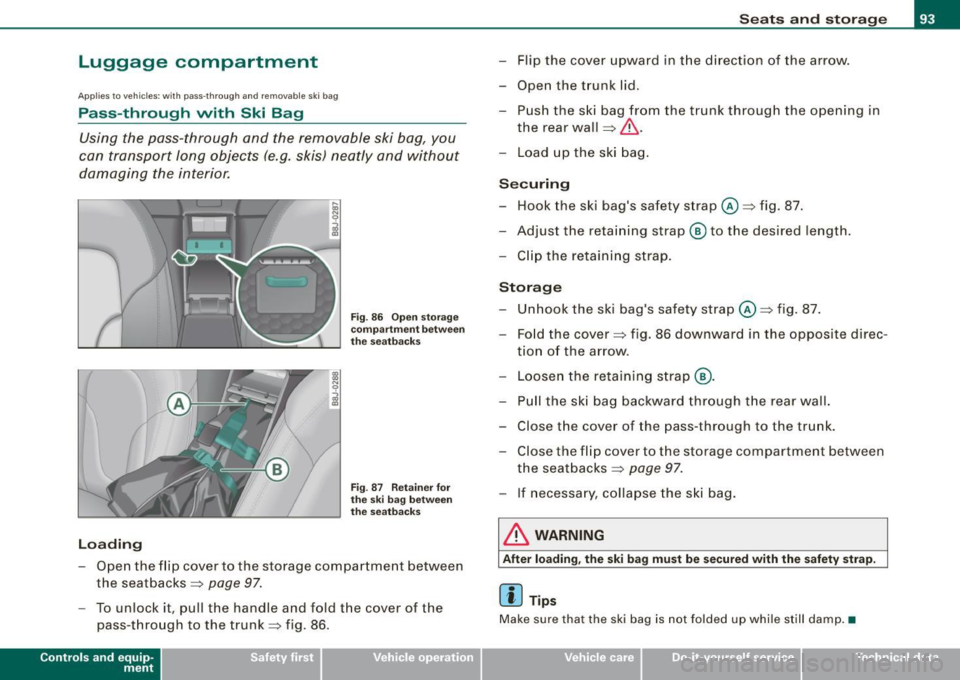
Loading
Fig . 86 Open storage
compartment between
the seatbacks
Fig . 87 Retainer for
the ski bag between
the seatbacks
-Open the flip cover to the storage compartment between
the seatbacks => page
97.
-To unlock it, pull the handle and fold the cover of the
pass -through to the trunk=> fig. 86.
Contro ls and eq uip
ment
Seats and storage
- Flip the cover upward in the direction of the arrow.
- Open the trunk lid.
- Push the ski bag from the trunk through the opening in
the rear wall
=> &, .
- Load up the ski bag.
Securing
Hook the ski bag's safety strap @=>fig. 87.
Adjust the retaining strap® to the desired length.
- Clip the retaining strap.
Storage
- Unhook the ski bag's safety strap@=> fig. 87.
- Fold the cover => fig. 86 downward in the opposite direc-
tion of the arrow .
- Loosen the retaining strap @.
Pull the ski bag backward through the rear wall.
- Close the cover of the pass-through to the trunk.
- Close the flip cover to the storage compartment between
the seatbacks => page
97.
- If necessary , collapse the ski bag.
& WARNING
After loading, the ski bag must be secured w ith the safety strap.
[ i] Tips
Mak e sure that the ski bag is not folded up while still damp. •
Vehicle care
I I irechnical data
Page 96 of 316
Seats and storage
Cup holder
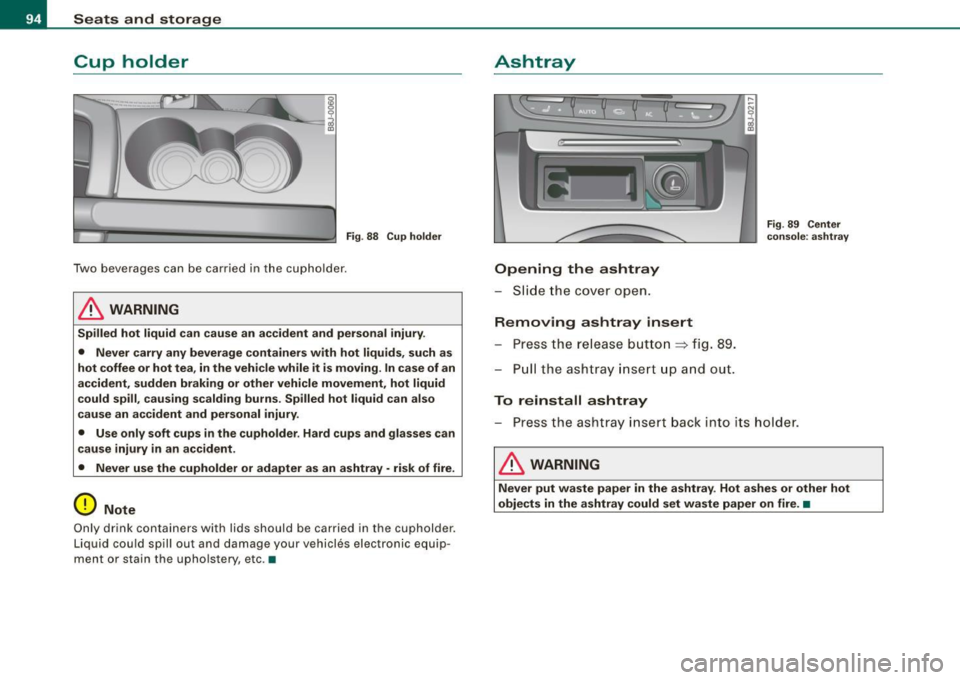
Fig . 88 Cup holder
Two beverages can be carried in t he cupho lder .
& WARNING
Spilled hot liquid can cause an accident and personal injury .
• Never carry any beverage containers with hot liquids , such as
hot coffee or hot tea , in the veh icle while it is moving . In case of an
accident, sudden braking or other vehicle movement , hot liquid
could spill , causing scalding burns . Spilled hot l iquid can a lso
c ause an ac cident and per sonal injury .
• Use only soft cups in the cupholder . Hard cups and glasses can
cause injury in an accident .
• Never use the cupholder or adapter as an ashtray -risk of fire.
0 Note
Only drink containers with lids should be carried in the cupholder.
Liquid cou ld spill out and damage your ve hicles electronic equip
ment or stain the upholstery, etc. •
Ashtray
Opening the ashtray
-Slide t he cover open.
Removing ashtray insert
Press th e re leas e butt on => fi g. 89.
Pull the ash tray in sert up an d o ut.
To reinstall ashtray
Fig . 89 Cen ter
con sole : ashtray
- Press the asht ray insert back into i ts hol der.
& WARNING
Never put waste paper in the ashtray . Hot ashes or other hot
objects in the ashtray could set waste paper on fire .•
Page 97 of 316

Cigarette lighter/socket
Cigarette lighter
The socket of the cigarette lighter may be used for 12 volt
appliances.
Fig . 90 Open ashtray
with cigarette lighter
The cigarette lighter or socket only work with the ignition
on.
Using the cigarette lighter
- Slide the cover open to reach the c igarette lighter.
- Push the knob=> fig. 90 in .
- Wait until the cigarette lighter knob pops out.
- Remove the cigarette lighter immediately and use it.
- Reinsert cigarette lighter into the socket after use.
Connecting an appliance
- Slide the cover open to reach the cigarette lighter.
- Remove cigarette lighter.
- Plug in appliance to be used .
Contro ls and eq uip
ment
Seats and storage
The socket of the cigarette lighter may be used for 12-volt appli
ances with maximum consumption of up to 100 watts , such as a
flash ligh t, small vacuum cleaner, etc.
Before you purchase any accessories, always read and follow the
information in=>
page 296, "Additional accessories and parts
replacement" .
& WARNING
Improper use of the cigarette lighter can cause serious injury or
start a fire.
• Be careful when using the cigarette lighter. If you do not pay
attention to what you are doing when you are using the cigarette
lighter you can burn yourself.
0 Note
To avoid damaging the socket, only use plugs that fit properly.
[ i] Tips
• When the engine is off and accessories are still plugged in and
are on, the vehicle battery can still be drained.
• The vehicle battery must not be charged with a standard small
charger that plugs into the cigarette lighter or outlet .•
Storage
General
& WARNING
• Always remove objects from the instrument panel. Any items
not put away could slide around inside the vehicle while driving or
~
Vehicle care I I irechnical data
Page 98 of 316
Seats and storage
& WARNING (continued)
when accelerating or when applying the brakes or when driving
around a corner.
• When you are driving make sure that anything you may have
placed in the center console or other storage locations cannot fall
out into the footwells . In case of sudden braking you would not be
able to brake, depress the clutch or accelerate. •
Glove compartment
The glove compartment is illuminated and can be locked .
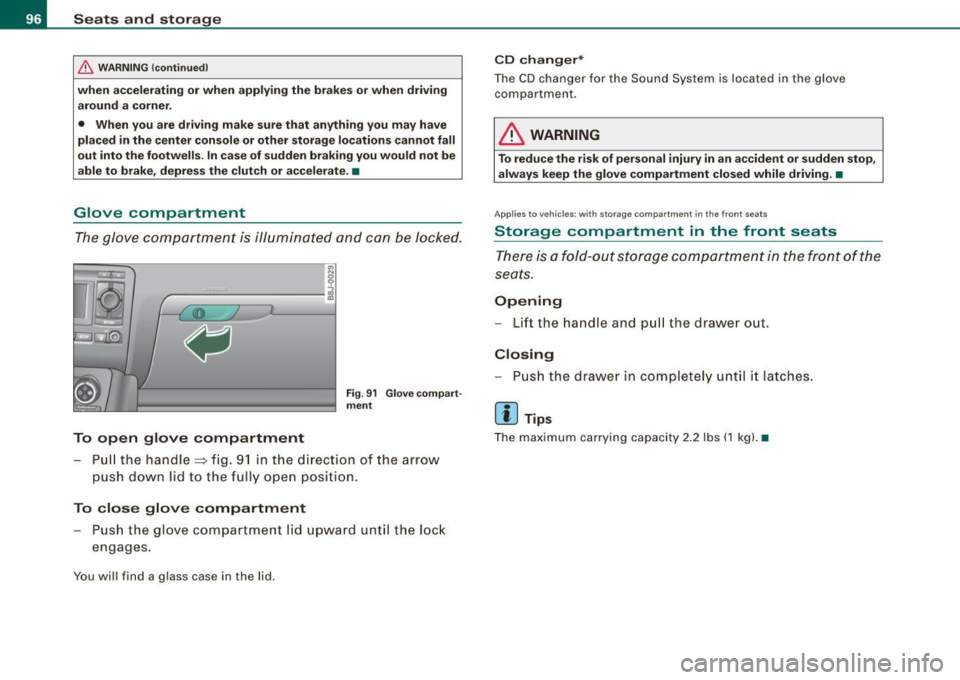
To open glove compartment
Fig. 91 Glove compart
ment
- Pull the handle=> fig. 91 in the direct ion of the arrow
push down lid to the fully open position.
To close glove compartment
Push the glove compartment lid upward until the lock
engages.
You will find a glass case in the lid .
CD changer*
The CD changer for the Sound System is located in the glove
compartmen t.
LJ}. WARNING
To reduce the risk of personal injury in an accident or sudden stop,
always keep the glove compartment closed while driving. •
App lies to veh icle s: w ith sto ra ge co mpart ment in the front seats
Storage compartment in the front seats
There is a fold-out storage compartment in the front of the
seats.
Opening
- Lift the handle and pull the drawer ou t.
Closing
- Push the drawer in completely until it latches.
[ i ] Tips
The maximum carrying capacity 2.2 lbs (1 kg). •
Page 99 of 316
Storage compartment between the seat
backs
Opening storage compartment
.... N
N
'i'
i
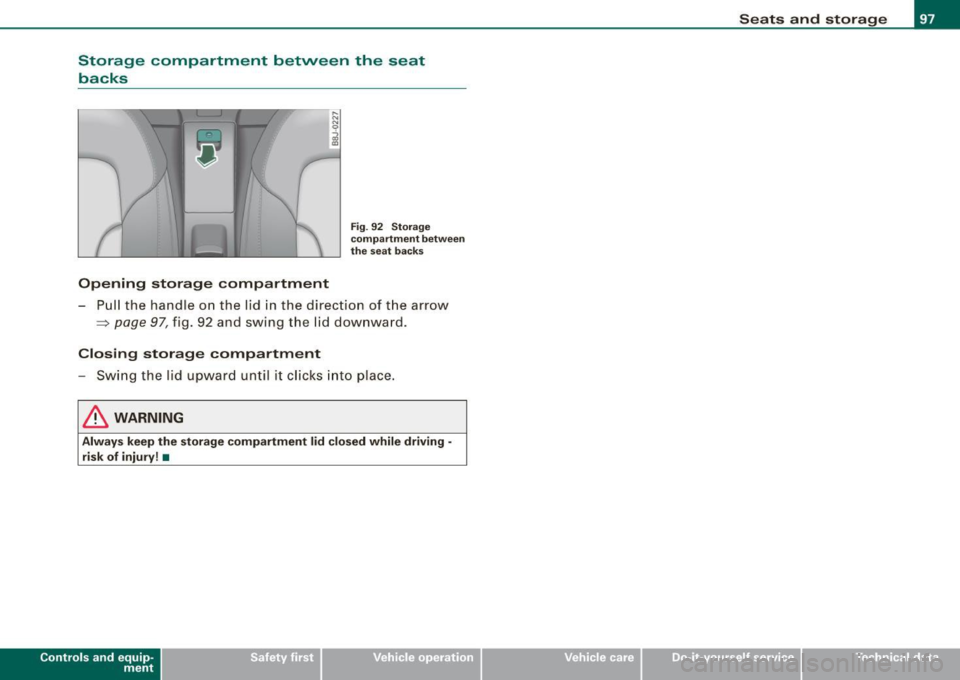
Fig. 92 Storage
compartment between
the seat backs
-Pull the handle on the lid in the direction of the arrow
~ page 97, fig. 92 and swing the lid downward.
Closing storage compartment
-Swing the lid upward until it clicks into place.
& WARNING
Always keep the storage compartment lid closed while driving -
risk of injury! •
Con tro ls and eq uip
ment
Seats and storage
Vehicle care I I irechnical data
Page 106 of 316
-Warm and cold .._ __________________________________________ _
rear window defogger that was switched on also remains stored for
15 minutes after the ignition is switched off .
If the eng ine is restarted within these 15 m inutes, the rear window
defogger is activated for 10 to 20 minutes, depending on outside
t emperature. With a vehicle that is parked for a short time, the rear
window defogger does not need to be manually activated again.
<£> For the sake of the environment
As soon as the rear window is clear, you should switch the rear
window defogger o ff. The reduced power consumption has a bene
ficial effect on fue l consumption .•
Ap plies to v ehicles : wit h heated seats
~--
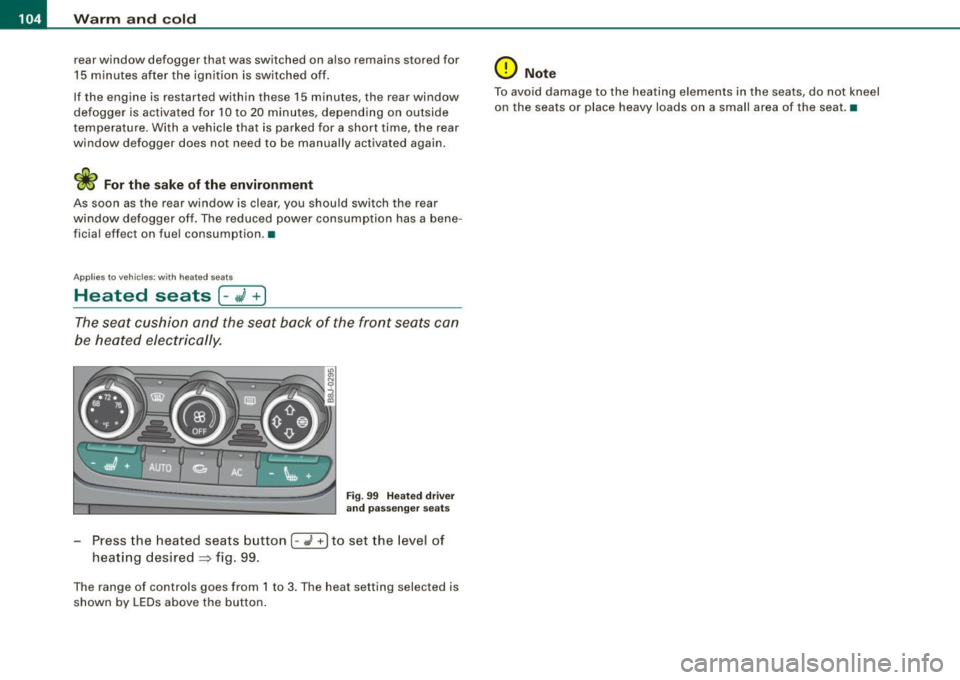
Heated seats (-,J +)
The seat cushion and the seat back of the front seats can
be heated electrically.
F ig . 9 9 He ate d driver
a nd p ass en ger se ats
- Press the heated seats button I-,J +Ito set the level of
heat ing desired=> fig. 99.
The range of controls goes from 1 to 3 . The heat setting selected is
shown by LEDs above the button .
0 Note
To avo id damage to the heating eleme nts in the seats, do not kneel
on the seats or place heavy loads on a small area of the seat. •
Page 130 of 316
___ o_ r_iv _ i _n....; g::;_ S_ a_f _e _ly=-- -------------------------------------------------
Driving Safely
General notes
Safe driving habits
Please remember -safety first!
This chapter contains important information, tips, suggestions and
warnings that you need to read and observe for your own safety, the
safety of your passengers and others. We have summarized here
what you need to know about safety belts, airbags, child restraints as well as child safety. Your safety is for us
priority number 1. Always
observe the information and warnings in this section -for your own
safety as well as for that of your passengers.
The information in this section applies to all model versions of your
vehicle. Some of the features described in this sections may be
standard equipment on some models, or may be optional equip
ment on others. If you are not sure, ask your authorized Audi dealer.
& WARNING
• Make certain that you follow the suggestions and heed the
WARNINGS in this Manual. It is in your interest and in the interest of your passengers.
• Always keep the complete Owner's Literature in your Audi
when you lend or sell your vehicle so that this important informa
tion will always be available to the driver and passengers.
• Always keep the Owner's literature handy so that you can find
it easily if you have questions. •
Safety equipment
The safety features are part of the occupant restraint
system and work together to help reduce the risk of injury
in a wide variety of accident situations.
Your safety and the safety of your passengers should not be left to
chance. Advances in technology have made a variety of features
available to help reduce the risk of injury in an accident. The
following is a listing of just a few of the safety features in your Audi:
• sophisticated safety belts for driver and all passenger seating
positions,
• safety belt pre-tensioners,
• front airbags,
• knee airbags for the front seats,
• side airbags in the front seats,
• LATCH anchorages for child restraints,
• adjustable steering column .
These individual safety features can work together as a system to
help protect you and your passengers in a wide range of accidents.
These features cannot work as a system if they are not always prop
erly adjusted and properly used!
Safety is everybody's responsibility! •
Important things to do before driving
Safety is everybody's job! Vehicle and occupant safety
always depends on the informed and careful driver.
For your safety and the safety of your passengers, before
driving always: .,_
Page 133 of 316

Driving Safely -
----------------
& WARNING (continued)
• Always adjust the driver's seat and the steering wheel so that
there are at least 4 inches (10 cm) between the knees and the
lower part of the instrument panel.
• Always hold the steering wheel on the outside of the steering
wheel rim with your hands at the 9 o'clock and 3 o'clock positions
to help reduce the risk of personal injury if the driver's airbag inflates .
• Never hold the steering wheel at the 12 o'clock position or with
your hands at other positions inside the steering wheel rim or on
the steering wheel hub. Holding the steering wheel the wrong way
can cause serious injuries to the hands, arms and head if the
driver's airbag inflates
• Pointing the steering wheel toward your face decreases the
ability of the supplemental driver's airbag to protect you in a colli
sion .
• Always sit in an upright position and never lean against or
place any part of your body too close to the area where the airbags
are located.
• Before driving, always adjust the front seats and head
restraints properly and make sure that all passengers are properly
restrained .
• Never adjust the seats while the vehicle is moving. Your seat
may move unexpectedly and you could lose control of the vehicle.
• Never drive with the backrest reclined or tilted far back! The
farther the backrests are tilted back, the greater the risk of injury due to incorrect positioning of the safety belt and improper
seating position.
• Children must always ride in child seats=>
page 168. Special
precautions apply when installing a child seat on the front
passenger seat=>
page 146. •
Controls and equip
ment Safety first Vehicle operation
Proper seating position for the front
passenger
The proper front passenger seating position is important
for safe, relaxed driving.
For your own safety and to reduce the ris k of injury in the
event of an accident, we recommend that you adjust the
seat for the front passenger to the following pos ition:
- Move the front passenger seat back as far as possible.
There must be a minimum of 10 inches (25 cm) between
the breastbone and the instrument panel =>
&.
- Adjust the angle of the seatback so that it is in an upright
position and your back comes in full contact with it
whenever the vehicle is moving.
- Adjust the head restraint so that the upper edge is as
even with the top of your head as possible but not lower
than eye level and so that it is as close to the back of your
head as possible =>
page 132.
-Keep both feet flat on the floor in front of the front
passenger seat.
- Fasten and wear safety belts correctly=>
page 141.
For detailed information on how to adjust the front passenger's
seat, see => page 87.
& WARNING
Front seat passengers who are unbelted, out of position or too
close to the airbag can be seriously injured or killed by the airbag
as it unfolds. To help reduce the risk of serious personal injury : .,
Vehicle care Do-it-yourself service Technical data