2008 AUDI TT ROADSTER seat adjustment
[x] Cancel search: seat adjustmentPage 144 of 316
___ S_a_ f_ e_ t-= y_ b_e_ l_ t _s _______________________________________________ _
& WARNING
Improperly positioned safety belts can cause serious injury in an
accident =:> page
142, "Safety belt position".
• Safety belts offer optimum protection only when the seat back
is upright and belts are properly positioned on the body.
• Never attach the safety belt to the buckle for another seat.
Attaching the belt to the wrong buckle will reduce safety belt effectiveness and can cause serious personal injury.
• A passenger who is not properly restrained can be seriously
injured by the safety belt itself when it moves from the stronger
parts of the body into critical areas like the abdomen.
• Always lock the convertible locking retractor when you are
securing a child seat in the vehicle=:> page
179. •
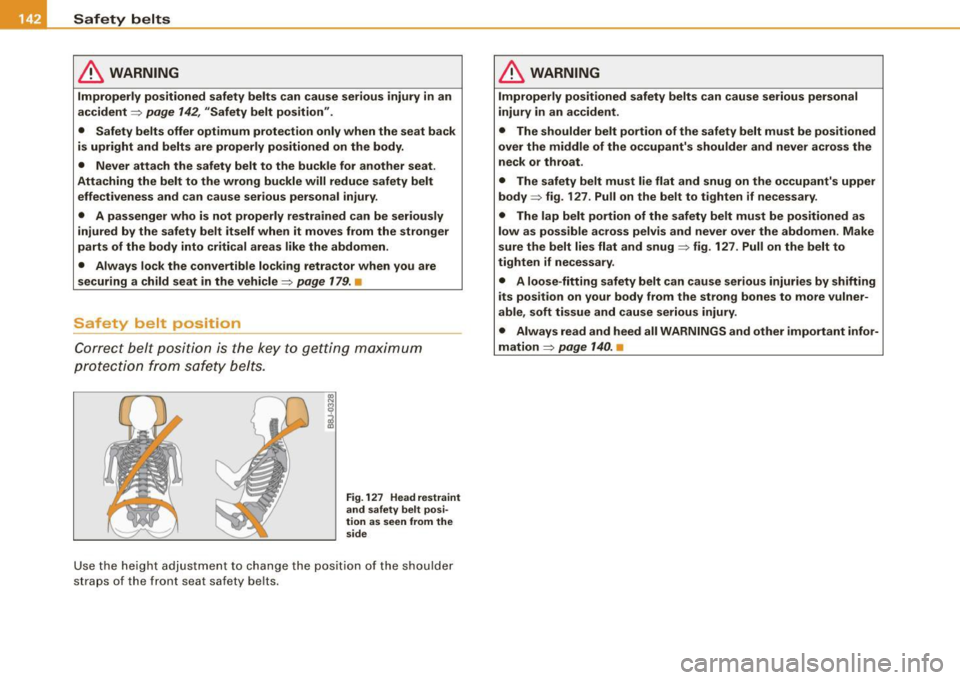
Safety belt position
Correct belt position is the key to getting maximum
protection from safety belts.
Fig. 127 Head restraint
and safety belt posi
tion as seen from the side
Use the height adjustment to change the position of the shoulder
straps of the front seat safety belts.
& WARNING
Improperly positioned safety belts can cause serious personal
injury in an accident.
• The shoulder belt portion of the safety belt must be positioned
over the middle of the occupant's shoulder and never across the
neck or throat .
• The safety belt must lie flat and snug on the occupant's upper
body
=> fig. 127 . Pull on the belt to tighten if necessary.
• The lap belt portion of the safety belt must be positioned as
low as possible across pelvis and never over the abdomen. Make
sure the belt lies flat and snug => fig. 127. Pull on the belt to
tighten if necessary.
• A loose -fitting safety belt can cause serious injuries by shifting
its position on your body from the strong bones to more vulner
able, soft tissue and cause serious injury.
• Always read and heed all WARNINGS and other important infor
mation => page
140. •
Page 148 of 316
___ A_ ir_ b_ a-g _ s_y _s_ t_ e_ m _________________________________________________ _
Airbag system
Important things to know
Importance of wearing safety belts and
sitting properly
Airbags are only supplemental restraints. For airbags to
do their job, occupants must always properly wear their
safety belts and be in a proper seating position.
For your safe ty a nd the safety of your passengers, before
driving o ff, a lways:
- Adjust the driver's seat and steering wheel properly
~ page 130,
-Adjust the front passenger's seat properly~ page 88,
- Wear safety belts properly~ page 140,
-Always properly use the proper child restraint to pro tect
children~
page 168 .
In a collision airbags must inflate within the blink of an eye and with
considerable force. The supplemental airbags can cause injuries if
the driver or the front seat passenger are not seated proper ly . There
fore in order to help the airbag to do its job, it is important, both as
a driver and as a passenger to sit properly at a ll times.
By keep ing room between your body and the steering wheel and the
front of the passenger compartment, the airbag can inflate fu lly and
comp letely and prov ide supplementa l protection in certain frontal
collisions =>
page 130, "Proper occupant seating positions". For
detai ls on the operation of the seat adjustment controls =>
page 88
and=> page 89.
It's especially important that chi ldren are proper ly restrained
=>
page 168.
There is a lot that the dr iver and the passenger can and must do to
help the individual safety features installed in your Audi work
together as a system.
P roper seating position is important so that the front airbag on the
driver side can do its job. I f you have a physical impairment or
condition that prevents you from sitting properly on the driver seat
with the safety belt properly fastened and reaching the pedals, o r if
you have concerns with regard to the function or operation of the
Advanced Airbag System, p lease contact your authorized Audi
dea ler or qua lif ied workshop, or call Audi Customer CARE at 1-800-
822 -2834 for possib le modifications to your vehicle.
When the airbag system deploys, a gas generator wi ll fill the
airbags, break open the padded covers, and inflate between the
steering wheel and the driver and be tween the instrument panel
and the front passenger. The airbags wil l deflate immediate ly after
deployment so that the front occupants can see through the wind
shield again without interruption.
A ll of this takes p lace in the b link of an eye, so fast that many people
don't even rea lize that the airbags have dep loyed . The airbags also
inflate with a great deal of force and nothing should be in their way
when they dep loy. Fron t airbags in combination wi th properly worn
safety belts slow down and limit the occupant's forward movement.
T ogether they he lp to prevent the driver and passenger from hitting
parts of the inside the vehic le while reducing the forces acting on
the occupant during the crash. In this way they he lp to reduce the
r isk of injury to the head and upper body in the crash. Airbags do not
protect the arms or the lower parts of the body .
Both front airbags w ill not inflate in al l fro ntal col lisions . The trig
gering of the airbag system depends on the vehic le deceleration
r ate caused by the colli sion and registe red by the electronic contro l
unit. If this rate is below the reference value programmed into the
cont rol unit, the airbags w ill not be t riggered, even though the car
may be bad ly damaged as a result of the collision. Vehicle damage, .,,,.
Page 151 of 316

__________________________________________________ A_ i_ r _b _a...; g::- s_ y=--- s_t _e _m __ lllll
& WARNING
A child in a rearward-facing child safety seat installed on the front
passenger seat will be seriously injured and can be killed if the
front airbag inflates -even with an Advanced Airbag System .
• The inflating airbag will hit the child safety seat or infant
carrier with great force and will smash the child safety seat and
child against the backrest, door or roof. • If you must install a rearward facing child safety seat on the
front passenger seat because of exceptional circumstances and
the PASSENGER AIR BAG OFF light does not come on and stay on, immediately install the rear -facing child safety seat in a rear
seating position and have the airbag system inspected by your
Audi dealer .
• Forward-facing child safety seats installed on the front
passenger's seat may interfere with the deployment of the airbag
and cause serious personal injury to the child.
& WARNING
If , in exceptional circumstances, you must install a forward-facing
child restraint on the front passenger's seat:
• Always make sure the forward-facing seat has been designed
and certified by its manufacturer for use on a front seat with a
passenger front and side airbag .
• Never put the forward -facing child restraint up against or very
near the instrument panel.
• Always move the passenger seat into its rearmost position in
the seat's fore and aft adjustment range, as far away from the
airbag as possible before installing the forward -facing child
restraint. The backrest must be adjusted to an upright position .
• Make sure that the PASSENGER AIR BAG OFF light comes on
and stays on all the time whenever the ignition is switched on .
Controls and equip ment Safety first
Vehicle operation
& WARNING
To reduce the risk of serious injury , make sure that the PASSENGER
AIR BAG OFF light will be displayed whenever a child restraint is installed on the front passenger seat and the ignition is switched
on .
• If the PASSENGER AIR BAG OFF light does not stay on , perform
the checks described=>
page 157, "Monitoring the Advanced
Airbag System ".
• Take the child restraint off the front passenger seat and install
it properly at one of the rear seat positions if the PASSENGER AIR
BAG OFF light does not stay on.
• Have the airbag system inspected by your Audi dealer immedi
ately. • Always carefully follow instructions from child restraint manu
facturers when installing child restraints .
& WARNING
If, in exceptional circumstances, you must install a forward or
rearward-facing child restraint on the front passenger's seat :
• Improper installation of child restraints can reduce their effec
tiveness or even prevent them from providing any protection.
• An improperly installed child restraint can interfere with the
airbag as it deploys and seriously injure or even kill the child -
even with an Advanced Airbag System .
• Always carefully follow the manufacturer's instructions
provided with the child safety seat or carrier .
• Never place additional items on the seat that can increase the
total weight registered by the weight -sensing mat and can cause
injury in a crash . •
Vehicle care Do-it-yourself service Technical data
Page 154 of 316
-Airbag system ----------------
•
a sma ll ch ild th at is heavi er than a typ ica l 1 ye ar-o ld child is on
th e front p assenger s eat (regar dle ss of whet her the child is in on e
of th e child saf ety seats listed~
page 1 70),
• a chil d w ho h as outgrow n chi ld re str ain ts is on the fr ont
passen ger seat.
I f the fr ont passe nge r ai rbag is tu rned off, the
PASSENGER AIR BAG
OFF
light in the cent er o f the instrum ent pan el wi ll come on and stay
o n.
The front airb ag o n the passenger si de may
not depl oy (the
PASSENGER AIR BAG OFF light does not illuminate and stay l it) if:
• a small ad ult or t eenage r is on the fr ont passenger sea t
• a passenger who is not sitting upright with their bac k against a
n o n-re clined back res t w it h th e ir fe et on th e ve hicle flo or in fr ont of
th e se at is on th e front pass enger s eat.
I f the front pas senger ai rbag depl oys, the Federa l Standard requ ires
the airb ag to me et the "low r is k" dep loy ment criter ia to h elp r educe
th e risk of in jury t hroug h in teraction w ith the a irbag. "Low risk"
de ploy ment occu rs in those c ras hes that ta ke p lace a t low er d ecel
erations as defined in the electron ic contro l unit~
page 157.
Always remember:
P lease be sur e to r ead the i mport ant info rm ation
in th e sections that follow and b e sur e to heed all of the WARN INGS.
& WARNING
To reduce the risk of injury when an airbag inflates , always wear
safety belts properly.
• If you are unrestrained , leaning forward, sitting sideways or out
of position in any way, your risk of injury is much higher.
• You will also receive serious injur ies and could even be killed if
you are up against the airbag or too close to it when it inflates ·
even with an Advanced Airbag~
page 146 .
& WARNING
A child in a rearward-facing child safety seat installed on the front
passenger seat will be seriously injured and can be killed if the
front airbag inflates -even with an Advanced Airbag System .
• Although the Advanced Airbag System in your vehicle is
designed to turn off the front airbag when a rearward -facing child
restraint has been installed on the front passenger seat , nobody
can absolutely guarantee that deployment is impossible in all
conceivable situations that may happen during the useful life of
your vehicle.
• The inflating airbag will hit the child safety seat or infant
carrier with great force and will smash the child safety seat and
child against the backrest, door, or roof .
• If you must install a rearward facing child safety seat on the
front passenger seat because of exceptional circumstances and
the PASSENGER AIR BAG OFF light does not come on and stay on ,
immediately install the rear-facing child safety seat in a rear
seating position and have the airbag system inspected by your
Audi dealer .
& WARNING
If, in exceptional circumstances , you must install a forward -facing
child restraint on the front passenger's seat :
• Always make sure the forward -facing seat has been designed
and certified by its manufacturer for use on a front seat with a
passenger front and side airbag .
• Never put the forward-facing child restraint up against or very
near the instrument panel.
• Always move the passenger seat into its rearmost position in
the seat's fore and aft adjustment range , as far away from the
airbag as poss ible , before installing the forward-facing child
restraint. The backrest must be adjusted to an upright position. ..,.
Page 174 of 316
-Child Safety
---=-------------------
& WARNING
(continued )
-Always heed all legal requirements pertaining to the installa
tion and use of child safety seats and carefully follow the instructions provided by the manuf acturer of the seat you are
using.
• Never let more than one child occupy a child safety seat .
• Never let babies or older children ride in a vehicle while sitting
on the lap of another passenger.
-Holding a child in your arms is never a substitute for a child
restraint system.
- The strongest person could not hold the child with the forces
that exist in an accident . The child will strike the interior of the
vehi cle and can also be struck by the passenger.
- The child and the passenger can also injure each another in an accident .
• Never install a rearward facing child safety seat on the front
passenger seat unless the PASSENGER AIR BAG OFF light comes
on and stays on. If the PASSENGER AIR BAG OFF light does not
come on and stay on the inflating airbag will hit the child safety
seat or infant carrier with great force and will smash the child
safety seat and child against the backrest , door or roof . Have the
airbag system inspected immediately by your Audi dealer.
• Forward-facing child safety seats installed on the front
passenger's seat can interfere with the airbag when it inflates and
cause serious injury to the child .
• If exceptional circumstances require the use of a forward
facing child restraint on the front passenger's seat , the child's
safety and well-being require that the following special precau
tions be taken :
- Make sure the forward -facing seat has been designed and
certified by its manufacturer for use on a front seat with a
passenger front and side airbag.
- Always carefully follow the manufacturer's instruct ions
provided with the child safety seat or carrier.
& WARNING (continued)
- Always move the front passenger seat into the rearmost
position of the passenger seat's fore and aft adjustment range ,
and as far away from the airbag as possible before installing
the child restraint .
- Always make sure that nothing prevents the front
passenger's seat from being moved to the rea rmost position in
its fore and aft adjustment range .
- Always make sure that the backrest is in the upright posi
tion.
• Always buckle the child safety seat firmly in pla ce even if a
child is not sitting in it . A loose child safety seat can fly around
during a sudden stop or in a collision .
• Always read and heed all WARNINGS whenever using a child
restrained in a vehicle is being used=>
page 137 , "Safety belts ",
=>
page 146, "Airbag system" and=> page 168 , "Child Safety".
& WARNING
To reduce the risk of serious injury , make sure that the PASSENGER
AIR BAG OFF light comes on and stays on whenever a child
restraint is installed on the front passenger seat and the ignition
is switched on .
• Never install a rearward facing child safety seat on the front
passenger seat unless the PASSENGER AIR BAG OFF light comes
on and stays on . If the PASSENGER AIR BAG OFF light does not
come on and stay on the inflating airbag will hit the child safety
seat or infant carrier with great force and will smash the child
safety seat and child against the backrest, door or roof. Have the
airbag system inspected immediately by your Audi dealer. •
Page 177 of 316
& WARNING !continued)
• Always follow the manufacturer's instructions provided with
the child safety seat or carrier.
• Always move the front passenger seat into the rearmost posi
tion of the passenger seat's fore and aft adjustment range, and as
far away from the airbag as possible before installing the child
restraint.
• Always make sure that nothing prevents the front passenger's
seat from being moved to the rearmost position in its fore and aft
adjustment range.
• Always make sure the backrest is in an upright position.
• Make sure that the PASSENGER AIR BAG OFF light comes on
and stays on all the time whenever the ignition is switched on.
• If the light does not stay on, perform the checks~
page 157,
uMonitoring the Advanced Airbag System".
• If the PASSENGER AIR BAG OFF light does not come on and stay
on have the airbag system inspected immediately by your Audi
dealer. •
Safety first
Child Safety
Booster seats
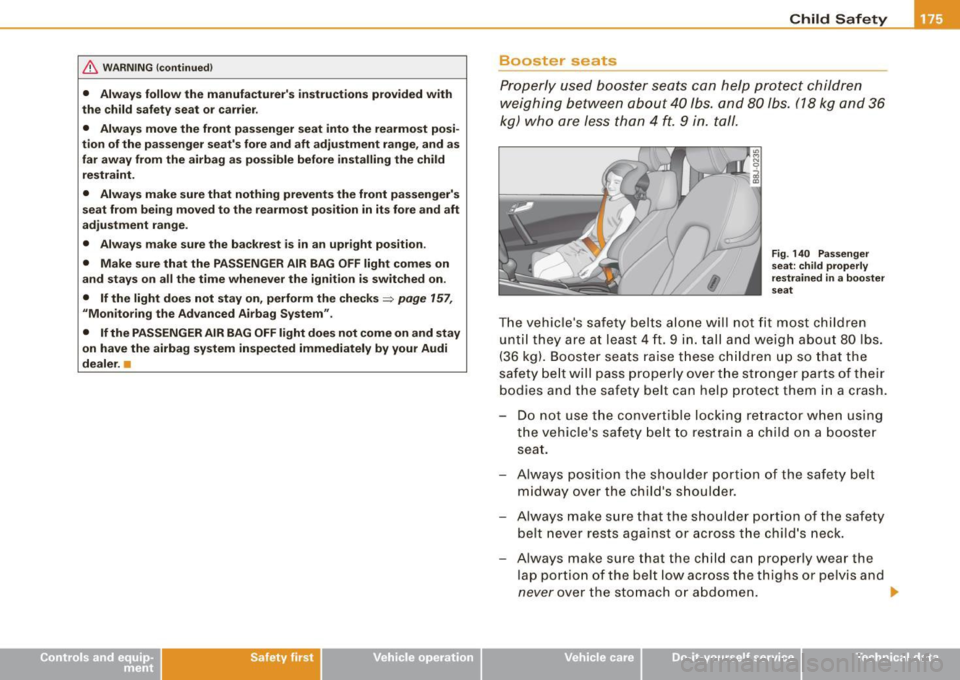
Properly used booster seats can help protect children
weighing between about 40 lbs. and 80 lbs. (18 kg and 36
kg) who are less than
4 ft. 9 in. tall.
II
Fig . 140 Passenger
seat: child properly
restrained
in a booster
seat
The vehicle 's safety belts alone will not fit most children
until they are at least
4 ft. 9 in. tall and weigh about 80 lbs.
(36 kg). Booster seats raise these children up so that the
safety belt will pass properly over the stronger parts of their bodies and the safety belt can help protect them in a crash .
- Do not use the convertible locking retractor when using
the vehic le 's safety belt to restrain a child on a booster
seat.
- Always posit ion the shoulder portion of the safety belt
midway over the child's shoulder.
- Always make sure that the shoulder port ion of the safety
belt never rests against or across the child's neck .
- Always make sure that the child can properly wear the
lap portion of the belt low across the thighs or pelvis and
never over the stomach or abdomen. •
Vehicle care I I irechnical data
Page 180 of 316
___ C_ h_ il_d _S_ a_f _e _ty ~----------------------------------------------
& WARNING
Improperly installed child safety seats increase the risk of serious
personal injury and death in a collision.
• Always make sure that the safety belt retractor is locked when
installing a child safety seat. An unlocked safety belt retractor
cannot hold the child safety seat in place during normal driving or
in a crash.
• Always buckle the child safety seat firmly in place even if a
child is not sitting in it. A loose child safety seat can fly around
during a sudden stop or in a collision
• The inflating airbag will hit the child safety seat or infant
carrier with great force and will smash the child safety seat and
child against the backrest, door or roof.
• Forward-facing child safety seats or infant carriers installed on
the front passenger's seat may interfere with the deployment of
the airbag and cause serious injury to the child .
• Always read and heed all WARNINGS whenever using a child
restrained in a vehicle is being used=>
page 168. Special precau
tions apply when installing a child safety seat on the front passenger seat=>
page 147, "Child restraints on the front seat -
some important things to know" .
& WARNING
Always take special precautions if you must install a forward or
rearward-facing child restraint on the front passenger's seat in
exceptional situations :
• Whenever a forward or rearward-facing child restraint is
installed on the front passenger seat , the PASSENGER AIR BAG
OFF light must come on and stay on whenever the ignition is
switched on.
• If the PASSENGER AIR BAG OFF light does not come on and stay
on , perform the checks described=>
page 157, ''Monitoring the
Advanced Airbag System".
& WARNING (continued)
• If the PASSENGER AIR BAG OFF light does not come on and stay
on whenever the ignition is switched on the inflating airbag will
hit the child safety seat or infant carrier with great force and will
smash the child safety seat and child against the backrest , door or
roof . Have the airbag system inspected immediately by your Audi
dealer.
• Improper installation of child restraints can reduce their effec
tiveness or even prevent them from providing any protection .
• An improperly installed child restraint can interfere with the
airbag as it deploys and seriously injure or even kill the child.
• Always carefully follow the manufacturer's instructions
provided with the child safety seat or carrier .
• Never place additional items on the seat that can increase the
total weight registered by the weight -sensing mat and can cause
injury in a crash .
in. WARNING
Forward-facing child restraints:
• Always make sure the forward-facing seat has been designed
and certified by its manufacturer for use on a front seat with a
passenger front and side airbag .
• Never put the forward-facing child restraint up , against or very
near the instrument panel.
• Always move the passenger seat into its rearmost position in
the seat's fore and aft adjustment range, as far away from the
airbag as possible before installing the forward -facing child
restraint. The backrest must be adjusted to an upright position.
• Make sure that the PASSENGER AIR BAG OFF light comes on
and stays on all the time whenever the ignition is switched on.
~
Page 309 of 316

______________________________________________ A_ l_,_ p _h_ a_ b_e _t_ic _ a _ l _in _ d_e _ x __ lll
Pass-through .. ..... .... ... .... .... .. 93 Proper safety belt position . ... .. ...... 142 Remote control ....... ... .. .. ... .. ... 48
Pedals ...... .... ... ........ .... .... 134 Proper seating position Resetting remote control ...... ... .. 52
Physical principles of a frontal collision 138
Polishing ...... .... .... ....... .... . 204
Pollen filter ......................... 99
Pollutant filter .. .... .... .... .... ... .. 99
Power locking switch ........... .... .. 53
Power locking system ... .... .... .... .. 50
Convenience close/open feature .... . 58
Locking and unlocking the vehicle from
inside .. .. .. .... .... ... .... .... . 53
Opening and closing the windows ... 58
Rear lid/trunk lid ..... .... .... .... . 55
Remote control ...... .... .... ... .. 48
Unlocking and locking vehicle . .... .. 51
Power seats
Adjusting the seatback ....... .... .. 91
Adjustment .. .... .... .... ...... ... 89
Power steering
See Electro -mechanical power assist 21,
190
Power top
Care and cleaning . ....... .... .... 203
Convenience close/open feature ... .. 63
Convenience opening/closing ... .... 63
Power window switches ...... ...... ... 57
Reactivating the system .... .... .... 59
Pregnant women
Special cons iderations when wearing a
safety belt . .... .... .... ... .... . 143 Front
passenger . ...... ........... 131
Occupants .. ...... ...... ... .. .... 130
a
Quartz clock .. ...... ..... .. .... .... .. 13
quattro®
See All Wheel Drive ............... 191
Question
R
What happens to unbelted occupants? .
139
Why safety belts? ... .. .... .... .... 137
Radiator fan .... .... ..... .. .... .... . 229
Rain sensor defective ................. 36
Reading lights ... ... ..... ... .... .... . 77
Rear lid ........ ....... ...... .... .... 55
Emergency release ......... ...... . 56
Rear light
Defective . ................... .... . 36
Rear spoiler . .... .... ....... ........ 187
Rear window defoggeir ............... 103
Rearview mirror Inside rearview mirror .. .... .... ... . 82
See also Mirrors ........... ....... . 82
Red symbols . ... .... .... .... .... ... . 31
Programming the Homelink® universal re- Refuelling ............... .... .... ... 216
mote contro l ... .... .... ... .... . 121 Release lever for hood .. .... .... .... . 219
Proper occupant seating positions .. ... 130 Remote
control garage door opener
(Homelink®l .... .... .... .... ... 121
Remote control key Unlocking and locking ..... .... .... . 51
Remo te master key
Battery replacement ...... .... .... . 48
Check light .. ....... .. ...... ...... 48
Remote rear lid release .... ... .. ...... . 55
Repair manuals ...... .... .... .... ... 294
Repairs Airbag system ................... 160
Replacement parts ... .... ... .... .... 296
Replacing Wheel rims .... .... ... ....... 249, 251
Replacing a fuse .. ...... .... .... .... 273
Replacing light bulbs .. ... .. . .... .. . . 277
Replacing tires and wheels ...... ..... 250
Reporting safety defects .. ... .... 136, 293
Reset button . .... ........ .... ... .... . 14
Resetting remote control ......... .... . 52
Retractor .......... .. .... ...... .... . 141
Reverse Automatic transmission .... ... .... 115
Rims Cas t alloy ..... .... .... .... .... ... 207
Replacing .... .... ....... ... . 249, 251
Stee l rims . .... ... .... ...... ... .. 206
Controls and equip
ment Safety first Vehicle operation
Vehicle care Do-it-yourself service Technical data