2008 AUDI TT ROADSTER roof
[x] Cancel search: roofPage 175 of 316
Child safety seats
Infant seats
Babies and infants up to about one year old and 22 lbs or
10 kg need special rearward-facing child restraints that
support the back, neck and head in a crash.
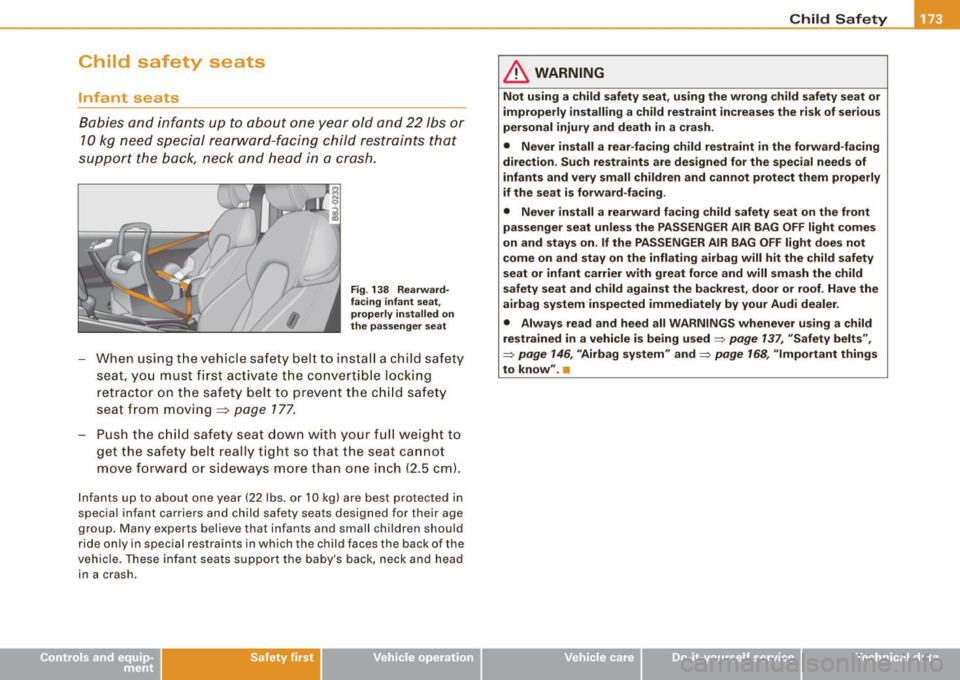
Fig. 138 Rearward
facing infant seat,
properly installed on
the passenger seat
- When using the vehicle safety belt to install a child safety
seat, you must first activate the convertible locking
retractor on the safety belt to prevent the child safety
seat from moving ::::,
page 177.
-Push the child safety seat down with your full weight to
get the safety belt really tight so that the seat cannot
move forward or sideways more than one inch (2.5 cm).
Infants up to about one year (22 lbs. or 10 kg) are best protected in
special infant carriers and child safety seats designed for their age
group. Many experts believe that infants and small children should
ride only in special restraints in which the child faces the back of the
vehicle. These infant seats support the baby's back, neck and head
in a crash.
Safety first
Child Safety
& WARNING
Not using a child safety seat, using the wrong child safety seat or
improperly installing a child restraint increases the risk of serious
personal injury and death in a crash .
• Never install a rear-facing child restraint in the forward-facing
direction. Such restraints are designed for the special needs of
infants and very small children and cannot protect them properly
if the seat is forward-facing.
• Never install a rearward facing child safety seat on the front
passenger seat unless the PASSENGER AIR BAG OFF light comes
on and stays on. If the PASSENGER AIR BAG OFF light does not
come on and stay on the inflating airbag will hit the child safety
seat or infant carrier with great force and will smash the child
safety seat and child against the backrest, door or roof. Have the
airbag system inspected immediately by your Audi dealer.
• Always read and heed all WARNINGS whenever using a child
restrained in a vehicle is being used~
page 137, "Safety belts",
::::, page 146, "Airbag system" and::::, page 168, "Important things
to know". •
Vehicle care I I irechnical data
Page 176 of 316
___ C_h _i_ld _ S_a_ f_e _t .:..y ____________________________________________ _
Convertible child safety seats
Properly used convertible child safety seats can help
protect toddlers and children over age one who weigh between 20 and 40 lbs. (10 and 20 kg) in a crash.
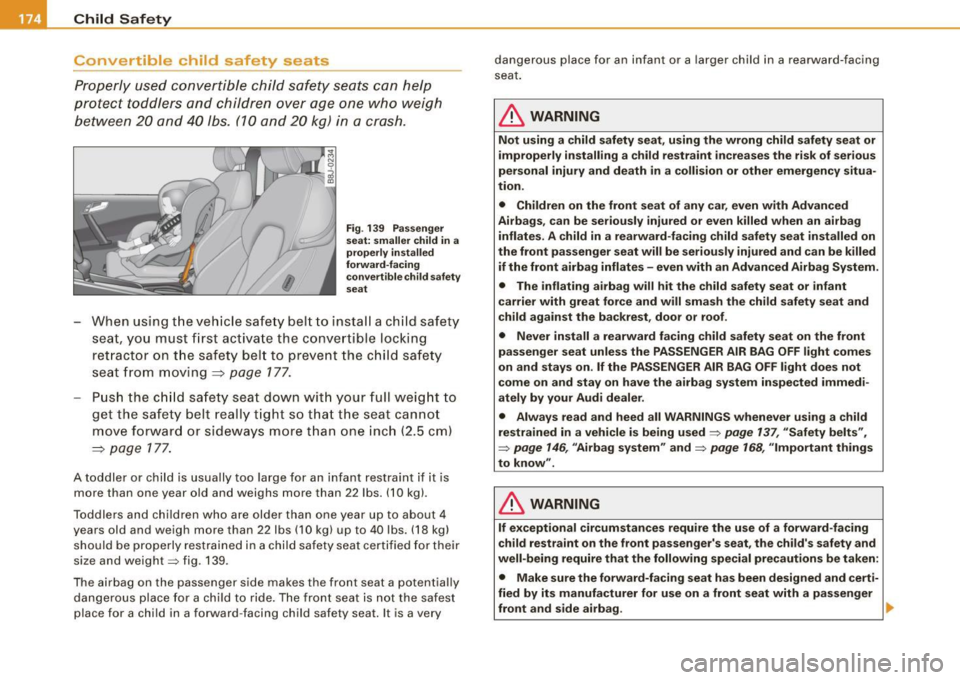
Fig. 139 Passenger
seat: smaller child in a
properly installed
forward-facing
convertible child safety
seat
When us ing the vehicle safety belt to install a child safety
seat, you must first activate the convert ible locking
retractor on the safety belt to prevent the child safety
seat from moving ~
page 177.
Push the child safety seat down with your full weight to
get the safety belt really tight so that the seat cannot move forward or sideways more than one inch (2.5 cm)
~ page 177.
A toddler or child is usually too large for an infant restraint if it is
more than one year old and weighs more than 22 lbs. (1 0 kg).
Toddlers and children who are older than one year up to about 4
years old and weigh more than 22 lbs (10 kg) up to 40 lbs. (18 kg) should be properly restrained in a child safety seat certified for their
size and weight=> fig. 139 .
The airbag on the passenger side makes the front seat a potentially dangerous place for a child to ride. The front seat is not the safest place for a child in a forward -facing child safety seat. It is a very dangerous place for an infant or a
larger child in a rearward-facing
seat.
& WARNING
Not using a child safety seat, using the wrong child safety seat or
improperly installing a child restraint increases the risk of serious
personal injury and death in a collision or other emergency situa
tion.
• Children on the front seat of any car, even with Advanced
Airbags, can be seriously injured or even killed when an airbag
inflates. A child in a rearward-facing child safety seat installed on
the front passenger seat will be seriously injured and can be killed
if the front airbag inflates -even with an Advanced Airbag System.
• The inflating airbag will hit the child safety seat or infant
carrier with great force and will smash the child safety seat and
child against the backrest, door or roof.
• Never install a rearward facing child safety seat on the front
passenger seat unless the PASSENGER AIR BAG OFF light comes
on and stays on. If the PASSENGER AIR BAG OFF light does not
come on and stay on have the airbag system inspected immedi
ately by your Audi dealer.
• Always read and heed all WARNINGS whenever using a child
restrained in a vehicle is being used=>
page 137, "Safety belts",
=>
page 146, "Airbag system" and=> page 168, "Important things
to know".
& WARNING
If exceptional circumstances require the use of a forward-facing
child restraint on the front passenger's seat, the child's safety and
well-being require that the following special precautions be taken:
• Make sure the forward-facing seat has been designed and certi
fied by its manufacturer for use on a front seat with a passenger
front and side airbag . .,
Page 179 of 316
& WARNING !continued)
• If the PASSENGER AIR BAG OFF light does not come on and stay
on whenever the ignition is switched on the inflating airbag will
hit the child safety seat or infant carrier with great force and will
smash the child safety seat and child against the backrest, door or
roof. Have the airbag system inspected immediately by your Audi
dealer.
• Always read and heed all WARNINGS whenever using a child
restrained in a vehicle is being used=>
page 137, "Safety belts",
=>
page 146, "Airbag system" and=> page 168, "Important things
to know". •
Safety belts and older children
Properly worn three point lap and shoulder belt can help
protect children weighing more than 80 lbs. (36 kg) and
who are at least 4 ft. 9 in. tall.
I
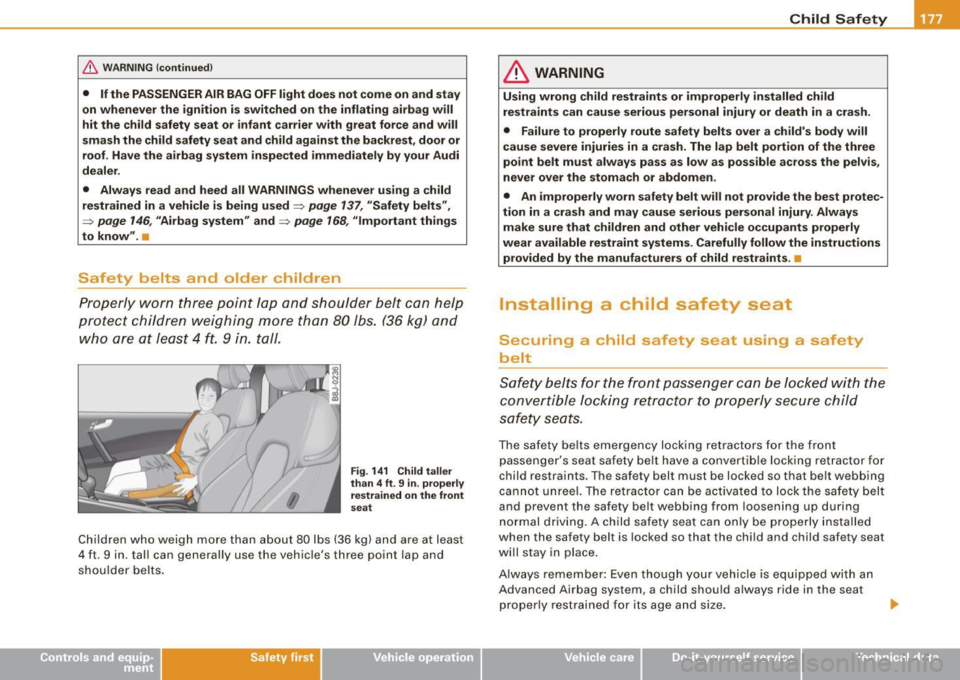
Fig. 141 Child taller
than 4 ft. 9 in. properly
restrained on the front
seat
Children who weigh more than about 80 lbs (36 kg) and are at least
4 ft . 9 in . tall can generally use the vehicle's three point lap and
shoulder belts.
Safety first
Child Safety
& WARNING
Using wrong child restraints or improperly installed child
restraints can cause serious personal injury or death in a crash.
• Failure to properly route safety belts over a child's body will
cause severe injuries in a crash. The lap belt portion of the three
point belt must always pass as low as possible across the pelvis,
never over the stomach or abdomen.
• An improperly worn safety belt will not provide the best protec
tion in a crash and may cause serious personal injury. Always
make sure that children and other vehicle occupants properly
wear available restraint systems. Carefully follow the instructions provided by the manufacturers of child restraints. •
Installing a child safety seat
Securing a child safety seat using a safety
belt
Safety belts for the front passenger can be locked with the
convertible locking retractor to properly secure child
safety seats.
The safety belts emergency locking retractors for the front
passenger's seat safety belt have a convertible locking retractor for
child restraints. The safety belt must be locked so that belt webbing
cannot unreel. The retractor can be activated to lock the safety belt
and prevent the safety belt webbing from loosening up during
normal driving. A child safety seat can only be properly installed
when the safety belt is locked so that the child and child safety seat
will stay in place.
Always remember: Even though your vehicle is equipped with an
Advanced Airbag system, a child should always ride in the seat properly restrained for its age and size. .,_
Vehicle care
I I irechnical data
Page 180 of 316
___ C_ h_ il_d _S_ a_f _e _ty ~----------------------------------------------
& WARNING
Improperly installed child safety seats increase the risk of serious
personal injury and death in a collision.
• Always make sure that the safety belt retractor is locked when
installing a child safety seat. An unlocked safety belt retractor
cannot hold the child safety seat in place during normal driving or
in a crash.
• Always buckle the child safety seat firmly in place even if a
child is not sitting in it. A loose child safety seat can fly around
during a sudden stop or in a collision
• The inflating airbag will hit the child safety seat or infant
carrier with great force and will smash the child safety seat and
child against the backrest, door or roof.
• Forward-facing child safety seats or infant carriers installed on
the front passenger's seat may interfere with the deployment of
the airbag and cause serious injury to the child .
• Always read and heed all WARNINGS whenever using a child
restrained in a vehicle is being used=>
page 168. Special precau
tions apply when installing a child safety seat on the front passenger seat=>
page 147, "Child restraints on the front seat -
some important things to know" .
& WARNING
Always take special precautions if you must install a forward or
rearward-facing child restraint on the front passenger's seat in
exceptional situations :
• Whenever a forward or rearward-facing child restraint is
installed on the front passenger seat , the PASSENGER AIR BAG
OFF light must come on and stay on whenever the ignition is
switched on.
• If the PASSENGER AIR BAG OFF light does not come on and stay
on , perform the checks described=>
page 157, ''Monitoring the
Advanced Airbag System".
& WARNING (continued)
• If the PASSENGER AIR BAG OFF light does not come on and stay
on whenever the ignition is switched on the inflating airbag will
hit the child safety seat or infant carrier with great force and will
smash the child safety seat and child against the backrest , door or
roof . Have the airbag system inspected immediately by your Audi
dealer.
• Improper installation of child restraints can reduce their effec
tiveness or even prevent them from providing any protection .
• An improperly installed child restraint can interfere with the
airbag as it deploys and seriously injure or even kill the child.
• Always carefully follow the manufacturer's instructions
provided with the child safety seat or carrier .
• Never place additional items on the seat that can increase the
total weight registered by the weight -sensing mat and can cause
injury in a crash .
in. WARNING
Forward-facing child restraints:
• Always make sure the forward-facing seat has been designed
and certified by its manufacturer for use on a front seat with a
passenger front and side airbag .
• Never put the forward-facing child restraint up , against or very
near the instrument panel.
• Always move the passenger seat into its rearmost position in
the seat's fore and aft adjustment range, as far away from the
airbag as possible before installing the forward -facing child
restraint. The backrest must be adjusted to an upright position.
• Make sure that the PASSENGER AIR BAG OFF light comes on
and stays on all the time whenever the ignition is switched on.
~
Page 181 of 316

_______________________________________________ C_h _ i_ld _ S_ a_ f_ e_ t..,:c y __ __
& WARNING
Rearward-facing child restraints:
• A child in a rearward-facing child safety seat installed on the
front passenger seat will be seriously injured and can be killed if
the front airbag inflates -even with an Advanced Airbag System.
• The inflating airbag will hit the child safety seat or infant
carrier with great force and will smash the child safety seat and
child against the backrest, door or roof.
• Always be especially careful if you must install a rearward
facing child safety seat on the front passenger seat in exceptional
circumstances.
• Make sure that the PASSENGER AIR BAG OFF light comes on
and stays on all the time whenever the ignition is switched on.
• Never install a rearward facing child safety seat on the front
passenger seat unless the PASSENGER AIR BAG OFF light comes
on and stays on. If the PASSENGER AIR BAG OFF light does not
come on and stay on have the airbag system inspected immedi
ately by your Audi dealer. •
Activating the convertible locking retractor
Use the convertible locking retractor to secure a child
restraint.
Always heed the child safety seat manufacturer's instruc
tions when installing a child restraint in your vehicle . To
activate the convertible locking retractor:
- Place the child restraint on a seat .
- Slowly pull the belt
all the way out.
- Route it around or through the child restraint belt path
~& -
Controls and equip
ment Safety first
Vehicle operation
-Push the child safety seat down with your full weight to
get the safety belt really tight.
- Insert the belt tongue into the buckle for that seating
position .
- Guide the safety belt back into the retractor unt il the belt
lies flat and snug on the child safety seat.
- You should hear a "clicking" noise as the belt winds back
into the inertia reel. Test the convertible locking retractor
by pul ling on the belt. You should no longer be able to
pull the belt out of the retractor. The convertible locking
retractor is now activated .
- Make sure that the red release button is facing away from
the child restraint so that it can be unbuckled quickly.
- Pull on the belt to make sure the safety belt is properly
tight and fastened so that the seat cannot move forward
or sideways more than one inch (2.5 cm).
& WARNING
Using the wrong child restraint or an improperly installed child
restraint can cause serious personal injury or death in a crash.
• Always make sure that the safety belt retractor is locked when
installing a child safety seat. An unlocked safety belt retractor
cannot hold the child safety seat in place during normal driving or
in a crash.
• Always buckle the child safety seat firmly in place even if a
child is not sitting in it. A loose child safety seat can fly around
during a sudden stop or in a crash.
• Always make sure the seat backrest to which the child restraint
is installed is in an upright position. Otherwise, the seat back with
the child safety seat attached to it could fly forward in the event of
an accident or other emergency situation. ..,
Vehicle care Do-it-yourself service Technical data
Page 203 of 316
_____________________________________________ C_ l_ e _a_ n_ in_ g_a _ n_d_ p_ r_ o_ t _e_ c_t _io _ n __ _
•
High temperatures, as from exposure to intense sunlight, intens ify
the corrosive effect particularly when humidity is high as well.
Under ce rtain circumstances ,
weekly washing may be necessary .
Under other conditions, a monthly washing and waxing may be
adequate.
After the winter, the
underside of the vehicle should be thoroughly
washed preferably in a professional car wash .
& WARNING
Always read and heed all WARNINGS and the information
=>
page 200 . •
Automatic car wash
The vehicle can be washed in almost any modern auto
matic car wash.
The vehicle paint is so durable that the vehicle can normally be
washed without problems in an automatic car wash . However , the
effect on the paint depends to a large extent on the design of the
facility, the filtering of the wash water, the type of wash and care
material, etc. If the paint has a dull appearance after going through
the car wash or is scratched, bring this to the attention of the oper
ator immediately . If necessary, use a different car wash .
The power top does not require specia l precautions before passing
through a car wash.
However, the car must not be treated with hot
wax after the wash cycle!
The wax could adversely affect the power
top and even damage the fabric over a period of time.
The power top do es not have to be washed every time you use a car
wash . The power top can be spared if the car wash facility is
equipped with manually adjustable roof brushes or rollers.
Before going through a car wash, be sure to take the usua l precau
tions such as closing the windows. Remove antenna if applicable . If
you have installed additional accessories on the vehicle -such as
spoilers, etc. -it is best to ask the car wash operator if these should
be removed.
& WARNING
Always read and heed all WARNINGS and the information
=> page 200. •
Washing the vehicle by hand
A lot of water is needed when washing a vehicle by hand.
-Before you start washing, make sure you have read and
understood the WARNINGS ::}
& in "General informa
tion" on
page 200.
-First soak all dried dirt until it is soft, then rinse it off.
- As you clean your vehicle, start with the roof and work
your way down to the bottom, using a sponge, a sponge
glove or a clean brush.
- Rinse the sponge or the sponge glove often, flushing it
clean each time.
- Use special car shampoo only for very persistent dirt .
- Rinse the car thoroughly with water.
- Use a chamois leather to gently wipe the exterior dry.
Use a separate sponge for cleaning the wheels, door si lls and other
regions exposed to road dirt. In this way, you will not scratch the
paint with coarse particles imbedded in the sponge the next time
you wash the car . .,,
Vehicle care I t •
Page 225 of 316

Checkin g and fillin g -
--------------~-
•
At the time of printing, engine oils available in the U.S . and Canada
t hat meet the exacting specifications of Audi oil standard VW 502 00
are synthetic engine oils . This does not mean, however, that every
synthetic engine oil will meet Audi oil standard VW 502 00. So
always be sure that you use an approved oil.
To help prevent the formation of harmful deposits use only oil with
the follow ing spec ifica tions pr inted on the oil container:
Au di oi l stan dar d VW 502 00
Oil container labels may carry the specification singly or in combi
nation with other designations and o il quality standards.
V isc osit y
Engine oils are graded according to their viscosity . The proper
viscosity grade oi l for your engine depends on climactic or seasona l
conditions where you drive . You can use oil with a v iscosity grade of
SAE 5W40 across all temperature ranges for normal driving condi
tions.
However, if eng ine oil viscosity grade SAE 5W40 is not available, you
can a lso use viscosity grade SAE 5W-30 or SAE 0W-40 as long as it
meets Audi oil qua lity standard VW 502 00 specifications .
Because engine oil that meets the Audi oil standard may not be
available everywhere when you need it, we s trong ly recommend
that you a lways carry with you an extra quart ( liter) of oil that
expressly conforms to the VW 502 00 specification, in case you have
to top off the o il while on the road.
On ly if the level of the oil is at or below the minimum mark on the
oi l dipstick -and no oil that express ly conforms to Audi oi l standa rd
VW 502 00 specifications is available -may you top off with a high
qual ity engine oi l, preferably synthetic -based, t hat meets ACEA A3,
ACEA A5 or ACEA 85, API SL or ILSAC GF -3 specifications, but even
then, only in viscosity grades SAE 5W -40, SAE 5W -30, or SAE 0W -40.
However, dur ing the entire time between oi l change intervals, never
top off w ith more than a total of 0.5 qt/liter engine oil that does not
confo rm to Audi oil specificat ion VW 502 00. For more information about engine oil that has been approved for
your vehicle, p lease con tac t ei the r your authorized Audi dea ler or
Aud i Customer Relations at 1 (800) 822-2834 or visit our web site at
www .audiusa .com or www .audicanada.ca. Here you will a lso find a
current list of oils (manufacturers, brand names etc.l that conform
to Audi oi l standard VW 502 00 .
Changing the engine oil
The engine oil and oil filter must be changed according to the
mi leage (k ilometers) and time intervals specified in your vehic le's
Maintenance
& Warranty booklet. Do not exceed these intervals -
harmfu l deposits from old engine oil can reduce engine perfor
mance and can lead to expens ive eng ine repairs.
Changing the oil at the recommended interva ls is so very important
because the lub ricating properties of oi l decrease gradua lly during
normal vehicle use. If you are not sure when you have your oil
changed, ask you r authorized Audi Service Advisor .
Under some circumstances the engine oil should even be changed
more frequently. Change oi l mo re often if you drive mostly short
distances, operate the vehicle in dusty areas o r mostly under stop
and -go traffic conditions, or when you use your vehicle where
temperatures stay below freezing point for long per iods.
Detergent additives in the oil will make fresh oi l look dark after the
engine has been running for a sho rt time. Th is is normal and is not
a reason to change the oil more often than recommended.
D amag e or malfun ctions due to la ck of mai nten ance
It is essential that you change your oi l at the recommended interva ls
using on ly engine oil that complies with Audi oil standard
VW 502 00. Your Limited New Vehicle War ranty does not cover
damage or malfunctions due to failure to fol low recommended
maintenance and use requirements as set forth in the Audi Owner's
Manual and Maintenance
& Warranty booklet . Your dealer wi ll have
to deny warranty coverage unless you present to the dealer proof in
the form of Service or Repair Orders that all scheduled maintenance
was performed in a timely manner. •
Vehicle care I t •
Page 234 of 316

-Ch
ecking and filling ---=-----=----------------
We recommend that you use maintenance -free or cyc le- resis
tant /leak -pr oof
batteries according to the standards TL 825 06 (from
December 1997) and VW 7 50 73 (from Augus t 2001 ).
Replacing the battery should be carried by a qualified workshop.
P lease follow the instructions on the battery cover.
0 Note
• All work on the battery requires technical knowledge. Please
contact an Audi dealership or another authorized facility for ques
tions about the battery- danger of acid bu rns and explosion hazard!
• The battery must not be opened! Do not try to change the
battery's liquid level, otherwise detonat ing gas wil l escape from the
battery - explosion ha zard!
• The AGM battery in the luggage compartment cannot leak,
because the electrolyte for this battery is absorbed into a special
g lass mat . This leak-proof battery must not be rep lace with a
conventiona l battery .
• Make sure the ventilation hose on the side of the battery is
connected, otherwise fumes or battery acid can leak out.
• Battery holde r and terminals always have to be secured correctly .
• Before al l wo rk on the battery follow the
warning s below :::> & in
" Working on the battery" on page
232.
~ For the sake of the environment
Because of the problem of proper d isposal of a battery, we recom
mend your authorized Audi dea ler change the battery fo r you.
Batteries contain sulfur ic acid and lead and must always be
disposed of properly in compliance with all environmental regula
t ions . Di sposing of vehicle batteries i mproper ly is very dangerous to
the environment. Make sure that the removed battery cannot over
ba lance, otherwise sulfur ic acid migh t escape!
[ i ] Tips
If your ve hic le is left standing for several weeks at extremely low
temperatures, the vehicle battery should be removed and stored
where it will no t free ze. This will preven t it from being damaged and
having to be replaced. •
Working on the battery
Be especially care ful w hen wor king o n or nea r the
battery!
Fig . 156 Luggag e
co mp artment : AGM
batte ry
The batte ry is loca ted in the lu g ga ge compartmen t.
- Sw ing up t he luggage compartmen t floo r.
Remove the cover p late b y tu rning the t humbw heel.
The positive (+) battery term ina l is protected by a pla stic cover . This
cover must be removed to access the positive( +) terminal when
connecting jumper cab les to start the engine.
Always heed the
safety w arnings , when working on the vehicle
battery or the vehicle electrical system to prevent injury.