2008 AUDI S8 airbag
[x] Cancel search: airbagPage 89 of 404

-Position the head restraint according to the occupant's
height~ page 91. For maximum protection, the top of
the head restraint should be at least at eye level, prefer
ably higher and ideally level with the top of the head
~ page 203, fig. 218.
& WARNING
Never place any objects in the driver's footwell. An object could
get into the pedal area and interfere with pedal function. In case
of sudden braking or an accident, you would not be able to brake
or accelerate. •
Front passenger's seat
Always move the front passenger seat into the rearmost
position.
To avoid contact with the airbag while it is deploying, do not
sit any closer to the instrument panel than necessary and
always wear the three-point safety belt provided adjusted
correctly. We recommend that you adjust the passenger's
seat in the following manner:
-Move the front passenger seat into the rearmost position
of the fore and aft adjustment
range~ & in "Why is
your seat adjustment so important?" on
page 86.
-Bring the backrest up to an (almost) upright position. Do
not ride with the seat reclined.
-The ideal position for the head restraint is with the upper
edge of the restraint level with the top of your head
~ page 91. You should not lower the top of the restraint
below the level of your eyes.
Contro ls a nd eq uip
ment
Seats and storage
-Place your feet on the floor in front of the passenger's
seat. •
Power seat
Controls
The operating logic for the switches corresponds to the
construction and function of the seat.
Fig. 81 Power seat:
Controls for seat
adjustment
The switches to adjust the seats correspond to the layout, the
design and the function of the seat. The seats are adjusted by
moving the switches following this logic .
@ Upper thigh support=> page 88
@ Seat adjustment=> page 88
© Massage function*=> page 89
® Seatback angle => page 89 and head restraint => page 91 adjust -
ment
© Separate adjustment of upper seatback section => page 89
0 Adjusting the lumbar support=> page 90
@ Safety belt height adjustment => page 216
Vehicle care
I I irechnical data
Page 92 of 404
Seats and storage
Adjusting the angle of the seat back
Push the switch ~ page 89, fig. 85 forward or to the rear
in the direction of the arrow to adjust the angle of the
seat back
~ & .
Adjusting the angle of upper seatback section
-Push the switch ~ page 89, fig. 86 forward or to the rear
to adjust the angle of upper seatback
section ~& .
& WARNING
• Never adjust the seatback while the vehicle is moving. If you
adjust your seat while the vehicle is moving, you are out of posi
tion. Never adjust the seatback when the vehicle is moving.
• To reduce the risk of injury in the case of sudden braking or
accident, front passengers must never ride in a moving vehicle
with the seatback reclined. Safety belts and the airbag system only offer maximum protection when the seatback is upright and
the safety belts are properly positioned on the body. The more the seatback is reclined, the greater the risk of personal injury from an
incorrect seating position and improperly positioned safety
belts. •
Lumbar support
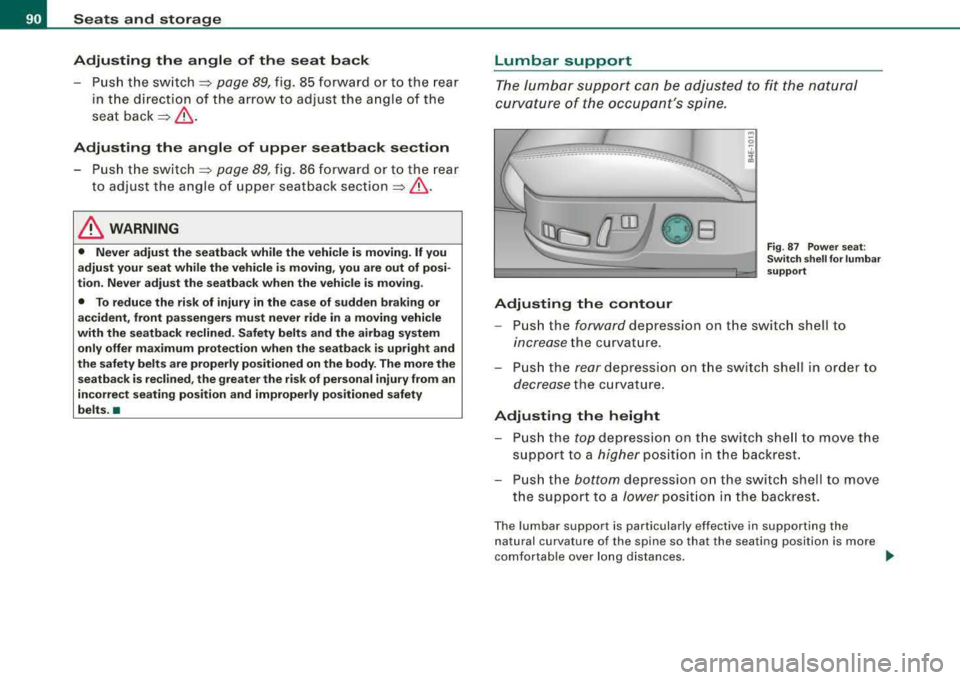
The lumbar support can be adjusted to fit the natural
curvature of the occupant's spine.
__ ... _,.· _____ ---....... ·--_----... -··--
OB
Adjusting the contour
Fig . 87 Power seat:
Switch shell for lumbar
support
-Push the forward depression on the switch shell to
increase the curvature .
-Push the rear depression on the switch shell in order to
decrease the curvature.
Adjusting the height
-Push the top depression on the switch shell to move the
support to a
higher position in the backrest.
-Push the bottom depression on the switch shell to move
the support to a
lower position in the backrest.
The lumbar support is particularly effective in supporting the
natural curvature of the spine so that the seating position is more
comfortable over long distances.
~
Page 111 of 404
![AUDI S8 2008 Owners Manual ________________________________________________ S_ e_ a_t _
s _a_ n_d _ s_t _o _ r_ a_ g~ e __ fflll
0 Note
To avoid damaging the socket, only use plugs that fit properly.
[ i] Tips
Wh](/manual-img/6/57619/w960_57619-110.png "AUDI S8 2008 Owners Manual ________________________________________________ S_ e_ a_t _
s _a_ n_d _ s_t _o _ r_ a_ g~ e __ fflll
0 Note
To avoid damaging the socket, only use plugs that fit properly.
[ i] Tips
Wh")
________________________________________________ S_ e_ a_t _
s _a_ n_d _ s_t _o _ r_ a_ g~ e __ fflll
0 Note
To avoid damaging the socket, only use plugs that fit properly.
[ i] Tips
When the engine is off and accessories are still plugged in and are
on, the vehicle battery can still be drained. •
Storage
General overview
There are numerous places to store items in your vehicle.
Glove compartment
Storage compartment
Pockets in the front seats*
Compartments in the door trim panels
Compartments in the rear doors*
Coat hooks => page 109
=> page 110
=> page 110
=> page 111
=> page 111
Left side storage compartment in the => page 112
trunk
--Right side storage compartment in the => page 113
trunk
Emergency warning triangle
=> page 348
& WARNING
• Always remove objects from the instrument panel. Any items
not stored could slide around inside the vehicle while driving or
Controls and equip ment
&, WARNING (continued)
when accelerating or when applying the brakes or when driving
around a corner.
• When you are driving make sure that anything you may have
placed in the center console or other storage locations cannot fall
out into the footwells. In case of sudden braking you would not be
able to brake or accelerate.
• Any articles of clothing that you have hung up must not inter
fere with the driver's view. The coat hooks are designed only for
lightweight clothing . Never hang any clothing with hard, pointed
or heavy objects in the pockets on the coat hooks. During sudden
braking or in an accident -especially if the airbag is deployed -
these objects could injure any passengers inside the vehicle. •
Glove compartment
Your Owner's Literature and the media player are stored
in the lockable glove compartment.
t------.-,.---------. l
i
Fig. 117 Glove
compartment
Page 113 of 404

Seats and storage -______________ ___,;.____.
Compartments in the door trim panels
Fig. 121 Storage
compartment in the
door panel
-To store items, tilt the compartment open => fig. 121.
& WARNING
Read and follow all WARNINGS => page 238, "Important safety
instructions on the side airbag system" .•
Appl ies to vehicles: with compartments in the rea r doors
Storage compartments in the rear doors
Contro ls a nd eq uip
ment
Fig . 122 Open storage
compartment Fig. 123 Inserting
storage compartment
The storage compartment is suitable for holding small
objects, such as eye glasses.
Opening
-To open, touch the compartment at the front edge
=> fig. 122.
Removing and inserting storage compartment
-Open the storage compartment.
-Grasp the sides of the storage compartment with both
hands and pull it straight out toward you.
-To insert the storage compartment again, hold it at a
slight angle and push the lower part into the retainer
until it
latches => fig. 123.
-Close the storage compartment. •
Vehicle care I I irechnical data
Page 114 of 404

-
Seats and storage
----=---------------
Coat hooks
Fig. 124 Coat hook
above left rear seat
There are fold -out coat hooks over each rear door.
-To open, touch the top of the coat hook=> fig. 124.
& WARNING
• Hang clothes in such a way that they do not impair the driver's
v1s1on.
• The coat hooks must only be used for lightweight clothing. Do
not leave any heavy or sharp edged objects in the pockets which
may interfere with the side curtain airbag deployment and can
cause personal injury in a crash.
• Do not use coat hangers for hanging clothing on the coat hooks
as this can interfere with proper deployment of the SIDEGUARD
head-protection airbags in an accident.
• Do not hang heavy objects on the coat hooks, as they could
cause personal injury
in a sudden stop. •
Left-sid e compartment
Fig. 125 Luggage
compartment, left side
Fig . 126 Luggage
compartment, left side
The DVD player for the nav igation system is in the left-side
storage compartment .
- To open the side storage compartment, turn the two pins
© to the vertical position.•
Page 130 of 404

___ O_ n_t_ h_ e_ ro_ a_d __________________________________________________ _
On the road
Steering
Adjusting steering wheel position
The steering wheel position can be adjusted for height
and reach .
First, adjust t he driver's seat correctly.
Height adjustment
Fig . 14 3 Sw itch fo r
s te erin g whe el a dju st
me nt
-P u sh the sw itch @ up or down :=> fig. 143 . The steering
wheel height changes fo r as l ong as you press the sw itch.
Rea ch adjustment
Push the switch @forward o r bac kward => fig. 143 . The
steering wheel reach changes for as long as you press
the switch.
There must be at least 10 inches (25 cm) between your chest and the
center of the steer ing wheel. If you cannot sit more than 10 inches
(25 cm) from the steering wheel, see if adaptive equipment is avail- able to help you reach the pedals and increase the distance from the
steering wheel.
For detailed in formation on how to adjust the driver's seat, see
=> page 87 .
The steering wheel can be adjusted even when the ig nition is turned
Of f. For vehicles w ith seat memory, the individual positions for the
steering wheel can be stored a long with the seat position.
& WARNING
Improper u se of steering wheel adju stment and improper seating
po sition can cause se rious per sonal inju ry .
• Adjust the steering wheel column only when the vehicle is not
mo ving to prevent los s of vehi cle control.
• Adjust the driver' s seat or steering wheel so that there is a
minimum of 10 in ches (25 cm ) bet ween your chest and the
s teering wheel
=> pag e 200 , fig. 216 . If you cannot maintain this
minimum di sta nce , the ai rbag sy stem can not prote ct you prop
erly .
• If physical limitations prevent you from s itting 10 inche s (25
cm ) or more from the steering wheel , check with your authori zed
Audi dealer to see if adapti ve equipment i s available .
• If the steering whee l is aligned with your face, the supple
mental drive r's airbag cannot provide as mu ch pr otection
in an
ac cident. Alway s make sure that the steerin g wheel i s aligned with
your che st .
• Alway s hold the steering wheel with your hand s at the 9 o'clock
and 3 o'clo ck posit ion s to reduce the ri sk of pers ona l injury if the
driv er's airbag deploys.
• Never hold the ste ering wheel at th e 12 o' clo ck position or with
your hand s inside the steerin g wheel rim or on the steering wheel
hub . Holding the steering wheel the wrong wa y can cau se ser ious ..,,
Page 200 of 404

___ D_ r
_ i_v _i_n ..;::g :;_ S_ a_ f_ e_, ly'----------------------------------------------------
Driving Safely
General notes
Safe driving habits
Please remember -safety first!
This chapter conta ins important informat ion, tips, instructions and
warnings that you need to read and observe for your own safety, the safety of your passenge rs and othe rs. We have summarized here
what you need to know about safety be lts, airbags, child restraints
as wel l as chi ld safety . Y o ur safety is for us
priority number 1 . Always
observe the information and warnings in this section
-for your own
safety as we ll as that of your passengers .
The information in this sect ion appl ies to al l model vers ions of your
vehic le. Some of the features described in this sections may be
standard equ ipmen t on some mode ls, or may be op tiona l equip
ment on others. If you are not sure, ask your authorized Audi dealer .
& WARNING
• Always mak e sure that you follo w the instru ctions and heed
the WARNINGS in this Manual. It is in your interest and in the interest of your passengers .
• Alway s keep the complete Owner' s Liter ature in your Audi
when you lend or sell your vehi cle so that th is important informa
tion will always be available to the driver and pas seng ers.
• Always keep the Owner's literature handy so that you can find
it e asily if you have question s. •
Safety equipment
The s afe ty featur es are par t of the occu pant restraint
system an d wor k together t o help red uce the risk of injury
in a wide variety of accident situati ons.
Your safety and the safety of your passengers should not be left to
chance . Advances in technology have made a variety of features
avai lable to help reduce the risk of injury in an accident. The
fo llo w ing is a l ist of just a few of the sa fe ty feat ures in your A udi :
• sophisticated safety belts for driver and a ll passenger seating
posit ions,
• safety be lt pretensioners,
• safety be lt force l imiters for the fr ont seats,
• safety be lt height adjustment systems for the front seats,
• front airbags,
• knee airbags for the front seats
• side airbags in the front seats and outer rear seats,
• side curtain a irbags (SIDEGUARD),
• special LATCH anchorages for chi ld restra ints,
• head restraints for each seating position,
• adjus table steer ing colum n.
T hese individua l safety features, can work together as a system to
help protect you and you r passengers in a wide ra nge of acc idents .
T hese features cannot work as a system if they are not always
correctly adjusted and correct ly used .
Safety i s everybody' s responsibility! •
Page 202 of 404

___ D_ ri_v _i_n ..;::g:c..- S_ a_ f
_ e____, IY,__ ________________________________________________ _
Proper occupant seating positions
Proper seating position for the driver
The proper driver seating position is important for safe ,
relaxed driving.
I.I> N
;
Fig. 216 The correct
distance between
driver and steering
wheel
Fig . 217 Correct head
restraint position for
driver
For your own safety and to reduce the risk of injury in the
event of an acc ident , we recommend that you adjust the
driver's seat to the following position:
- Adjust the driver's seat so that you can easily push the
pedals all the way to the floor while keeping your knee(s)
slightly
bent =:>& .
- Adjust the angle of the seatback so that it is in an upright
position so that your back comes in full contact with it
when you drive.
- Adjust the steering wheel so that there is a distance of at
least 10 inches (25 cm) between the steering wheel and
your breast
bone =:> fig. 216. If not possible, see your
authorized Audi dealership about adaptive equipment.
- Adjust the steering wheel so that the steering wheel and
airbag cover points at your chest and not at your face.
- Grasp the top of the steering wheel with your elbow(s)
slightly bent.
- Adjust the head restraint so that the upper edge is as even with the top of your head as poss ible but no lower
than eye level and so that it is as close to the back of your
head as
poss ible =:> fig. 217 .
- Fasten and wear safety belts
correctly =:> page 213.
- Always keep both feet in the footwell so that you are in
control of the vehicle at all times.
For detailed information on how to adjust the driver's seat, see
=> page 87 .
& WARNING
Drivers who are unbelted, out of position or too close to the airbag
can be seriously injured by an airbag as it unfolds. To help reduce
the risk of serious personal injury:
• Always adjust the driver's seat and the steering wheel so that
there are at least 10 inches
125 cm) between your breastbone and
the steering wheel. .,