2008 AUDI S8 airbag
[x] Cancel search: airbagPage 203 of 404

& WARNING (continued)
• Always adjust the driver's seat and the steering wheel so that
there are at least 4 inches (10 cm) between the knees and the
lower part of the instrument panel .
• Always hold the steering wheel on the outside of the steering
wheel rim with your hands at the 9 o'clock and 3 o'clock positions
to help reduce the risk of personal injury if the driver's airbag inflates .
• Never hold the steering wheel at the 12 o'clock position or with
your hands at other positions inside the steering wheel rim or on
the steering wheel hub. Holding the steering wheel the wrong way
can cause serious injuries to the hands, arms and head if the
driver's airbag inflates
• Pointing the steering wheel toward your face decreases the
ability of the supplemental driver's airbag to protect you in a colli
sion .
• Always sit in an upright position and never lean against or
place any part of your body too close to the area where the airbags
are located.
• Before driving, always adjust the front seats and head
restraints properly and make sure that all passengers are properly
restrained .
• Never adjust the seats while the vehicle is moving. Your seat
may move unexpectedly and you could lose control of the vehicle.
• Never drive with the backrest reclined or tilted far back! The
farther the backrests are tilted back, the greater the risk of injury due to incorrect positioning of the safety belt and improper
seating position.
• Children must always ride in child seats
=> page 243. Special
precautions apply when installing a child seat on the front
passenger seat
=> page 218 . •
Controls and equip
ment Safety first
Vehicle operation
Driving Safely
Proper seating position for the front
passenger
The proper front passenger seating position is important
for safe, relaxed driving.
For your own safety and to reduce the risk of injury in the
event of an accident, we recommend that you adjust the
seat for the front passenger to the follow ing position:
- Move the front passenger seat back as far as possible.
There must be a minimum of 10 inches (25 cm) between
the breastbone and the instrument
panel=> &.
-Adjust the angle of the seatback so that it is in an upright
position and your back comes in full contact with it
whenever the vehicle is moving.
- Adjust the head restraint so that the upper edge is as
even with the top of your head as possible but not lower
than eye level and so that it is as close to the back of your
head as
possible => page 203.
-Keep both feet flat on the floor in front of the front
passenger seat.
- Fasten and wear safety belts
correctly =:> page 213.
For detailed information on how to adjust the front passenger's
seat, see
=> page 86 .
& WARNING
Front seat passengers who are unbelted, out of position or too
close to the airbag can be seriously injured or killed by the airbag
as it unfolds. To help reduce the risk of serious personal injury : ..,_
Vehicle care Do-it-yourself service Technical data
Page 204 of 404

___ D_ r
_ i_v _i_n ..;::g :;_ S_ a_ f_ e_, ly'----------------------------------------------------
&, WARNING (continued)
• Passengers must always sit in an upright position and never
lean against or place any part of their body too close to the area
where the airbags are located.
• Passengers who are unbelted, out of position or too close to the
airbag can be seriously injured by an airbag as it unfolds with
great force in the blink of an eye.
• Always make sure that there are at least 10 inches
125 cm)
between the front passenger's breastbone and the instrument
panel.
• Always make sure that there are at least 4 inches 110 cm)
between the front passenger's knees and the lower part of the
instrument panel.
• Each passenger must always sit on a seat of their own and
properly fasten and wear the safety belt belonging to that seat.
• Before driving, always adjust the front passenger seat and
head restraint properly.
• Always keep your feet on the floor in front of the seat. Never
rest them on the seat, instrument panel, out of the window, etc.
The airbag system and safety belt will not be able to protect you properly and can even increase the risk of injury in a crash.
• Never drive with the backrest reclined or tilted far back! The
farther the backrests are tilted back, the greater the risk of injury
due to incorrect positioning of the safety belt and improper
seating position.
• Children must always ride in child seats
=> page 243. Special
precautions apply when installing a child seat on the front
passenger
seat => page 218. •
Proper seating positions for passengers in
rear seats
Rear seat passengers must sit upright with both feet on
the floor consistent with their physical size and be prop
erly restrained whenever the vehicle is in use.
To reduce the risk of injury caused by an incorrect seating
position in the event of a sudden braking maneuver or an
accident, your passengers on the rear bench seat must
always observe the following :
- Adjust the head restraint so that the upper edge is as
even with the top of your head as possible but no lower
than eye level
=> page 203.
- Keep both feet flat in the footwell in front of the rear seat .
- Fasten and wear safety belts
properly => page 213.
-Make sure that children are always properly restrained in
a child restraint that is appropriate for their size and age
=> page 243.
& WARNING
Passengers who are improperly seated on the rear seat can be
seriously injured in a crash.
• Each passenger must always sit on a seat of their own and
properly fasten and wear the safety belt belonging to that seat.
• Safety belts only offer maximum protection when the safety
belts are properly positioned on the body and securely latched. By
not sitting upright, a rear seat passenger increases the risk of
personal injury from improperly positioned safety belts!
• Always adjust the head restraint properly so that it can give
maximum protection. •
Page 205 of 404
Driving Safely fflll
---------------------------------------------:::....---=--
Proper adjustment of head restraints
Correctly adjusted head restraints are an important part
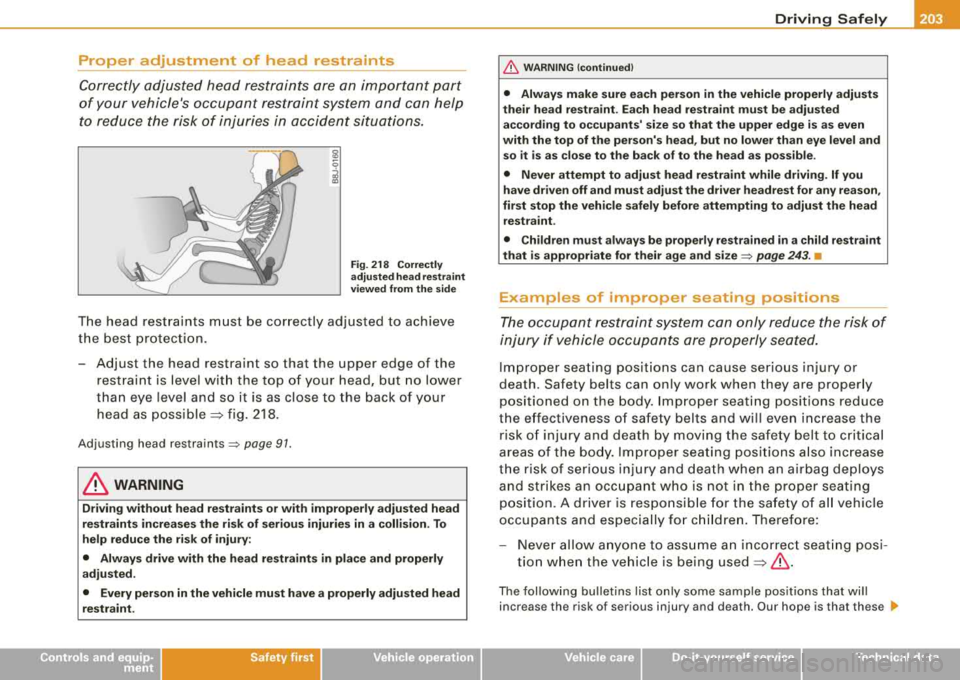
of your vehicle's occupant restraint system and can help to reduce the risk of injuries in accident situations.
Fig . 218 Correctly
adjusted head restraint
viewed from the side
The head restraints must be correctly adjusted to achieve
the best protection.
- Adjust the head restraint so that the upper edge of the
restraint is level with the top of your head, but no lower
than eye level and so it is as close to the back of your
head as
possible ~ fig. 218.
Adjusting head restraints=> page 91.
& WARNING
Driving without head restraints or with improperly adjusted head
restraints increases the risk of serious injuries in a collision. To
help reduce the risk of injury:
• Always drive with the head restraints in place and properly
adjusted.
• Every person in the vehicle must have a properly adjusted head
restraint.
Controls and equip ment Safety first Vehicle operation
&, WARNING
(continued)
• Always make sure each person in the vehicle properly adjusts
their head restraint. Each head restraint must be adjusted according to occupants' size so that the upper edge is as even
with the top of the person's head, but no lower than eye level and
so it is as close to the back of to the head as possible .
• Never attempt to adjust head restraint while driving. If you
have driven off and must adjust the driver headrest for any reason,
first stop the vehicle safely before attempting to adjust the head
restraint.
• Children must always be properly restrained in a child restraint
that is appropriate for their age and size
=> page 243. •
Examples of improper seating positions
The occupant restraint system can only reduce the risk of
injury if vehicle occupants are properly seated.
Improper seating positions can cause serious injury or
death . Safety belts can only work when they are properly
positioned on the body. Improper seating positions reduce
the effectiveness of safety belts and will even increase the
risk of injury and death by moving the safety belt to critical
areas of the body. Improper seating positions also increase
the risk of serious injury and death when an airbag deploys
and strikes an occupant who is not in the proper seating
position. A driver is responsible for the safety of all vehicle
occupants and especially for children. Therefore:
- Never allow anyone to assume an incorrect seating posi
tion when the vehicle is being
used ~& .
The following bulletins list only some sample positions that will
increase the risk of serious injury and death. Our hope is that these
.,_
Vehicle care Do-it-yourself service Technical data
Page 206 of 404

___ D_ r
_ i_v _i_n ..;::g :;_ S_ a_ f_ e_, ly'----------------------------------------------------
examp les w ill ma ke you mo re aware of seat ing positions tha t ar e
d an ge ro us.
Therefore, whenever the vehicle is moving:
• ne ver sta nd up in the v ehi cle
• never stand on t he seats
• never knee l on the seats
• n ev e r r id e with th e seatback r eclin ed
• never lie down on the rear seat
• n ever lea n up aga inst t he instrument pane l
• n ever sit on the e dge of the sea t
• never sit sideways
• ne ver le an out t he w indo w
• never put your feet out the window
• never put your feet on t he instrument p anel
• n ever rest your f eet on th e seat cushi on or b ac k of the sea t
• never ride in the footwe ll
• n ever ride i n the cargo area
& WARNING
Improper seating positions increase the risk of serious personal
injury and death whenever a vehicle is being used.
• Always make sure that all vehi cle occupants stay
in a proper
seating position and are properly restrained whenever the vehicle
is being used. •
Driver and passenger side footwell
Important safety instructions
& WARNING
Always make sure that the knee airbag can inflate without inter
ference . Objects between yourself and the airbag can increase the
risk of injury in an a ccident by interfering with the way the airbag
deploys or by being pushed into you as the airbag deploys .
• No persons (children) or animals should ride in the footwell in
front of the passenger seat .
If the airbag deploys, this can result in
serious or fatal injuries .
• No objects of any kind should be carried in the footwell area in
front of the driver's or passenger 's seat . Bulky objects (shopping
bags, for example) can hamper or prevent proper deployment of
the airbag. Small objects can be thrown through the vehicle if the
airbag deploys and injure you or your passengers. •
Pedal area
Pedals
The pedals must always b e fre e to move and mus t never
b e in terf ere d with by a floor mat or a ny ot her object.
M ake sure that all pedals move free ly w ithout interfe rence and that
n oth in g p reve nts t hem fr om re tu rni ng to t heir or igin a l pos itio ns.
O nly use floor mats that leave the pedal a rea free and can be
se cu red w ith flo or mat fa st ene rs.
If a bra ke circu it fa ils, i ncr eas ed brake pedal trav el is r equ ired to
bring the veh icle to a f ull stop.
Page 213 of 404

Because the passengers of this vehicle are not using safety belts
=> page 210, fig. 220, they will keep moving at the same speed the
vehicle was moving just before the crash, un til some thing stops
them
-here, the wall ~ page 210, fig. 221.
The same principles apply to people sitting in a vehicle that is involved in a frontal collision. Even at city speeds of 20 to 30 mph
(30 to 50 km/h), the forces acting on the body can reach one ton
(2,000 lbs, or 1,000 kg) or more . A t grea ter spe eds, these forc es are
even higher.
People who do not use safety bel ts are also no t attached to their
vehicle. In a frontal collision they will also keep moving forward at
the speed their vehicle was travelling just before the crash. Of course, the laws of physics don't just apply to frontal collisions, they
determine what happens in all kinds of accidents and collisions. •
What happens to occupants not wearing
safety belts?
In crashes unbelted occupants cannot stop themselves
from flying forward and being injured or killed. Always
wear your safety belts!
Fig . 222 A driver not
wearing a safety belt is
violently thrown
forward
Safety belts
Fig . 223 A rear
passenger not wearing
a safety belt will fly
forward and strike the
driver
Unbelted occupants are no t able to resist the tremendous forces of
impact by holding tight or bracing themselves. Without the benefit
of safety restraint systems, the unrestrained occupant will slam
violently into the steering wheel, instrument panel, windshield, or
whatever else is in the
way~ fig. 222 . This impact with the vehicle
interior has all th e energy th ey had just before the crash.
Never rely on airbags alone for protection. Even when they deploy,
airbags provide only additional protection. Airbags are not
supposed to deploy in all kinds of accidents. Although your Audi is
equipped with airbags , all vehicle occupants, including the driver,
must wear safety belts correctly in order to minimize the risk of
severe injury or death in a crash .
Remember too , that airbags will deploy only once and that your
safety belts are always there to offer protection in those accidents
in which airbags are not suppos ed to deploy or wh en they have
already deployed. Unbelted occupants can also be thrown out of the
vehicle where even more severe or fatal injuries can occur .
It is also important for the rear passengers to wear safety belts
correctly . Unbelted passengers in the rear seats endanger not only
themselves but also the dr iver and other
passengers => fig. 223. In a
frontal collision they will be thrown forward violently, where they can hit and injure the driver and/or front seat passenger. •
Vehicle care I I Technical data
Page 214 of 404

lfflJ _ ___.:::S:,::a ~f ..::e :..::t Ly _ b~ e:.:.:lt ~s::._ _____________________________________________ _
Safety belts protect
People think it's possible to use the hands to brace the
body in a min or c ollision . It's simply not true!
Fig . 22 4 Driv er is
c orr ectly r est rai ned in
a su dd en braki ng
m aneuver
Safety belts used properly can make a big difference. Sa fety belts
help to keep passengers in their seats, gradually reduce energy
levels app lied to the body in an accident, and help prevent the
uncontrolled movement that can cause serious injuries. In addition,
safety be lts re duce the danger of being thrown out of the vehic le .
Safety belts attach passengers to the car and give them the benefit
of being s lowed down more gently or "softly" through the "give" in
the safety belts, crush zones and other sa fety features engineered
into today's vehicles. By "absorbing" the kinetic energy over a
longer pe riod of time, the sa fety belts make the forces on the body
more "tolerable" and less likely to cause injury .
Altho ugh these examples are based on a frontal co llision, safety
belts can a lso substantially reduce the risk of injury in other kinds
of crashes . So, whether you're on a long trip or just going to the
corner store, a lways buckle up and make sure others do, too. Acci
dent statistics show that vehicle occupants properly wearing safety
belts have a lower ris k of being injured and a much better chance of
surviving an accident. Properly using safety belts also greatly
increases the abi lity of the supplementa l airbags to do their job in a
collision . For th is reason, wearing a safety belt is legally required in
most countries including much of the United States and Canada. Although your Audi is equipped with airbags, you sti
ll have to wear
t he safety belts provided . Fron t air bags, for example, are activated
only in some frontal collisions. The front a irbags are not activated in
a ll fro ntal co llisions, in side and rear coll isions, in ro ll ove rs or in
cases where there is not enough dece leration through impact to the
front of the vehicle . The sa me goes for the other airbag systems in
you r Aud i. So, always wear your safety belt and make sure every
body in your vehic le is properly restrained! •
Important safety instructions about safety
belts
Safety belts must always be correctly posi tio ned across
t he strongest bones of your body.
- Al ways wear safety belts as illust rated and described in
th is chapte r.
-Make s ure tha t yo ur sa fety be lts ar e always ready for us e
and are not damage d.
& WARNING
Not wearing safety belts or w earing them improperl y increas es
the risk of serious per sonal injury and death . S afety belts ca n work
onl y when used corre ctl y.
• Alway s fa sten your s afety belt s correctly before driving off and
make sure all p assengers ar e correctly restrain ed.
• For ma ximum protect ion , safet y belts must always be po si
tioned properly on the body .
• Never strap more than one person , including sm all ch ildren ,
into any belt.
• Never pla ce a safety belt ove r a child sitting on your lap .
• Alway s keep feet
in the footwell in front of the seat while the
vehicle is being driven .
.,_
Page 218 of 404

___ s_a _f _e _t -=-y _ b_ e_lt _s ______________________________________________ _
Adjusting safety belt height Use the safety belt height adjustment to change belt posi
tion on the shoulder.
Fig . 229 Adjusting
shoulder belt height
The safety belt height adjustors for the front seats can be
used to adjust the height of the shoulder portion of the
safety belt so that it is positioned correctly.
- Push the
latch ~ fig. 229 up or down so that the shoulder
portion of the safety belt is positioned nearly midway
over the
shoulder ~ & in "Safety belt position" on
page 214.
& WARNING
Always read and heed all WARNINGS and other important informa
tion
~ page 212. •
Improperly worn safety belts
Incorrectly positioned safety belts can cause severe inju
ries.
Wearing safety belts improperly can cause serious injury or
death. Safety belts can only work when they are correctly positioned on the body. Improper seating
positions reduce
the effectiveness of safety belts and will even increase the
risk of injury and death by moving the safety belt to critical
areas of the body. Improper seating positions also increase
the risk of serious injury and death when an airbag deploys
and strikes an occupant who is not in the correct seating position. A driver is responsible for the safety of all vehicle
occupants and especially for children. Therefore:
- Never permit anyone to assume an incorrect sitting posi
tion in the vehicle while
traveling ~& .
& WARNING
Improperly worn safety belts increase the risk of serious personal
injury and death whenever a vehicle is being used.
• Always make sure that all vehicle occupants are correctly
restrained and stay in a correct seating position whenever the
vehicle is being used.
• Always read and heed all WARNINGS and other important infor
mation
~ page 212. •
Safety belt pretensioners
How safety belt pretensioners work
In front, side and rear-end collisions above a particular
severity, safety belts are tensioned automatically.
The safety belts are equipped with safety belt pretensioners . The
system is activated by sensors in front, side and rea r-end collisions
of great severity . This tightens the belt and takes up belt
slack ~ &
in "Service and disposal of safety belt pretensioner" on page 217.
Taking up the slack helps to reduce forward occupan t movement
during a collision.
•
Page 219 of 404
![AUDI S8 2008 Owners Manual Safety b elts -
----------------=--
[ i ] Tip s
The sa fet y belt pretens ioner can on ly be activated once.
• I n minor frontal and side col lisions, in rear -end collisions, in](/manual-img/6/57619/w960_57619-218.png "AUDI S8 2008 Owners Manual Safety b elts -
----------------=--
[ i ] Tip s
The sa fet y belt pretens ioner can on ly be activated once.
• I n minor frontal and side col lisions, in rear -end collisions, in")
Safety b elts -
----------------=--
[ i ] Tip s
The sa fet y belt pretens ioner can on ly be activated once.
• I n minor frontal and side col lisions, in rear -end collisions, in a
rollover and in accidents involving very litt le impact force, the safety
belt pretensioner are not activated .
• When the safety be lt pretensioner is activated, a fine dust is
released . This is normal and is not caused by a fire i n the vehicle.
• T he relevant safety requirements must be observed when the
vehic le or c om po n en ts of the system are scrapped . A qua lifi ed deal
ership is fami liar with these regulations and wil l be p leased to pass
on the info rmation to you .
• Be sure to observe al l safety, environmenta l and other regula
t ions if the veh ic le or indiv idual parts of the sys tem, particu larly the
safety belt or airbag, are to be disposed. We recommend you have
your au thorized A udi dea ler perform this service for you .•
Service and disposal of safety belt
pretension er
The safety belt pretens io ners are parts of the sa fety be lts on your
Audi. Installing, removing, servicing or repairing of belt preten
s ioners can damage the sa fe ty be lt system and prevent it from
working correctly in a collision.
There a re some important things yo u have to know to make su re
t hat t he effec tive ness o f the system w ill not be impaired and that
discarded compone nts do not cause injury or po llute the environ
ment.
& WARNING
Improper care , servicing and repair pro cedures can increase the
ri sk of personal injury and death by preventing a safety belt
pretension er from activating when needed or activating it unex
pectedly:
Controls and equip ment Safety first
Vehicle operation
&, WARNING (continued )
• The belt pretensioner system can be a ctivated only once. If belt
preten sioner s ha ve been activated, the system mu st be repla ced .
• Never repair , adju st, or change any part s of the safety belt
s ystem .
• Safety belt sy stems including safety belt pretensioners cannot
be repaired. Speci al pro cedures are required for removal , in stalla
tion and di sposal of this system .
• For any work on the safety belt system , we strongly re com
mend that you see your authorized Audi dealer or qualified techni
c ian who ha s an Audi approved repair m anual , training and spe cial
equipment nece ssary .
~ For the sake of the environment
Undeployed airbag modu les and pretensioners might be c lassif ied
as Perchlorate Material -special handling may apply, see
www .dtsc.ca .gov/hazardouswaste/perchlorate . When the vehicle or
parts of the restraint system including airbag modules safety be lts
with pretensioners are scrapped, a ll applicable laws and regu la
tions must be observed . Your authorized Au di dealer is fa mi liar with
these requirements and we recommend that you have your dea ler
perfor m this service for y ou.•
Vehicle care Do-it-yourself service Technical data