2008 AUDI S6 tow
[x] Cancel search: towPage 201 of 390

________________________________________________ D_r_iv _ i _n_ g~ S_ a_ fe_ ly __ lffllll
Use only floor mats that leave the pedal area unobstructed and that
are firmly secured so that they cannot slip out of position. You can
obtain suitable floor mats from your authorized Audi Dealer.
Floor mat fasteners are installed in your Audi.
Floor mats used in your vehicle must be attached to these fasteners.
Properly securing the floor mats will prevent them from sliding into
positions that could interfere with the pedals or impair safe opera
tion of your vehicle in other ways .
& WARNING
Pedals that cannot move freely can result in a loss of vehicle
control and increase the risk of serious personal injury.
• Always make sure that floor mats are properly secured.
• Never place or install floor mats or other floor coverings in the
vehicle that cannot be properly secured in place to prevent them
from slipping and interfering with the pedals or the ability to
control the vehicle.
• Never place or install floor mats or other floor coverings on top
of already installed floor mats. Additional floor mats and other
coverings will reduce the size of the pedal area and interfere with
the pedals.
• Always properly reinstall and secure floor mats that have been
taken out for cleaning.
• Always make sure that objects cannot fall into the driver foot
well while the vehicle is moving. Objects can become trapped
under the brake pedal and accelerator pedal causing a loss of
vehicle control. •
Controls and equip ment Safety first Vehicle operation
Stowing luggage
Loading the luggage compartment
All
luggage and other objects must be properly stowed
and secured in the luggage compartment.
Fig. 191 Safe load
positioning: heavy
cargo positioned as far
forward as possible .
Loose items in the luggage compartment can shift
suddenly, changing vehicle handling characteristics . Loose
items can also increase the risk of serious personal injury in
a sudden vehicle maneuver or in a collision.
Distribute the load evenly in the luggage compartment .
- Always place and properly secure heavy items in the
luggage compartment as far forward as possible
::::>fig.191.
Secure luggage using the tie-downs provided=> page 97.
- Make sure that the rear seat back is securely latched in
place.
~
Vehicle care Do-it-yourself service Technical data
Page 211 of 390
& WARNING
Improperly positioned safety belts can cause serious personal
injury in an accident.
• Expectant mothers must always wear the lap portion of the
safety belt as low as possible across the pelvis and below the
rounding of the abdomen.
• Always read and heed all WARNINGS and other important infor
mation
=> & in "Fastening safety belts" on page 206. •
Unfastening safety belts
Unbuckle the safety belt with the red release button only
after the vehicle has stopped.
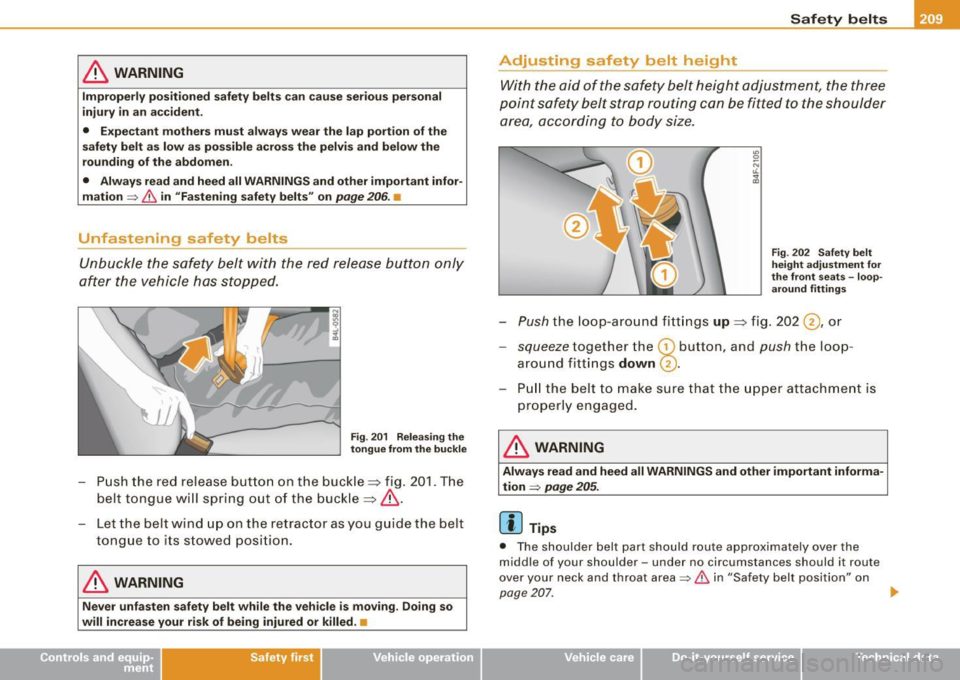
~ .. a,
Fig . 201 Releasing the
tongue from the buckle
- Push the red release button on the buckle~ fig. 201. The
belt tongue will spring out of the buckle
~ & .
- Let the belt wind up on the retractor as you guide the belt
tongue to its stowed position.
& WARNING
Never unfasten safety belt while the vehicle is moving. Doing so
will increase your risk of being injured or killed. •
Safety first
Safety belts
Adjusting safety belt height
With the aid of the safety belt height adjustment, the three
point safety belt strap routing can be fitted to the shoulder
area, according to body size.
Fig . 202 Safety belt
height adjustment for
the front seats -loop
around fittings
Push the loop -around fittings up ~ fig. 202 @, or
- squeeze together the G) button, and push the loop
around fittings
down @.
- Pull the belt to make sure that the upper attachment is
properly engaged.
& WARNING
Always read and heed all WARNINGS and other important informa
tion
=> page 205.
[ i ] Tips
• The shoulder belt part should route approximately over the
middle of your shoulder -under no circumstances should it route
over your neck and throat area=>
& in "Safety belt position" on
page~Z •
•
Vehicle care I I Technical data
Page 222 of 390
___ A_ i_r _b _a _ g~ s_ y_ s_t _e _m ___________________________________________________ _
passenger seat shou ld b e turned off or not=> pa ge 214, "Child
res train ts on the fron t seat - so m e impor tant thi ngs to kno w".
• A sensor in the safety belt latch for the driver and fo r the front
s e at pass enger that s enses w hether th at sa fet y belt is la tc hed or not
and transmits this information to the el ectron ic control unit .
& WARNING
Damage to the front passenger seat can prevent the front airbag
from working properly .
• Improper repair or disassembly of the front passenger and
driver seat will prevent the Advanced Airbag System from func
tioning properly .
• Repairs to the front passenger seat must be performed by qual
ified and properly trained workshop personnel.
• Never remove the front passenger or driver seat from the
vehicle.
• Never remove the upholstery from the front passenger seat .
• Never disassemble or remove parts from the seat or disconnect
wires from it .
• Never carry sharp objects in your pockets or place them on the
seat .
If the weight-sensing mat in the passenger seat is punctured
it cannot work properly.
• Never carry things on your lap or carry objects on the
passenger seat. Such items can increase the weight registered by
the weight-sens ing mat and send the wrong information to the
airbag control unit .
• Never store items under the front passenger seat . Parts of the
Advanced Airbag System under the passenger seat could be damaged , preventing them and the airbag system from working
properly.
• Never place seat covers or replacement upholstery that have
not been specifically approved by Audi on the front seats.
& WARNING (continued)
• Seat covers can prevent the Advanced Airbag System from
recognizing child restraints or occupants on the front passenger
seat and prevent the side airbag in the seat backrest from
deploying properly .
• Never use cushions, pillows, blankets or similar items on the
front passenger seat . The additional padding will prevent the
weight-sensing mat in the seat from accurately registering the
child restraint or person on the seat and prevent the Advanced
Airbag System from functioning properly.
• If you must use a child restraint on the front passenger seat
and the child restraint manufacturer's instructions require the use
of a towel , foam cushion or something else to properly position
the child restraint, make certain that the PASSENGER AIR BAG OFF
light comes on and stays on whenever the child restraint is
i nstalled on the front passenger seat .
• If the PASSENGER AIR BAG OFF light does not come on and stay
on, immediately install child restraint in a rear seating position
and have the airbag system inspected by your Audi dealer. •
How the Advanced Airbag System
components work together
T he front Advanced Airbag System and the si de airba gs supplement
t h e protection offered by the fro nt three -point safety be lt s with
pretensioners and load limiters a nd t he adjustab le head restraints
to help reduce the risk of in jury in a wide range of accident and
cras h situati ons. Be s ure to read the im por tant i nformation about
safety and heed the WAR NINGS in this chapter.
Depl oyment of the Adva nced A irbag Sy stem and the acti vat ion of
th e safety be lt pr etensioners dep ends on the decele ration
m easu re d by the crash se nso rs and regi stered by the e lec troni c
control unit . Crash s eve rity depends on speed and dec eleration as
~
Page 249 of 390

Child Safety 111111
-------------------------------------------------=---
& WARNIN G (continu ed )
• Alway s buckle the child safety s eat firmly in place even if a
child i s not sitting in it . A loose child safet y sea t ca n fly a round
during a sudden stop or in a cra sh .
• Alway s make sure the se at ba ckr es t to which the child re str ai nt
i s in stalled i s in an upright po sition and se curely latched into place
a nd cannot fold forw ard . Otherwi se, the seat back with the child
s a fety seat atta ched to it could fly forw ard in the event of an a cci
d ent o r other emergency situat ion .
• Alwa ys read and heed all WARNINGS wh enever u sing a child
re str ained in a vehicle is being u sed
=> page 234. Spe cial precau
tio ns appl y when install ing a child safety se at o n th e front
p ass enger seat =>
page 214 , "Ch ild re str ai nt s on t he front sea t -
s ome important t hings to know ".•
Deactivating the convertible locking retractor
The convertible locking retractor for child restraints will
be deactivated automatically when the belt is wound all
the way back into the retractor.
- Press the red button on the safety belt buck le . Th e belt
tongue will pop out of the buckle.
- Guide t he belt a ll the way back into its stowed position .
Always let the safety belt retract complete ly into its stowed posit ion .
The safety belt can now be used as an ordinary safety be lt without
the conve rtible locking retractor for child restra ints.
I f the convertible locking retractor should be activated inadvert
ently, the safety belt must be unfastened and guided comp lete ly
back into its stowed position to deactivate th is feature . If the
convertible locking retractor is not deactivated, the safety be lt will
gradually become tighte r and unc omf ortab le to wear .
Controls and equip
ment Safety first Vehicle operation
& WARNING
Impr
operly in stalled chi ld safety seat s in crea se th e ris k o f ser iou s
per sonal injury and death in a collision.
• Never unfaste n th e safety belt to dea ctivate the con vertib le
lockin g retractor for child re straint s while the veh icle i s moving .
You wou ld not be r estra ined a nd co uld be seriou sly inj ured in an
accident.
• Always re ad and heed all WARNING S whenever using a child
re str ained in a vehicle is be ing u sed
=> page 2 34. Spe cial pre cau
tion s appl y when in stalling a chi ld safet y seat on the front
pas senger seat =>
page 214 , "Child re straint s on the front seat -
so me important thing s to know ".•
Additional Information
What types of child restraint anchors are
available and how are they related to child
safety?
For years, child restraints have been installed using the safety belts
a lready present in every vehicle.
Since September 1, 1999, child restraint manufacturers have been
providing tether straps that attach the top of the chi ld restraint to
the vehic les structure, on most of their forward -facing systems in
order to comply with U.S. Federal regulations for child restraint
performance in a crash. Vehic le manufacturers are required to
phase -in tether anchorages for attachment of the tether strap in
t heir U.S. vehic les beginn ing September 1, 1999 .
The combination of the tether anchorages and the lower anchor
ages is now generally called the
LATCH system for " Lowe r Anchor
and Tether for Chi ldren ". ..,
Vehicle care Do-it-yourself service Technical data
Page 264 of 390

___ ln_ t _e_ ll-'"ig ...,_ e_ n_t _t_ e_ c_ h _ n_o _ l_o _,.g= y,_ __________________________________________ _
& WARN ING (continued )
• Before des cending a steep grade , reduce speed and shift trans
mission into a lower gear or lower dr iving range. D o not r ide the
brakes or hold the pedal down too long or too often . This could
c au se the brake s to get hot and dimin ish braking effi ciency.
• Do not "ride the brakes " by resting your foot on the pedal when
you do not intend to b rake. This may cause the brakes to overheat ,
premature wear and in crea sed stopping distan ce.
• Under certain climat ic and oper ating condit ion s s uch as
passing through water, driving in heavy rain or after washing the
vehicle , the effectiveness of the brakes can be reduced. In winter ,
ice c an a ccumulate on the brake pads , linings , discs and drums .
Carefully apply brakes fo r a test. Brakes will dry and ice coatings
will be cleaned off after a few careful brake applications .
• Driving for an e xtended pe riod of time on salt-covered road s
without using your brakes can also affect braking efficiency . Clean
off accumulated salt coating from brake disc s and pads with a few
careful brake applications .
• If you damage the front spoile r, or if you install a different
spoiler , be sure the air flow to the front brakes is not obstructed .
Otherwise the brake system could overheat reducing the effective
ness of the entire br ake system .
• Failure of one brake circuit will impair the braking capability
resulting in an increased stopping distance . Avo id driving the
vehicle and have it towed to the nearest Audi dealer or qualified
workshop .
u
Brake booster
T he brake boo ster ad ds e xtra bra kin g pow er.
T he brake booster works with vacuum pressure which is created
only when t he en gine is run ning~ &.
& WARNING
• Never let the vehi cle roll to a stop with the engine shut off .
• If the brake boo ster is not working, for example when towing
your vehicle , or because the brake booster has somehow been
damaged, the brake pedal must be pre ssed considerably harder to
make up for the lack of booster assistance . •
Functioning of Anti-Lock Brake System (ABS)
-- --
ABS preven ts the wheels from l ocking up und er bra kin g.
T he ABS contributes effectively to vehicle contro l since it prevents
th e w hee ls fr om lo cking when the brakes a re app lied . T hi s m ea ns
that the vehicle remains steerable and is less l ikely to skid.
With ABS you do not need to pump the brake . Just hold the brake
pedal down .
H owever, do not expect the AB S to shorten braking distance under
all circu ms tances. When drivi ng on grave l or on newly fa lle n sn ow
on top of icy surfaces, braking distance may be even longer, there
f o re, unde r these c ircums ta nces , it is es pecially imp ortant th at you
drive slow ly and with great care .
How the ABS system works
An automatic check is made when a speed of about 4 mph (6 km/h)
i s r eac hed . W he n th is happens, a pumping n oise ca n be heard.
I f a n indiv idual wheel be gins to rotat e too slowly in relation to
vehic le speed and tends to lock, the ABS automatically reduces
brake pressur e to p revent that whee l from loc king .
T his automatic adjustment p rocess will cause a slight vibration of
t he brake peda l a nd some noi ses t o a le rt yo u th at ve hicle speed
must be adapted to ex isting road and traffic conditions. .,
Page 266 of 390
___ ln_ t _e_ ll-'"ig ...,_ e_ n_t _t_ e_ c_ h _ n_o _ l_o _,.g= y,_ __________________________________________ _
• Be aware of the different than usual steering response and
adj ust you r steer ing for ce accordingly.
• Have the problem checked and set right by an Audi dealer as
s o on as possible .
[ i ] Tip s
• When th e engine is running, never hold the steering whee l
turned all the way to the right or to the left for longer than 15 seconds. The power steering pump will overheat the hydrau lic
fluid if you keep ho lding the steering wheel turned all the way. This
is like ly to damage the power steering system.
• If the power steering system should fail entirely, or if the engine
is not running (for example, while being towed), you wil l still be able
to steer the vehicle . However,
considerably more effort will be
required to do so.
• If the power steering system should have a leak, or is not func
tioni ng properly, contact your authorized Audi dealer immediately.
• The power steering system requires a specially formulated
hydraulic fluid . The power steering reservoir is the one located most
forward on the left side of the engine compartment~
page 298. The
correct fluid level in the reservoir is important for proper func
tioning of the power steering.
App lies to vehic les: with A ll Wheel Dr ive
Dr iving with your quattro®
With All Wheel Drive, all four wheels are driven.
Gen era l i nfo rm ati on
With All Wheel Drive, power is d istr ibuted to all four whee ls. Th is
happens automatica lly depending on your driving style and the
road conditions at the time. See also ~
page 259, "Electronic differ
entia l lock (EDU".
Wint er tir es
When driving in the winte r, your vehicle with All Wheel Drive has an
advantage, even with regular tires. In winter road conditions it may
be advisable to mount winter tires (or all -season tires) for improved
driveability and braking: these tires must be mounted on
a ll fou r
wh eel s.
See also ~ page 329, "Winter tires".
Tire chains
Where tire chains are mandatory on certain roads, this normally
a lso app lies to veh icles with A ll Wheel Drive~
page 330, "Snow
chains".
R epl acing w hee ls/t ires
Vehicles with All Wheel Drive must always have tires of the same
size. Also avoid tires with different tread depths . For details see
page ~
page 325, "New tires and replacing tires and wheels" .
Off-R oa d dri ving?
Your Audi does no t have enough ground c learance to be used as an
off -road vehic le. It is therefore best to avoid rough tracks and
uneven terrain as much as possible . Also refer to~
page 269.
& WARNING
Always a djust yo ur driving to r oad and traffi c condition s. Do not
let the e xtr a s afet y affor ded b y All Whee l Dri ve tempt you into
taking extr a risks.
• Although the All Wheel Dr ive i s very effe ct ive , a lwa ys
r e member that braking capacity i s limited b y tire trac tion. You
s hould therefore not d riv e at e xcess iv e speed s on icy or slipp ery
road surfaces .
• On we t road surf aces, be care fu l no t to d riv e t oo fas t beca use
the front whe els could b egin to slid e on top of the w ater (aqu a
planing ). If t his sho uld occ ur, you will h ave no warn ing from a
s udden incr ease in engine sp eed a s with a front -wh eel drive
v ehicl e. Alwa ys dri ve at spee d s w hic h are s uited to th e road condi
tion s - risk of cra sh.
;:i
Page 270 of 390

___ D_ r_iv _ in_... g"'- a_ n_ d_ e_ n_ v_i_r _o _n_ m_ e_n_ t _______________________________________________ _
New brake pads
--
Remember that new brake pads do not have a full braking
effect during the first 250 miles (400 kilometers) after they
are installed .
New brake pads have to be "burnished in" before they have optimal
grab =>& .
During the break -in period, you should avoid putting severe loads
on the brakes . Severe loads include, for examp le, sudden hard
braking, in particular at very high speeds or, for example, on moun
tain passes.
& WARNING
New brake pads don't have the best stopping power and must be
"broken-in" during the initial 100 to 150 miles (150 to 200 kilome
ters) of normal city driving. You can compensate for this by
pressing the brake pedal more firmly . This also applies later when
new pads are installed.
:J
Catalytic converter
It is very important that your emission control system
(catalytic converter) is functioning properly to ensure that
your vehicle is running in an environmentally sound
manner.
- Always use lead-free gasoline:=> page 291, "Fuel supply".
- Never run the tank down all the way to empty.
- Never put too much motor oil in your engine ==>
page 302,
"Adding engine oil 't=:;r\11
•
Never try to push- or tow-start your vehicle.
The catalytic converter is an efficient "clean-up" device built into the
exhaust system of the vehicle. The catalytic converter burns many
of the po llutants in the exhaust gas before they are released into the
atmosphere.
The exclusive use of unleaded fuel is critically important for the life
of the catalytic converter and proper functioning of the engine.
& WARNING
• Do not park or operate the vehicle in areas where the hot
exhaust system may come in contact with dry grass, brush, fuel
spill or other material which can cause a fire .
• Do not apply additional undercoating or rustproofing on or
near the exhaust manifold, exhaust pipes, catalytic converter or
heat shields. During driving, the substance used for undercoating
could overheat and cause a fire .
0 Note
• Be aware that just one tank filling with leaded fuel will alr eady
seriously degrade the performance of the catalytic converter.
• Do not exceed the correct engine oil level=>
page 302.
• Do not drive until the fuel tank becomes completely empty. The
engine could misfire. Unburned fuel could also get into the exhaust
system and this could cause the catalytic converter to overheat.
• Do not turn off the ignition while the vehicle is moving.
• Do not continue to operate your vehicle under these conditions,
as otherwise fuel can reach the catalytic converter. This could result
in overheating of the converter, requiring its replacement .
• To assure efficient operation of the Emission Control System:
- Have your vehicle maintained properly and in accordance with
the service recommendations in your Maintenance
& Warranty
booklet. •
Page 274 of 390

-Tr
aile r t ow ing ---=--------------
Trailer towing
Driving with a trailer
General information
Your Audi was designed primarily for passenger transpor
tation.
If you plan to tow a trailer, please remember that the additional load
wi ll affect durability, economy and performance.
Trai ler towing not on ly p laces more stress on the vehicle, it a lso ca lls
for more concentration from the driver.
For this reason, always fol low the operating and driving instructions
provided and use common sense.
0 Note
If you are going to tow a trai ler, you must activate the trailer opera
tion mode =>
page 184, "Towing a trailer".
Technical requirements
Tra iler hitch
Use a weight-carrying hitch conforming to the gross trailer weight .
The hitch must be suitable for your vehicle and trailer and must be
mounted secure ly on the ve hicle's chass is at a
technically sound
location. Use only a trailer hitch with a removable ball mount.
Always check with the trai ler hitch manufacturer to make sure that
you are using the correct hitch .
Do not use a bumper hit ch.
The hitch must be installed in such a way tha t it does not interfere
with the impact-absorbing bumper system. No modifications should be made to the vehic le exhaust and brake systems. From time to time, check that all hitch mounting bolts remain securely
fastened.
When you are no
t towing a trailer, remove the traile r hitch ball
mount. This prevents the hitch from causing damage shou ld your
vehic le be struck from behind=>& .
Traile r br akes
If your trailer is equipped with a braking system, check to be sure
that it conforms to al l regu lations.
The trai ler hydraulic brake system must no t be direct ly connected to
the vehicle's hydraulic brake system.
Safet y chains
Always use safety chains between your vehicle and the trailer.
Trailer light s
Trailer lights must meet a ll regulations. Be sure to check with your
Audi dealer for correc t wiring, sw itches and relays .
Mirrors
If you are unable to see the traf fic behind you using the regu lar
outside mirrors, then you
must install extended mirrors. It is impor
tant that you
always have c lear vision to the rear.
& WARNING
After rem oving the tr aile r hitch , do not store it in your vehi cle. In
ca se of sudde n braking , the hit ch co uld fl y for ward and injure you
or your p asseng ers. a