2008 AUDI S6 child lock
[x] Cancel search: child lockPage 255 of 390
Mounting and releasing the anchorage hook
If you use a child restraint system with hooks or other
latches attached to adjustable straps.
Mounting
- Press the anchorage hook wit h the spring catch re lease
onto the lower anchorage so that the anchorage hook locks into place .
- Pull on the anchorage hook to make sure that it has
securely engaged the lower anchorage.
- Tighten the strap following the child restraint manufac
turer 's instructions.
Releasing
- Loosen the tens ion on the strap following the child
restraint manufacturer's instructions .
- Depress the spring catch on the hook. - Hold the spring catch in depressed posit ion .
- Move the hook in the direction of the vehicle floor so that
there is enough space to release the anchorage hook
from the lower anchorage.
& WARNING
• Improper installation of child restraints will increase the risk of
injuries in a crash.
• Always refer to the child restraints manufacturer's instructions
for proper instaHation of the child restraint and proper use of the
lower anchorages or safety belts in your vehicle. •
Safety first
Tether anchors
Child Safety
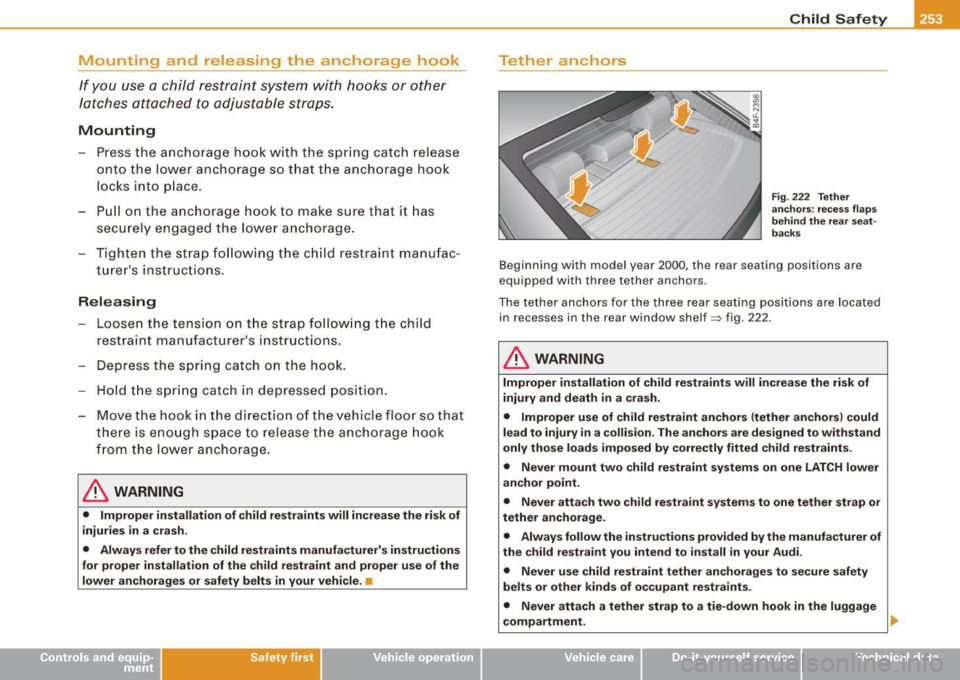
Fig. 222 Tether
anchors: recess flaps
behind the rear seat
backs
B eginning with mod el year 2000 , th e re ar sea ting posi tions are
equipped with three tether anchors.
The tether anchors for the three rear seating positions are located in r ecess es in the r ear window shelf~ fig . 222.
& WARNING
Improper installation of child restraints will increase the risk of
injury and death in a crash.
• Improper use of child restraint anchors (tether anchors) could
lead to injury in a collision. The anchors are designed to withstand
only those loads imposed by correctly fitted child restraints.
• Never mount two child restraint systems on one LATCH lower
anchor point.
• Never attach two child restraint systems to one tether strap or
tether anchorage.
• Always follow the instructions provided by the manufacturer of
the child restraint you intend to install in your Audi.
• Never use child restraint tether anchorages to secure safety
belts or other kinds of occupant restraints.
• Never attach a tether strap to a tie-down hook in the luggage
compartment.
Vehicle care I I irechnical data
Page 289 of 390
_____________________________________________ C_ l_ e _a_ n_ in_ g_a _ n_d_ p_ r_ o_ t _e_ c_t _io _ n __ lll
•
consider if children, anima ls or other factors m ight prove to be
partic ularly hard on the leather.
By contrast, leather types that are covered by a colored finish layer
are more durable. This has a positive effect on the leather 's resis
tance to wear and soiling in da ily use. On the ot her hand, the typica l
characteristics of natural leather are barely or not apparent.
However, this does not mean that the leather itself is of inferior
quality .
Care and h andling
Because of the exclusive nature of the types of leather that Audi
uses and their unique properties (such as sensitivity to oils, grease,
soiling, etc.l, you will need to be somewhat careful with these
lea thers, and a cer tain type of care is requ ired . For example, dark
clothing materials can discolor leather seats (especial ly if such
clothing is damp and was not dyed correctly). Dust and dirt par ticles
in pores , folds, and seams can have an abrasive effect and can
damage the leather surface as well as weaken seams .
The leather shou ld be c leaned regularly as needed . After having
been used for a relatively long time , your leather seats will acquire
a rich aged finish . This is a characteristic of natural leather and a
sign of true qua lity.
I n order to maintain the value of this natural p roduc t over the life of
your vehic le, you should fo llow the recommendations below :
0 Note
• To keep your leather from b leaching out, do not allow it to be
exposed to bright sun light for long per iods of time . If you have to
leave the vehicle parked outside for long periods, cover the leather
to protect it from direct exposure to sunlight.
• Sharp ob jects on c lothing, such as zippers, rivets or sharp pieces
on belts can leave permanent scratches or sc rape marks on the
surface of t he leather.
[ i ] Tip s
• After each time you clean the leathe r and at regular intervals, use
a leather preservative creme that contains UV -blockers and that
works into the leather . This creme wil l nour ish and moisturize the
leather, helping it to breathe and stay supple . It a lso helps to build
up a protect ive coating on the sur face .
• Clean the leather every 2 -3 months, and c lean any areas that get
soiled.
• Remove fresh marks made by ballpoint pens, ink, lipstick, shoe
polish, etc . as soon as possible .
• Preserve the co lor of the leather as needed by using a special
colored leather care creme to touch up areas of uneven co lor. •
App lies to ve hic les : w ith n atura l le at he r
Cleaning and caring for leather upholstery
and trim
Natural leather requires special care and atten tion .
Normal cleaning
Clean so iled areas wi th a slightly mo is tened cot to n or
woole n cloth.
More stubborn dirt
- More stub born dirt can be removed using a cloth satu
rated wi th a mild soap solut io n (2 tab lespoons mild
liq uid soap) .
- Neve r allow the soap solution to sa turate the leathe r, and
make certain that no water soaks i nto the seams .
Wipe off the soap solution with a soft, dry cloth. .,,
Vehicle care I t •
Page 299 of 390

___________________________________________ C_ h:....:e :....: c:....: k..:..: i..:.. n :..::g ::.....:: a:..:.n ..:..: d=---.:. f..:..:il ..:..:li ..:..n :.:::g !--_!11
•
Closing the engine hood
- Pull the hood down until the pressure from the struts is
reduced .
- Let the hood
drop down and latch in place. Do not try to
push it shut;
it may fail to engage => &.
& WARNING
A hood that is not completely latched could fly up and block your
view while driving.
• When you close the engine hood, check it to make sure the
safety catch has properly engaged. The hood should be flush with
the surrounding vehicle body parts.
• If you notice while driving that the hood is not secured prop
erly, stop at once and close it. •
Working in the engine compartment
Be especially careful whenever you work in the engine
compartment.
Whenever you must perform any work in the engine compartment,
for example checking and filling different fluids, there is a risk of injury, burns and accidents. To prevent personal injury always
observe the following WARNINGS. The engine compartment of any
vehicle is a hazardous area
~ & .
& WARNING
To help avoid injury, before you check anything under the hood :
• Turn off the engine.
• Remove the ignition key.
• Apply the parking brake .
& WARNING (continued)
• Move selector lever to "P" (Park).
• Always let the engine cool down. Hot components will burn
skin on contact.
• To reduce the risk of being burned, never open the hood if you
see or hear steam or coolant escaping from the engine compart
ment. Wait until no steam or coolant can be seen or heard before
carefully opening the hood.
• Keep children away from the engine compartment .
• Never spill fluids on hot engine components. They can cause a
fire.
• Never touch the radiator fan. The auxiliary electric fan is
temperature controlled and can switch on suddenly.
• Never open the coolant reservoir cap when the engine is still
warm . The coolant system is pressurized and hot coolant could
spray out.
• Protect your face, hands and arm from steam or hot engine
coolant by placing a thick rag over the cap when you open the
coolant reservoir.
• If work on the fuel system or the electrical system is necessary :
- Always disconnect the battery.
- Never smoke or work near heaters or open flames . Fluids in
the engine compartment could start a fire.
- Keep an approved fire extinguisher immediately available.
• To avoid electrical shock and personal injury while the engine
is running or being started, never touch:
- Ignition cables
- Other components of the high voltage electronic ignition system.
• If you must perform a check or repair with the engine running: -First, fully apply the parking brake, move selector lever to "P"
(Park). .,
Vehicle care
I t •
Page 309 of 390

___________________________________________ C_ h_e _c_ k_ i_n _g _ a_n _d_ f_il _li _n _g __ lll
•
T he fluid level may drop slightly after some time due to the auto
m atic adjustment of the brake pads. This is not cause for alarm .
If the brake fluid level fal ls
considerably below the "MIN" mark , the
brake warning/indicator light (U.S. models :
BRAKE, Canadian models:
{(j))) will come on~ page 23 and ~ page 32. Do not continue to
operate the vehic le. The complete brake system should be thor
oughly checked by an authorized Audi dealer or other qua lified
facili ty and the cause corrected . If the brake fluid level is too low, the
brake warning/indicator l ight will illuminate. Contact an au thorized
Audi dea ler
immediate ly .•
Changing brake fluid
Have the brake fl uid changed by an experienced techni
ci an.
Brake fluid absorbs moisture from the air. If the water content in the
brake fluid is too h igh, corrosion in the brake system may result
after a period of time. The boiling point of the brake fluid will also
decrease considerab ly and decrease braking performance .
Therefore , the brake fluid must be changed
e v ery tw o year s. Always
use new brake fluid which conforms to Federal Motor Vehic le Stan
dard "FMVSS 116 DOT 4".
T he brake fluid res ervoir can b e difficult to reach, th erefore, we
recommend that you have the brake fluid changed by your autho
rized
Audi de aler . Your dealer has the correct tools, the right brake
fl uid and the know -how to do t his fo r you .
& WARNING
• Brake fluid is poi sonous . It mu st be stored onl y in the clo sed
o riginal cont ainer out of the rea ch of children!
• Brake failure c an re sult from old or inappropri ate br ake flu id .
Obs erv e the se pre caution s:
& WAR N IN G (c ontinued )
-Use only brake fluid that meet s SAE specification J 1703 and
c onfo rm s to Feder al Moto r Vehicle St andard 116 . Al wa ys check
w ith your authori zed Audi dealer to make sure you are u sin g
the corre ct b rake flu id. The cor rect type of br ake fluid is als o
indic ated on the brake fl uid reservoir .
- The brake fluid mus t be ne w. Heav y use of th e brake s can
ca use a vapor lock if the bra ke fluid i s left in the sy stem too
long . Thi s can seriou sly affect the efficiency of the brake s as
w ell as your s afety . This could r esult in an a ccident .
0 Note
Brake fluid will damage the paint of your vehicle .
the special too ls required and the necessary expertise, we recom
mend that you have the brake fluid changed by your authori zed Audi
dea ler .•
Battery
General information
Und er n ormal operating conditions, the battery in your Audi does
not need any maintenance. With
high outside temperatures or long
daily drives we recommend that you have the electrolyte level
checked by a se rvice facility . The e lectrolyte level should a lso be
checked each time the battery is charged~
page 310 .
Have the batte ry checked when you take your vehic le in for service.
You are well advised to replace a battery that is o lder than 5 years . _,,
Vehicle care I t •
Page 374 of 390

-Alphabetical index ..,,,_.:_.__ ____ _...::.:...::..;.:___ ________________ _
A
A . ccessones ............. .... .... .. .
Adapter for cupholder ..... ...... ... . 368
103
Ad . A' S .
apt1ve 1r uspens1on .. .... ... .... 182
Automatic mode . . . . . . . . . . . . . . . . . 183
Description . . . . . . . . . . . . . . . . . . . . . 182
Dynamic mode . . . . . . . . . . . . . . . . . . 183
Jacking mode when changing a flat tire .
184
Lift mode . . . . . . . . . . . . . . . . . . . . . . . 183
Setting the driving modes .. .... ... 183
Standard mode . . . . . . . . . . . . . . . . . . 183
Trailer towing mode ... .... .... ... 184
Warning/indicator lights ....... .... 21
Adaptive Cruise Control . . . . . . . . . . . . . . 135
Changing speed .. ........... .... 138
Driver information ............... 142
Driver interven tion prompt ........ 146
Driving in traffic ...... .... ...... . 136
Driving program ...... .... .... ... 147
Error messages . . . . . . . . . . . . . . . . . . 145
Open road . . . . . . . . . . . . . . . . . . . . . . 136
Override . . . . . . . . . . . . . . . . . . . . . . . . 136
Request for driver to assume control 136
Save speed . . . . . . . . . . . . . . . . . . . . . . 137
Setting distance . . . . . . . . . . . . . . . . . 140
Setting time interval .. .. .......... 140
Settings . . . . . . . . . . . . . . . . . . . . . . . . 147
Specia l driving situations ......... 147
Status messages . . . . . . . . . . . . . . . . . 145
Switching on and off .. .... ... .... 137
System limits ...... .... .......... 147
Tempor arily turning off ... ...... .. 139
warning/indicator lights .... ...... . 143
Adaptive Light ......... ... .... .... ... 73
defective .......... .... ..... .. .... 37
Adding
Engine coolant ......... ... .... ...
305
Engine oil ... .. ...... ....... ..... 302
Windshield washer fluid .... .... ... 312
Additional accessories .... .... .... ... 368
Additives
Engine oil ... .. ..... .. ...... .....
302
Adjusting
Instrument cluster i llumination ......
16
Steering column electrically .... ... 123
Steering column manually ...... ... 122
Ad' . f Justing ront seats .. .... .... .... ... 87
Advanced Key ...... .. .... ........... 59 Care
........ ..... ....... ... .. ...
226
Child restraints .................. 236
Children ....... ....... .... ..... . 235
Components (front airbags) ........ 219
Danger of fitting a chi ld safety seat on the
front passenger seat .. ..... .. ...
214
Disposal ............ .. .... ...... 226
Fron t airbags ...... .... .... .. 216, 217
How do the front airbags work? . ... 221
How many airbags does my vehicle have?
219
How the Advanced Airbag System compo -
nents work together . . . . . . . . . . . . .
220
Important things to know ... ..... .. 212
Indicato r light ...... ... .. .... .... 223
Monitoring .... .... .... ...... .... 223
PASSENGER AIR BAG OFF light ..... 224
Repairs ..... .. .... .... ... ... ... . 226
Driver messages . . . . . . . . . . . . . . . . .
128 Safety instructions .... .... .... ... 225
Locking vehicle ................. .. 61 Side airbags ... .... .... ... ... ... . 228
START button ................... 126 Side curtain airbags (SIDEGUARD) .. 231
Starting engine ........ ..... .. ... 126 Weight-sensing mat .. ....... ..... 235
STOP button .... ... .... .... ...... 127 When must the system be inspected? .. .
Switching engine off ...... .... ...
127 223
Switching on ignition ...... .... ... 126 All Whee l Drive ... .... .... .......... 264
Unlocking vehicle ........... ...... 60 Alloy wheels . .... .... ....... .... ... 283
Air conditioning
See Climate controls ... .......... . 11 O
Airbag
Warning/indicator lights ..... ......
20
Airbag system ... ... .. .... .... .. 212, 229
Advanced Airbag System ...... .... 216
Advanced Airbag System components
219
All- whee l drive
Winter tires .... ........... .... ..
329
Alternator
See Generator . . . . . . . . . . . . . . . . . . . . 19
Anti -freeze
See Engine coolant system ...... .. 303
Anti-glare inside day-night mirror .... .. 82
Page 376 of 390

llffl __ A_ l..:,. p _ h_ a_ b_e _t_ic _ a_l _in _ d_e_ x ____________________________________________ _
Brake system . . . . . . . . . . . . . . . . . . . . . . . 306
Anti-lock brake system . . . . . . . . . . . . . 22
Brake fluid . . . . . . . . . . . . . . . . . . . . . . 306
Brake fluid specifications for refill and replacement . . . . . . . . . . . . . . . . . . . 307
Brake pads . . . . . . . . . . . . . . . . . . . . . . 268
Electromechanical parking brake ... 129
General information .............. 261
How does moisture or road salt affect the brakes? ....................... 261
Malfunction ........ ... ...... .... . 32
Warning/indicator lights ........... 23
Worn brake pads symbol . . . . . . . . . . . 37
Break -in period . . . . . . . . . . . . . . . . . . . . . 267
Brake pads . . . . . . . . . . . . . . . . . . . . . . 268
Tires .... ... .. .... .... .......... 267
Bu lbs ... .... .. ... ...... ....... .... 349
Bumper cover Caution when parking near a parking bar -
rier or curb ...... ... .... .... ... 130
C
Ca lifornia Proposition 65 Warning 298
Battery specific . . . . . . . . . . . . . . . . . . 310
Capacities ......................... 363
Car care ................. .... .... .. 278
Interior .......... .... .... ...... . 285
Plastic and vinyl .. .... ........... 282
Weatherstrips ....... ........ .... 283
Care of exterior .... ....... .......... 278
Cargo area
See Loading the luggage compartment ..
199 Cargo net
.... .... ... ........ ...... .. 98
Catalytic converter . ........ .... .... . 268
CD changer . . . . . . . . . . . . . . . . . . . . . . . . 107
Central locking Emergency locking . . . . . . . . . . . . . . . . 57
Changing a flat tire ........ .... ... ... 338
Changing a wheel .... .. ..... .. .. .... 338
Changing engine oi l ....... .... ... ... 302
Chassis Undercoating ... .. .... .... .... ... 284
See also Adaptive Aar Suspension . . . 182
CHECK button . . . . . . . . . . . . . . . . . . . . . . . 16
Checking Engine coolant level .............. 304
Checking tire pressure .. ........... .. 319
Child restraints Danger of using child restraints in the front seat ......... ... .... ...... 214
What types of chi ld restraint anchors are
available? . .... ..... ...... .... .. 247
Where can I get additional information
about child restraints? ...... ... .. 248
Child safety ...... ...... .... ... . 234, 239
Additional information ............ 253
Booster seats ................. ... 242
Convertible chi ld safety seats .. .... 240
Convertible locking retractor ....... 244
Guidance fixtures for lower anchorages
250
Important safety instructions for using
child safety seats .... ...... ... .. 237
Important things to know when driving with children ................... 234 Infant
seats ... .... .... ....... .. . 239
Install ing a child restraint using the
LATCH system .. ...... ..... .. ... 252
Lower anchorages ... .. .... .... ... 249
Mounting and releasing the anchorage
hook . ............ ....... .... .. 253
Older children and safety belts ..... 243
Safety belts and older children ..... 243
Tether anchors .. ...... .... ...... 253
Tether strap ... .... .... ...... .... 254
Which restraint system should my older
chi ld wear? ....... ........... .. 243
Child safety lock
rear doors {power) . .... ........ .... 59
Child safety seats .. .... ...... .... ... 239
Convertible locking retractor .. ..... 244
Danger of using child restraints in the
front seat ...................... 214
How do I properly install a child safety
seat in my vehicle? .... ... .... ... 237
Installing .. .. .. .... .... ... .... ... 244
LATCH system ....... ........ .... 252
Safety instructions ............... 237
Cigarette I ig hter . . . . . . . . . . . . . . . . . . . . 105
Cleaning Alcantara {synthetic suede) . ....... 288
Engine compartment ...... .... ... 289
Fabrics and fabric coverings . ...... 285
Instrument panel ....... ........ .. 286
Interior ........... .... .......... 285
Leather ... .... .................. 287
MMI display .............. .... ... 285
MMI terminal .. .... .... ... .... ... 285
Plastic and vinyl ... .... .... .... ... 282
Page 377 of 390

Alphab eti ca l ind ex -
--------------------------'-----
Plastic parts
Safety belts 286
289
Trim strips .... ... ....... ..... .. . 281
trim strips .... ........... ........ 282
Cleaning and protection .. .... ... ..... 278
Climate control ... .... .... .... .... .. 110
Synchronizing .. .... .... .... ..... 112
Warm and cold ........ .... .... ... 110
Climate controls Air distribution ........... .... .... 116
Air outlets ..... .. .... .... ...... .. 118
Air outlets (rear) ...... ....... .... . 118
Air recirculation .... .... .... .... .. 117
AUTO (standard setting) . .... .... .. 113
Basic settings . . . . . . . . . . . . . . . . . . . . 119
Center air vent ...... .... ....... .. 121
Controls ............. .... ....... 112
Defrosting/defogging . .... ... .... . 116
Description ... ..... .. .... ...... .. 110
ECON operation . . . . . . . . . . . . . . . . . . 120
Fan . .......... ...... .... ...... .. 116
Heated seats, front .... ... .... .... 114
Key coded setting ................ 110
Recirculation mode (automatic) ... .. 120
Recommended settings . .... .... .. 110
Residual heat .. ...... .... ...... .. 113
Setting the temperature . .... .... .. 114
SETUP ......... .... ... .. .... 119, 120
Solar blower fan/solar roof .. ...... . 119
Solar operation ... ........... .... 121
Switching on and off .. .... ...... .. 113
Synchronization .. .... ........... . 120
Using climate control economically . 119
Clock ......... ........ .... ... .... ... 14
Controls and equip
ment Safety first
Closing D
Power sun roof
. . . . . . . . . . . . . . . . . . . . 67
Coat hooks ... .... .... .... .... ... ... 109 Damping
Cold tire inflation pressure ....... .... 317
See Adaptive Air Suspension ...... . 182
Compass mirror .. ... ..... ... .... ... .. 85 Data ..
... .... .... .... ... .... .... ... 363
Consumer Information ......... .. 201, 365 Data recorder ..
...... .... ...... .... . 258
Contacting NH TSA .. .. .. ... ... .... .. 201 Date display
........... ........ ...... 14
Continuously Variable Transmission (CVT) Daytime
running lights ... .... .... .. 70, 71
See multitronic® .. .... .... .... ... 159 def
Convertible chi ld seats What does this mean when it appears in
How do I properly install a convertib le the trip odometer display? .
.... .... 15
child seat in my vehicle? ......... 240 Defective light bu
lb warning .... .... ... 27
Safety instructions ................ 240 Defrosting/defogging the windows .... 116
Convertible locking retractor Defrosting/defogging windows ..... ... 118
Activating .......... .... .... .... . 246
Determin ing correct load limit ........ . 322
Deactivating . .... .... ... ..... ... . 247
Digital clock ..... ..... ...... .... .... . 14
Using to secure a chi ld safety seat . 244,
246
Coolant system ..................... 303 Digital compass
... .. .... .... .... ..... 85
Digita l speedometer ........... ....... 27
Dimensions .... .... .... ........... . 362
Coo ling System
Expansion tank .. .... .... ... .. .... 304
Cornering light .... ... .... .... ... .. .. 73
Cruise control
Changing speed .................. 133
Presetting your speed ............. 133
Switching off .................... 133
Switching on .................... 132
Warning/indicator lights .. .... ...... 22
See also Adaptive Cruise Control . ... 135
Cruising range ......... ...... .... ... . 40
Cupholder . ... .. ...... ....... .... .. 103 Dipstick
Reading the dipstick properly .... .. 301
Distance control system
See Adaptive Cruise Control ........ 135
Doors Power child safety lock . ........ .... 59
Power side door closer ............. 56
Driver information system ...... .... . .. 25
Digita l speedometer . .. .. . ... .... .. 27
Driver information messages . .... ... 30
Open door or rear lid warning .... ... 27
Outside temperature display ...... .. 26
Sound system display .. .... .... .... 26
Vehicle operation Vehicle care Do-it-yourself service Technical data
Page 379 of 390

______________________________________________ A_ l_,_ p _h_ a_ b_e _t_i c_ a _ l _in _ d_e _ x __ ftllll
Proper disposal of drained engine oil 302
Recycling used engine oil ..... ..... 302
Un leaded fuel ..... ....... .... ... . 291
What should I do with an old battery?
311
EPC
See Electronic power control . .... ... 19
ESP
See Electronic stabilization program
(ESP) ..... ... .. .... .... ...... ... 19
Event Data Recorder (EDR) ... .... ..... 258
Expansion tank ...... ....... ........ 304
Exterior lighting in the mirror housing ... 73
Eyeglasses compartment ............. 108
F
Fan
Radiator .............. .......... 306
Fastening eyelets ...... .... .......... 97
Flat tire Changing ... ... ... .. .... ...... .. 338
Floor mats . . . . . . . . . . . . . . . . . . . . . . . . . 198
Fog lights .... .... .... ... .. .... .... .. 72
Fo lding master key with remote contro l . 48
Foot pedals ...... .. .... .... ..... ... 198
For the sake of the environment Gasoline fumes and the environment 293
Letting you r engine warm up ...... . 125
Reducing engine noise by early
upshifting .. ...... ..... .... ... .. 13
Refuel ing .... .... ....... .... .... 293
Controls and equip
ment Safety first
Saving
fuel by early upshifting .... .. 13
Usingtherearwindowdefogger .. .. 117
Front airbags
Description ......... .... .... .... . 216
How they work .... ........ ....... 221
Front arm rest adjusting . ...... .... .... ... .... ... 96
Storage compartment ... .... ..... .. 96
Front ashtray .... .... .... ........ ... 104
Front fog lights ..... ........ .... .... . 72
Front seats .. ............ .... ....... . 87
Adjusting ... ....... .... .... .... . 195
Child restraints in the front seat ... . 214
Fronta l collisions and the laws of physics
203
Fuel Additives ... .. ...... .... ..... .... 291
Blended gasoline .... ....... .... .. 291
Consumption ....... .... .... .... .. 40
Fi ller neck ......... .. ... .... .... . 292
Fuel gauge ... .. .... .... ...... .... 15
Gasoline .. .... ... .... .... .... ... 291
Gasoline additives ................ 292
Low fuel level .............. .... 15, 36
Octane rating .................... 291
Recommendation ....... ... ... ... 291
Refuel ling .............. ...... ... 293
Reserve .......................... 15
Tank capacity .... .... ... .... .... . 363
Un locking the fue l f iller flap by hand 295
Fuse arrangement ............. ...... 345 G
Garage door opener (HomeLink®) . .... . 186
Gas discharge lamps . .... ........... . 349
Gauges Engine coolant temperature .. .. .. . .. 13
Fuel gauge ..... .... .. .. . ... ...... 15
Speedometer ... .... ... .. .... ..... 15
Tachometer . .... .... .... .... ...... 14
Trip odometer ... .. .... .... ... .. .. . 15
General illustration Instruments and controls ... .. .... .. 11
Generator Warning/indicator lights ............ 19
G lossary of tire and loading terminology .. .
314
G love compartment ......... .... .... 107
cd changer ... .... .... .... .... ... 107
Valet key function .... .... .... ... .. 51
G love compartment -emergency unlocking
108
Gross Vehicle Weight Rating (GVWR) ... 361
H
Head restraints ... .... ..... ... ... ... 197
Adjusting .. .... .... ... .... .... ... 197
Front seats ... .... .... ... .... ..... 93
Installation and removal ............ 94
Rear seats .... .... .... .... ..... 94, 95
Headlight washer reservoir .. .... .... . 312
Vehicle operation Vehicle care Do-it-yourself service Technical data