Page 64 of 116

7-15
1
2
3
4
5
67
8
9
10
11
if possible.
When crossing the side of a hill:
�
Always follow proper procedures as de-
scribed in the Owner’s Manual.
�
Avoid hills with excessively slippery or loose
surfaces.
�
Shift your weight to the uphill side of the
ATV.
If your ATV has stalled or stopped and you believe
you can continue up the hill, restart carefully to
make sure you do not lift the front wheels which
could cause you to lose control. If you are unableto continue up the hill, dismount the ATV on the up-
hill side. Physically turn the ATV around and then
descend the hill.
If you start to roll backwards, DO NOT apply the
rear brake to stop or try to put the ATV in gear. The
ATV could easily tip over backwards. Instead, ap-
ply the front brake gradually, or dismount the ATV
immediately on the uphill side.WARNING
EWB01761
Maintain a steady speed when climbing a hill.
If you lose all forward speed:
�
Keep weight uphill.
�
Apply the brakes.
�
Lock the parking brake after you are
stopped.
If you begin rolling backwards:
�
Keep weight uphill.
�
Never apply the rear brake while rolling
backwards. Apply the front brake.
�
When fully stopped, apply the rear brake as
well, and then lock the parking brake.
Dismount on uphill side or to a side if pointed
straight uphill. Turn the ATV around and re-
mount, following the procedure described in
the Owner’s Manual.
OK
Page 67 of 116
7-18
1
2
3
4
5
67
8
9
10
11
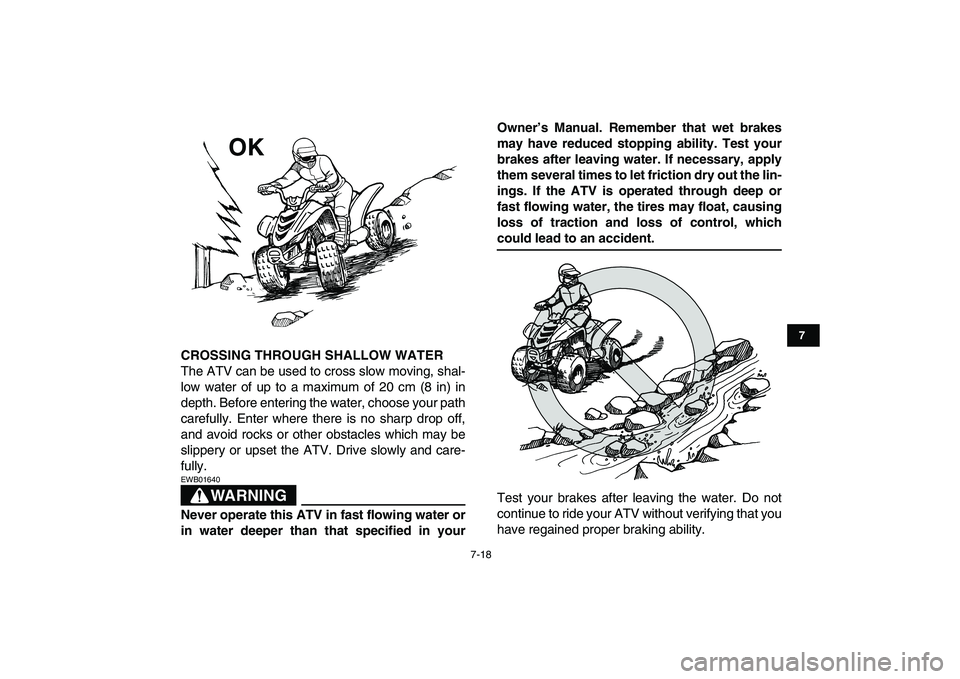
CROSSING THROUGH SHALLOW WATER
The ATV can be used to cross slow moving, shal-
low water of up to a maximum of 20 cm (8 in) in
depth. Before entering the water, choose your path
carefully. Enter where there is no sharp drop off,
and avoid rocks or other obstacles which may be
slippery or upset the ATV. Drive slowly and care-
fully.
WARNING
EWB01640
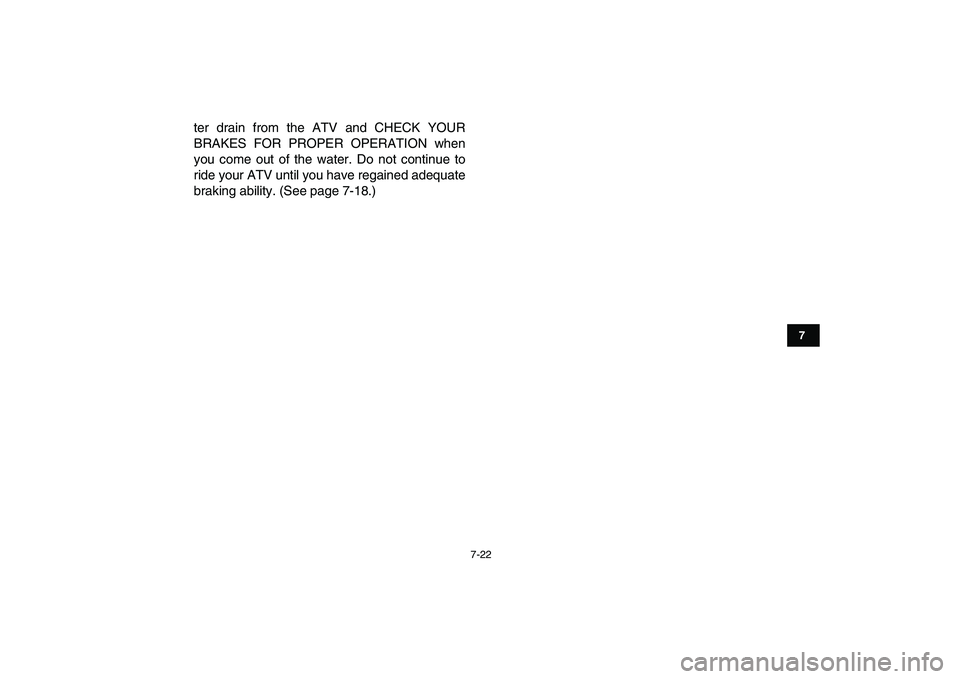
Never operate this ATV in fast flowing water or
in water deeper than that specified in yourOwner’s Manual. Remember that wet brakes
may have reduced stopping ability. Test your
brakes after leaving water. If necessary, apply
them several times to let friction dry out the lin-
ings. If the ATV is operated through deep or
fast flowing water, the tires may float, causing
loss of traction and loss of control, which
could lead to an accident.
Test your brakes after leaving the water. Do not
continue to ride your ATV without verifying that you
have regained proper braking ability.
OK
Page 69 of 116
7-20
1
2
3
4
5
67
8
9
10
11
you go over obstacles, always follow proper
procedures as described in the Owner’s Manu-
al.
SLIDING AND SKIDDING
Care should be used when riding on loose or slip-
pery surfaces since the ATV may slide. If unex-
pected and uncorrected, sliding could lead to an
accident.
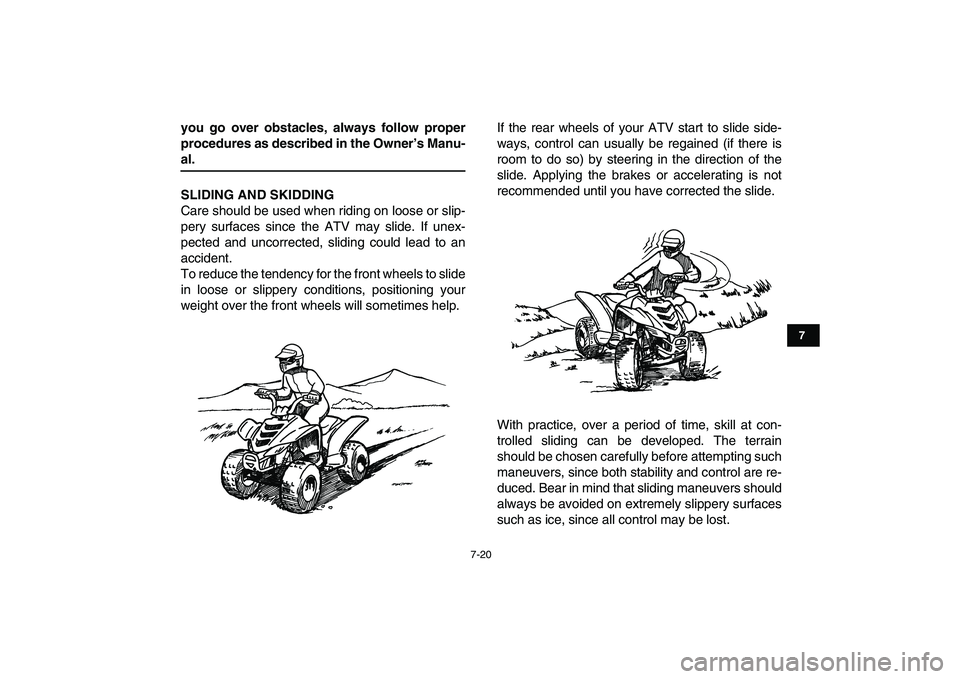
To reduce the tendency for the front wheels to slide
in loose or slippery conditions, positioning your
weight over the front wheels will sometimes help.If the rear wheels of your ATV start to slide side-
ways, control can usually be regained (if there is
room to do so) by steering in the direction of the
slide. Applying the brakes or accelerating is not
recommended until you have corrected the slide.
With practice, over a period of time, skill at con-
trolled sliding can be developed. The terrain
should be chosen carefully before attempting such
maneuvers, since both stability and control are re-
duced. Bear in mind that sliding maneuvers should
always be avoided on extremely slippery surfaces
such as ice, since all control may be lost.
Page 70 of 116

7-21
1
2
3
4
5
67
8
9
10
11
WARNING
EWB01661
Learn to safely control skidding or sliding by
practicing at low speeds and on level, smooth
terrain.
On extremely slippery surfaces, such as ice,
go slowly and be very cautious in order to re-
duce the chance of skidding or sliding out of
control.
WHAT TO DO IF...
This section is designed to be a reference guide
only. Be sure to read each section on riding tech-
niques completely.
WHAT TO DO...
�
If your ATV doesn’t turn when you want it to:
Bring the ATV to a stop and practice the turning
maneuvers again. Be sure you are putting your
weight on the footboard to the outside of the
turn. Position your weight over the front wheels
for better control. (See page 7-12.)
�
If your ATV begins to tip while turning:
Lean more into the turn to regain balance. If nec-
essary, gradually let off the throttle and/or steer
to the outside of the turn. (See page 7-12.)
�
If your ATV starts to slide sideways:
Steer in the direction of the slide if you have the
room. Applying the brakes or accelerating is not
recommended until you have corrected the
slide. (See page 7-20.)
�
If your ATV can’t make it up a hill you are trying
to climb:
Turn the ATV around if you still have forward
speed. If not, stop, dismount on the uphill side of
the ATV and physically turn the ATV around. If
the ATV starts to slip backwards, DO NOT USE
THE REAR BRAKE – the ATV may tip over on
top of you. Instead, apply the front brake or dis-
mount the ATV on the uphill side. (See
page 7-13.)
�
If your ATV is traversing a sloping surface:
Be sure to ride with your weight positioned to-
wards the uphill side of the ATV to maintain
proper balance. If the ATV starts to tip, steer
down the hill (if there are no obstacles in your
way) to regain balance. If you discover that the
ATV is going to tip over, dismount on the uphill
side. (See page 7-13.)
�
If your ATV encounters shallow water:
Ride slowly and carefully through slow moving
water, watching for obstacles. Be sure to let wa-
Page 71 of 116
7-22
1
2
3
4
5
67
8
9
10
11
ter drain from the ATV and CHECK YOUR
BRAKES FOR PROPER OPERATION when
you come out of the water. Do not continue to
ride your ATV until you have regained adequate
braking ability. (See page 7-18.)
Page 74 of 116

8-3
1
2
3
4
5
6
78
9
10
11
EBU22403
Periodic maintenance and lubrication chart
NOTE:
�
For ATVs not equipped with an odometer or an hour meter, follow the month maintenance intervals.
�
For ATVs equipped with an odometer or an hour meter, follow the km (mi) or hours maintenance inter-
vals. However, keep in mind that if the ATV isn’t used for a long period of time, the month maintenance
intervals should be followed.
�
Items marked with an asterisk should be performed by a Yamaha dealer as they require special tools,
data and technical skills.
NO. ITEMCHECK OR MAINTENANCE
JOBINITIAL EVERY
Whichev-
er comes
firstmonth136612
km
(mi)320
(200)1200
(750)2400
(1500)2400
(1500)4800
(3000)
hours 20 75 150 150 3001
*
Fuel line
�
Check fuel hoses for cracks or other damage, and
replace if necessary.
√√√
2 Spark plug
�
Check condition and clean, regap, or replace if
necessary.
√√√√√
3
*
Valves
�
Check valve clearance and adjust if necessary.
√ √√√
4
*
Timing chain
�
Check chain tension.
�
Adjust if necessary.
√ √√√
5 Air filter element
�
Clean and replace if necessary.Every 20–40 hours (more often in wet or
dusty areas)
6
*
Front brake
�
Check operation and correct if necessary.
�
Check brake lever free play and adjust if neces-
sary.
√√√√√
�
Replace brake shoes. Whenever worn to the limit
Page 75 of 116

8-4
1
2
3
4
5
6
78
9
10
11
7
*
Rear brake
�
Check operation and correct if necessary.
�
Check brake lever free play and adjust if neces-
sary.
√√√√√
�
Replace brake shoes. Whenever worn to the limit
8
*
Wheels
�
Check runout and for damage, and replace if nec-
essary.
√ √√√
9
*
Tires
�
Check tread depth and for damage, and replace if
necessary.
�
Check air pressure and balance, and correct if
necessary.
√ √√√
10
*
Wheel bearings
�
Check for looseness or damage, and replace if
necessary.
√ √√√
11
*
Drive shaft univer-
sal joint
�
Lubricate with lithium-soap-based grease.
√√√
12
*
Chassis fasteners
�
Make sure that all nuts, bolts, and screws are
properly tightened.
√√√√√
13
*
Shock absorber
assemblies
�
Check operation and correct if necessary.
�
Check for oil leakage and replace if necessary.
√√√
14
*
Knuckle shafts
�
Lubricate with lithium-soap-based grease.
√√√
15
*
Steering shaft
�
Lubricate with lithium-soap-based grease.
√√√
16
*
Steering system
�
Check operation and repair or replace if damaged.
�
Check toe-in and adjust if necessary.
√√√√√
17
*
Carburetor
�
Check choke operation and correct if necessary.
�
Check engine idling speed and adjust if neces-
sary.
√√√√
NO. ITEMCHECK OR MAINTENANCE
JOBINITIAL EVERY
Whichev-
er comes
firstmonth 1 3 6 6 12
km
(mi)320
(200)1200
(750)2400
(1500)2400
(1500)4800
(3000)
hours 20 75 150 150 300
Page 76 of 116

8-5
1
2
3
4
5
6
78
9
10
11
18
*
Crankcase breather
system
�
Check breather hose for cracks or other damage,
and replace if necessary.
√√√
19 Engine oil
�
Change.
�
Check ATV for oil leakage, and correct if neces-
sary.
√ √√√
20 Final gear oil
�
Change.
�
Check ATV for oil leakage, and correct if neces-
sary.
√√
21
*
Moving parts and
cables
�
Lubricate.
√√√√
22
*
Throttle lever hous-
ing and cable
�
Check operation and correct if necessary.
�
Check throttle cable free play and adjust if neces-
sary.
�
Lubricate throttle lever housing and cable.
√√√√√
23
*
Exhaust system
�
Check for leakage and replace gasket(s) if neces-
sary.
�
Check for looseness and tighten all screw clamps
and joints if necessary.
√√√
24 Spark arrester
�
Clean.
√√√
25
*
Front and rear brake
switches
�
Check operation and correct if necessary.
√√√√√
26
*
Battery
�
Check electrolyte level and specific gravity, and
correct if necessary.
�
Make sure that the breather hose is properly
routed.
√√√√√
NO. ITEMCHECK OR MAINTENANCE
JOBINITIAL EVERY
Whichev-
er comes
firstmonth136612
km
(mi)320
(200)1200
(750)2400
(1500)2400
(1500)4800
(3000)
hours 20 75 150 150 300