Page 38 of 116

5-3
1
2
3
45
6
7
8
9
10
11
EBU19540
Fuel
Make sure that there is sufficient fuel in the tank.
(See page 4-8.)
WARNING
EWB00520
�
Do not overfill the fuel tank. Fuel expands
when it heats up. If the fuel tank is overfilled,
fuel could spill out due to heat from the en-
gine or the sun.
�
Be careful not to spill fuel, especially on the
engine or exhaust pipe which can cause a
fire and severe injury. Wipe up any spilled
fuel immediately.
�
Do not refuel right after the engine has been
running and is still very hot.
�
Be sure the fuel tank cap is closed securely.
EBU19560
Engine oil
Make sure that the engine oil is at the specified lev-
el. Add oil as necessary. (See page 8-8.)
EBU19590
Final gear oil
Make sure that the final gear oil is at the specified
level. Add oil as necessary. (See page 8-11.)
EBU19650
Front and rear brakes
Brake levers
�
Check for correct free play in the brake levers. If
the free play is incorrect, adjust it. (See pages
8-20 and 8-22.)
�
Check operation of the levers. They should
move smoothly and there should be a firm feel-
ing when the brake is applied. If not, have the
ATV checked by a Yamaha dealer.
Brake operation
Test the brakes at slow speed after starting out to
make sure they are working properly. If the brakes
do not provide proper braking performance, check
the brakes for wear. (See page 8-19.)
WARNING
EWB00570
Always check the brakes at the start of every
ride. Do not ride the ATV if you find any prob-
lem with the brakes or you could lose braking
ability, which could lead to an accident. If a
problem cannot be corrected by the adjust-
ment procedures provided in this manual, have
the ATV checked by a Yamaha dealer.
Page 42 of 116

6-1
1
2
3
4
56
7
8
9
10
11
EBU19880
OPERATION
EBU19900
Read the Owner’s Manual carefully before riding
the ATV.
WARNING
EWB00630
Read the Owner’s Manual carefully to become
familiar with all controls in order to help pre-
vent any loss of control, which could cause an
accident or injury. If there is a control or func-
tion you do not understand, ask your Yamaha
dealer.
EBU20241
Starting a cold engine
WARNING
EWB00640
Always make sure all control cables work
smoothly before you begin riding in cold
weather. If the control cables are frozen or do
not work smoothly, you could be unable to
control the ATV, which could lead to an acci-
dent or collision.
CAUTION:
ECB00150
See the “Engine break-in” section on page 6-5
prior to operating the engine for the first time.
1. Set the parking brake.
2. Turn the fuel cock to “ON”.
3. Turn the main switch to “ON” and the engine
stop switch to “RUN”.
4. Shift the transmission into neutral. The neutral
indicator light should come on. If the indicator
light does not come on, have a Yamaha deal-
er check the electrical circuit.
NOTE:
This model is equipped with an ignition circuit cut-
off system. The engine can be started under the
following conditions.
�
The transmission is in neutral.
�
The rear brake lever is applied with the drive se-
lect lever in the drive position. However, it is rec-
ommended to shift into neutral before starting
the engine.
5. Use the choke in reference to the figure:
Page 44 of 116

6-3
1
2
3
4
56
7
8
9
10
11
crank the engine more than 10 seconds on each
attempt.
7. If the engine is started with the choke in posi-
tion (1), the choke should be returned to posi-
tion (2) to warm up the engine. If the engine is
started with the choke in position (2), keep the
choke in this position to warm up the engine.
CAUTION:
ECB00160
For maximum engine life, always warm the en-
gine up before starting off. Never accelerate
hard when the engine is cold!
8. Continue warming up the engine until it idles
smoothly, then return the choke to position (3)
before riding.
NOTE:
The engine is warm when it responds normally to
the throttle with the choke turned off.
EBU20301
Starting a warm engine
Follow the same procedure as for starting a cold
engine, with the exception that the choke is not re-
quired when the engine is warm. Instead, start the
engine with the throttle slightly open.
EBU27880
Shifting
This ATV has an automatic, centrifugal clutch.
To shift into the drive position, release the throttle
lever and apply the parking brake.
To shift into neutral, stop the ATV by releasing the
throttle lever and applying the brakes smoothly
and evenly.
EBU20630
To start out and accelerate
1. Release the throttle lever.
CAUTION:
ECB00210
Always close the throttle before shifting the
transmission into drive, otherwise damage to
the engine and drive train may result.
2. Apply the parking brake. (See page 6-5.)
3. Shift the transmission into drive.
Page 45 of 116

6-4
1
2
3
4
56
7
8
9
10
11
NOTE:
Before shifting the transmission into drive, be sure
to apply the parking brake. The engine will stop if
you attempt to shift into drive without applying the
parking brake first.
4. Squeeze the rear brake lever to release the
parking brake.
5. Gradually open the throttle while slowly re-
leasing the rear brake lever.
WARNING
EWB00740
Always open the throttle gradually. Opening
the throttle abruptly would increase the chance
of an accident. It could make the ATV wheelie
or overturn.
EBU20660
To decelerate
When slowing down or stopping, release the throt-
tle and apply the brakes smoothly and evenly. Im-
proper use of the brakes can cause the tires to lose
traction, reducing control and increasing the possi-
bility of an accident.
CAUTION:
ECB00190
Even with the transmission in the neutral posi-
tion, do not coast for long periods of time with
the engine off, and do not tow the ATV for long
distances. The transmission is properly lubri-
cated only when the engine is running. Inade-
quate lubrication may damage the
transmission.
1. Drive select lever
2. Drive position
1
2
Page 46 of 116
6-5
1
2
3
4
56
7
8
9
10
11
EBU20681
Engine break-in
There is never a more important period in the life of
your engine than the first 20 hours of riding. For
this reason, you should read the following material
carefully.
Since the engine is brand new, do not put an ex-
cessive load on it for the first 20 hours. The various
parts in the engine wear and polish themselves to
the correct operating clearances. During this peri-
od, prolonged full-throttle operation or any condi-
tion that might result in engine overheating must
be avoided.
0–10 hours
Avoid prolonged operation above 1/2 throttle. Vary
the speed of the ATV regularly. Do not operate it at
one set throttle position.
10–20 hours
Avoid prolonged operation above 3/4 throttle. Rev
the engine freely, but do not use full throttle at any
time.
20 hours and beyond
The ATV can now be operated normally.CAUTION:
ECB00220
If any engine trouble should occur during the
engine break-in period, immediately have a
Yamaha dealer check the ATV.
EBU26770
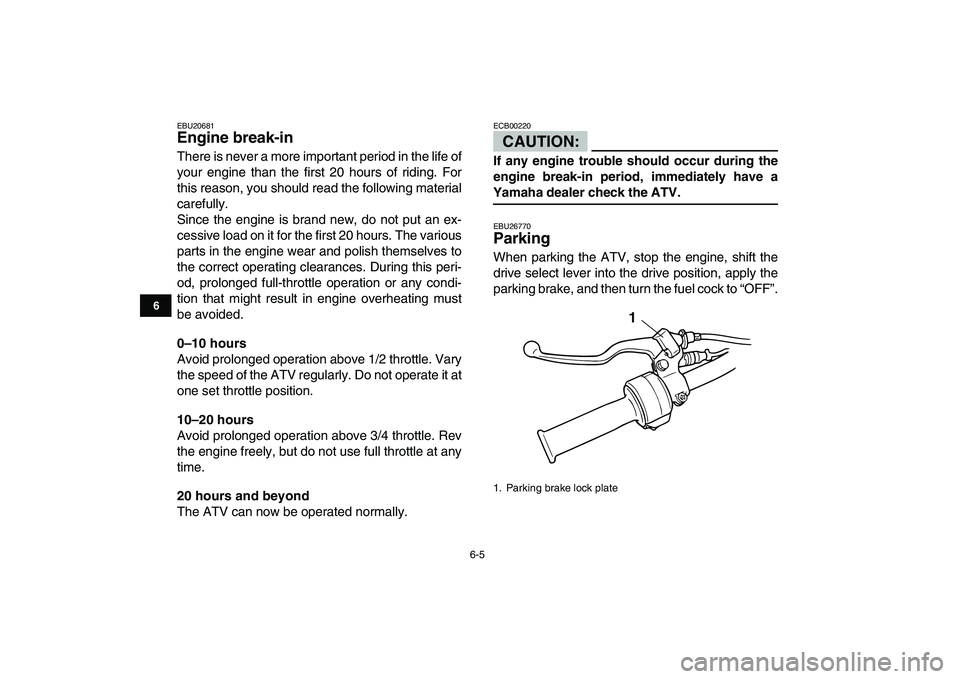
Parking
When parking the ATV, stop the engine, shift the
drive select lever into the drive position, apply the
parking brake, and then turn the fuel cock to “OFF”.
1. Parking brake lock plate
1
Page 47 of 116
6-6
1
2
3
4
56
7
8
9
10
11
EBU20800
Parking on a slope
WARNING
EWB00880
Avoid parking on hills or other inclines. Park-
ing on a hill or other incline could cause the
ATV to roll out of control, increasing the
chance of an accident. If you must park on an
incline, place the ATV transversely across the
incline, shift the shift lever to the drive posi-
tion, stop the engine, apply the parking brake,
and then block the front and rear wheels with
rocks or other objects.Do not park the ATV at all on hills that are so
steep you could not walk up them easily.
1. Bring the ATV to a stop by applying the brakes
in the drive position.
2. Stop the engine.
3. With the rear brake lever applied, apply the
parking brake and slowly release the brake le-
ver.
1. Locked position
1
Page 60 of 116

7-11
1
2
3
4
5
67
8
9
10
11
WARNING
EWB01550
Always mount a caution flag on the ATV to
make you more visible when operating in areas
where you might not be seen by other vehicles.
Watch carefully for other vehicles.
Do not ride in areas posted “no trespassing”.
Do not ride on private property without getting per-
mission.Select a large, flat, unpaved area to become famil-
iar with your ATV. Make sure that this area is free
of obstacles and other riders. You should practice
control of the throttle, brakes, and turning tech-
niques in this area before trying more difficult ter-
rain. Always avoid riding on paved surfaces: the
ATV is designed for use on unpaved surfaces only,
and handling maneuvers are more difficult to per-
form on pavement.
Set the parking brake and follow the instruction on
page 6-1 to start the engine. Once it has warmed
up you are ready to begin riding your ATV. Re-
member that the engine and exhaust pipe will be
hot when riding and afterwards; do not allow skin
or clothing to come in contact with these compo-
nents.
Page 61 of 116

7-12
1
2
3
4
5
67
8
9
10
11
With the engine idling, shift the transmission into
the drive position and then release the parking
brake. Apply the throttle slowly and smoothly. The
centrifugal clutch will engage and you will start to
accelerate. If the throttle is applied too abruptly, the
front wheels may lift off the ground, resulting in a
loss of directional control. Avoid higher speeds un-
til you are thoroughly familiar with the operation of
your ATV.
When slowing down or stopping, release the throt-
tle and apply the brakes smoothly and evenly. Im-
proper use of the brakes can cause the tires to lose
traction, reducing control and increasing the possi-
bility of an accident.
TURNING YOUR ATV
To achieve maximum traction on unpaved surfac-
es, the two rear wheels are mounted solidly on one
axle and turn together at the same speed. There-
fore, unless the wheel on the inside of the turn is al-
lowed to slip or lose some traction, the ATV will
resist turning. A special turning technique must be
used to allow the ATV to make turns quickly and
easily. It is essential that this skill be learned first at
low speed.
WARNING
EWB01570
Always follow proper procedures for turning
as described in this Owner’s Manual. Practice
turning at low speeds before attempting to turn
at faster speeds. Do not turn at speeds too fast
for your skills or the conditions.
As you approach a curve, slow down and begin to
turn the handlebars in the desired direction. As you
do so, put your weight on the footboard to the out-
side of the turn (opposite your desired direction)
and lean your upper body into the turn. Use the
throttle to maintain an even speed through the
turn. This maneuver will let the wheel on the inside
of the turn slip slightly, allowing the ATV to make
the turn properly.
