2007 SKODA SUPERB service
[x] Cancel search: servicePage 188 of 259
Inspecting and Replenishing187
Using the systemSafetyDriving TipsGeneral MaintenanceBreakdown assistanceTechnical Data
Engine oil specifications for vehicles with fixed service intervals (QG2)
Engine oil specifications for models with flexible service intervals (QG1)
Caution
Only the above-mentioned oils
may be used on vehicles with flexible service inter-
vals (QG1). We recommend always refilling with oil of the same specification since
this will maintain the properties of the oil. In exceptional cases, you must top up
only once engine oil complying with Sp ecification VW 502 00 (only for petrol
engines) or Specification VW 505 01 (only for diesel engines) to maximum 0.5 litres.
You must not use other engine oi ls - risk of engine damage!
Note
•Before a long drive we recommend th at you purchase and carry with you
engine oil which complies with the specif ication for your vehicle. Consequently,
you will always have the correct engine oil for refilling.
•We recommend using a preservative from the Škoda original accessories
offered by your Škoda dealer.
•For further information - see Service shedule.
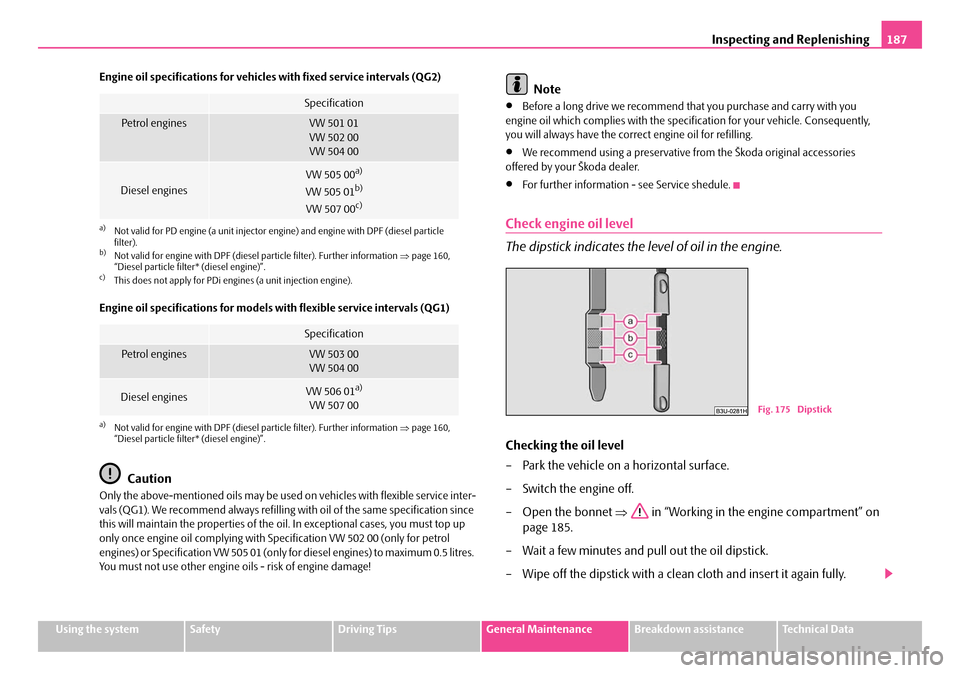
Check engine oil level
The dipstick indicates the le vel of oil in the engine.
Checking the oil level
– Park the vehicle on a horizontal surface.
– Switch the engine off.
– Open the bonnet ⇒ in “Working in the engine compartment” on
page 185.
– Wait a few minutes and pull out the oil dipstick.
– Wipe off the dipstick with a clean cloth and insert it again fully.
Specification
Petrol enginesVW 501 01
VW 502 00
VW 504 00
Diesel engines
VW 505 00a)
VW 505 01b)
VW 507 00c)
a)Not valid for PD engine (a unit injector engine) and engine with DPF (diesel particle
filter).
b)Not valid for engine with DPF (diesel pa rticle filter). Further information ⇒page 160,
“Diesel particle filter* (diesel engine)”.
c)This does not apply for PDi engi nes (a unit injection engine).
Specification
Petrol enginesVW 503 00
VW 504 00
Diesel enginesVW 506 01a)
VW 507 00
a)Not valid for engine with DPF (diesel pa rticle filter). Further information ⇒page 160,
“Diesel particle filter* (diesel engine)”.
Fig. 175 Dipstick
NKO B5 20.book Page 187 Friday, March 2, 2007 1:46 PM
Page 190 of 259

Inspecting and Replenishing189
Using the systemSafetyDriving TipsGeneral MaintenanceBreakdown assistanceTechnical Data
Changing engine oil
The engine oil must be changed at the intervals stated in the Service schedule or
according to the service interval indicator ⇒page 14.
WARNING
•Only carry out the engine oil change, if you have the required profes-
sional knowledge!
•Read and observe the warning notes ⇒page 185, “Working in the engine
compartment” before working in the engine compartment.
•Let the engine cool down - risk of burning from hot oil.
•Wear an eye protection - risk of caustic burns due to oil splashes.
•Oil is toxic! Store old oil in a safe place out of the reach of children and
unauthorized persons until you dispose of it properly.
Caution
You must not pour any additives into th e engine oil - risk of engine damage!
Damage, which results from such produc t, are excluded from the warranty.
For the sake of the environment
•You must on no account pour oil into the ground or into the sewage system.
•In view of the problems involved in prop erly disposing of old oil, the material,
equipment and the knowledge required for such work, we recommend that you
have the oil and oil filter change carried out by your Škoda Service Partner.
Note
After your skin has come in contact with the oil, you must thoroughly wash your
skin.
Cooling system
Coolant
The job of the coolant is to cool the engine.
The cooling system does not require an y maintenance under normal operating
conditions. The coolant consist s of water with a concentration of coolant additive
of 40 %. This mixture not only provides antifreeze protection down to -25°C but
also protects the cooling and heating system from corrosion. It also prevents the
formation of scale and significantly increases the boiling point of the coolant.
You must therefore not reduce the concentration of antifreeze agent in the coolant
by adding water, also not during the su mmer months or in countries with a warm
climate. The concentration of coolant additive in the coolant must be at least
40%.
You can increase the amount of antifreeze in the coolant if a higher concentration
of antifreeze is necessary for climatic reasons but only up to 60% (antifreeze
protection down to approx. -40°C). The an tifreeze protection tails off above that
concentration.
Vehicles exported to countries with a co ld climate (e.g. Sweden, Norway, Finland)
are already factory-filled with a coolant which offers antifreeze protection down to
about -35°C. In these countries the concentr ation of coolant additive should be at
least 50 %.
Coolant
The cooling system is filled at the works with coolant (purple in colour), which
complies with the specification TL-VW 774 F.
We recommend that you use the antifreeze agent - G12 PLUS (purple in colour).
Please contact your Škoda Se rvice Partner if you have any questions regarding the
coolant or if you wish to fill up with a different coolant.
Your Škoda Service Partner can also suppl y you with the correct coolant additives.
NKO B5 20.book Page 189 Friday, March 2, 2007 1:46 PM
Page 193 of 259

Inspecting and Replenishing
192
⇒page 186. The brake fluid reservoir on right-hand steering models is
positioned on the other side of the engine compartment.
– Switch the engine off.
– Open the bonnet ⇒ in “Working in the engine compartment” on
page 185.
– Pull off the rubber seal ⇒page 191, fig. 177 partially away and lift
the cover slightly.
– Inspect the brake fluid level at the reservoir . The level must be
between the “MIN” and “MAX” markings. The markings are indicated
on the side of the reservoir.
A slight drop in the fluid level results when driving due to normal wear-and-tear
and automatic adjustment of the br ake pads, and is perfectly normal.
There may be an indication of a leak in th e brake system, however, if the fluid level
drops significantly within a short time or if it drops below the “MIN” marking. A situ-
ation where the brake fluid level is too low is indicated by the warning light
lighting up in the instrument cluster ⇒page 29. In this case stop the car immedi-
ately and do not drive any further! Cont act a Škoda Dealer to obtain profes-
sional assistance.
WARNING
•Read and observe the warning notes ⇒page 185, “Working in the engine
compartment” before working in the engine compartment.
•If the fluid level has dropped below the MIN marking, do not drive any
further - risk of accident! Contact a Škoda dealer to obtain professional
assistance.
Replacing brake fluid
Brake fluid absorbs moisture. This causes the fluid to absorb moisture from the
surrounding air over a period of time. Excessive water in the brake fluid may be the
cause of corrosion in the brake system. Th e water content also lowers the boiling point of the brake fluid.
This is why brake fluid mu st be replaced every two
years.
One may only use new genuine brake fluid from Škoda Auto a.s. The specification
for the brake fluid is “FMVSS 116 DOT 4”.
We recommend that you have the brake fluid replaced by a Škoda Service Partner
as part of an Inspection Service.
WARNING
•Using old brake fluid can result in seve re stress on the brakes because of
the formation of vapour bubbles in th e brake system. This greatly impairs
the braking efficiency and thus al so the safety of your vehicle.
•Brake fluid is toxic! It must therefore be kept safely in closed original
containers and well away from children and unauthorized persons.
Caution
Brake fluid damages the paintwork of the vehicle.
For the sake of the environment
In view of the problems involved with prop er disposal of brake fluid, the special
tools and the professional knowledge required, you should have the brake fluid
replaced by a Škoda Service Partner.
AB
AC
AA
NKO B5 20.book Page 192 Friday, March 2, 2007 1:46 PM
Page 196 of 259

Inspecting and Replenishing195
Using the systemSafetyDriving TipsGeneral MaintenanceBreakdown assistanceTechnical Data
Inspecting the electrolyte level
The battery is practically maintenance-free under normal oper ating conditions.
We do, however, recommend that you have the electrolyte level inspected from
time to time by a specialist garage when outside temperatures are high or when
driving on long trips. You should also check the electrolyte level ⇒page 195 each
time the battery is charged.
The battery acid level will also be chec ked as part of the Inspection Service.
Operation in winter
The battery has to provide greater amounts of electricity during the winter. It also
has only part of the initial power output at low temperatures that it has at normal
temperatures.
A discharged battery may already freez e at temperatures just below 0°C.
We therefore recommend that you have the battery checked by a specialist garage
before the start of the winter, and recharged if necessary.
Note
If the vehicle is not going to be driven for a period of some weeks when there is very
severe frost one should remove ⇒page 196 the battery and store it in a place
which is protected from frost. This prevents the battery from freezing up and
thereby being destroyed.
Charging the battery
A properly charged battery is essential for reliably starting the
engine.
–Read the warning notes ⇒ in “Working on the battery” on
page 193 and ⇒.
– Switch the ignition and all electrical components off. – Only for “quick-charging”: Disconnect
both battery cables (first of all
“negative”, then “positive”).
– Carefully attach the terminal clamps of the charger to the battery terminals (red = “positive”, black = “negative”).
– You can now plug the mains cable of the charger into the power socket
and switch on the charger.
– When charging is completed: switch the charger off and unplug the mains cable from the power socket.
– Only then should you disconnect the terminal clamps of the charger.
– Reconnect the cables to the battery (first of all “positive”, then “nega- tive”).
It is not normally necessary to disconnect the cables of the battery if you recharge
the battery using low amperages (as for example from a mini-charger). Please also
refer to the instructions from the charger manufacturer.
A charging current of 0.1 of the total battery capacity (or lower) is that which should
be used until full charging is achieved.
It is, however, necess ary to disconnect both cables be fore charging the battery with
high amperages, so-called “ quick-charging”.
“Quick-charging” a battery is dangerous ⇒ in “Working on the battery” on
page 193. It requires a special charger an d appropriate knowledge. We therefore
recommend that you have your battery qu ick-charged only by your specialist
garage.
A discharged battery may already freeze at temperatures just below 0°C. ⇒. We
recommend that you no longer use a ba ttery which has thawed out because the
casing of the battery may be cracked through the formation of ice and this would
allow battery electrolyte to flow out.
The vent plugs of the battery should not be opened for charging.
NKO B5 20.book Page 195 Friday, March 2, 2007 1:46 PM
Page 199 of 259

Inspecting and Replenishing
198
Caution
•On no account should you add radiator antifreeze or other additives to the
windscreen washer fluid.
•If the vehicle is fitted with headligh t cleaning system, you should only add
cleaning products which do not attack th e polycarbonate coating of the headlights
to the windscreen washer fluid. Please contact your Škoda Service Partner, who will
tell you which cleaning agent you can use.
Note
Do not take the filter out of the windscreen wash container when filling it up again
with liquid otherwise dirt can get into the liquid transportation system and can lead
to faults in operation of the windscreen wash system.
NKO B5 20.book Page 198 Friday, March 2, 2007 1:46 PM
Page 202 of 259

Wheels and Tyres201
Using the systemSafetyDriving TipsGeneral MaintenanceBreakdown assistanceTechnical Data
For the sake of the environment
Tyres which are insufficiently inflated increase your fuel consumption.
Wear indicators
The base of the tread of the original tyres has wear indicators 1.6 mm high, installed
at right angles to the direction of travel. These wear indicators are located at 6 - 8
points depending on the make and are evenly spaced around the circumference of
the tyre ⇒fig. 185 . Markings on the walls of the tyres through the letters “TWI”,
triangular symbols or other symbols identify the position of the wear indicators.
A remaining tread of just 1.6 mm, measured in the grooves of the tread next to the
wear indicators, means that your tyres have reached their legally permissible
minimum tread depth.
WARNING
•You must have your tyres replaced with new ones at the latest when the
wear indicators have been worn do wn. The legally permissible minimum
tread depth should be observed.
•Worn tyres do not provide the necessary adhesion to the road surface at
high speeds on wet roads. One could experience “aquaplaning” (uncon-
trolled movements of the vehicle - “swimming” on a wet road surface).
Changing wheels around
If significantly greater wear is present on the front tyres, we recommend changing
the front wheels around with the rear wheels as shown in the diagram ⇒fig. 186 .
You will then obtain approximately the same life for all the tyres.
It may be advantageous to swap the tyre s over “crosswise” when certain types of
wear characteristic arise on the running surface of the tyres (but not in the case of
unidirectional tyres). Škoda Service Pa rtners can provide you with details.
We recommend that you change the wheels around every 10 000 km in order to
achieve even wear on all wheels and to obtain optimal tyre life.
New tyres and wheels
Tyres and wheel rims are important design elements. One should therefore use the
tyres and wheel rims which have been released for use by Škoda Auto. They are
exactly matched to the vehicl e type and therefore contribu te significantly to good
road holding and safe driving characteristics ⇒ .
Only fit radial tyres of the same type on all 4 wheels, size (rolling circumference)
and, if possible, the same tread pattern on one axle.
The Škoda Service Partners have access to the most current information about
which tyres we have released for use on your vehicle.
Fig. 185 Tyre tread with
wear indicators
Fig. 186 Changing
wheels around
NKO B5 20.book Page 201 Friday, March 2, 2007 1:46 PM
Page 203 of 259

Wheels and Tyres
202
We recommend that you have any work rela ting to tyres or wheels carried out by
your Škoda Service Partner . Your dealer has all of the necessary special tools and
replacement parts available plus the required specialist knowledge and is also in a
position to properly dispose of the old tyres. A large number of Škoda Service Part-
ners also have an attractive range of tyres and wheels available.
The tyre/wheel combinations which are appr oved for your vehicle are indicated in
your vehicle documents. Approval and lice nsing may differ according to the legis-
lation prevailing in individual countries.
Proper knowledge of the tyre data makes it easier for you to select the correct type
of tyre. Tyres do, for example, have the following inscription on their walls:
205 / 60 R 15 91 V
What this means is:
The following speed restrictions apply to tyres. The
date of manufacture is also stated on the tyre wall (possibly only on the inside
of wheel):
DOT ... 20 04...
means, for example, that the tyre was manufactured in the 20th week of the year
2004.
Any spare wheel which differs from the tyres fitted to the vehicle (e.g. winter tyres
or low-profile tyres) should only be used only for a short time in the event of a
puncture and when adopting an appropriately cautious style of driving. It should be
replaced as quickly as possible by a normal wheel.
WARNING
•Only use those tyres or wheel rims which have been approved for your
model of Škoda Auto a.s. vehicle. Failure to observe this instruction will
adversely affect the road safety of your vehicle - risk of accident! Approval
and licencing of your vehicle on publ ic roads may also become void as a
result.
•You must on no account drive at a hi gher speed than is permissible for
your tyres - risk of an accident resulting from tyre damage and loss of control
over your vehicle.
•Tyres which are 6 years old or more should only be fitted in exceptional
cases and when adopting an approp riately cautious style of driving.
•Never fit tyres which have already been used without having adequate
knowledge of their previous history. Ty res age even if they have not been
used at all or only very little. A spare tyre must only be used in exceptional
cases and only then when adopting an appropriately cautious style of
driving.
•Do not, where possible, replace indivi dual tyres but at least replace them
on both wheels of a given axle at the same time. Always fit the tyres with the
deeper tread depth to the front wheels.
For the sake of the environment
Old tyres must be disposed of in conf ormity with the appropriate regulations.
205Tyre wid th in mm
60Height/width ratio in %
RCode letter for the type of tyre - Radial
15Diameter of wheel in inches
91Load index
VSpeed symbol
Speed symbolPermissible maximum speed
S180 km/h
T190 km/h
H210 km/h
V240 km/h
W270 km/h
Y300 km/h
NKO B5 20.book Page 202 Friday, March 2, 2007 1:46 PM
Page 204 of 259

Wheels and Tyres203
Using the systemSafetyDriving TipsGeneral MaintenanceBreakdown assistanceTechnical Data
Note
It is not normally possible to fit wheels from other models of cars for technical
reasons. This may also apply in certain circumstances to the wheels of the same
type of vehicle.
Wheel bolts
Wheels and wheel bolts are matched to each other in terms of design. Each time
you fit other wheels - e.g. light alloy wheels or wheels with winter tyres - you must
therefore also use the matching wheel bolts of the correct length and shape of
spherical cap. This is essential to ensure that the wheels are tightly fitted and that
the brake system operates properly.
If you retrofit wheel trims (or have this done), please also ensure that an adequate
flow of air remains assured for cooling the brake system.
The Škoda Service Partners are instructed in the technical possibilities which exist
regarding converting or retrofitti ng wheels, tyres and wheel trim.
WARNING
•In case of incorrect treatment of the wheel bolts, the wheel can loosen
when the car is moving - risk of accident!
•The wheel bolts must be clean and must turn easily. However, they must
never be treated with grease or oil.
•If the wheel bolts are tightened to a too low tightening torque, the rim
can lossen when the car is moving - risk of accident! A tightening torque
which is too high can damage the bolts and threads and this can result in
permanent deformation of the contact surfaces on the rims.
Caution
The prescribed tightening torque of the wheel bolts for steel and light alloy wheels
is 120 Nm.
Winter tyres
The handling of your vehicle will be significantly improved when driving on wintry
roads if you fit winter tyres. Summer tyres do not offer the same grip on ice, snow
and at temperatures below 7 °C because of their construction (width, rubber blend,
tread pattern). This applies in particul ar to vehicles which are equipped with low-
profile tyres or high-speed tyres (code index V, W or Y on wall of tyre).
Winter tyres must be mounted on all four wheels to obtain the best handling char-
acteristics.
You must only fit those types of winter tyre which are approved for your vehicle. The
permissible sizes of winter tyres are stated in your vehicle documents. Approvals
may differ because of national legislation.
Please remember that the tyres should be inflated to 20 kPa (0.2 bar) more than is
the case for summer tyres ⇒page 200.
Winter tyres no longer offer the same winter performance once the tyre tread has
worn down to a depth of about 4 mm.
Ageing also causes winter tyres to lose most of their winter performance properties
- even in cases where the remaining tread depth is still clearly more than 4 mm.
Speed restrictions apply to winter tyres as well as to summer tyres ⇒page 201,
⇒ .
You can fit winter tyres of a lower speed ca tegory to your vehicle provided that you
also do not drive faster than the permissible maximum speed for such tyres, even
if the possible maximum speed of your vehicle is higher. The corresponding tyre
category can damage the tyres when exceeding the permissible maximum speed.
Please pay attention to the notes if you decide to fit winter tyres ⇒page 199.
You can also fit so-called “all-year tyres” instead of winter tyres.
Please contact your specialist garage if there are any points which are not clear who
will be able to provide you with information regarding the maximum speed for your
tyres.
NKO B5 20.book Page 203 Friday, March 2, 2007 1:46 PM