2007 SKODA SUPERB service
[x] Cancel search: servicePage 119 of 259

Communicating and Navigating
118
Note
•If the setting of the memory is changed, you must take the mobile phone out of
the adapter and insert it again in order to transmit the data from the newly set
memory into the information display.
•If you do not operate the mobile phone (do not scroll in the memory, do no call,
etc.) it switches automatically ov er to radio mode after 60 seconds.
•If you switch the ignition off and leave the mobile phone inserted in the adapter,
the system switches off automaticall y the mobile phone after 30 minutes.
•If you have stored in the phonebook name s with special characters (ticks, lines
etc.), the special characters will not alwa ys be correctly displayed on the informa-
tion display.
•The function of the convenience operating feature with the buttons on the
multifunction steering wheel is not available on all mobile phones and adapters.
Please contact your Škoda Service Partner, who will tell you which adapter and
which mobile phone you can use.
CD changer*
Take out and insert CD magazine
The CD changer for the radio and navigation system is located in the left
side compartment of the luggage compartment.
Take magazine out of the changer
– Open safety stop ⇒fig. 128 fully.
– Press button . The magazine is automatically ejected.
– Take out the magazine.
Insert magazine into the changer
– Insert the magazine with the arrow of the illustration upwards up to the stop ⇒page 119, fig. 129 . The tip of the arrow on the magazine
must point at the same time to the magazine box.
– Slide safety stop closed.
After inserting the magazine, it is analysed how many CDs are in the magazine.
If there is no magazine in the changer, NO CD MAGAZINE is displayed in the CD-
mode on the display of the radio.
You can also take out the magazine when the radio is switched off.
Caution
Always close the safety cover after insertin g the magazine. The safety cover protects
the CD-changer from dirt and dust partic les penetrating into the CD-changer, in
order to avoid operational faults.
Note
•Described in this Owner's Manual are only the steps required for the operation
of the CD-changer.
•You will find further information for this setting menu in the Radio Owner's
Manual.
•Only Use CD-magazines from Škoda Original Accessories.
Fig. 128 The CD changer
A1
A3A2
NKO B5 20.book Page 118 Friday, March 2, 2007 1:46 PM
Page 121 of 259

Communicating and Navigating
120
Fa u lt d i sp la y s
On the radio display the following fault displays can be displayed:
•NO CD CHANGER - CD-changer is not co nnected to the magazine.
•NO CD MAGAZINE - no magazine in the CD-changer.
•NO CD - the selected compartment in the magazine of the CD-changer is
empty.
•SURFACE - in the selected compartment the CD with playback side is inserted
upwards.
Tips for operating the CD-changer
Please pay attention to the following notes for operating the CD-changer.
•Only clean CDs without scratches and damages should be used, in order to
guarantee a proper, high-quality CD-playback.
•Affix no labels to the CDs.
•Always store non-used CDs in the CD-s torage from the Škoda genuine accesso-
ries provided for this as well as in the original folding box.
•Never expose CDs to direct sun rays.
•Use a soft, non-fluffy cloth to clean the CDs. Wipe the CD straight-lined from
the middle to the outside. Strong dirt mu st be eliminated with usual CD-cleaner.
•Please never use liquids such as gasoline , paint thinner or disk cleaner, other-
wise the surface of the CD could get damaged.
Precaution measures for laser equipment
Laser equipment is classifi ed according to DIN IEC 76 (CO) 6/VDE 0837 in the
safety categories 1 - 4.
The Škoda CD-changer correspond s to the safety category 1. The laser used for equipment of category 1 is to such an extent energy-poor and/or
shielded that there is no risk of danger
when used in accordance with the regula-
tion.
WARNING
Please always pay full attention to the traffic situation around you!
Note
Do not remove the equipment cover. The equipment does not contain any parts,
which can be serviced by the user.
Warranty
The same guarantee conditions apply for our factory-fitted radio system as for new
vehicles.
Note
A damage in the sense of the warranty must not be the result from improper
handling of the system or from unprofes sional repair attempts. In addition, no
external damage must be present.
NKO B5 20.book Page 120 Friday, March 2, 2007 1:46 PM
Page 123 of 259
Communicating and Navigating
122
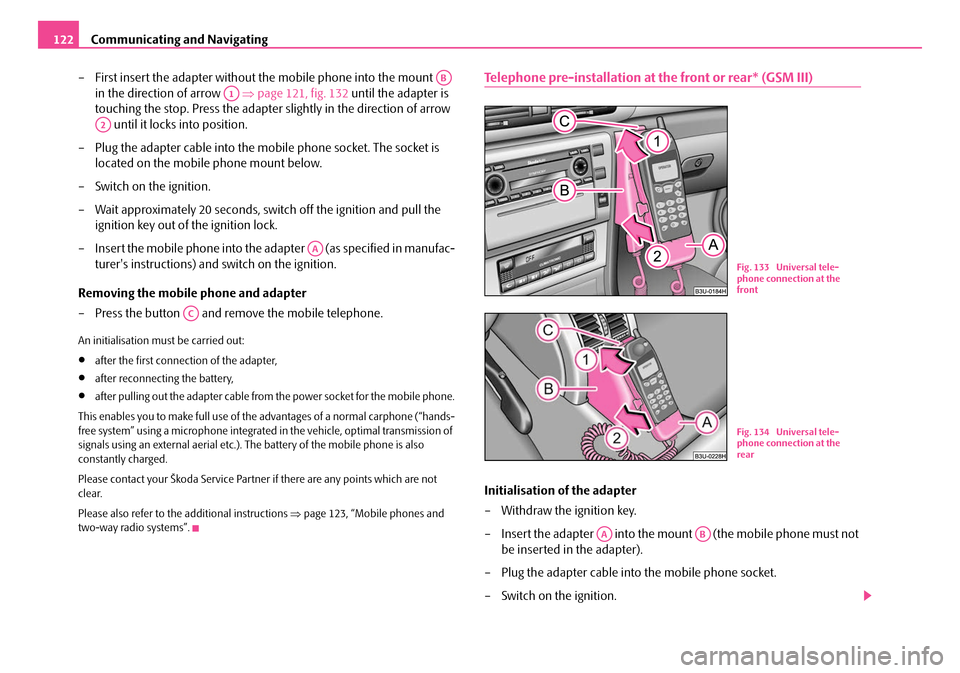
– First insert the adapter without the mobile phone into the mount in the direction of arrow ⇒page 121, fig. 132 until the adapter is
touching the stop. Press the adapter slightly in the direction of arrow until it locks into position.
– Plug the adapter cable into the mobile phone socket. The socket is located on the mobile phone mount below.
– Switch on the ignition.
– Wait approximately 20 seconds, switch off the ignition and pull the ignition key out of the ignition lock.
– Insert the mobile phone into the adapter (as specified in manufac- turer's instructions) and switch on the ignition.
Removing the mobile phone and adapter
– Press the button and remove the mobile telephone.
An initialisation mu st be carried out:
•after the first connection of the adapter,
•after reconnecting the battery,
•after pulling out the adapter cable from the power socket for the mobile phone.
This enables you to make full use of the ad vantages of a normal carphone (“hands-
free system” using a microphone integrated in the vehicle, optimal transmission of
signals using an external aerial etc.). The battery of the mobile phone is also
constantly charged.
Please contact your Škoda Service Partner if there are any points which are not
clear.
Please also refer to the additional instructions ⇒page 123, “Mobile phones and
two-way radio systems”.
Telephone pre-installation at the front or rear* (GSM III)
Initialisation of the adapter
– Withdraw the ignition key.
– Insert the adapter into the mount (the mobile phone must not be inserted in the adapter).
– Plug the adapter cable into the mobile phone socket.
– Switch on the ignition.
AB
A1
A2
AA
AC
Fig. 133 Universal tele-
phone connection at the
front
B1Z-0042HB1Z-0042H
Fig. 134 Universal tele-
phone connection at the
rear
AAAB
NKO B5 20.book Page 122 Friday, March 2, 2007 1:46 PM
Page 124 of 259

Communicating and Navigating123
Using the systemSafetyDriving TipsGeneral MaintenanceBreakdown assistanceTechnical Data
– Wait approximately 20 seconds, switch off the ignition and pull the
ignition key out of the ignition lock.
– Insert the mobile phone into the adapter (as specified in manufac- turer's instructions) and switch on the ignition.
An initialisation must be carried out:
•after the first connection of the adapter,
•after reconnecting the battery,
•after pulling out the adapter cable from the power socket for the mobile phone.
This enables you to make full use of the advantages of a normal carphone (“hands-
free system” using a microphone integrated in the vehicle, optimal transmission of
signals using an external aerial etc.). The battery of the mobile phone is also
constantly charged.
A telephone mount is factory-fitted for the front mobile phone and for the rear
mobile phone. The front telephone mount is located on the front centre console
⇒ page 122, fig. 133 , the rear on the rear centre console ⇒page 122, fig. 134 .
Adapter (Cullmann) and mobile phone are not factory-fitted by Škoda Auto.
Please also refer to the additional instructions ⇒page 123, “Mobile phones and
two-way radio systems”.
Note
For technical reasons it is not possible to use simultaneously the front and rear
mobile phone. Ensure that the adapter is always inserted only in the bracket
.
Mobile phones and two-way radio systems
The installation of a mobile phone and tw o-way radio system in a vehicle should
only be carried out by a Škoda Dealer.
Škoda Auto a.s. permits the operation of mobile phones and two-way radio
systems with a professionally installed external aerial and a maximum transmission
power of up to 10 watts. Our specialist garage is also happy to inform you about the possibilities available
for installing and operating mobile telephones and radio transmitters which have
an output greater than 10 watts. The Škoda Service Partners can provide you with
details about the technical possibilities for retrofitting of mobile telephones and
radio transmitters.
The operation of commercially available mo
bile phones or two-way radio systems
may cause operational problems in the electronic systems of your car. The reasons
for this may be:
•no external aerial,
•external aerial incorrectly installed,
•transmission power gr eater than 10 watts.
You should therefore not operate a mobile phone or two-way radio system
inside the vehicle without the use of an external aerial, or with an external aerial
which has been incorrectly installed.
You should also be aware of the fact that only an external aerial makes it possible
to achieve the optimal range of such equipment.
WARNING
•If a mobile phone or two-way radio sy stem is operated inside the vehicle
without using an external aerial, or wi th an external aerial which has been
incorrectly installed, the result can be excessive electromagnetic fields
which may cause harm to your health.
•Please always pay full attention to the traffic situation around you!
•You must not install two-way radio systems, mobile phones or mounts
on the covers of the airbags or within the immediate deployment range of
airbags. This might result in injuries to the occupants in the event of an acci-
dent!
Note
Please also refer to the operating instructions of the mobile phones and two-way
radio systems.
AAAB
NKO B5 20.book Page 123 Friday, March 2, 2007 1:46 PM
Page 135 of 259

Seat belts
134
Taking seat belts off
– Press the red button in the belt lock ⇒fig. 143 . The spring force causes
the tongue of the lock to jump out.
– Guide the belt back with your hand to enable the inertia reel to wind
up the belt webbing more easily.
A plastic knob in the belt webbing holds the belt tongue in a position which is easy
to get hold of.
Three-point safety belt for the middle rear seat
Your car is equipped as standa rd with the three-point seat belt in the middle rear
seat. It is used in the same way as the three-point seat belts on the left and right (at
front and rear). The three-point seat belt for the rear middle seat must be put on
first to allow the pelvic part of the belt to run between the belt lock for the right
three-point seat belt and the backrest, whil e avoiding crossing the belt webbing of
the right and middle seat belts.
WARNING
The three-point safety belt for the rear middle seat can only fulfil its function
reliably when the backrests are correctly locked into position ⇒page 70.
Blocking seat belts
The three-point seat belts for the front passenger and for the rear seats can be
blocked for attaching a child safety seat ⇒ page 152, “Attaching child safety seat”.
Blocking the belt in this way ensures that th e child seat is held firmly in position in
the car.
WARNING
Never attach a child safety seat on the front passenger seat if the child is
seated with its back facing in direct ion of travel when the front passenger
airbag is still activated ⇒page 147, “Use of child safety seats on the front
passenger seat”. Risk of severe or even fatal injuries!
Belt tensioners
Safety for the driver and passengers wearing their seat belts, is enhanced by the
belt tensioners fitted to the inertia reels of the front and rear side three-point seat
belts, in addition to the protecti on afforded by the airbag system.
The fastened three-point seat belts are au tomatically tensioned in the event of a
frontal collision of a certain severity. Th e rear outside belt tensioners are also
deployed if the seat belt is not fastened.
The belt tensioner is deployed in the event of a frontal collision of major severity. A
powder charge is ignited in the inertia reels during deployment. The belt webbing
is pulled into the inertia reels by a mech anical system and the belt is tensioned.
Belt tensioners are not activated in the ev ent of minor frontal collisions, side and
rear-end collisions, in the ca se of a rollover and also not in accidents in which no
major forces are produced from the front.
WARNING
•The service life of seat belts and belt tensioners is 15 years from the date
of manufacture of the vehicle. It is then necessary to have the seat belts
replaced by a specialist garage.
Fig. 143 Releasing lock
tongue from belt lock
NKO B5 20.book Page 134 Friday, March 2, 2007 1:46 PM
Page 136 of 259

Seat belts135
Using the systemSafetyDriving TipsGeneral MaintenanceBreakdown assistanceTechnical Data
•Any work on the belt tightener syst em, including removal and installa-
tion of system components because of other repair work, must only be
carried out by a specialist garage.
•The protective function of the system is only adequate for a single acci-
dent. If the belt tensioners have been deployed, it is then necessary to
replace the entire system.
•The Owner's Manual must also be ha nded over to the new owner if the
vehicle is sold.
Note
•Smoke is generated when the belt tensioners are deployed. This is not an indi-
cation of a fire in the vehicle.
•It is essential to pay attention to relevant safety regulations if the vehicle or indi-
vidual parts of the system are scrapped. Škoda Service Partners are familiar with
these regulations and will be able to provide you with detailed information in this
respect.
•When disposing of vehicle or parts of the system, it is important to comply with
the national legal requirements.
WARNING (continued)
NKO B5 20.book Page 135 Friday, March 2, 2007 1:46 PM
Page 137 of 259

Airbag system
136
Airbag system
Description of the airbag system
General information on the airbag system
The front airbag system is complementary to the three-point seat belts and offers
additional protection for the head and ches t area of the driver and passenger in the
event of a frontal collision.
In the case of a violent side crash, the side and head airbags* reduce the risk of inju-
ries to the occupants on the part of th e body facing the side of the accident ⇒.
The airbag system is only functional after the ignition has been switched on.
The operational readiness of the airbag system is monitored electronically. The
airbag warning light comes on for a few seconds each time the ignition is switched
on.
The airbag system (according to vehicl e equipment) essentially consists of:
•an electronic control unit,
•the two front airbags,
•the side airbags,
•Head airbags*
•an airbag warning light in the instrument cluster,
•a front passenger airbag switch* ⇒page 144,
•an indicator light for a switched off fron t seat passenger airbag* in the middle
of the dash panel ⇒page 144.
A fault in the airbag system exists if:
•the airbag indicator light does not light up when the ignition is switched on,
•the warning light does not go out after about 3 seconds after the ignition is
switched on,
•the airbag indicator light goes out and comes on again after the ignition is
switched on,
•the airbag indicator light comes on or flickers when driving,
•an airbag indicator light showing a swit ched-off front passenger airbag* in the
middle of the dash panel flashes.
WARNING
•To enable the occupants of a car to be protected with the greatest
possible effect when the airbag is deployed, the front seats must be
⇒ page 127, “Correct seated position” co rrectly adjusted to match the body
size of the occupant.
•If you do not fasten the seat belts when driving, lean too far forward or
adopt an incorrect seated position, you are exposing yourself to increased
risk of injury in the event of an accident.
•Have the airbag system checked imme diately by a specialist garage if a
fault exists. Otherwise, there is a risk of the airbag not being activated in the
event of an accident.
•No modifications of any kind may be made to parts of the airbag system.
•It is prohibited to manipulate individual parts of the airbag system as this
might result in the airbag being deployed.
•The protective function of the airbag system is sufficient for only one
accident. The airbag system must then be replaced if the airbag has been
deployed.
•The airbag system needs no maintenance during its working life.
•If you sell your car, please hand over the complete vehicle documenta-
tion to the new owener. Please note that the documents relating to the
possibility of deactivating the front passenger airbag are also part of the
vehicle documents!
•If the vehicle or individual parts of the airbag system are scrapped, it is
essential to observe the relevant safety precautions. Škoda Service Partners
are familiar with these regulations.
•When disposing of vehicle or parts of the airbag system, it is important
to comply with the national legal requirements.
NKO B5 20.book Page 136 Friday, March 2, 2007 1:46 PM
Page 145 of 259

Airbag system
144
Deactivating an airbag
Deactivating airbags
If any airbags have been deactivated, switch them on again as soon
as possible so that they are able to again provide their proper protec-
tion.
There is the technical means installed within your vehicle to switch off the front,
side or head airbag (take out of commission).
This is why you should have the deactiva tion of the airbags carried out by a
specialist garage.
On vehicles equipped with the switch for deactivation of the airbags, you can deac-
tivate the front and side passenger airbag by means of this switch ⇒page 144.
Deactivation of airbags is envisaged only for particular instances, such as if:
•you must in exceptional cases use a child seat on the front passenger seat
where the child has its back to the directio n of travel of the vehicle (in some coun-
tries this must be in the direction of trav el due to other legal regulations applying)
⇒ page 146, “Important safety information regarding the use of child safety seats”
•you are not able to maintain the distance of at least 25 cm between middle of
steering wheel and chest, despite the driver seat being correctly adjusted,
•special attachments are required in the area of the steering wheel because of a
physical disability,
•you have installed other seats (e.g. orthopaedic seats without side airbags).
Monitoring the airbag system
The functionality of the airbag system is also monitored electronically, when one
airbag has been switched off
If the airbag was switched off using diagnostic equipment:
•The warning light for the airbag system lights up for 3 seconds after switching
on the ignition and then flashes for 12 seconds afterwards in 2 second intervals.
Front passenger airbags sw itched off using the switch for front passenger
airbags* in stowage compartmen t on the front passenger side:
•The airbag warning light comes on in th e instrument cluster for about 3 seconds
each time the ignition is switched on.
•Switching off airbags is indicated in the middle of the dash panel by the lighting
up of the indicator light ⇒ fig. 153 .
Note
Your Škoda Service Partner will be able to advise you whether national legislation in
your country allows airbags in your vehicle to be deactivated, and which ones.
Switch for the front seat passenger airbags*
Fig. 152 Storage
compartment: Switch for
the front seat passenger
airbags
Fig. 153 Indicator light
for a switched off front
seat passenger airbag
NKO B5 20.book Page 144 Friday, March 2, 2007 1:46 PM