2007 SKODA SUPERB engine oil
[x] Cancel search: engine oilPage 166 of 259
Driving and the Environment165
Using the systemSafetyDriving TipsGeneral MaintenanceBreakdown assistanceTechnical Data
Avoiding full throttle
Driving more slowly means saving fuel.
Sensitive use of the accelerator will not only significantly reduce fuel consumption
but also positively influence environmental pollution and wear of your vehicle.
You should avoid fully exploiting the top speed of your vehicle wherever possible.
Fuel consumption, pollutant emissions and vehicle noises increase disproportion-
ally at high speeds.
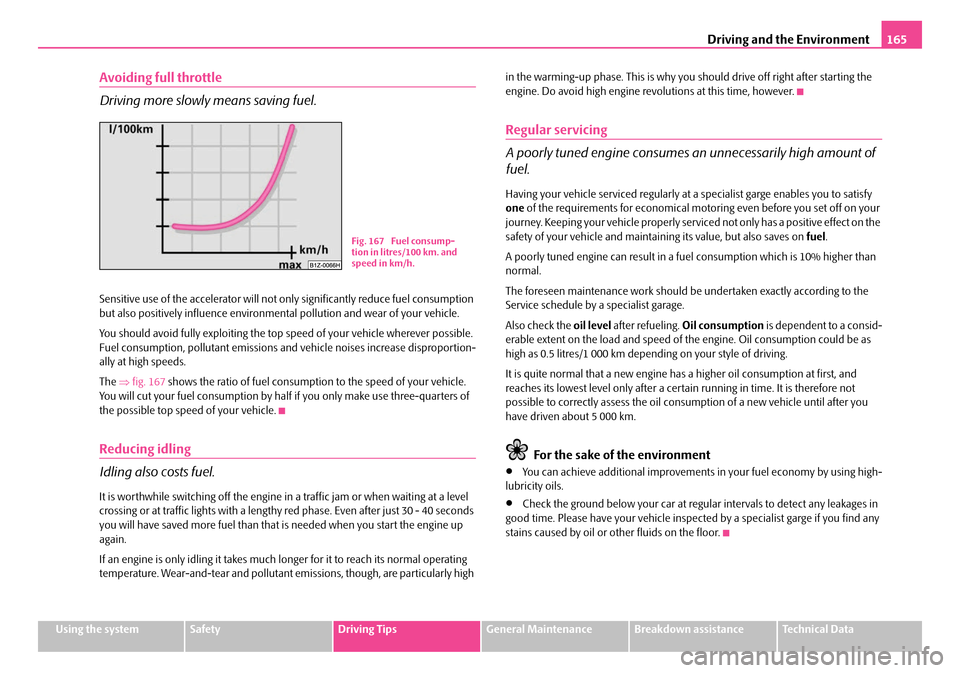
The ⇒fig. 167 shows the ratio of fuel consumptio n to the speed of your vehicle.
You will cut your fuel consumption by half if you only make use three-quarters of
the possible top speed of your vehicle.
Reducing idling
Idling also costs fuel.
It is worthwhile switching off the engine in a traffic jam or when waiting at a level
crossing or at traffic lights with a length y red phase. Even after just 30 - 40 seconds
you will have saved more fuel than that is needed when you start the engine up
again.
If an engine is only idling it takes much longer for it to reach its normal operating
temperature. Wear-and-tear and pollutant em issions, though, are particularly high in the warming-up phase. This is why you should drive off right after starting the
engine. Do avoid high engine re
volutions at this time, however.
Regular servicing
A poorly tuned engine consumes an unnecessarily high amount of
fuel.
Having your vehicle serviced regularly at a specialist garge enables you to satisfy
one of the requirements for economical motoring even before you set off on your
journey. Keeping your vehicle properly serviced not only has a positive effect on the
safety of your vehicle and maintaining its value, but also saves on fuel.
A poorly tuned engine can result in a fu el consumption which is 10% higher than
normal.
The foreseen maintenance work should be undertaken exactly according to the
Service schedule by a specialist garage.
Also check the oil level after refueling. Oil consumption is dependent to a consid-
erable extent on the load and speed of the engine. Oil consumption could be as
high as 0.5 litres/1 000 km depending on your style of driving.
It is quite normal that a new engine ha s a higher oil consumption at first, and
reaches its lowest level only after a certain running in time. It is therefore not
possible to correctly assess the oil cons umption of a new vehicle until after you
have driven about 5 000 km.
For the sake of the environment
•You can achieve additional improvements in your fuel economy by using high-
lubricity oils.
•Check the ground below your car at regula r intervals to detect any leakages in
good time. Please have your vehicle inspected by a specialist garge if you find any
stains caused by oil or other fluids on the floor.
Fig. 167 Fuel consump-
tion in litres/100 km. and
speed in km/h.
NKO B5 20.book Page 165 Friday, March 2, 2007 1:46 PM
Page 169 of 259
Driving and the Environment
168
Unleaded petrol
A vehicle fitted with a petrol engine must always be refuelled with unleaded petrol
⇒ page 163. The automobile associations can provide you with information
regarding the locations of filling stations which offer unleaded petrol.
Headlight
The low beam of your headlights is set asymmetrically. It illuminates the side of the
road on which you are driving to a greater extent. If you drive abroad on the other
side of the road, you will dazzle oncoming traffic.
It is necessary in order to avoid dazzling oncoming traffic to stick a sticker over a
certain part of the headlights.
Headlight stickers can be obtained as a spare part from the Skoda Service Partners.
Headlights with Xenon lamps are designed for driving in countries with traffic on
the right or on the left. Have this do ne always at a Škoda Service Partner.
Note
You can obtain further information regardin g masking over or converting the head-
lights from your Škoda Service Partner.
Avoiding damage to your vehicle
When driving on poor roads and lanes or when driving over kerbstones, steep
ramps etc., you must pay particular attent ion to ensuring that any low-slung parts
of the vehicle, such as spoiler and ex haust, do not touch the ground and get
damaged.
This particularly applies to models with a lowered suspension (sport suspension)
and also when your vehicle is fully laden.
NKO B5 20.book Page 168 Friday, March 2, 2007 1:46 PM
Page 179 of 259

Taking care of your vehicle and cleaning the vehicle
178
Engine compartment
Good corrosion protection is very importan t, particularly in winter when one often
drives over its salt-strewn roads. One should therefore clean the entire engine
compartment before and after the salt spreading period, in order to prevent the salt
from being destructive.
Škoda Service Partners have the cleani ng agents recommended by the manufac-
turer and also the required equipment.
WARNING
•It is necessary to observe the guidelines given in the chapter before
working on the engine compartment ⇒page 185.
•Let the engine cool down before cleaning the engine compartment.
Caution
•Engine cleaning may be only be und ertaken when the ignition is off.
•It is recommended to cover the generator before washing the engine compart-
ment.
For the sake of the environment
The dirty water produced by washing the engine has washed away petrol, and resi-
dues of grease and oil and should therefor e be cleaned by an oil separator. This is
why engine washing should only be undertaken in a garage or at a fueling station
(when these are fitted with the required equipment).
Care of the interior of vehicle
Plastic parts, artificial leather and cloths
You can clean plastic parts and artificial leather with a moist cloth. You should only
treat such parts with special solvent-free plastic cleaning and care products it
does prove to be adequate. Upholstery cloth and cloth trim on the
doors, luggage compartment cover, head-
liner etc. are best treated with special cleaning products, using if necessary a dry
foam and a soft sponge or brush.
We recommend using a cleaning product from Škoda genuine accessories offered
by your Škoda dealer.
Caution
Solvent-free cleaners attack the material and can damage it.
Fabric covers of electrically heated seats
Do not clean the seat covers moist as this may result in damage to the seat heating
system.
Clean such covers using special agents, for example dry foam.
Natural leather
Natural leather requires quite particular care and attention.
Leather should be treated from time to time according the following
guidelines depending on how much it is used.
Normal cleaning
– Clean soiled areas of the leather with slightly moistened cotton or
woollen cloth.
Severe soiling
– Clean severely soiled areas with a cloth dipped in a mild soapy solu- tion (2 spoonfuls of natural soap to 1 litre of water).
– Ensure that the leather is not soaked through at any point and that no water gets into the stitching of the seams.
– Dry off the leather with a soft, dry cloth.
NKO B5 20.book Page 178 Friday, March 2, 2007 1:46 PM
Page 186 of 259

Inspecting and Replenishing185
Using the systemSafetyDriving TipsGeneral MaintenanceBreakdown assistanceTechnical Data
WARNING
•Never open the bonnet if you see that steam or coolant is flowing out of
the engine compartment - risk of scaldi ng! Wait long enough until the steam
or coolant has stopped escaping.
•For safety reasons, the bonnet must always be properly closed when
driving. One should therefore check that the lock has in fact engaged prop-
erly after closing the bonnet.
•Stop your vehicle immediately while driv ing if you notice that the lock is
not properly engaged and close the bonne t properly - risk of an accident!
Caution
•Before opening the bonnet, ensure that the arms of the windscreen wipers are
correctly in place against the windscreen. Otherwise, there is a risk of damage to the
paintwork.
Working in the engine compartment
Particular care is required when carrying out any work in the engine
compartment!
There is a risk of injuries, scalding, accidents and fire when working in the
engine compartment, e.g. inspecting and replenishing oil and other fluids. For
this reason, it is essential to comply with the warning instructions stated
below and with the general applicable rules of safety. The engine compart-
ment of your car is a hazardous area ⇒ .
WARNING
•Never open the bonnet if you see that steam or coolant is flowing out of
the engine compartment - risk of scaldi ng! Wait long enough until the steam
or coolant has stopped escaping.
•Switch off the engine and pull out the ignition key.
•Apply the handbrake firmly.
•If your vehicle is fitted with a ma nual gearbox, move the gearshift lever
into Neutral, or if it is fitted with automatic gearbox, move the selector lever
into position P.
•Allow the engine to cool down.
•Keep children clear of the engine compartment.
•Do not touch any hot engine parts - risk of burns!
•Never spill oil and other fluids over the hot engine. Such fluids (e.g. the
antifreeze contained in the coolant) may ignite!
•Avoid short circuits in the electrical system - particularly on the battery.
•Never place your hand into the radiator fan as long as the engine is still
warm. The fan might suddenly start running!
•Never open the cap of the coolant expa nsion bottle as long as the engine
is still warm. The cooling system is pressurized!
•Cover over the cap of the coolant expansion reservoir with a large cloth
when opening it as protection for your face, hands and arms from hot steam
or hot coolant.
•Do not let objects, such as e.g cleaning cloth or tools lie in the engine
compartment.
•If you wish to work under the vehicle, you must secure the vehicle from
rolling away and support it with suitable supporting blocks: the car jack is
not sufficient for this - risk of injury!
•In cases where it be necessary to carry out inspection work when the
engine is running there is an additional risk from rotating parts (e.g. the V-
ribbed belt, alternator, radiator fan) and from the high-voltage ignition
system. Please observe in addition the following:
−Never touch the electrical cabl es of the ignition system.
− Absolutely avoid any jewellery, loose items of clothing or long hair
from getting into the rotating parts of the engine - Hazard! Therefore
remove any jewellery beforehand, tie up your hair and wear tight fitting
clothing.
WARNING (continued)
NKO B5 20.book Page 185 Friday, March 2, 2007 1:46 PM
Page 187 of 259

Inspecting and Replenishing
186
•Please also comply with the warnin g instructions stated below when
carrying out any essential work on the fuel system or on the electrical
system:
−Always separate the car batter y from the electrical system.
− Do not smoke.
− Never carry out any work close to naked flames.
− Always keep a working fire extinguisher at hand.
Caution
When replenishing fluids in the engine, always ensure that the fluids are on no
account mixed up. This may result in major operating problems and also vehicle
damage!
Overview of the engine compartment
The main inspection points
Fig. 174 6-cylinder 2.8 ltr./ 142 kW petrol engine
Battery (below a cover) . . . . . . . . . . . . . . . . . . . . . . . . . . . . . . . . . . . . .
Engine oil dipstick . . . . . . . . . . . . . . . . . . . . . . . . . . . . . . . . . . . . . . . . . .
Brake fluid reservoir . . . . . . . . . . . . . . . . . . . . . . . . . . . . . . . . . . . . . . . .
Coolant expansion bottle . . . . . . . . . . . . . . . . . . . . . . . . . . . . . . . . . . .
Engine oil filler opening . . . . . . . . . . . . . . . . . . . . . . . . . . . . . . . . . . . . .
Windshield washer fluid reservoir . . . . . . . . . . . . . . . . . . . . . . . . . . .
Power steering reservoir . . . . . . . . . . . . . . . . . . . . . . . . . . . . . . . . . . . .
Note
The location of the inspection points in the engine compartment of petrol and
diesel engines is practically identical.
Engine oil
Engine oil specifications
The grade of engine oil should be selected in accordance with
precise specifications.
The engine of your vehicle has been factor y-filled with a high-grade oil which you
can use throughout the year - except in extreme climatic regions.
You can mix various oils together with each other when refilling with oil. This does
not, however, apply for models with flexible service intervals (QG1).
Engine oils are, of course, undergoing co ntinuous further development. Thus the
information stated in this Owner's Manual is only correct at the time of publication.
Škoda Service Partners are informed by Škoda Auto a.s. about current changes. This
why you should always have engine oil changed by your Škoda Service Partner.
The specifications (VW standards) stated in the following must be indicated sepa-
rately or together with other specifications on the bottle.
WARNING (continued)A1193A2187
A3191
A4190
A5188
A6197
A7160
NKO B5 20.book Page 186 Friday, March 2, 2007 1:46 PM
Page 188 of 259
Inspecting and Replenishing187
Using the systemSafetyDriving TipsGeneral MaintenanceBreakdown assistanceTechnical Data
Engine oil specifications for vehicles with fixed service intervals (QG2)
Engine oil specifications for models with flexible service intervals (QG1)
Caution
Only the above-mentioned oils
may be used on vehicles with flexible service inter-
vals (QG1). We recommend always refilling with oil of the same specification since
this will maintain the properties of the oil. In exceptional cases, you must top up
only once engine oil complying with Sp ecification VW 502 00 (only for petrol
engines) or Specification VW 505 01 (only for diesel engines) to maximum 0.5 litres.
You must not use other engine oi ls - risk of engine damage!
Note
•Before a long drive we recommend th at you purchase and carry with you
engine oil which complies with the specif ication for your vehicle. Consequently,
you will always have the correct engine oil for refilling.
•We recommend using a preservative from the Škoda original accessories
offered by your Škoda dealer.
•For further information - see Service shedule.
Check engine oil level
The dipstick indicates the le vel of oil in the engine.
Checking the oil level
– Park the vehicle on a horizontal surface.
– Switch the engine off.
– Open the bonnet ⇒ in “Working in the engine compartment” on
page 185.
– Wait a few minutes and pull out the oil dipstick.
– Wipe off the dipstick with a clean cloth and insert it again fully.
Specification
Petrol enginesVW 501 01
VW 502 00
VW 504 00
Diesel engines
VW 505 00a)
VW 505 01b)
VW 507 00c)
a)Not valid for PD engine (a unit injector engine) and engine with DPF (diesel particle
filter).
b)Not valid for engine with DPF (diesel pa rticle filter). Further information ⇒page 160,
“Diesel particle filter* (diesel engine)”.
c)This does not apply for PDi engi nes (a unit injection engine).
Specification
Petrol enginesVW 503 00
VW 504 00
Diesel enginesVW 506 01a)
VW 507 00
a)Not valid for engine with DPF (diesel pa rticle filter). Further information ⇒page 160,
“Diesel particle filter* (diesel engine)”.
Fig. 175 Dipstick
NKO B5 20.book Page 187 Friday, March 2, 2007 1:46 PM
Page 189 of 259

Inspecting and Replenishing
188
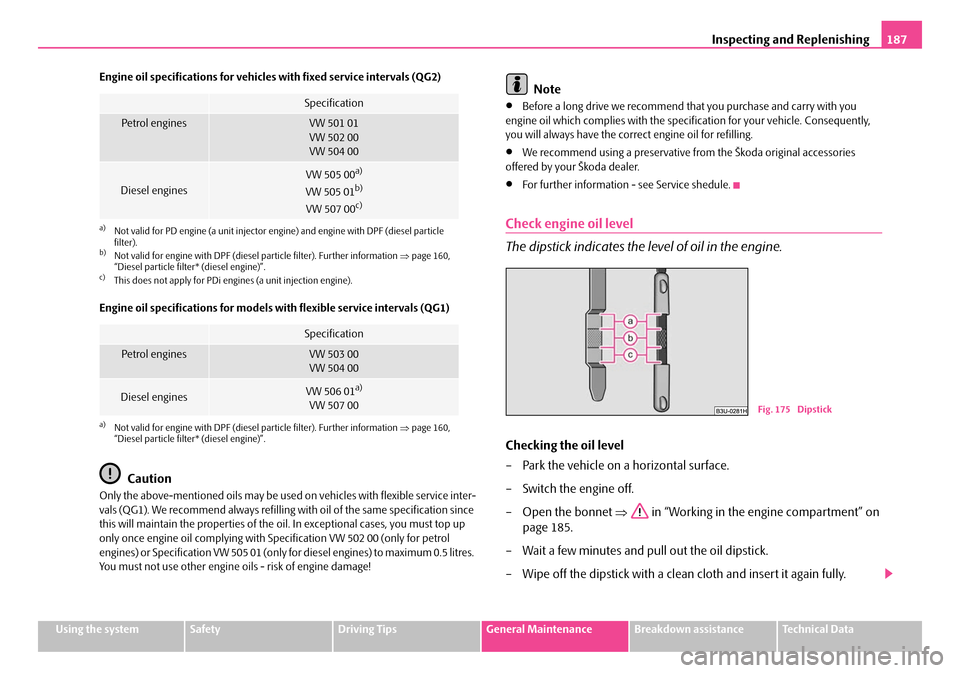
– After this, once again withdraw the dipstick and read off the oil level ⇒page 187, fig. 175 .
Oil level within range
– You must not top up the oil.
Oil level within range
–You may top up the oil. It is possible that the oil level may then be
within range after doing this.
Oil level within range
–You must top up the oil ⇒page 188. It is sufficient, once this is done,
to keep the oil level is within range .
It is normal for the engine to consume oil. The oil cons umption may be as much as
0.5 l/1 000 km depending on your style of driving and the conditions under which
you operate your vehicle. The oil consumpt ion may be slightly higher than this
during the first 5 000 kilometres.
One should therefore check the oil level at regular intervals, preferably every time
after the fuel tank is filled or after driving for long stretches.
We recommend maintaining the oil level within the range if the engine has been
operating at high loads, for example during a lengthy motorway trip during the
summer months, towing a trailer or negotiating a high mountain pass, but not
above this .
The warning light in the instrument cluster will indicate whether the oil level is too
low ⇒page 27, “Engine oil ”. In this case, check the oil level as soon as possible.
Top up with an approp riate quantity of oil.
WARNING
Read and observe the warning notes ⇒page 185, “Working in the engine
compartment” before working in the engine compartment.
Caution
•The oil level must on no account ex tend beyond the range . Danger of
damaging the catalytic converter.
•Do not continue your journey if for some reason it is not possible under the
conditions prevailing to top up with oil. Switch the engine off and obtain profes-
sional assistance from a specialist garage, otherwise it could lead to severe engine
damage.
Replenishing engine oil
– Inspect the oil level ⇒page 187.
– Unscrew the cap of the engine oil filler opening.
– Pour in a suitable grade of oil in portions of 0.5 litres ⇒page 186,
“Engine oil specifications”.
– Inspect the oil level ⇒page 187.
– Carefully screw on the cap of the filler opening and push the dipstick in fully.
WARNING
•Avoid dripping oil onto hot parts of the engine when topping up will oil -
a risk of fire!
•Read and observe the warning notes ⇒page 185, “Working in the engine
compartment” before working in the engine compartment.
For the sake of the environment
The oil level must on no account be above the range ⇒page 187, fig. 175. Oil
will otherwise be drawn in through the cr ankcase ventilation and may pass through
the exhaust system to atmosphere. The oi l may combust in the catalytic converter
and damage it.
Aa
Ab
Aa
Ac
Ab
Aa
Aa
Aa
NKO B5 20.book Page 188 Friday, March 2, 2007 1:46 PM
Page 190 of 259

Inspecting and Replenishing189
Using the systemSafetyDriving TipsGeneral MaintenanceBreakdown assistanceTechnical Data
Changing engine oil
The engine oil must be changed at the intervals stated in the Service schedule or
according to the service interval indicator ⇒page 14.
WARNING
•Only carry out the engine oil change, if you have the required profes-
sional knowledge!
•Read and observe the warning notes ⇒page 185, “Working in the engine
compartment” before working in the engine compartment.
•Let the engine cool down - risk of burning from hot oil.
•Wear an eye protection - risk of caustic burns due to oil splashes.
•Oil is toxic! Store old oil in a safe place out of the reach of children and
unauthorized persons until you dispose of it properly.
Caution
You must not pour any additives into th e engine oil - risk of engine damage!
Damage, which results from such produc t, are excluded from the warranty.
For the sake of the environment
•You must on no account pour oil into the ground or into the sewage system.
•In view of the problems involved in prop erly disposing of old oil, the material,
equipment and the knowledge required for such work, we recommend that you
have the oil and oil filter change carried out by your Škoda Service Partner.
Note
After your skin has come in contact with the oil, you must thoroughly wash your
skin.
Cooling system
Coolant
The job of the coolant is to cool the engine.
The cooling system does not require an y maintenance under normal operating
conditions. The coolant consist s of water with a concentration of coolant additive
of 40 %. This mixture not only provides antifreeze protection down to -25°C but
also protects the cooling and heating system from corrosion. It also prevents the
formation of scale and significantly increases the boiling point of the coolant.
You must therefore not reduce the concentration of antifreeze agent in the coolant
by adding water, also not during the su mmer months or in countries with a warm
climate. The concentration of coolant additive in the coolant must be at least
40%.
You can increase the amount of antifreeze in the coolant if a higher concentration
of antifreeze is necessary for climatic reasons but only up to 60% (antifreeze
protection down to approx. -40°C). The an tifreeze protection tails off above that
concentration.
Vehicles exported to countries with a co ld climate (e.g. Sweden, Norway, Finland)
are already factory-filled with a coolant which offers antifreeze protection down to
about -35°C. In these countries the concentr ation of coolant additive should be at
least 50 %.
Coolant
The cooling system is filled at the works with coolant (purple in colour), which
complies with the specification TL-VW 774 F.
We recommend that you use the antifreeze agent - G12 PLUS (purple in colour).
Please contact your Škoda Se rvice Partner if you have any questions regarding the
coolant or if you wish to fill up with a different coolant.
Your Škoda Service Partner can also suppl y you with the correct coolant additives.
NKO B5 20.book Page 189 Friday, March 2, 2007 1:46 PM