2007 SKODA ROOMSTER Time
[x] Cancel search: TimePage 169 of 248
Taking care of your vehicle and cleaning the vehicle168
Engine compartment
Good corrosion protection is very important, particularly in winter when one often drives over its salt-strewn roads. One should therefore clean the entire engine compartment before and after the salt spreading period, in order to prevent the salt from being destructive.
Škoda Service Partners have the cleani ng agents recommended by the manufac- turer and also the required equipment.
WARNING
•It is necessary to observe the guidelines given in the chapter before working on the engine compartment ⇒page 174.
•Let the engine cool down before cleaning the engine compartment.
Caution
•Engine cleaning may be only be undertaken when the ignition is off.
•It is recommended to cover the generator before washing the engine compart- ment.
For the sake of the environment
The dirty water produced by washing the engine has washed away petrol, and resi- dues of grease and oil and should therefor e be cleaned by an oil separator. This is why engine washing should only be undertaken in a garage or at a fueling station (when these are fitted with the required equipment).
Care of the interior of vehicle
Plastic parts, artificial leather and cloths
You can clean plastic parts and artificial leather with a moist cloth. You should only treat such parts with special solvent-free plastic cleaning and care products it does prove to be adequate.
Upholstery cloth and cloth trim on the doors, luggage compartment cover, head- liner etc. are best treated with special cleaning products, using if necessary a dry foam and a soft sponge or brush.
We recommend using a cleaning product from Škoda genuine accessories offered by your Škoda dealer.
Caution
Solvent-free cleaners attack the material and can damage it.
Fabric covers of electrically heated seats
Do not clean the seat covers moist as this may result in damage to the seat heating system.
Clean such covers using special agents, for example dry foam.
Natural leather
Natural leather requires quite particular care and attention.
Leather should be treated from time to time according the following
guidelines depending on how much it is used.
Normal cleaning
– Clean soiled areas of the leather with slightly moistened cotton or
woollen cloth.
Severe soiling
– Clean severely soiled areas with a cloth dipped in a mild soapy solu-
tion (2 spoonfuls of natural soap to 1 litre of water).
– Ensure that the leather is not soaked through at any point and that no
water gets into the stitching of the seams.
– Dry off the leather with a soft, dry cloth.
NKO A05R 20 MR08.book Page 168 Wednesday, March 28, 2007 9:42 AM
Page 170 of 248

Taking care of your vehicle and cleaning the vehicle169
Using the systemSafetyDriving TipsGeneral MaintenanceBreakdown assistancePraktikTechnical Data
Removing stains
– Remove fresh stains which are water-based (e.g. coffee, tea, juices,
blood etc.) with an absorbent cloth or household paper or use the
cleaner from the care set for a stain which has already dried in.
– Remove fresh stains on a fat base (e.g. butter, mayonnaise, chocolate
etc.) with an absorbent cloth or household cleaning paper or with the
cleaner from the care set if the stain has not yet penetrated into the
surface.
– Use a grease dissolver for grease stains which have dried in.
–Eliminate special stains (e.g. ball-point pens, felt pen, nail varnish,
dispersion paint, shoe cream etc.) with a special stain remover suit-
able for leather.
Leather care
– Treat the leather every six months with the leather care product avail-
able from Škoda Service Partners.
– Apply only a small amount of the care product.
– Dry the leather off with a soft cloth
We recommend that you consul t your Škoda Service Partner, if you have any ques- tions regarding cleaning and ca re of the leather interior.
Caution
•You must on no account treat the leather with solvents (e.g. gasoline, turpen- tine), floor wax, shoe cream or such like.
•Avoid leaving your vehicle for lengthy pe riods in bright sunlight in order to avoid bleaching the leather. If you leave your vehicle parked in the open for lengthy periods, protect the leather from the direct rays of the sun by covering it over.
•Sharp-edged objects on items of clothing such as zip fasteners, rivets, sharp- edged belts may leave permanent scratche s or signs of rubbing on the surface.
Note
•Use a care cream with light blocker and impregnation effect regularly and each time after cleaning the leather. The cream no urishes the leather, allows it to breathe and keeps it supple and also provides moisture. It also creates surface protection.
•Clean the leather every 2 to 3 months, remove fresh soiling each time this occurs.
•Remove fresh stains such as those from ball-point pens, ink, lipstick, shoe cream etc., as quickly as possible.
•Care also for the leather dye. Refreshen areas which have lost their colour with a special coloured leather cream as required.
Seat belts
– Keep the seat belts clean!
– Wash seat belts which have become soiled using a mild soapy solu-
tion.
– Inspect the seat belts regularly to ensure they are in good condition.
Belt webbing which has become severely soiled may prevent the inertia reel from reeling up the belt properly.
WARNING
•The seat belts must not be removed for cleaning.
•Never clean the seat belts chemically as dry cleaning may destroy the fabric. The seat belts must also not be allowed to come into contact with corrosive liquids (such as acids etc.).
•Seat belts which have damage to the webbing, the connections, the inertia reel or the lock should be replaced by a Škoda Service Partner.
•Inertia reel belts must be completely dried before being reeled up.
NKO A05R 20 MR08.book Page 169 Wednesday, March 28, 2007 9:42 AM
Page 172 of 248

Fuel171
Using the systemSafetyDriving TipsGeneral MaintenanceBreakdown assistancePraktikTechnical Data
•Your vehicle is not adapted for use of biofuel (RME), therefore this fuel must not be refuelled and driven. Using this fuel (RME) can lead to damage to the engine or the fuel system.
Operation in winter
Winter-grade diesel fuel
A different grade of diesel fuel is available at filling stations in winter than during the summer. Using “summer-grade diesel fuel” at temperatures below 0°C can result in operational problems because the diesel be comes viscous as a result of paraffin separation.
It is therefore the case that DIN EN 590 prescribes diesel fuel class for certain periods of the year which can also be pu rchased at the corresponding time during the year. “Winter-grade diesel fuel” will still operate properly even at a temperature of -20°C.
It is often the case in countries with diff erent climatic conditions that diesel fuels available have a different temperature characteristic. Škoda Service Partners and filling stations in the count ry concerned will be able to provide you with informa- tion regarding the diesel fuels available.
Prewarming fuel
The vehicle is fitted with a fuel filter prewarming system. This secures operation of a vehicle using diesel fuel down to an environmental temperature of -25°C.
Caution
It is not permitted to add the various fuel additives on the market, including petrol, to diesel fuel in order to improve its flow properties.
Refuelling
Opening the fuel filler cap
– Open the fuel filler flap with the hand.
– Unlock the fuel filler cap on the fuel filler tube to the left using the
vehicle key.
– Unscrew the fuel filler cap anti-clo ckwise and place the fuel filler cap
from above on the fuel filler flap ⇒fig. 153.
Closing fuel filler cap
– Screw on the cap by turning it to the right until it is heard to lock.
Fig. 152 Right rear side of the vehicle: Fuel filler flap
Fig. 153 Filler flap with cap unscrewed
NKO A05R 20 MR08.book Page 171 Wednesday, March 28, 2007 9:42 AM
Page 173 of 248

Fuel172
– Lock the fuel filler cap on the fuel filler tube to the right using the
vehicle key.
– Press the fuel tank flap closed.
The correct grades of fuel for your vehicle are stated on a sticker affixed to the inside of the fuel filler flap. Further information on fuel ⇒page 170.
The fuel tank has a capacity of about 55 litres.
WARNING
Pay attention to any legal requirements if you do carry a spare canister in the vehicle. We do not recommend carrying any fuel canisters in your vehicle for safety reasons. The canister can be da maged in the event of an accident and fuel may leak out.
Caution
•Remove any fuel which has spilled onto the paintwork of your vehicle immedi- ately - risk of paint damage!
•Vehicles fitted with catalytic converter should never be allowed to let the fuel tank to run completely empty. An irregular supply of fuel to the engine can result in misfiring and unburnt fuel may get into the exhaust system, which may result in overheating and damage to the catalytic converter.
•Make sure that the valve is not pressed into the filler tube when inserting the pump nozzle into the filler tube. Otherwis e you are unintentionally filling up the volume, which in case of heat can cause an expansion of the fuel. This can lead to an overflow of fuel or damage to parts of the fuel reservoir.
•The fuel tank is full just as soon as the pump nozzle switches off for the first time, provided the nozzle has been operated properly. Do not continue refuelling - otherwise the expansion volume is filled up.
NKO A05R 20 MR08.book Page 172 Wednesday, March 28, 2007 9:42 AM
Page 177 of 248
Inspecting and Replenishing176
Engine oil
Engine oil specifications
The grade of engine oil should be selected in accordance with
precise specifications.
The engine of your vehicle has been fact ory-filled with a high-grade oil which you can use throughout the year - exce pt in extreme climatic regions.
You can mix various oils together with each other when refilling with oil. This does not, however, apply for models with flexible service intervals (QG1).
Engine oils are, of course, undergoing co ntinuous further development. Thus the information stated in this Owner's Manual is only correct at the time of publication.
Škoda Service Partners are informed by Škoda Auto a.s. about current changes. We recommend having this oil change und ertaken by a Škoda Service Partner.
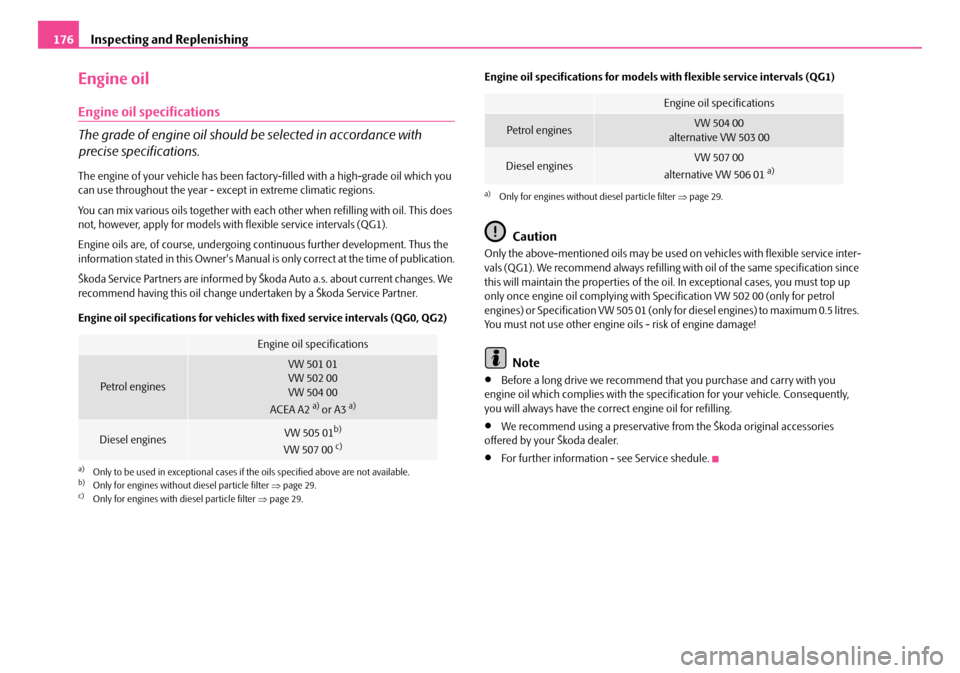
Engine oil specifications for vehicles with fixed service intervals (QG0, QG2)
Engine oil specifications for models with flexible service intervals (QG1)
Caution
Only the above-mentioned oils may be used on vehicles with flexible service inter- vals (QG1). We recommend always refilling with oil of the same specification since this will maintain the properties of the oi l. In exceptional cases, you must top up only once engine oil complying with Specification VW 502 00 (only for petrol engines) or Specification VW 505 01 (only for diesel engines) to maximum 0.5 litres. You must not use other engine oi ls - risk of engine damage!
Note
•Before a long drive we recommend that you purchase and carry with you engine oil which complies with the specif ication for your vehicle. Consequently, you will always have the correct engine oil for refilling.
•We recommend using a preservative fr om the Škoda original accessories offered by your Škoda dealer.
•For further information - see Service shedule.
Engine oil specifications
Petrol engines
VW 501 01 VW 502 00 VW 504 00
ACEA A2 a) or A3 a)
a)Only to be used in exceptional cases if the oils specified above are not available.
Diesel enginesVW 505 01b)
VW 507 00 c)
b)Only for engines without diesel particle filter ⇒page 29.c)Only for engines with diesel particle filter ⇒page 29.
Engine oil specifications
Petrol enginesVW 504 00 alternative VW 503 00
Diesel enginesVW 507 00
alternative VW 506 01 a)
a)Only for engines without diesel particle filter ⇒page 29.
NKO A05R 20 MR08.book Page 176 Wednesday, March 28, 2007 9:42 AM
Page 178 of 248

Inspecting and Replenishing177
Using the systemSafetyDriving TipsGeneral MaintenanceBreakdown assistancePraktikTechnical Data
Check engine oil level
The dipstick indicates the level of oil in the engine.
Checking the oil level
– Park the vehicle on a horizontal surface.
– Switch the engine off.
– Open the bonnet ⇒ in “Working in the engine compartment” on
page 174.
– Wait a few minutes and pull out the oil dipstick ⇒.
– Wipe off the dipstick with a clea n cloth and insert it again fully.
– Then withdraw the dipstick ag ain and read off the oil level.
Oil level within range
– You must not top up the oil.
Oil level within range
– You may top up the oil. It is possible that the oil level may then be
within range after doing this.
Oil level within range
–You must top up the oil. It is sufficient, once this is done, to keep the
oil level is within range .
It is normal for the engine to consume oi l. The oil consumption may be as much as 0.5 l/1 000 km depending on your style of driving and the conditions under which you operate your vehicle. The oil consumpt ion may be slightly higher than this during the first 5 000 kilometres.
One should therefore check the oil level at regular intervals, preferably every time after the fuel tank is filled or after driving for long stretches.
We recommend maintaining the oil level within the range if the engine has been operating at high loads, for example during a lengthy motorway trip during the summer months, towing a trailer or negotiating a high mountain pass, but not above this .
The warning light in the instrument cluster* will indicate ⇒page 25 whether the oil level is too low. In this case, check the oil level as soon as possible. Top up with an appropriate quantity of oil.
WARNING
Read and observe the warning notes ⇒page 174, “Working in the engine compartment” before working in the engine compartment.
Caution
•Always check the oil level on vehicles with engine 1.2 l/51 kW when the engine is warm. Otherwise the measuring result is incorrect und oil could be incorrectly replenished - risk of engine damage!
•The oil level must on no account ex tend beyond the range . Danger of damaging the cata lytic converter.
•Do not continue your journey if for some reason it is not possible under the conditions prev ailing to top up with oil. Switch the engine off and obtain profes- sional assistance from a specialist garage, otherwise it could lead to severe engine damage.
Fig. 158 Dipstick
Aa
Ab
Aa
Ac
Ab
Ab
Aa
NKO A05R 20 MR08.book Page 177 Wednesday, March 28, 2007 9:42 AM
Page 180 of 248

Inspecting and Replenishing179
Using the systemSafetyDriving TipsGeneral MaintenanceBreakdown assistancePraktikTechnical Data
also protects the cooling and heating system from corrosion. It also prevents the formation of scale and significantly increases the boiling point of the coolant.
You must therefore not reduce the concentr ation of antifreeze agent in the coolant by adding water, also not during the summ er months or in countries with a warm climate. The concentration of coolant additive in the coolant must be at least 40%.
You can increase the amount of antifreeze in the coolant if a higher concentration of antifreeze is necessary for climatic reasons but only up to 60% (antifreeze protection down to approx. -40°C). The an tifreeze protection tails off above that concentration.
Vehicles exported to countries with a co ld climate (e.g. Sweden, Norway, Finland) are already factory-filled with a coolant wh ich offers antifreeze protection down to about -35°C. In these countries the concentr ation of coolant additive should be at least 50 %.
Coolant
The cooling system is filled at the works with coolant (purple in colour), which complies with the specification TL-VW 774 F.
We recommend that you use the antifreeze agent - G12 PLUS (purple in colour).
We recommend that you contact your Škod a Service Partner if you have any ques- tions regarding the coolant or if you wish to fill up with a different coolant.
Your Škoda Service Partner can also suppl y you with the correct coolant additives.
Caution
•Other coolant additives may cause operational problems which, in partic- ular, involves significantly redu cing the anticorrosion effect.
•Any faults or problems resulting from corrosion may cause a loss of coolant and, as a consequence of th is, result in major engine damage.
Inspecting the coolant level
The coolant expansion bottle is located in the engine compartment on
the right.
– Switch the engine off.
– Open the bonnet ⇒ in “Working in the engine compartment” on
page 174.
– Check the level of coolant in the coolant expansion bottle ⇒fig. 159.
The coolant level when the engine is cold must lie between the “MIN”
and “MAX” markings. The level may also rise slightly above the
“MAX” marking when the engine is warm.
If the coolant level in the reservoir is too low, this is indicated by the warning light in the instrument cluster ⇒page 24. We nevertheless recommend inspecting the coolant level directly at the reservoir from time to time.
Loss of coolant
A loss of coolant is first and foremost an indication of a leak in the system. You should not merely top up the coolant in the reservoir. It is also important to have the cooling system inspected without delay by a specialist garage.
Fig. 159 Engine compartment: Coolant expansion bottle
ABAA
NKO A05R 20 MR08.book Page 179 Wednesday, March 28, 2007 9:42 AM
Page 182 of 248

Inspecting and Replenishing181
Using the systemSafetyDriving TipsGeneral MaintenanceBreakdown assistancePraktikTechnical Data
Radiator fan
The radiator fan may switch on suddenly.
The radiator fan is driven by an electric motor and controlled by a thermostat according to the coolant temperature.
The radiator fan may continue running fo r up to 10 minutes after the engine has been switched off - even if the ignition is also off. It may also switch on suddenly after a certain time, if
•the coolant temperature ha s risen because of an accumulation of heat or
•the warm engine compartment is heated up additionally by strong sunlight.
WARNING
You must therefore be aware when working in the engine compartment that the fan may switch on suddenly - risk of injury!
Brake fluid
Inspecting the brake fluid level
The brake fluid reservoir is located on the left of the engine compartment.
The brake fluid reservoir on right-hand steering models is positioned on
the other side of the engine compartment.
– Switch the engine off.
– Open the bonnet ⇒ in “Working in the engine compartment” on
page 174.
– Inspect the brake fluid level in the reservoir ⇒fig. 160. The level must
be between the “MIN” and “MAX” markings.
A slight drop in the fluid level results when driving due to normal wear-and-tear and automatic adjustment of the br ake pads, and is perfectly normal.
There may be an indication of a leak in the brake system, however, if the fluid level drops significantly within a short time or if it drops below the “MIN” marking. A situ-ation where the brake fluid level is too low is indicated by the warning light lighting up in the instrument cluster ⇒page 28. In this case stop the car immedi- ately and do not drive any further! Cont act a Škoda Dealer to obtain profes- sional assistance.
WARNING
•Read and observe the warning notes ⇒page 174, “Working in the engine compartment” before working in the engine compartment.
•If the fluid level has dropped below the MIN marking, do not drive any further - risk of accident! Contact a Škoda dealer to obtain professional assistance.
Replacing brake fluid
Brake fluid absorbs moisture. This causes the fluid to absorb moisture from the surrounding air over a period of time. Excessive water in the brake fluid may be the cause of corrosion in the brake system. Th e water content also lowers the boiling point of the brake fluid. This is why brake fluid must be replaced every two years.
Fig. 160 Engine compartment: Brake fluid reservoir
NKO A05R 20 MR08.book Page 181 Wednesday, March 28, 2007 9:42 AM