Page 86 of 384

REVERSE (R):To back up, press the clutch
pedal. After the vehicle stops, shift into
REVERSE (R). Slowly let up on the clutch
pedal as you press the accelerator pedal. If it is
hard to shift, let the shift lever return to NEUTRAL
and release the clutch pedal. Then press the
clutch pedal again and shift into REVERSE (R).
Do not attempt to shift into the fth gear
position prior to shifting into REVERSE (R).
Your transmission has a lock out feature which
prevents a fth gear to reverse gear shift.
Notice:Shifting to REVERSE (R) while your
vehicle is moving forward could damage
the transmission. The repairs would not
be covered by your warranty. Shift to
REVERSE (R) only after your vehicle is
stopped.
Also, use FIRST (1) or REVERSE (R), along
with the parking brake, for parking your vehicle.Parking Brake
The parking brake lever is located between the
front seats.
To se the parking brake, hold the brake pedal
down and pull up on the parking brake lever.
If the ignition is on, the brake system warning light
will come on. SeeBrake System Warning Light
on page 134.
To release the parking brake, hold the brake pedal
down. Pull the parking brake lever up until you can
press the release button. Hold the release button
in as you move the brake lever all the way down.
86
ProCarManuals.com
Page 87 of 384

If you forget to release your parking brake, a chime
will sound and a warning message will be displayed
in the Driver Information Center (DIC) when the
vehicle is moving faster than 5 mph (8 kph). See
DIC Warnings and Messages on page 147.
Notice:Driving with the parking brake on
can overheat the brake system and cause
premature wear or damage to brake system
parts. Verify that the parking brake is fully
released and the brake warning light is
off before driving.
Shifting Into Park (P)
(Automatic Transmission)
{CAUTION:
It can be dangerous to get out of your
vehicle if the shift lever is not fully in
PARK (P) with the parking brake rmly set.
CAUTION: (Continued)
CAUTION: (Continued)
Your vehicle can roll. If you have left the
engine running, the vehicle can move
suddenly. You or others could be injured.
To be sure your vehicle will not move, even
when you are on fairly level ground, use
the steps that follow.
1. Hold the brake pedal down and set the
parking brake.
2. Move the shift lever into PARK (P) by holding
the button on the shift lever and pushing
the lever all the way toward the front of the
vehicle.
3. Turn the ignition key to LOCK.
4. Remove the key and take it with you. If you
can leave your vehicle with the ignition key
in your hand, your vehicle is in PARK (P).
87
ProCarManuals.com
Page 88 of 384

Leaving Your Vehicle With the
Engine Running
{CAUTION:
It can be dangerous to leave your vehicle
with the engine running. Your vehicle
could move suddenly if the shift lever is
not fully in PARK (P) with the parking
brake rmly set. And, if you leave the
vehicle with the engine running, it could
overheat and even catch re. You or
others could be injured. Do not leave your
vehicle with the engine running.
If you have to leave your vehicle with the engine
running, be sure your vehicle is in PARK (P)
and your parking brake is rmly set before you
leave it. After you have moved the shift lever into
PARK (P), hold the regular brake pedal down.If the vehicle has an automatic transmission, see if
you can move the shift lever away from PARK (P)
without rst pushing the shift lock release button.
If you can, it means that the shift lever was not fully
locked into PARK (P).Torque Lock
If you are parking on a hill and you do not
shift your transmission into PARK (P) properly,
the weight of the vehicle may put too much
force on the parking pawl in the transmission.
You may nd it difficult to pull the shift lever
out of PARK (P). This is called “torque lock.”
To prevent torque lock, set the parking brake
and then shift into PARK (P) properly before you
leave the driver’s seat. To nd out how, see
Shifting Into Park (P) (Automatic Transmission)
on page 87.
88
ProCarManuals.com
Page 89 of 384

When you are ready to drive, move the shift
lever out of PARK (P)beforeyou release the
parking brake.
If torque lock does occur, you may need to
have another vehicle push yours a little uphill to
take some of the pressure from the parking pawl
in the transmission, so you can pull the shift
lever out of PARK (P).
Shifting Out of Park (P)
Your vehicle has an automatic transmission
shift lock control system.
To shift out of PARK (P):
1. Apply the regular brake pedal.
2. Then press the shift lever button.
3. Move the shift lever to the desired gear.If you are still unable to shift out of PARK (P):
1. Fully release the shift lever button.
2. While holding down the brake pedal,
press the shift lever button again.
3. Move the shift lever to the desired gear.
If you still cannot move the shift lever from
PARK (P), consult your dealer.
Parking Your Vehicle
(Manual Transmission)
Before leaving your manual transmission vehicle,
fully press the clutch pedal in, move the shift
lever in either FIRST (1) gear or REVERSE (R),
and rmly apply the parking brake. SeeManual
Transmission Operation on page 85.
89
ProCarManuals.com
Page 92 of 384
Running the Engine While Parked
It is better not to park with the engine running. But if
you ever have to, here are some things to know.
{CAUTION:
Idling the engine with the climate control
system off could allow dangerous exhaust
into your vehicle. See the earlier caution
underEngine Exhaust on page 91.
Also, idling in a closed-in place can let
deadly carbon monoxide (CO) into your
vehicle even if the climate control fan is
at the highest setting. One place this
can happen is a garage. Exhaust — with
CO — can come in easily. NEVER park
in a garage with the engine running.
Another closed-in place can be a blizzard.
SeeWinter Driving on page 218.
{CAUTION:
It can be dangerous to get out of your
vehicle if the automatic transmission shift
lever is not fully in PARK (P) with the
parking brake rmly set. Your vehicle can
roll. Do not leave your vehicle when the
engine is running unless you have to.
If you have left the engine running, the
vehicle can move suddenly. You or others
could be injured. To be sure your vehicle
will not move, even when it is on fairly
level ground, always set the parking brake
and move the automatic transmission
shift lever to PARK (P), or the manual
transmission shift lever to NEUTRAL.
Follow the proper steps to be sure your vehicle
will not move. SeeShifting Into Park (P)
(Automatic Transmission) on page 87andParking
Your Vehicle (Manual Transmission) on page 89.
92
ProCarManuals.com
Page 101 of 384

Notice:Leaving the convertible top down
and exposing the interior of your vehicle
to outdoor conditions may cause damage.
Always close the convertible top if leaving
your vehicle outdoors.
Notice:Lowering the convertible top when
there are objects in the storage area could
damage it or break the glass rear window.
Always verify that no objects are in the storage
area before lowering the convertible top.
Notice:Lowering the top if it is damp, wet,
or dirty can cause stains, mildew, and damage
to the inside of your vehicle. Dry off the top
before lowering it.
Notice:If you lower the top on your vehicle
in cold weather (0°F/-18°C or lower), you
may damage top components. Do not lower
the top in cold weather.Notice:If you raise or lower the convertible
top while the vehicle is in motion, you
could damage the top or the top mechanism.
The repairs would not be covered by
your warranty. Always put an automatic
transmission in PARK (P) or a manual
transmission in FIRST (1) or REVERSE (R),
turn the ignition off and engage the parking
brake before raising or lowering the
convertible top.
{CAUTION:
Moving parts of the convertible top can
be dangerous. People can be injured by
the convertible top and its mechanism.
Keep people away from your vehicle
when you are lowering or raising the top.
101
ProCarManuals.com
Page 102 of 384
Lowering the Manual Convertible Top
1. Park on a level surface and set the parking
brake. Shift an automatic transmission into
PARK (P). Shift a manual transmission
into FIRST (1) or REVERSE (R).
2. Make sure the ignition is turned off.
3. Push the trunk release button located in
the glove box, or on the remote keyless
entry, if equipped.
4. Lift the trunk.
5. The convertible top front latch, located above
the inside rearview mirror, must be unlatched.
Pull the latch down and turn it counterclockwise
to unlatch it.
Leave the latch open and turned to prevent
damage.
6. Pull rearward on the side edge (B) of the
convertible top and pull it off of the windshield
frame.
7. Push the convertible top down into the
trunk (D).
102
ProCarManuals.com
Page 103 of 384
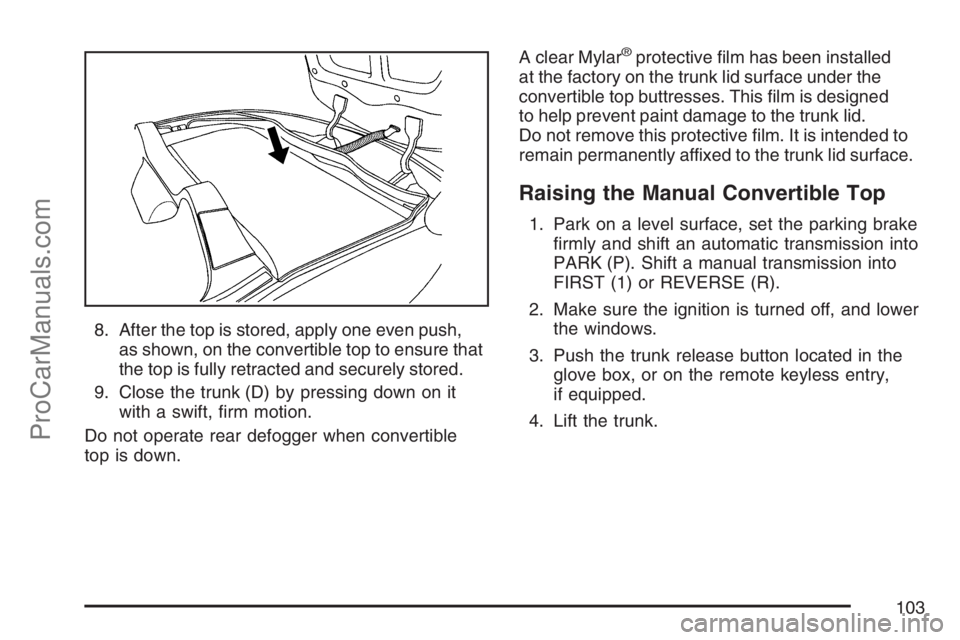
8. After the top is stored, apply one even push,
as shown, on the convertible top to ensure that
the top is fully retracted and securely stored.
9. Close the trunk (D) by pressing down on it
with a swift, rm motion.
Do not operate rear defogger when convertible
top is down.A clear Mylar
®protective lm has been installed
at the factory on the trunk lid surface under the
convertible top buttresses. This lm is designed
to help prevent paint damage to the trunk lid.
Do not remove this protective lm. It is intended to
remain permanently affixed to the trunk lid surface.
Raising the Manual Convertible Top
1. Park on a level surface, set the parking brake
rmly and shift an automatic transmission into
PARK (P). Shift a manual transmission into
FIRST (1) or REVERSE (R).
2. Make sure the ignition is turned off, and lower
the windows.
3. Push the trunk release button located in the
glove box, or on the remote keyless entry,
if equipped.
4. Lift the trunk.
103
ProCarManuals.com