Page 270 of 384

Brake Wear
Your vehicle has four-wheel disc brakes.
Front disc brake pads have built-in wear indicators
that make a high-pitched warning sound when
the brake pads are worn and new pads are
needed. The sound may come and go or be heard
all the time your vehicle is moving, except when
you are pushing on the brake pedal rmly.
{CAUTION:
The brake wear warning sound means
that soon the brakes will not work well.
That could lead to an accident. When
you hear the brake wear warning sound,
have your vehicle serviced.
Notice:Continuing to drive with worn-out
brake pads could result in costly brake repair.Some driving conditions or climates may cause a
brake squeal when the brakes are rst applied
or lightly applied. This does not mean something
is wrong with your brakes.
Properly torqued wheel nuts are necessary to help
prevent brake pulsation. When tires are rotated,
inspect brake pads for wear and evenly tighten
wheel nuts in the proper sequence to Saturn
torque specications.
Brake linings should always be replaced as
complete axle sets.
Brake Pedal Travel
See your retailer if the brake pedal does not return
to normal height, or if there is a rapid increase
in pedal travel. This could be a sign of brake
trouble.
Brake Adjustment
Every time you apply the brakes, with or without
the vehicle moving, your brakes adjust for wear.
270
ProCarManuals.com
Page 295 of 384

If your vehicle has Goodyear Eagle F1-GS1
P245/45R18 size tires, they are directional
tires and must roll in a certain direction for the
best overall performance. The direction is shown
by an arrow on the tire sidewall. Because
these tires are directional, they should be rotated
as shown here. These tires should only be
moved from front to rear and rear to front on
the same side of the vehicle.After the tires have been rotated, adjust the front
and rear ination pressures as shown on the
Tire and Loading Information label. SeeLoading
Your Vehicle on page 225for an example of
the Tire and Loading Information label and
its location on your vehicle. Make certain that all
wheel nuts are properly tightened. See “Wheel
Nut Torque” underCapacities and Specications
on page 331.
{CAUTION:
Rust or dirt on a wheel, or on the parts to
which it is fastened, can make wheel nuts
become loose after a time. The wheel could
come off and cause a crash. When you
change a wheel, remove any rust or dirt
from places where the wheel attaches to
the vehicle. In an emergency, you can use
a cloth or a paper towel to do this; but be
sure to use a scraper or wire brush later,
if you need to, to get all the rust or dirt off.Directional Tires
295
ProCarManuals.com
Page 302 of 384
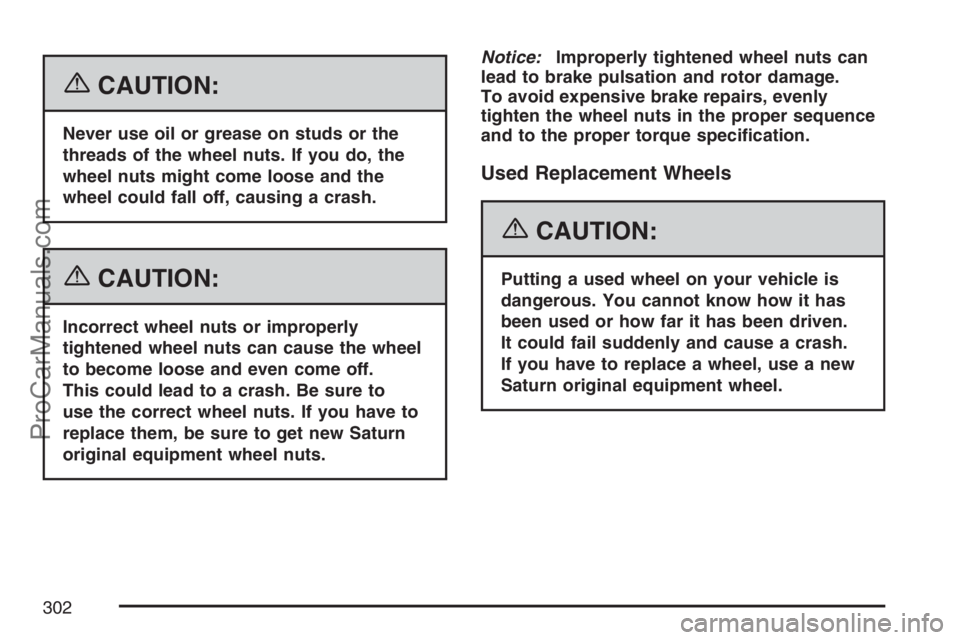
{CAUTION:
Never use oil or grease on studs or the
threads of the wheel nuts. If you do, the
wheel nuts might come loose and the
wheel could fall off, causing a crash.
{CAUTION:
Incorrect wheel nuts or improperly
tightened wheel nuts can cause the wheel
to become loose and even come off.
This could lead to a crash. Be sure to
use the correct wheel nuts. If you have to
replace them, be sure to get new Saturn
original equipment wheel nuts.Notice:Improperly tightened wheel nuts can
lead to brake pulsation and rotor damage.
To avoid expensive brake repairs, evenly
tighten the wheel nuts in the proper sequence
and to the proper torque specication.
Used Replacement Wheels
{CAUTION:
Putting a used wheel on your vehicle is
dangerous. You cannot know how it has
been used or how far it has been driven.
It could fail suddenly and cause a crash.
If you have to replace a wheel, use a new
Saturn original equipment wheel.
302
ProCarManuals.com
Page 332 of 384
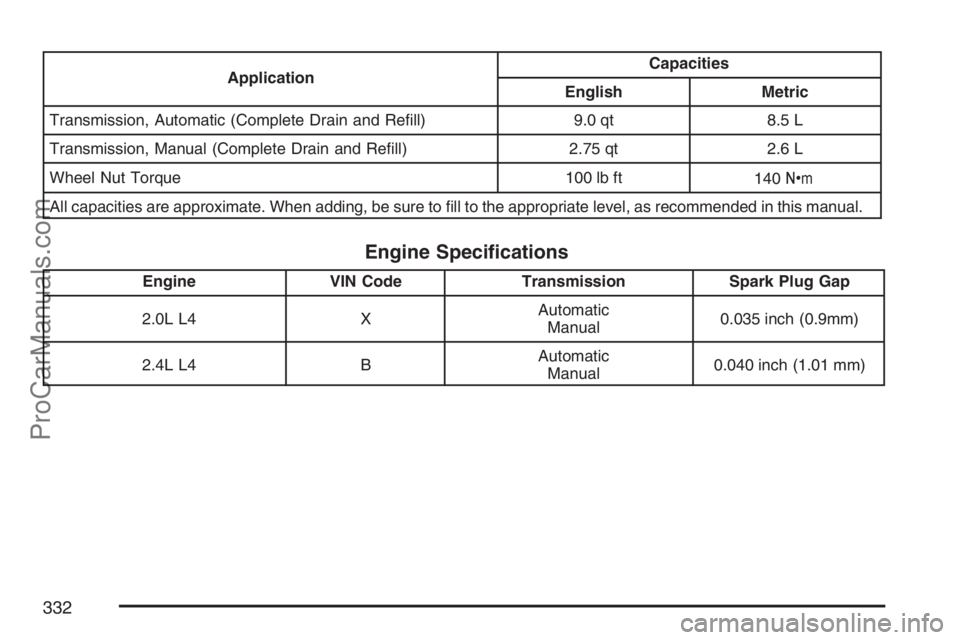
ApplicationCapacities
English Metric
Transmission, Automatic (Complete Drain and Rell) 9.0 qt 8.5 L
Transmission, Manual (Complete Drain and Rell) 2.75 qt 2.6 L
Wheel Nut Torque 100 lb ft
140Y
All capacities are approximate. When adding, be sure to ll to the appropriate level, as recommended in this manual.
Engine Specications
Engine VIN Code Transmission Spark Plug Gap
2.0L L4 XAutomatic
Manual0.035 inch (0.9mm)
2.4L L4 BAutomatic
Manual0.040 inch (1.01 mm)
332
ProCarManuals.com