Page 239 of 384

{CAUTION:
If you spill fuel and then something ignites
it, you could be badly burned. Fuel can
spray out on you if you open the fuel cap
too quickly. This spray can happen if your
tank is nearly full, and is more likely in
hot weather. Open the fuel cap slowly
and wait for any hiss noise to stop. Then
unscrew the cap all the way.
Be careful not to spill fuel. Do not top off or overll
the tank and wait a few seconds after you have
nished pumping before removing the nozzle.
Clean fuel from painted surfaces as soon as
possible. SeeWashing Your Vehicle on page 318.
When replacing the fuel cap, turn it clockwise until it
clicks. Make sure the cap is fully installed. The
diagnostic system can determine if the fuel cap has
been left off or improperly installed. This would
allow fuel to evaporate into the atmosphere.
SeeMalfunction Indicator Lamp on page 138.Your vehicle has a Driver Information Center (DIC).
The CHECK GAS CAP message displays if the fuel
cap is not properly installed. SeeDIC Warnings
and Messages on page 147for more information.
{CAUTION:
If a re starts while you are refueling,
do not remove the nozzle. Shut off the
ow of fuel by shutting off the pump or
by notifying the station attendant. Leave
the area immediately.
Notice:If you need a new fuel cap, be sure to
get the right type. Your retailer can get one
for you. If you get the wrong type, it may not t
properly. This may cause your malfunction
indicator lamp to light and may damage
your fuel tank and emissions system. See
Malfunction Indicator Lamp on page 138.
239
ProCarManuals.com
Page 243 of 384
A. Windshield Washer Fluid Reservoir. See
“Adding Washer Fluid” underWindshield
Washer Fluid on page 267.
B. Coolant Surge Tank and Pressure Cap.
SeeCooling System on page 260.
C. Brake Master Cylinder Reservoir. See
“Brake Fluid” underBrakes on page 268
andHydraulic Clutch on page 254.
D. Engine Oil Dipstick (Out of View). See
“Checking Engine Oil” underEngine Oil
on page 245.
E. Engine Air Cleaner/Filter. SeeEngine
Air Cleaner/Filter on page 252.F. Engine Oil Fill Cap. See “When to Add
Engine Oil” underEngine Oil on page 245.
G. Power Steering Fluid Reservoir. See
Power Steering Fluid on page 266.
H. Remote Negative (−) Ground (Out of View).
SeeJump Starting on page 272.
I. Battery (Out of View). SeeBattery on page 271.
J. Remote Positive (+) Terminal. SeeJump
Starting on page 272.
K. Underhood Fuse Block. SeeUnderhood
Fuse Block on page 328.
243
ProCarManuals.com
Page 245 of 384

A. Windshield Washer Fluid Reservoir. See
“Adding Washer Fluid” underWindshield
Washer Fluid on page 267.
B. Coolant Surge Tank and Pressure Cap.
SeeCooling System on page 260.
C. Brake Master Cylinder Reservoir. See
“Brake Fluid” underBrakes on page 268
andHydraulic Clutch on page 254.
D. Engine Oil Dipstick. See “Checking Engine
Oil” underEngine Oil on page 245.
E. Engine Air Cleaner/Filter. SeeEngine
Air Cleaner/Filter on page 252.
F. Engine Oil Fill Cap. See “When to Add
Engine Oil” underEngine Oil on page 245.
G. Power Steering Fluid Reservoir. See
Power Steering Fluid on page 266.
H. Remote Negative (−) Ground (Out of View).
SeeJump Starting on page 272.
I. Battery (Out of View). SeeBattery on page 271.
J. Remote Positive (+) Terminal. SeeJump
Starting on page 272.
K. Underhood Fuse Block. SeeUnderhood
Fuse Block on page 328.Engine Oil
Checking Engine Oil
It is a good idea to check the engine oil every time
you get fuel. In order to get an accurate reading,
the oil must be warm and the vehicle must be
on level ground.
The engine oil dipstick handle is a yellow loop.
SeeEngine Compartment Overview on page 242
for the location of the engine oil dipstick.
1. Turn off the engine and give the oil several
minutes to drain back into the oil pan. If you
do not do this, the oil dipstick might not
show the actual level.
2. Pull the dipstick and clean it with a paper
towel or cloth, then push it back in all the
way. Remove it again, keeping the tip down
and check the level.
245
ProCarManuals.com
Page 251 of 384

After changing the engine oil, the system must be
reset as follows:
1. Turn the ignition to RUN, with the engine off.
2. Press the information and reset buttons
on the Driver Information Center (DIC) at
the same time to enter the personalization
menu. SeeDIC Vehicle Personalization
on page 152.
3. Press the information button to scroll through
the available personalization menu modes
until the DIC display shows OIL-LIFE RESET.
4. Press and hold the reset button until the DIC
display shows ACKNOWLEDGED. This will
tell you the system has been reset.
5. Turn the key to LOCK.
If the CHANGE OIL SOON message comes back
on when you start your vehicle, the engine oil
life system has not reset. Repeat the reset
procedure.What to Do with Used Oil
Used engine oil contains certain elements that
may be unhealthy for your skin and could
even cause cancer. Do not let used oil stay on
your skin for very long. Clean your skin and nails
with soap and water, or a good hand cleaner.
Wash or properly dispose of clothing or rags
containing used engine oil. See the manufacturer’s
warnings about the use and disposal of oil
products.
Used oil can be a threat to the environment. If you
change your own oil, be sure to drain all the oil from
the lter before disposal. Never dispose of oil by
putting it in the trash, pouring it on the ground, into
sewers, or into streams or bodies of water. Instead,
recycle it by taking it to a place that collects used
oil. If you have a problem properly disposing of
used oil, ask your retailer, a service station, or a
local recycling center for help.
251
ProCarManuals.com
Page 264 of 384
{CAUTION:
You can be burned if you spill coolant
on hot engine parts. Coolant contains
ethylene glycol and it will burn if the
engine parts are hot enough. Do not spill
coolant on a hot engine.
1. Remove the coolant surge tank pressure cap
when the cooling system, including the
coolant surge tank pressure cap and upper
radiator hose, is no longer hot. Turn the
pressure cap slowly counterclockwise about
two or two and one-half turns. If you hear
a hiss, wait for that to stop. This will allow
any pressure still left to be vented out
the discharge hose.2. Then keep
turning the
pressure
cap slowly,
and remove it.
264
ProCarManuals.com
Page 274 of 384
4. Open the hood on the other vehicle and
locate the positive (+) and negative (−)
terminal locations on that vehicle.
You will not need to access your battery for
jump starting. Your vehicle has a remote
positive (+) and a remote negative (−) jump
starting terminal.
The remote positive (+)
terminal is located
under a red plastic
cover on the engine
compartment fuse block.
Open the cover to
access the terminal.The remote negative (−)
ground bracket is
located in the rear of
the engine compartment,
on the passenger’s side
of the vehicle, and is
marked GND (−).
SeeEngine Compartment Overview on
page 242for more information on the location
of the positive (+) and negative (−) terminals
on your vehicle.
{CAUTION:
An electric fan can start up even when the
engine is not running and can injure you.
Keep hands, clothing and tools away from
any underhood electric fan.
274
ProCarManuals.com
Page 280 of 384
To replace one of these bulbs, do the following:
1. Open the hood. SeeHood Release
on page 241for more information.
2. Remove the bulb access cover from the bulb
(high or low-beam only) you need to change.
3. Turn the bulb socket counterclockwise and
pull it from the headlamp assembly.
4. Remove the electrical connector from the
bulb socket.
5. Holding the base of the socket, pull the old
bulb from the socket.
6. Install a new bulb.
7. Reverse Steps 2 through 5 to reinstall.Front Turn Signal, Parking and
Fog Lamps
A. Front Turn Signal/
Parking Lamp
B. Fog Lamp
To replace one of these bulbs, do the following:
1. Open the hood. SeeHood Release on
page 241for more information.
2. Reach underneath the front bumper and
locate the bulb assembly.
3. Turn the bulb socket counterclockwise and
pull out the bulb assembly.
4. Disconnect the bulb socket from the electrical
connector.
5. Install a new bulb.
6. Reverse the steps to reinstall.
280
ProCarManuals.com
Page 281 of 384
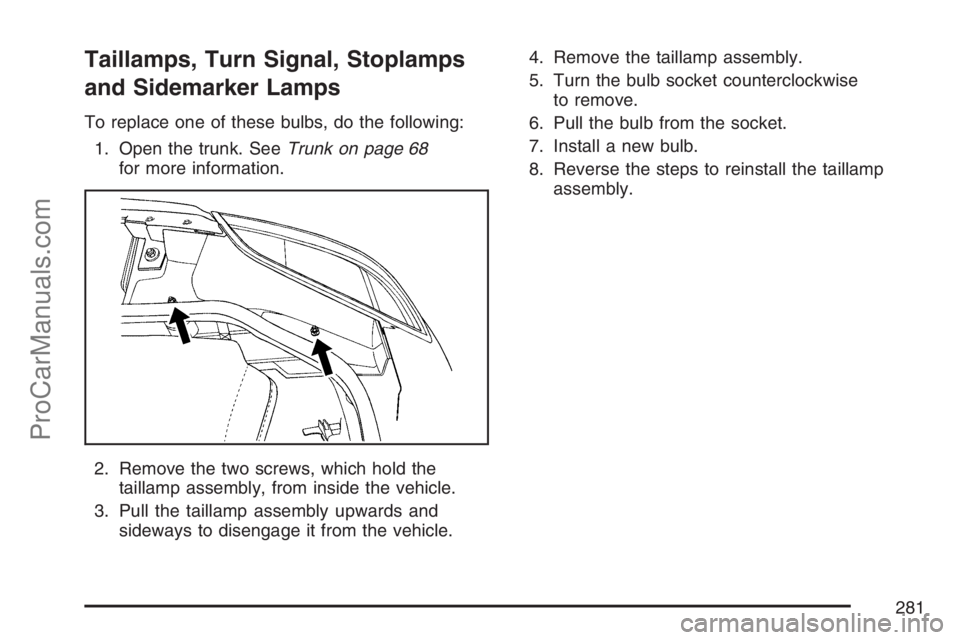
Taillamps, Turn Signal, Stoplamps
and Sidemarker Lamps
To replace one of these bulbs, do the following:
1. Open the trunk. SeeTrunk on page 68
for more information.
2. Remove the two screws, which hold the
taillamp assembly, from inside the vehicle.
3. Pull the taillamp assembly upwards and
sideways to disengage it from the vehicle.4. Remove the taillamp assembly.
5. Turn the bulb socket counterclockwise
to remove.
6. Pull the bulb from the socket.
7. Install a new bulb.
8. Reverse the steps to reinstall the taillamp
assembly.
281
ProCarManuals.com