2007 SATURN SKY lock
[x] Cancel search: lockPage 360 of 384

The following services are provided in the U.S.
during the Bumper-to-Bumper warranty period and
in Canada, during the Base Warranty coverage
period of the New Vehicle Limited Warranty, up to
a maximum coverage of $100.
Fuel Delivery:Delivery of enough fuel for the
customer to get to the nearest service station
(approximately $5 in the U.S. and 10 litres
in Canada). Service to provide diesel may
be restricted. For safety reasons, propane
and other alternative fuels will not be provided
through this service.
Lock-out Service:To ensure security, the
driver must present the vehicle registration
and personal ID before lock-out service
is provided. Lock-out service will be covered
at no charge if you are unable to gain
entry into your vehicle. If you vehicle will not
start, Roadside Assistance will arrange to have
your vehicle towed to the nearest authorized
retailer. In the U.S., replacement keys made
at the customer’s expense will be delivered
within 10 miles.
Emergency Tow From a Public Roadway
or Highway:Tow to the nearest Saturn
retailer for warranty service or in the event
of a vehicle-disabling accident. Winch-out
assistance provided when the vehicle is mired
in sand, mud, or snow.
Flat Tire Change:If your vehicle has a spare
time, installation of that tire, in good condition,
will be covered at no charge. The customer
is responsible for the repair or replacement
of the tire if not covered by a warrantable
failure.
Jump Start:No-start occurrences which
require a battery jump start will be covered
at no charge.
360
ProCarManuals.com
Page 363 of 384

Vehicle Data Collection and
Event Data Recorders
Your vehicle, like other modern motor vehicles,
has a number of sophisticated computer systems
that monitor and control several aspects of the
vehicle’s performance. Your vehicle uses
on-board vehicle computers to monitor emission
control components to optimize fuel economy,
to monitor conditions for airbag deployment
and, if the vehicle has the Anti-lock Brake
System (ABS), to provide anti-lock braking and
to help the driver control the vehicle in difficult
driving situations. Some information may be stored
during regular operations to facilitate repair of
detected malfunctions; other information is stored
only in a crash event by computer systems,
such as those commonly called Event Data
Recorders (EDR).
In a crash event, computer systems, such as the
airbag Sensing and Diagnostic Module (SDM)
in your vehicle may record information about the
condition of the vehicle and how it was operated,
such as data related to engine speed, brake
application, throttle position, vehicle speed, safetybelt usage, airbag readiness, airbag performance,
and the severity of a collision. This information
has been used to improve vehicle crash
performance and may be used to improve
crash performance of future vehicles and driving
safety. Unlike the data recorders on many
airplanes, these on-board systems do not
record sounds, such as conversation of vehicle
occupants.
To read this information, special equipment is
needed and access to the vehicle or the device
that stores the data is required. GM will not access
information about a crash event or share it with
others other than:
with the consent of the vehicle owner or,
if the vehicle is leased, with the consent of
the lessee,
in response to an official request of police
or similar government office,
as part of GM’s defense of litigation through
the discovery process, or
as required by law.
363
ProCarManuals.com
Page 371 of 384

A
Accessories and Modications..................... 233
Accessory Power Outlet(s).......................... 121
Adding Equipment to Your Airbag-Equipped
Vehicle....................................................... 55
Additives, Fuel............................................ 236
Add-On Electrical Equipment....................... 325
Air Cleaner/Filter, Engine............................. 252
Air Conditioning........................................... 122
Airbag
Passenger Status Indicator....................... 131
Readiness Light....................................... 130
Airbag Sensing and Diagnostic
Module (SDM).......................................... 363
Airbag System............................................... 43
Adding Equipment to Your
Airbag-Equipped Vehicle......................... 55
How Does an Airbag Restrain?.................. 48
Passenger Sensing System....................... 50
Servicing Your Airbag-Equipped Vehicle..... 54
What Makes an Airbag Inate?.................. 48
What Will You See After an Airbag
Inates?................................................. 48
When Should an Airbag Inate?................. 47
Where Are the Airbags?............................. 45Antenna, Fixed Mast................................... 190
Antenna, XM™ Satellite Radio Antenna
System.................................................... 190
Anti-Lock Brake System (ABS).................... 197
Anti-Lock Brake, System Warning Light....... 135
Appearance Care
Aluminum or Chrome-Plated Wheels........ 320
Care of Safety Belts................................ 318
Chemical Paint Spotting........................... 322
Cleaning Exterior Lamps/Lenses.............. 319
Cleaning the Inside of Your Vehicle.......... 315
Convertible Top........................................ 320
Fabric/Carpet........................................... 316
Finish Care.............................................. 319
Finish Damage......................................... 322
Instrument Panel, Vinyl, and Other
Plastic Surfaces.................................... 317
Leather.................................................... 317
Sheet Metal Damage............................... 321
Tires........................................................ 321
Underbody Maintenance........................... 322
Vehicle Care/Appearance Materials.......... 323
Washing Your Vehicle .............................. 318
Weatherstrips........................................... 318
Windshield and Wiper Blades................... 319
Ashtray(s).................................................... 122
371
ProCarManuals.com
Page 372 of 384

Audio System(s).......................................... 158
Audio Steering Wheel Controls................. 188
Care of Your CD Player........................... 190
Care of Your CDs.................................... 190
Fixed Mast Antenna................................. 190
Radio with CD................................162, 168
Setting the Time..............................159, 160
Theft-Deterrent Feature............................ 188
Understanding Radio Reception............... 189
XM™ Satellite Radio Antenna System...... 190
Automatic Door Lock..................................... 68
Automatic Door Unlock.................................. 68
Automatic Transmission
Fluid........................................................ 254
Operation................................................... 82
B
Battery........................................................ 271
Run-Down Protection............................... 121
Before Leaving on a Long Trip.................... 215
Brake
Anti-Lock Brake System (ABS)................. 197
Emergencies............................................ 199
Parking...................................................... 86
System Warning Light.............................. 134Brakes........................................................ 268
Braking....................................................... 196
Braking in Emergencies............................... 199
Break-In, New Vehicle................................... 77
Bulb Replacement....................................... 279
Back-Up Lamps....................................... 282
Front Turn Signal, Parking and Fog
Lamps.................................................. 280
Halogen Bulbs......................................... 279
Headlamp Aiming..................................... 278
Headlamps and Parking Lamps................ 279
License Plate Lamps................................ 282
Replacement Bulbs.................................. 283
Taillamps, Turn Signal, Stoplamps and
Sidemarker Lamps................................ 281
Buying New Tires........................................ 296C
California Fuel............................................. 236
California Proposition 65 Warning................ 234
Canadian Owners........................................... 3
Capacities and Specications...................... 331
Carbon Monoxide................. 68, 91,218, 230
372
ProCarManuals.com
Page 374 of 384

Cooling System........................................... 260
Cruise Control............................................. 115
Cupholder(s)................................................. 99
Customer Assistance Information
Customer Assistance for Text
Telephone (TTY) Users......................... 358
Customer Assistance Offices.................... 358
Customer Satisfaction Procedure.............. 354
GM Mobility Reimbursement Program...... 359
Reporting Safety Defects to Saturn.......... 369
Reporting Safety Defects to the
Canadian Government.......................... 368
Reporting Safety Defects to the
United States Government.................... 368
Roadside Assistance Program.................. 359
Service Publications Ordering
Information........................................... 369
D
Daytime Running Lamps............................. 119
Defensive Driving........................................ 192
Delayed Locking............................................ 67
Disc, MP3................................................... 179
Doing Your Own Service Work.................... 234Door
Automatic Door Lock................................. 68
Automatic Door Unlock.............................. 68
Delayed Locking........................................ 67
Manual Door Locks.................................... 66
Power Door Locks..................................... 67
Driver
Position, Safety Belt................................... 18
Seat Height Adjuster.................................... 9
Driver Information Center (DIC)................... 144
DIC Operation and Displays..................... 144
DIC Vehicle Personalization..................... 152
DIC Warnings and Messages................... 147
Driving
At Night................................................... 209
City.......................................................... 213
Defensive................................................. 192
Drunken................................................... 193
Freeway................................................... 214
Hill and Mountain Roads.......................... 216
In Rain and on Wet Roads...................... 210
Rocking Your Vehicle to Get it Out.......... 225
Winter...................................................... 218
374
ProCarManuals.com
Page 375 of 384

E
Electrical System
Add-On Equipment................................... 325
Floor Console Fuse Block........................ 326
Fuses and Circuit Breakers...................... 325
Headlamp Wiring..................................... 325
Power Windows and Other Power
Options................................................. 325
Underhood Fuse Block............................. 328
Electronic Stability Control........................... 201
Electronic Stability Control Indicator Light.... 136
Engine
Air Cleaner/Filter...................................... 252
Battery..................................................... 271
Check and Service Engine Soon Light..... 138
Coolant.................................................... 255
Coolant Temperature Warning Light.......... 137
Drive Belt Routing.................................... 348
Engine Compartment Overview................ 242
Exhaust..................................................... 91
Oil ........................................................... 245
Oil Life System........................................ 250Engine (cont.)
Overheating............................................. 258
Starting...................................................... 80
Entry/Exit Lighting....................................... 120
Event Data Recorders (EDR)...................... 363
Extender, Safety Belt..................................... 27
F
Filter
Engine Air Cleaner................................... 252
Finish Damage............................................ 322
Fixed Mast Antenna.................................... 190
Flashers, Hazard Warning........................... 110
Flash-to-Pass.............................................. 112
Flat Tire...................................................... 303
Fluid
Automatic Transmission............................ 254
Manual Transmission................................ 254
Power Steering........................................ 266
Windshield Washer.................................. 267
Fog Lamp Light........................................... 142
Fog Lamps.................................................. 120
375
ProCarManuals.com
Page 376 of 384

Fuel............................................................ 235
Additives.................................................. 236
California Fuel.......................................... 236
Filling a Portable Fuel Container.............. 240
Filling Your Tank...................................... 238
Fuels in Foreign Countries....................... 237
Gage....................................................... 143
Gasoline Octane...................................... 235
Gasoline Specications............................ 236
Low Warning Light................................... 143
Fuses
Floor Console Fuse Block........................ 326
Fuses and Circuit Breakers...................... 325
Underhood Fuse Block............................. 328
G
Gage
Fuel......................................................... 143
Speedometer........................................... 129
Tachometer.............................................. 129
Gasoline
Octane..................................................... 235
Specications........................................... 236Glove Box..................................................... 99
GM Mobility Reimbursement Program.......... 359
H
Hazard Warning Flashers............................ 110
Headlamp
Aiming..................................................... 278
Headlamp Wiring......................................... 325
Headlamps.................................................. 118
Bulb Replacement.................................... 279
Daytime Running Lamps.......................... 119
Flash-to-Pass........................................... 112
Front Turn Signal, Parking and Fog
Lamps.................................................. 280
Halogen Bulbs......................................... 279
Headlamps and Parking Lamps................ 279
High/Low Beam Changer ......................... 112
On Reminder........................................... 119
Heater......................................................... 122
Height Adjuster, Driver Seat............................ 9
Highbeam On Light..................................... 142
Highway Hypnosis....................................... 216
Hill and Mountain Roads............................. 216
376
ProCarManuals.com
Page 377 of 384
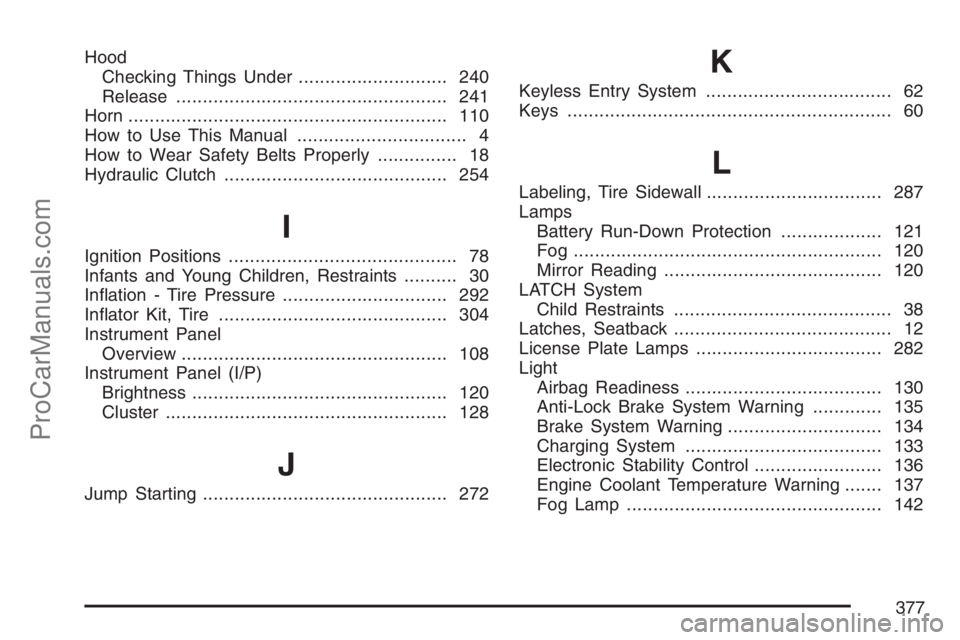
Hood
Checking Things Under............................ 240
Release................................................... 241
Horn............................................................ 110
How to Use This Manual................................ 4
How to Wear Safety Belts Properly............... 18
Hydraulic Clutch.......................................... 254
I
Ignition Positions........................................... 78
Infants and Young Children, Restraints.......... 30
Ination - Tire Pressure............................... 292
Inator Kit, Tire........................................... 304
Instrument Panel
Overview.................................................. 108
Instrument Panel (I/P)
Brightness................................................ 120
Cluster..................................................... 128
J
Jump Starting.............................................. 272
K
Keyless Entry System................................... 62
Keys............................................................. 60
L
Labeling, Tire Sidewall................................. 287
Lamps
Battery Run-Down Protection................... 121
Fog .......................................................... 120
Mirror Reading......................................... 120
LATCH System
Child Restraints......................................... 38
Latches, Seatback......................................... 12
License Plate Lamps................................... 282
Light
Airbag Readiness..................................... 130
Anti-Lock Brake System Warning............. 135
Brake System Warning............................. 134
Charging System..................................... 133
Electronic Stability Control........................ 136
Engine Coolant Temperature Warning....... 137
Fog Lamp................................................ 142
377
ProCarManuals.com