Page 1045 of 1449

BASIC BRAKE SYSTEM -General Information35A-3
GENERAL INFORMATION
The brake system offers high dependability and durability along with improved braking performance and
brake sensitivity.
SERVICE PRECAUTION
Take care not to contact the parts or tools to the caliper because the paint of caliper will be scratched.
SPECIFICATIONS
ItemsSpecifications
Master cylinderTypeTandem type
I.D. mm26.9
Brake boosterTypeVacuum type, tandem
Effective dia. of power cylinder mm205 + 230
Boosting ratio4.5 (Pedal depressing force: 230 N)
Rear wheel hydraulic
controlmethod
Vehicles with ABS Electronic brake-force distribution (EBD)
control methodVehicles without ABS Proportioning valves
Proportioning valves
VehicleswithoutABS
TypeSingle type¢2
Decompression ratio0.25
Front brakes
RS(standard)
TypeFloating caliper, 2 piston, ventilated disc
Disc effective dia.¢thickness mm227¢24
Wheel cylinder I.D. mm42.9 (¢2)
Pad thickness mm10.0
Clearance adjustmentAutomatic
Front brakes
Type4 opposed piston, ventilated disc
Disc effective dia.¢thickness mm263¢32
Wheel cylinder I.D. mm40.0 (¢2), 46.0 (¢2)
Pad thickness mm10.0
Clearance adjustmentAutomatic
Rear brakes
RS(standard)
TypeFloating caliper, 1 piston, ventilated disc
Disc effective dia.¢thickness mm237¢20
Wheel cylinder I.D. mm34.9
Pad thickness mm10.0
Clearance adjustmentAutomatic
Rear brakes
Type2 opposed piston, ventilated disc
Disc effective dia.¢thickness mm252¢22
Wheel cylinder I.D. mm40.0 (¢2)
Pad thickness mm9.0
Clearance adjustmentAutomatic
Brake fluidDOT3 or DOT4
Page 1046 of 1449
BASIC BRAKE SYSTEM -General Information35A-4
CONSTRUCTION DIAGRAM
Brake booster*
Rear disc brake
Parking brake
Front disc brake Master cylinder*Hydraulic unit*
Brake booster*
Rear disc brake
Parking brake
Front disc brake Master cylinder and
proportioning valves*
NOTE
For R.H. drive vehicles, only the position indicated by the * is symmetrical.
Page 1047 of 1449
Page 1051 of 1449
BASIC BRAKE SYSTEM -On-vehicle Service35A-9
CHECK VALVE OPERATION CHECK
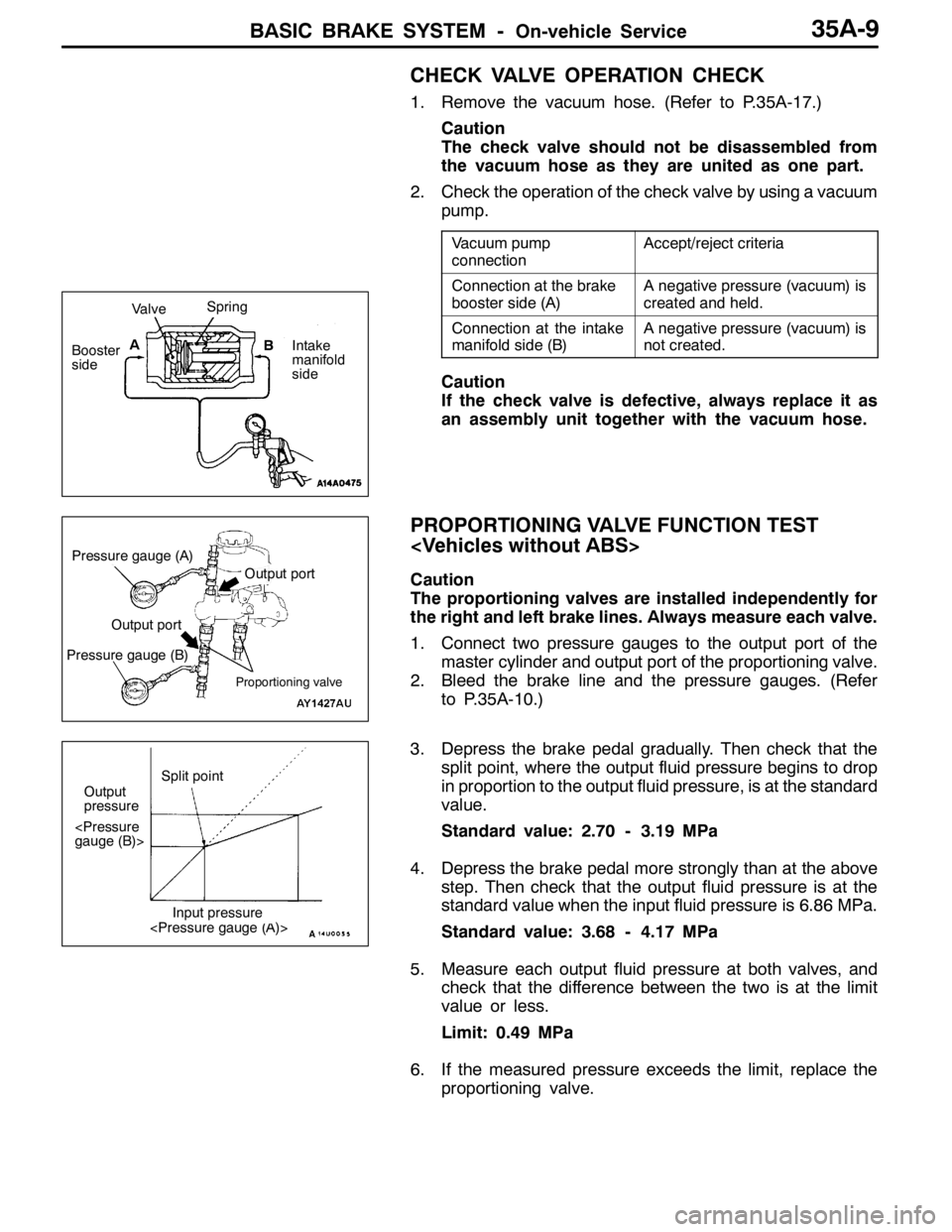
1. Remove the vacuum hose. (Refer to P.35A-17.)
Caution
The check valve should not be disassembled from
the vacuum hose as they are united as one part.
2. Check the operation of the check valve by using a vacuum
pump.
Vacuum pump
connectionAccept/reject criteria
Connection at the brake
booster side (A)A negative pressure (vacuum) is
created and held.
Connection at the intake
manifold side (B)A negative pressure (vacuum) is
not created.
Caution
If the check valve is defective, always replace it as
an assembly unit together with the vacuum hose.
PROPORTIONING VALVE FUNCTION TEST
Caution
The proportioning valves are installed independently for
the right and left brake lines. Always measure each valve.
1. Connect two pressure gauges to the output port of the
master cylinder and output port of the proportioning valve.
2. Bleed the brake line and the pressure gauges. (Refer
to P.35A-10.)
3. Depress the brake pedal gradually. Then check that the
split point, where the output fluid pressure begins to drop
in proportion to the output fluid pressure, is at the standard
value.
Standard value: 2.70 - 3.19 MPa
4. Depress the brake pedal more strongly than at the above
step. Then check that the output fluid pressure is at the
standard value when the input fluid pressure is 6.86 MPa.
Standard value: 3.68 - 4.17 MPa
5. Measure each output fluid pressure at both valves, and
check that the difference between the two is at the limit
value or less.
Limit: 0.49 MPa
6. If the measured pressure exceeds the limit, replace the
proportioning valve.
ValveSpring
Booster
sideA
B
Intake
manifold
side
Pressure gauge (A)
Proportioning valve
Output port
Output port
Pressure gauge (B)
gauge (B)>
Input pressure
Output
pressureSplit point
Page 1052 of 1449

BASIC BRAKE SYSTEM -On-vehicle Service35A-10
BLEEDING
Caution
Specified brake fluid: DOT3 or DOT4
Always use the specified brake fluid. Avoid using a
mixture of the specified brake fluid and other fluid.
MASTER CYLINDER BLEEDING
The master cylinder used has no check valve, so if bleeding
is carried out by the following procedure, bleeding of air from
the brake pipeline will become easier. (When brake fluid is
not contained in the master cylinder.)
1. Fill the reserve tank with brake fluid.
2. Keep the brake pedal depressed.
3. Have another person cover the master cylinder outlet
with a finger.
4. With the outlet still closed, release the brake pedal.
5. Repeat steps 2 - 4 three or four times to fill the inside
of the master cylinder with brake fluid.
BREMBO DISC BRAKE BLEEDING
Caution
Take care not to contact the parts or tools to the caliper
because the paint of caliper will be scratched. And if
there is brake fluid on the caliper, wipe out quickly.
Connect a vinyl tube to the outer end of the air bleeder screw
to bleed the circuit of air. Then, connect the vinyl tube to
the inner end and bleed the circuit of air. Except for these,
the conventional procedures shall be followed. After the circuit
has been bled of air, tighten both air bleeder screws securely.
BRAKE PIPE LINE BLEEDING
Bleed the air in the sequence shown in the figure.
Air bleeder screw
( ): R.H. drive vehicles
4 (2)
1 (3)
2 (4)
3 (1)
( ): R.H. drive vehicles
4, 6 (1, 3)
2 (5)
1, 3 (4, 6)
5 (2)
Vehicles with ABS
Vehicles without ABS
Page 1059 of 1449
BASIC BRAKE SYSTEM -Brake Pedal/Proportioning Valve,
Master Cylinder and Brake Booster35A-17
INSPECTION
STOP LAMP SWITCH CHECK
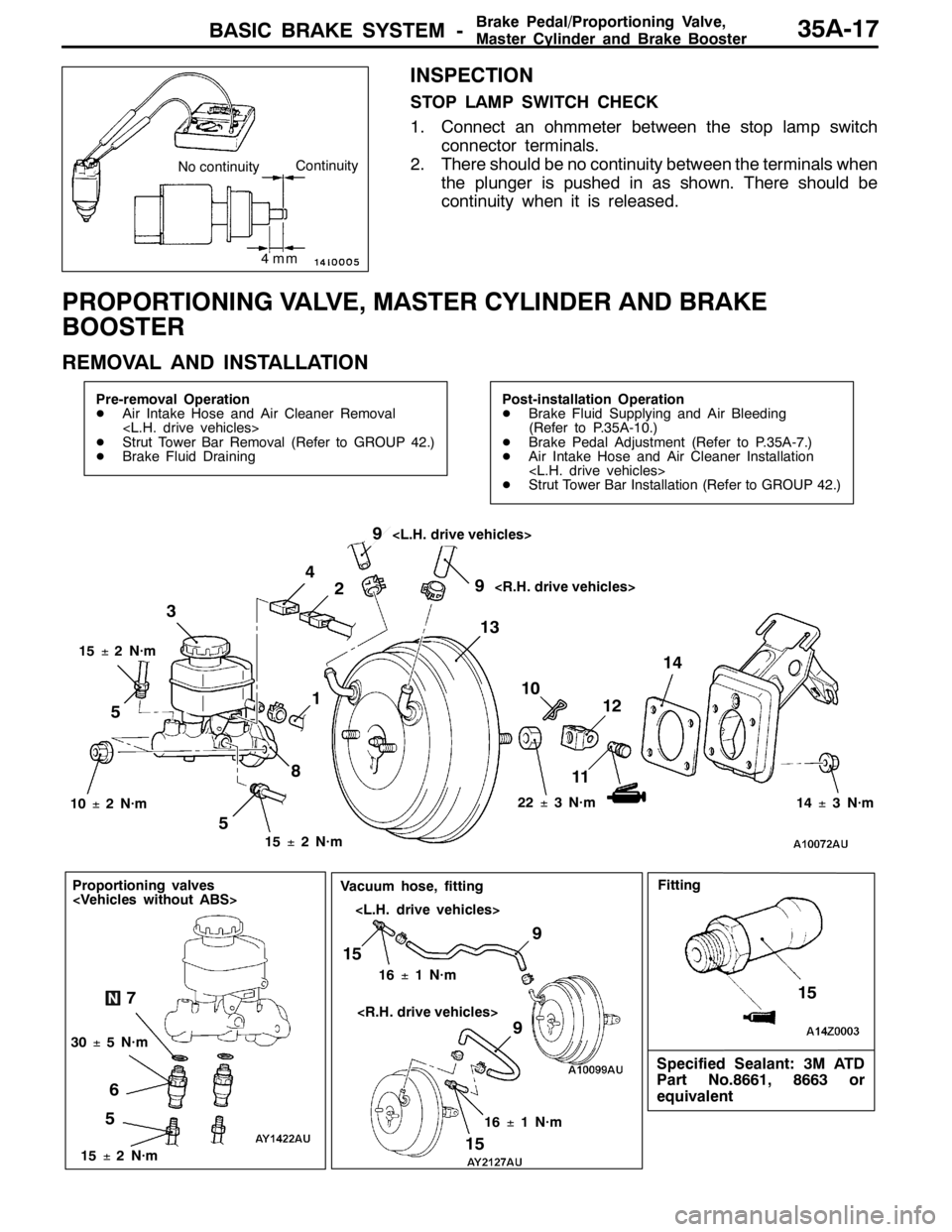
1. Connect an ohmmeter between the stop lamp switch
connector terminals.
2. There should be no continuity between the terminals when
the plunger is pushed in as shown. There should be
continuity when it is released.
PROPORTIONING VALVE, MASTER CYLINDER AND BRAKE
BOOSTER
REMOVAL AND INSTALLATION
Pre-removal Operation
DAir Intake Hose and Air Cleaner Removal
DStrut Tower Bar Removal (Refer to GROUP 42.)
DBrake Fluid DrainingPost-installation Operation
DBrake Fluid Supplying and Air Bleeding
(Refer to P.35A-10.)
DBrake Pedal Adjustment (Refer to P.35A-7.)
DAir Intake Hose and Air Cleaner Installation
DStrut Tower Bar Installation (Refer to GROUP 42.)
510
11 3
12 4
14
15±2N·m 15±2N·m
22±3N·m
10±2N·m
13 2
8
14±3N·m
519
9
15±2N·m
5
Proportioning valves
67
30±5N·m
9
15
16±1N·m
9
15
16±1N·m
Vacuum hose, fitting
Specified Sealant: 3M ATD
Part No.8661, 8663 or
equivalent
15
Fitting
4mm
No continuityContinuity
Page 1060 of 1449

BASIC BRAKE SYSTEM -ProportioningValve,MasterCylinder
and Brake Booster35A-18
Master cylinder removal steps
1. Clutch hose connection
2. Brake fluid level sensor connector
3. Reservoir cap assembly
4. Brake fluid level sensor
5. Brake pipe connection
6. Proportioning valve
7. O ring
8. Master cylinder
Proportioning valve removal steps
5. Brake pipe connection
6. Proportioning valve
7. O ring
Brake booster removal steps
1. Clutch hose connection
2. Brake fluid level sensor connector5. Brake pipe connection
8. Master cylinder
"BADPush rod protrusion amount check and
adjustment
"AA9. Vacuum hose
(With built-in check valve)
10. Snap pin
11. Pin assembly
12. Clevis
DRemove A/C liquid pipe B
from the
retaining clip.(Refer to GROUP 55A
- Refrigerant Line.)
13. Brake booster
14. Sealer
Fitting removal steps
"AA9. Vacuum hose
(With built-in check valve)
15. Fitting
INSTALLATION SERVICE POINTS
"AAVACUUM HOSE CONNECTION
Insert the vacuum hose to the brake booster with its paint
mark facing upward, and then secure the hose by using the
hose clip.
"BAPUSH ROD PROTRUSION AMOUNT CHECK AND
ADJUSTMENT
1. Measure dimension (A).
Standard value (A) : 8.98 - 9.23 mm
NOTE
When a negative pressure of 66.7 kPa is applied to the
brake booster, the push rod should protrude 10.27 – 10.53
mm.
Block gauge Measuring distance A
A
Page 1061 of 1449
BASIC BRAKE SYSTEM -ProportioningValve,MasterCylinder
and Brake BoosterBASIC BRAKE SYSTEM -ProportioningValve,MasterCylinder
and Brake Booster35A-19
2. If the protrusion amount is not within the standard value
range, adjust the push rod length by turning the push
rod. Use the special tool to turn the push rod while holding
the rod spline with angle-nose pliers.
MASTER CYLINDER
DISASSEMBLY AND REASSEMBLY
1
2
3838
Brake fluid: DOT3 or DOT4
77
5Master cylinder kit
4
9
6
10
9
8
9
10
Disassembly steps
1. Reservoir cap
2. Filter
3. Spring pin
4. Reservoir tank
5. Reservoir seal6. Pin
7. Piston retainer
8. Primary piston assembly
9. Secondary piston assembly
10. Master cylinder body
Angle-nose pliers
MB991568
Rod spline