2007 MITSUBISHI LANCER EVOLUTION water pump
[x] Cancel search: water pumpPage 487 of 1449

ENGINE OVERHAUL -Water Pump and Water Hose11B-33
INSTALLATION SERVICE POINTS
"AAO-RING/WATER INLET PIPE INSTALLATION
Replace the O-ring for the water inlet pipe with a new part,
and apply water on the periphery of the O-ring so that it
can be inserted easily into the water pump and thermostat
housing.
Caution
(1) Never apply grease or oil, such as engine oil, on the
O-ring.
(2) Install the water inlet pipe onto the thermostat
housing, and then fix.
"BAWATER OUTLET FITTING INSTALLATION
Squeeze out form-in-place gasket at a 3 mm width, and apply
at the position shown in the illustration.
Form-in-place gasket
Specified gasket:
Mitsubishi Genuine Part No. MD970389 or
equivalent
"CAENGINE COOLANT TEMPERATURE GAUGE UNIT
INSTALLATION
When reusing the bolts, apply the specified sealant on the
threads.
Sealant
Specified sealant:
3M
TMAAD Part No. 8672 or equivalent
"DAENGINE COOLANT TEMPERATURE SENSOR
INSTALLATION
Apply the specified sealant onto the threads.
Sealant
Specified sealant:
3M
TMAAD Part No. 8731 or equivalent
Caution
Make sure that the tool does not contact the connector
section (resin section).
Page 526 of 1449

ENGINE LUBRICATION -General Information12-2
GENERAL INFORMATION
The lubrication method is a fully force-fed, full-flow
filtration type. The oil pump is a gear type which
is driven by the crankshaft via the timing belt.
ENGINE OILS
Health Warning
Prolonged and repeated contact with mineral oil
will result in the removal of natural fats from the
skin, leading to dryness, irritation and dermatitis.
In addition, used engine oil contains potentiallyharmful contaminants which may cause skin cancer.
Adequate means of skin protection and washing
facilities must be provided.
Recommended Precautions
The most effective precaution is to adapt working
practices which prevent, as far as practicable, the
risk of skin contact with mineral oils, for example
by using enclosed systems for handling used engine
oil and by degreasing components, where
practicable, before handling them.
Other precautions:
DAvoid prolonged and repeated contact with oils,
particularly used engine oils.
DWear protective clothing, including impervious
gloves where practicable.
DAvoid contaminating clothes, particularly
underpants, with oil.
DDo not put oily rags in pockets, the use of
overalls without pockets will avoid this.
DDo not wear heavily soiled clothing and
oil - impregnated foot - wear. Overalls must be
cleaned regularly and kept separate from
personal clothing.DWhere there is a risk of eye contact, eye
protection should be worn, for example,
chemical goggles or face shields; in addition
an eye wash facility should be provided.
DObtain First Aid treatment immediately for open
cuts and wounds.
DWash regularly with soap and water to ensure
all oil is removed, especially before meals (skin
cleansers and nail brushes will help). After
cleaning, the application of preparations
containing lanolin to replace the natural skin
oils is advised.
DDo not use petrol, kerosine, diesel fuel, gas
oil, thinners or solvents for cleaning skin.
DUse barrier creams, applying them before each
work period, to help the removal of oil from
the skin after work.
DIf skin disorders develop, obtain medical advice
without delay.
Page 537 of 1449

MPI -General Information13A-5
MULTI-POINT FUEL INJECTION SYSTEM DIAGRAM
L1 Oxygen sensor (front)
L2 Oxygen sensor (rear)
L3 Air flow sensor
L4 Intake air temperature sensor
L5 Throttle position sensor
L6 Camshaft position sensor
L7 Crank angle sensor
L8 Barometric pressure sensor
L9 Engine coolant temperature sensor
L10 Detonation sensor
Engine-ECU
l1 Injector
l2 Idle speed control servo
l3 Fuel pressure control solenoid valve
l4 Waste gate solenoid valve
l5 EGR control solenoid valve
l6 Purge control solenoid valve
l7 Secondary air control solenoid valve
DPower supply
DIgnition switch IG
DIgnition switch ST
DVehicle speed sensor
DA/C switch
DA/C load signal
DTachometer
DPower steering fluid pressure switch
DAlternator FR terminal
DDiagnosis control terminal
DIntercooler water spray switch (automatic)
DIntercooler water spray switch (manual)DEngine control relay
DFuel pump relay 2, 3
DA/C relay
DIgnition coil
DFan controller
DCondenser fan relay (HI)
DCondenser fan relay (LOW)
DEngine warning lamp
DDiagnosis output
DAlternator G terminal
DIntercooler water spray relay
DIntercooler water spray lamp
L1 Oxygen
sensor
(front)
L4 Intake air
temperature
sensorL5 Throttle
position
sensor
L6 Camshaft
position sensorl1 Injector l2 Idle
speed
control
servo
l6 Purge
control
solenoid
valve
Three-way
catalytic converter Canister
Air
inletVacuum
tank
Fuel
pressure
reguratorFrom
fuel tank
To fuel tank
PCV valveFrom
fuel pump
Waste gate
actuatorL2 Oxygen sensor (rear) Check
valveBy-pass
valve
l5 EGR control
solenoid valve
l4 Waste gate
solenoid valve L8 Barometric
pressure
sensor
L3 Air flow
sensorl7 Secondary
air control
solenoid
valve
Secondary
air valvel3 Fuel pressure
control
solenoid valve
EGR
valve
L9 Engine coolant
temperature sensor
L7 Crank angle sensor
L10 Detonation sensor
Page 584 of 1449

MPI -Troubleshooting13A-52
INSPECTION CHART FOR TROUBLE SYMPTOMS
Inspection
procedureCheck itemsReference page
1Communication between MUT-IIand entire system is not possible.13A-54
2Only communication between MUT-IIand engine-ECU is not possible.13A-55
3Engine warning lamp does not illuminate immediately after ignition switch is set to ON position.13A-56
4Engine warning lamp stays illuminated and does not turn OFF.13A-57
5Starting disabled (Starter does not rotate.)13A-58
6Starting disabled (Starter rotates but initial combustion does not occur.)13A-59
7Starting disabled (Initial combustion occurs but is incomplete.)13A-61
Improper starting (Starting time is long.)
8Unstable idling (Rough idling, hunting)13A-63
Inappropriate idling speed (High or low idling speed)
Engine stalls (Die out) during idling
9Engine stalls when starting travel. (Pass out)13A-66
10Engine stalls during deceleration13A-67
11Pulsation (Hesitation, sag)13A-68
Poor acceleration
Stumbling
Surging
12Shock during acceleration13A-70
13Shock during deceleration13A-71
14Knocking13A-72
15Deviation of ignition interval13A-73
16Run on (Dieseling)13A-74
17Abnormal odor, white smoke, black smoke, high CO or HC concentration when idling13A-75
18Battery dies13A-77
19Overheating13A-79
20Abnormal radiator fan motor rotation13A-80
21A/C ineffective13A-81
22Engine-ECU power supply, engine control relay, ignition switch-IG1 system13A-82
23Fuel pump system13A-85
24Radiator fan control relay system13A-87
25Condenser fan relay system13A-89
26A/C switch system13A-92
27A/C compressor relay system13A-93
28A/C load signal system13A-95
29Secondary air control solenoid valve system13A-96
30Intercooler water spray circuit system13A-97
31Intercooler water spray lamp system13A-99
32Ignition coil (integrated power transistor) system13A-100
Page 611 of 1449
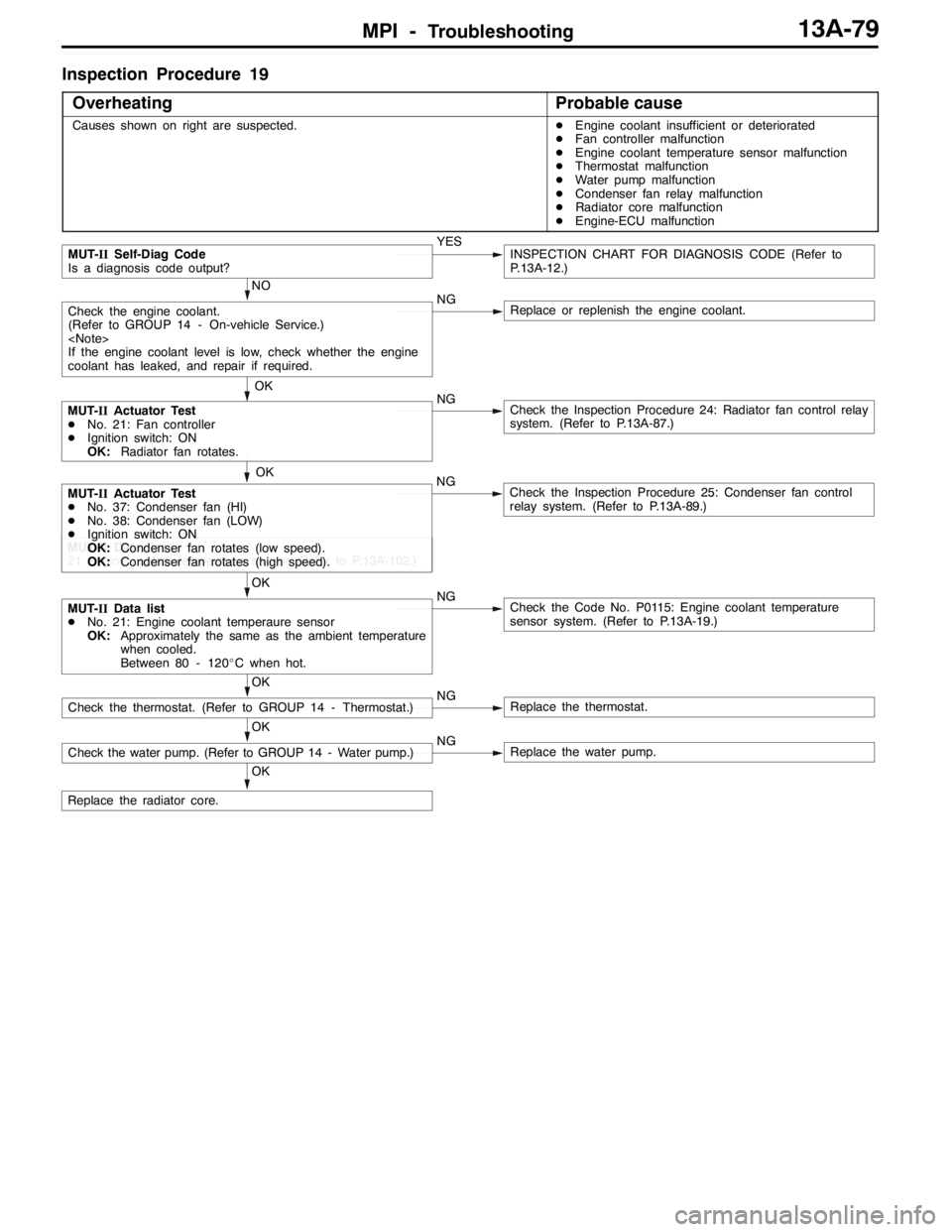
MPI -Troubleshooting13A-79
Inspection Procedure 19
Overheating
Probable cause
Causes shown on right are suspected.DEngine coolant insufficient or deteriorated
DFan controller malfunction
DEngine coolant temperature sensor malfunction
DThermostat malfunction
DWater pump malfunction
DCondenser fan relay malfunction
DRadiator core malfunction
DEngine-ECU malfunction
NO
NG
Replace or replenish the engine coolant.
OK
Replace the radiator core.
OK
Check the water pump. (Refer to GROUP 14 - Water pump.)NGReplace the water pump.
OK
Check the thermostat. (Refer to GROUP 14 - Thermostat.)NGReplace the thermostat.
OK
MUT-IIData list
DNo. 21: Engine coolant temperaure sensor
OK:Approximately the same as the ambient temperature
when cooled.
Between 80 - 120_C when hot.NGCheck the Code No. P0115: Engine coolant temperature
sensor system. (Refer to P.13A-19.)
MUT-IIData list
21 Engine coolant temperature sensor (Refer to P.13A-102.)
OK
MUT-IIActuator Test
DNo. 37: Condenser fan (HI)
DNo. 38: Condenser fan (LOW)
DIgnition switch: ON
OK:Condenser fan rotates (low speed).
OK:Condenser fan rotates (high speed).NGCheck the Inspection Procedure 25: Condenser fan control
relay system. (Refer to P.13A-89.)
MUT-IIActuator Test
DNo. 21: Fan controller
DIgnition switch: ON
OK:Radiator fan rotates.NGCheck the Inspection Procedure 24: Radiator fan control relay
system. (Refer to P.13A-87.)
OK
Check the engine coolant.
(Refer to GROUP 14 - On-vehicle Service.)
If the engine coolant level is low, check whether the engine
coolant has leaked, and repair if required.
MUT-IISelf-Diag Code
Is a diagnosis code output?YESINSPECTION CHART FOR DIAGNOSIS CODE (Refer to
P.13A-12.)
Page 642 of 1449

MPI -Troubleshooting13A-110
Terminal No.Normal condition Check condition (Engine condition) Check item
12Power supplyIgnition switch: “ON”System voltage
25
19Air flow sensor reset
signal
Engine: Idle operation0-1V
signal
Engine speed: 3,000 r/min6-9V
21Fan controllerRadiator fan is not operating0 - 0.3 V
Radiator fan is operating0.7 V or more
22Fuel pump relay 2Ignition switch: “ON”System voltage
Engine: Idle operation1 V or less
24A/C load signalDEngine:
Idle operation
DA/C switch: ON
(A/C compressor
runs)DOutdoor air
sensor ambient
temperature:
18_C or more
DA/C setting
temperature:
Minimum
temperature
DA/C air volume:
Maximum1 V or less
DA/C setting
temperature:
indoor
temperature
DA/C air volume:
MinimumSystem voltage
32Condenser fan motor
relay (HI)Fan inactive state
(Engine coolant temperature: 90_C or less)System voltage
Fan high-speed rotation state
(Engine coolant temperature: 105_C or more)1 V or less
33Alternator G terminalDEngine: After warm-up, idle operation
DRadiator fan: Not operating
DHeadlamp: OFF→ON
DStop lamp: OFF→ON
DRear defogger switch: OFF→ONVoltage increases by
0.2 - 3.5 V
34Condenser fan motor
relay (LOW)Fan inactive state
(Engine coolant temperature: 90_C or less)System voltage
Fan low-speed rotation state (Engine coolant
temperature: 95 - 100_C or more)1 V or less
35Intercooler water
spraylamp
Ignition switch: “ON”System voltage
spraylamp
Ignition switch: “LOCK” (OFF)1 V or less
36Engine warning lampIgnition switch: “LOCK” (OFF)→“ON”1 V or less→System
voltage (After several se-
conds have elapsed)
Page 643 of 1449

MPI -Troubleshooting13A-111
Terminal No.Normal condition Check condition (Engine condition) Check item
37Power steering fluid
pressure switchEngine: Idling after
warming upWhen steering wheel
is stationarySystem voltage
When steering wheel
is turned1 V or less
38Engine control relayIgnition switch: “LOCK” (OFF)System voltage
Ignition switch: “ON”1 V or less
39Fuel pump relay 3While engine is idling, suddenly depress the
accelerator pedal.Temporarily rises slightly
from 1 V or less.
41Alternator FR
terminalDEngine: After warm-up, idle operation
DRadiator fan: Not operating
DHead lamp: OFF→ON
DStop lamp: OFF→ON
DRear deffogger switch: OFF→ONVoltage decrease
44Intercooler water
spray switch (Auto)DIgnition switch: “ON”
DIntercooler water spray switch: ON1 V or less
DIgnition switch: “ON”
DIntercooler water spray switch: OFFSystem voltage
45A/C switchEngine: Idle operationTurn the A/C switch
OFF0.5 V or less
DA/C switch: ON
DA/C setting
temperature
When room tem-
perature is 25_C
or more: Max
Cool
When room tem-
perature is 25_C
or less: Max. HotSystem voltage
53Secondary air control
solenoid valveIgnition switch: “ON”System voltage
54Oxygen sensor
heater(Rear)
Engine: Idling after warming up1 V or less
heater(Rear)
Engine speed: 5,000r/minSystem voltage
55Intercooler water
sprayrelay
Ignition switch: “ON”System voltage
spray relay
Ignition switch: “LOCK” (OFF)1 V or less
58Tachometer signalEngine speed: 3,000r/min0.3 - 3.0 V
60Oxygen sensor
heater(front)
Engine: Idling after warming up1 V or less
heater(front)
Engine speed: 5,000r/minSystem voltage
71Ignition switch - STEngine: Cranking8 V or more
Page 689 of 1449

14-1
ENGINE COOLING
CONTENTS
GENERAL INFORMATION 2..................
SERVICE SPECIFICATIONS 2.................
LUBRICANT 2...............................
SEALANT 2..................................
SPECIAL TOOLS 3...........................
TROUBLESHOOTING 3.......................
ON-VEHICLE SERVICE 6.....................
Engine Coolant Leak Checking 6................
Radiator Cap Opening Pressure Check 6........Engine Coolant Replacement 6..................
Concentration Measurement 7...................
Radiator Fan Relay Continuity Check 8..........
Radiator Fan Controller Check 8................
Radiator Fan Motor Check 10...................
THERMOSTAT 11............................
WATER PUMP 13............................
WATER HOSE AND WATER PIPE 14..........
RADIATOR 15................................