2007 MERCEDES-BENZ C-CLASS SALOON tyre pressure
[x] Cancel search: tyre pressurePage 320 of 377

Flat tyre
317G
Risk of accident
If the tyre pressure is now lower than
1.3 bar, the tyre is too badly damaged. Do
not drive any further. Consult a qualified
specialist workshop which has the neces -
sary specialist knowledge and tools to carry
out the work required. Mercedes-Benz rec-
ommends that you use a Mercedes-Benz
Service Centre for this purpose. In particu-
lar, work relevant to safety or on safety-
related systems must be carried out at a
qualified specialist workshop.
X If the tyre pressure is still at least 1.3 bar,
correct it (see fuel filler flap for values).
To increase the tyre pressure: switch on
the electric air pump.
To reduce the tyre pressure :open pres-
sure release screw aon pressure
gauge b.
X Drive to the nearest workshop and have the
tyre changed there.
X Have the TIREFIT kit replaced as soon as
possible at a qualified specialist workshop ,
e.g. at a Mercedes-Benz Service Centre. G
Risk of accident
Do not exceed the maximum speed of 80
km/h.
The “max. 80 km/h” sticker must be affixe d
within the driver's field of vision.
The vehicle's handling characteristics may
be affected. H
Environmental not
e
Have the used TIREFIT kit disposed of pro-
fessionally, e.g. at a Mercedes-Benz
Service Centre.
X Have the TIREFIT kit replaced every fou r
years at a qualified specialist workshop ,
e.g. a Mercedes-Benz Service Centre. Version
2 1
TIREFIT sealant filler bottle
2 Recess
3 On/off switch
4 Electric connector with cable
5 Air pump hos e
6 Flange
X Pull connector 4and air pump hose 5
from the housing.
X Screw air pump hose 5onto flange 6of
TIREFIT filler bottle 1.
X Place TIREFIT sealant filler bottle 1head
downwards into recess 2of the electric
air pump. Practical advice
204_AKB; 2; 3, en-GB
mkalafa,
2007-06-26T23:11:51+02:00 - Seite 317
Page 321 of 377

Flat tyre
3187
Valve
8 Filler hos e
X Remove the cap from valve 7on the faulty
tyre.
X Screw filler hose 8onto valve 7.
X Insert connector 4into the cigarett e
lighter socket (Y page 197) or into a 12V
socket* in your vehicle (Y page 198).
X Turn the ignition key to position 1in the
ignition lock .
X Press on/off switch 3on the electric air
pump to I.
The electric air pump is switched on. The
tyre is inflated. i
First, TIREFIT is pumped into the tyre. The
pressure can briefly rise to around 5 bar.
Do not switch off the compressor during
this phase.
X Let the compressor run for five minutes.
The tyre should then have a pressure of at
least 1.8 bar.
! Do not operate the electric air pump for
longer than six minutes without a break,
otherwise it may overheat.
The air pump can be operated again once
it has cooled down.
If a pressure of 1.8 bar is not reached after
five minutes:
X Switch off and disconnect the electric ai r
pump and drive the vehicle forwards or
backwards approximately 10 m.
This distributes the TIREFIT more evenly.
X Remove the sealant filler bottle from th e
electric pump.
X Pump up the tyre again. G
Risk of accident
If a pressure of 1.8 bar is not achieved afte r
five minutes, the tyre is too badly damaged. Do not drive any further. Consult a qualified
specialist workshop which has the neces-
sary specialist knowledge and tools to carry
out the work required. Mercedes-Benz rec-
ommends that you use a Mercedes-Benz
Service Centre for this purpose. In particu-
lar, work relevant to safety or on safety-
related systems must be carried out at
a
qualified specialist workshop.
If a tyre pressure of 1.8 bar is reached:
X Press 0on the electric air pump switch.
The electric air pump is switched off.
X Disconnect the electric air pump and stow
it away .
X Fold up the warning triangle and stow it
away .
X Pull away immediately.
This distributes the TIREFIT more evenly
around the tyre.
X Stop after driving for approximately ten
minutes and check the tyre pressure with
the electric air pump. G
Risk of accident
If the tyre pressure is now lower than
1.3 bar, the tyre is too badly damaged. Do
not drive any further. Consult a qualified Practical advice
204_AKB; 2; 3, en-G
B
mkalafa , 2007-06-26T23:11:51+02:00 - Seite 318
Page 322 of 377

Flat tyre
319specialist workshop which has the neces-
sary specialist knowledge and tools to carry
out the work required. Mercedes-Benz rec -
ommends that you use a Mercedes-Benz
Service Centre for this purpose. In particu-
lar, work relevant to safety or on safety-
related systems must be carried out at a
qualified specialist workshop. 9
Pressure release button
a Pressure gauge
X If the tyre pressure is still at least 1.3 bar,
correct it (see fuel filler flap for values).
To increase the tyre pressure: switch on
the electric air pump.
To reduce the tyre pressure :press yellow
pressure release button 9next to pres-
sure gauge a. X
Drive to the nearest workshop and have the
tyre changed there.
X Have the TIREFIT kit replaced as soon as
possible at a qualified specialist workshop ,
e.g. at a Mercedes-Benz Service Centre. G
Risk of accident
Do not exceed the maximum speed of 80
km/h.
The “max. 80 km/h” sticker must be affixe d
within the driver's field of vision.
The vehicle's handling characteristics may
be affected. H
Environmental not
e
Have the used TIREFIT kit disposed of pro-
fessionally, e.g. at a Mercedes-Benz
Service Centre.
X Have the TIREFIT kit replaced every fou r
years at a qualified specialist workshop ,
e.g. a Mercedes-Benz Service Centre. Changing a wheel and fitting the spar
e
wheel * G
Risk of accident
The wheel dimensions and tyre size of the
spare wheel*, the emergency spare
wheel* and standard wheels may differ
from one another.
Your vehicle's handling characteristics will
be altered when a "Minispare"/collapsibl e
emergency spare wheel* is fitted. Adapt
your style of driving accordingly.
The “Minispare”/collapsible emergency
spare wheel* must only be used as a tem-
porary measure. Do not exceed the maxi-
mum speed of 80 km/h and do not
deactivate ESP ®
. G
Risk of accident
Have the “Minispare”/collapsible emer-
gency spare wheel* or the spare wheel *
replaced with a new wheel as soon as pos-
sible at a qualified specialist workshop
which has the necessary specialist knowl-
edge and tools to carry out the work
required. Mercedes-Benz recommends
that you use a Mercedes-Benz Service
Centre for this purpose. In particular, work Practical advice
* optiona l
204_AKB; 2; 3, en-GB
mkalafa,
2007-06-26T23:11:51+02:00 - Seite 319 Z
Page 326 of 377

Flat tyre
323
X
Turn the jack back to its initial position and
store it and the rest of the vehicle tool kit
in the boot/luggage compartment.
Vehicles with the "Minispare" emergency
spare wheel*:
X Transport the faulty wheel in the boot/lug-
gage compartment.
or
X Depending on the size of the wheel, yo u
may also be able to secure the faulty whee l
in the spare wheel well. In this case, you
will have to remove the stowage well casin g
from the spare wheel well and stow it
securely in the boot/luggage compart-
ment. MOExtended run-flat system*
The MOExtended run-flat system* must only
be used in conjunction with the tyre pressure
loss warning system*.
! The maximum permissible distance which
can be driven in run-flat mode depends on
the load in the vehicle. It is 50 km if the
vehicle is partially laden and 30 km if fully
laden. The maximum permissible distance which
can be driven in run-flat mode is counted
from the moment the tyre pressure loss
warning appears in the multi-function dis-
play.
You must not exceed a maximum speed of
80 km/h.
i Vehicles featuring the MOExtended run-
flat system* are not equipped with the
TIREFIT kit*.
It is therefore recommended to additionally
equip your vehicle with the TIREFIT kit*
when fitting tyres that do not feature run-
flat properties, e.g. winter tyres.
i A TIREFIT kit* is available from any quali-
fied specialist workshop, e.g. a Mercedes-
Benz Service Centre. G
Risk of accident
The handling characteristics of your vehicl e
deteriorate in run-flat mode, for example:
R when cornering
R when braking
R when accelerating rapidly
Adapt your driving style accordingly and
avoid sudden changes in direction and sud- den acceleration, as well as driving over
obstacles (i.e. kerbs, potholes), and driving
off-road. This is particularly the case when
the vehicle is heavily laden .
The maximum permissible distance that
can be driven in run-flat mode depends to
a large extent on the loads placed on the
vehicle. It can be shorter due to high
speeds, a heavy load, sudden acceleration
and/or manoeuvring, the road surface con-
dition, outside temperature, etc., or further
if you drive carefully and conservatively.
Do not continue to drive in run-flat mode if:
R you hear banging noises
R the vehicle starts to shake
R you see smoke and smell rubber
R ESP ®
is intervening constantly
R there are tears in the sidewalls of the tyr e
After driving in run-flat mode, you must
have the rims checked for damage at a
qualified specialist workshop which has the
necessary specialist knowledge and tools
to carry out the work required. The faulty
tyre must be replaced in every case.
Mercedes-Benz recommends that you use
a Mercedes-Benz Service Centre for this Practical advice
* optional
204_AKB; 2; 3, en-GB
mkalafa,
2007-06-26T23:11:51+02:00 - Seite 323 Z
Page 350 of 377

Tyres and wheels
34
7 Tyres and wheels
! For safety reasons, Mercedes-Benz rec-
ommends that you only use tyres which
have been approved by Mercedes-Benz
specifically for your vehicle. These tyres ar e
specially adapted for use with the control
systems, such as ABS or ESP ®
, and are
marked as follows:
R MO = Mercedes-Benz Original
R MOE = Mercedes-Benz Original Extended
(with run-flat characteristics)
If you use other tyres, Mercedes-Benz can-
not accept any responsibility for damage
which may occur. Information about tyres
can be obtained from any Mercedes-Ben z
Service Centre.
! If you fit tyres other than those tested and
recommended by Mercedes-Benz, charac-
teristics such as handling, noise levels and
fuel consumption, etc. may be adversel y
affected. In addition, when driving with a
load, dimensional variations and differen t
tyre deformation characteristics could
cause the tyres to make contact with the
bodywork and axle components. This could
result in damage to the tyres or the vehicle. i
Further information about tyres and
wheels can be obtained from any
Mercedes-Benz Service Centre.
You will find a table of tyre pressures on the
inside of your vehicle's fuel filler flap . You
will find further information about tyre pres-
sures in the "Operation" section
( Y page 213). Technical data
204_AKB; 2; 3, en-GB
mkalafa,
2007-06-26T23:11:51+02:00 - Seite 347
Page 356 of 377
Tyres and wheels
35
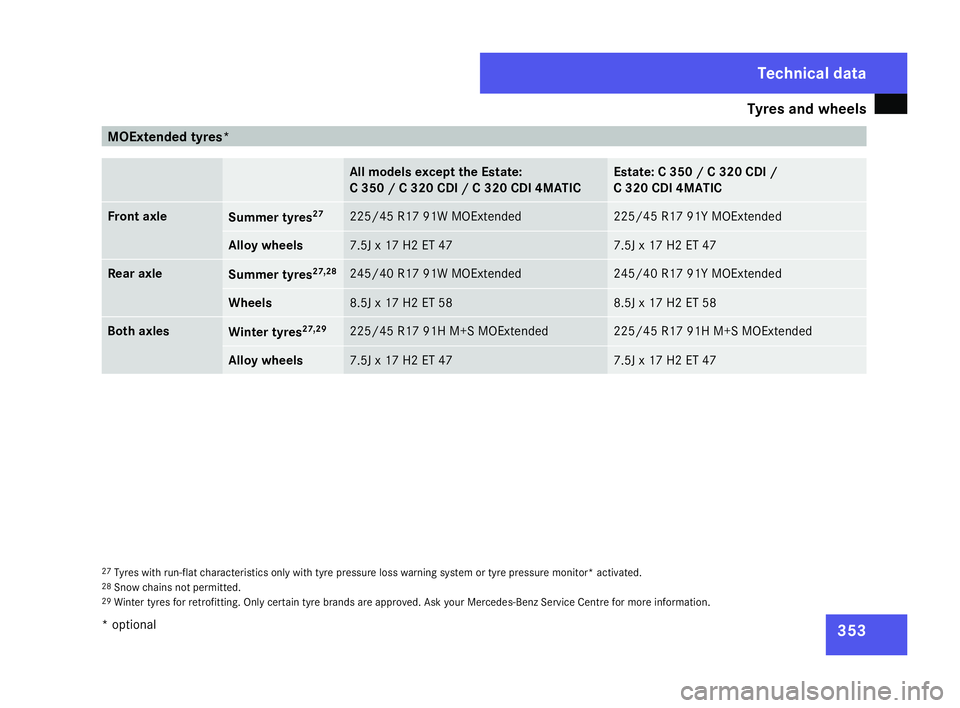
3 MOExtended tyres*
All models except the Estate:
C 350 / C 320 CDI / C 320 CDI 4MATI
C Estate: C 350 / C 320 CDI
/
C 320 CDI 4MATIC Front axl
e Summer tyres
27 225/45 R17 91W MOExtended 225/45 R17 91Y MOExtended
Alloy wheels 7.5J x 17 H2 ET 47 7.5J x 17 H2 ET 47
Rear axle
Summer tyres
27,28 245/40 R17 91W MOExtended 245/40 R17 91Y MOExtended
Wheels 8.5J x 17 H2 ET 58 8.5J x 17 H2 ET 58
Both axles
Winter tyres
27,29 225/45 R17 91H M+S MOExtended 225/45 R17 91H M+S MOExtended
Alloy wheels 7.5J x 17 H2 ET 47 7.5J x 17 H2 ET 47
27
Tyres with run-flat characteristics only with tyre pressure loss warning system or tyre pressure monitor* activated.
28 Snow chains not permitted.
29 Winter tyres for retrofitting. Only certain tyre brands are approved. Ask your Mercedes-Benz Service Centre for more information . Techni
cal data
* optiona l
204_AKB; 2; 3, en-GB
mkalafa,
2007-06-26T23:11:51+02:00 - Seite 353