6c.
Driving at constant
speed of 30 km/h in 2nd
gear
d. Driving at 50 km/h in 3rd
gear with accelerator
fully closed
e. Driving at constant
speed of 50 km/h in 4th
gear (1) 100%, (2) 0%, (3)
100%
Second solenoid valve
(2) 100%, (3) 100%,
(4) 0% Overdrive solenoid valve
(1) 0km/h
(4) 50km/h Vehicle speed sensor
(4) 1,800 ~ 2,100rpm Input shaft speed sensor
(4) 1,800 ~ 2,100rpm Output shaft speed sensor
7 Selector lever position
: D (Carry out on a
flat and straight road)
a.
Accelerate to 4th gear at
a throttle position sensor
output of 1.5V
(accelerator opening
angle of 30 %).
b. Gently decelerate to a
standstill.
c. Accelerate to 4th gear at
a throttle position sensor
output of 2.5 V
(accelerator opening
angle of 50%).
d. While driving at 60 km/h
in 4th gear, shift down
to 3rd gear.
e. While driving at 40 km/h
in 3rd gear, shift down
to 2nd gear.
f. While driving at 20 km/h
in 2nd gear, shift down
to 1st gear. For (1), (2) and (3),
the reading should be
the same as the
specified output shaft
torque, and no
abnormal shocks
should occur.
For (4), (5) and (6),
downshifting should
occur immediately
after the shifting
operation is made.
Malfunction when shifting
Displaced shift points
Does not shift
Does not shift from 1 to 2 or
2 to 1
Does not shift from 2 to 3 or
3 to 2
Does not shift from 3 to 4 or
4 to 3
8 Selector lever position
: N (Carry out on a
flat and straight road)
Move selector lever to R
range drive at constant
speed of 10km/h The ratio between
input and output shaft
speed sensor data
should be the same
as the gear ratio
when reversing.Does not shift
TORQUE CONVERTER STALL TEST
This test measures the maximum engine speed when the selector lever is in the D or R position. The torque converter
stalls to test the operation of the torque converter, starter motor, one- way clutch operation, the holding performance of
the clutches, and brakes in the transaxle.
Do not let anybody stand in front of or behind the vehicle while this test is being carried out
1. Check the automatic transmission fluid level and temperature, and the engine coolant temperature.
a. Fluid level : At the HOT mark on the oil level gauge
b. Fluid temperature : 80~100°C (176~212°F)
c. Engine coolant temperature : 80~100°C(176~212°F)
2. Prevent all the wheels from moving during the test.
3. Pull the parking brake lever up, with the brake pedal fully depressed.
4. Start the engine.
Tolerance(rpm) 5,000
6,0007,0008,000Engine
Revolution (rpm) ±150
±180±210 -Gasoline
±150 ±150 --Diesel
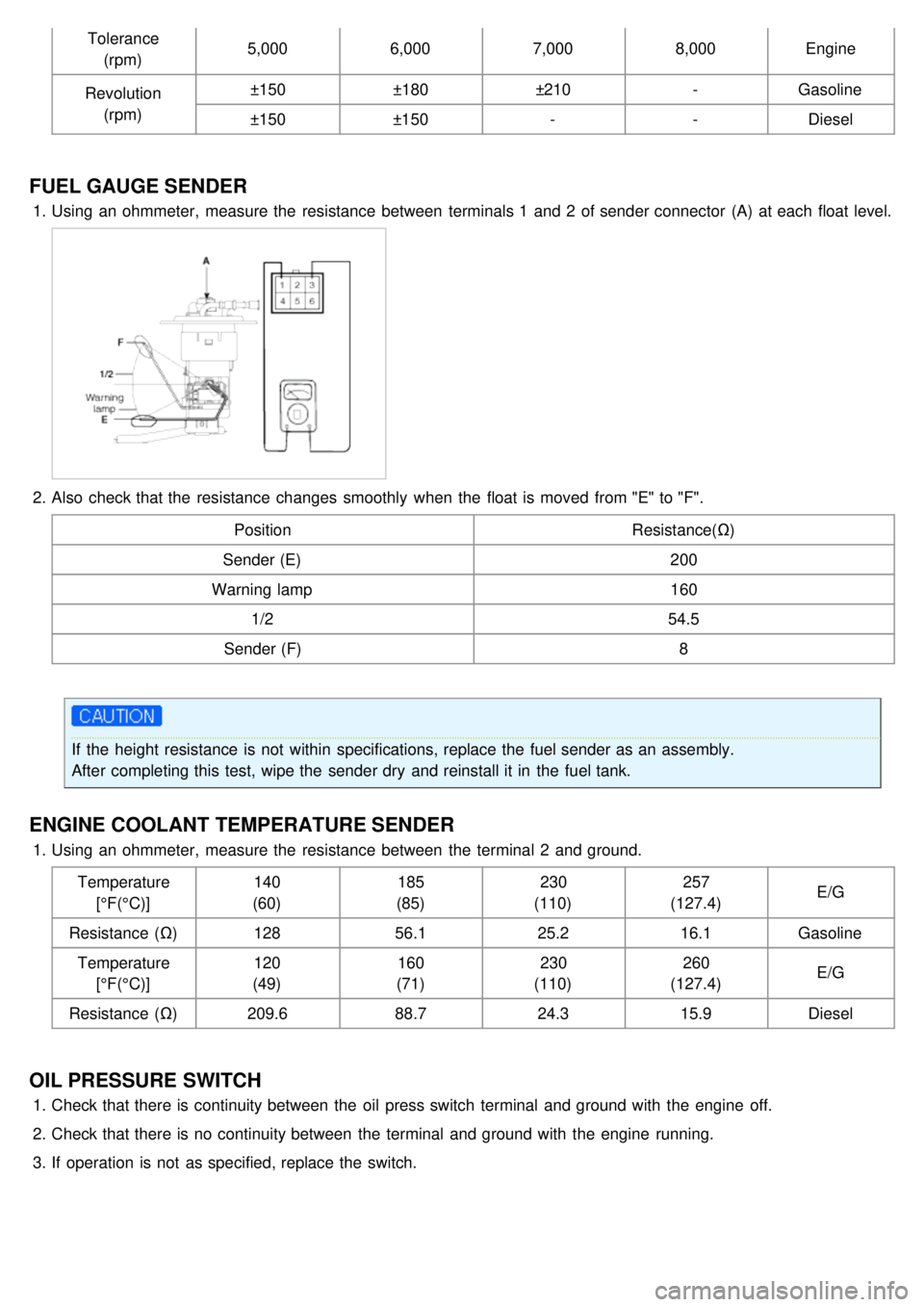
FUEL GAUGE SENDER
1.Using an ohmmeter, measure the resistance between terminals 1 and 2 of sender connector (A) at each float level.
2.Also check that the resistance changes smoothly when the float is moved from "E" to "F".
Position Resistance(Ω)
Sender (E) 200
Warning lamp 160
1/2 54.5
Sender (F) 8
If the height resistance is not within specifications, replace the fuel sender as an assembly.
After completing this test, wipe the sender dry and reinstall it in the fuel tank.
ENGINE COOLANT TEMPERATURE SENDER
1.Using an ohmmeter, measure the resistance between the terminal 2 and ground.
Temperature[°F(°C)] 140
(60) 185
(85) 230
(110) 257
(127.4) E/G
Resistance (Ω) 12856.1 25.216.1Gasoline
Temperature [°F(°C)] 120
(49) 160
(71) 230
(110) 260
(127.4) E/G
Resistance (Ω) 209.688.724.315.9Diesel
OIL PRESSURE SWITCH
1.Check that there is continuity between the oil press switch terminal and ground with the engine off.
2. Check that there is no continuity between the terminal and ground with the engine running.
3. If operation is not as specified, replace the switch.