Page 319 of 480

The fuel cap is located on the driver’s side of
the vehicle.
Some vehicles might have a fuel door. Open the
door to access the fuel cap.
Some vehicles might have a locking fuel cap.
Use the fuel cap key to unlock the fuel cap.
If you ever need a replacement key, your dealer
can help you get one.
To remove the fuel cap, turn it slowly
counterclockwise. While refueling, let the
fuel cap hang by the tether, if it has one.
{CAUTION:
If you spill fuel and then something
ignites it, you could be badly burned.
Fuel can spray out on you if you open
the fuel cap too quickly. This spray can
happen if your tank is nearly full, and is
more likely in hot weather. Open the fuel
cap slowly and wait for any hiss noise to
stop. Then unscrew the cap all the way.
Be careful not to spill fuel. Do not top off or overll
the tank and wait a few seconds after you have
nished pumping before removing the nozzle.
Clean fuel from painted surfaces as soon as
possible. SeeWashing Your Vehicle on page 410.
When replacing the fuel cap, turn it clockwise until
it clicks. Make sure the cap is fully installed. The
diagnostic system can determine if the fuel cap
has been left off or improperly installed. This would
allow fuel to evaporate into the atmosphere.
SeeMalfunction Indicator Lamp on page 186.
319
Page 323 of 480

A. Windshield Washer Fluid Reservoir. See
“Adding Washer Fluid” underWindshield
Washer Fluid on page 346.
B. Engine Coolant Recovery Tank. SeeEngine
Coolant on page 335.
C. Engine Air Cleaner/Filter. SeeEngine Air
Cleaner/Filter on page 328.
D. Power Steering Fluid Reservoir. SeePower
Steering Fluid on page 345.
E. Automatic Transmission Fluid Dipstick (If
Equipped). See “Checking the Fluid Level” under
Automatic Transmission Fluid on page 329.
F. Engine Oil Fill Cap. See “When to Add Engine
Oil” underEngine Oil on page 323.
G. Radiator Pressure Cap. SeeCooling System
on page 340.
H. Remote Negative (−) Terminal (GND). See
Jump Starting on page 352.
I. Engine Oil Dipstick. See “Checking Engine Oil”
underEngine Oil on page 323.
J. Positive (+) Battery Terminal. SeeJump
Starting on page 352.
K. Brake Fluid Reservoir. See “Brake Fluid” under
Brakes on page 347.L. Engine Compartment Fuse Block. SeeEngine
Compartment Fuse Block on page 418.
M. Battery. SeeBattery on page 351.
N. Hydraulic Clutch Fluid Reservoir (If Equipped).
SeeHydraulic Clutch on page 334.
Engine Oil
Checking Engine Oil
It is a good idea to check the engine oil every time
you get fuel. In order to get an accurate reading,
the oil must be warm and the vehicle must be
on level ground.
The engine oil dipstick handle is a yellow loop.
SeeEngine Compartment Overview on page 322
for the location of the engine oil dipstick.
1. Turn off the engine and give the oil several
minutes to drain back into the oil pan. If you
do not do this, the oil dipstick might not
show the actual level.
2. Pull out the dipstick and clean it with a paper
towel or cloth, then push it back in all the
way. Remove it again, keeping the tip down,
and check the level.
323
Page 327 of 480

How to Reset the Engine Oil Life
System
The Engine Oil Life System calculates when to
change your engine oil and lter based on vehicle
use. Anytime your oil is changed, reset the
system so it can calculate when the next oil
change is required. If a situation occurs where you
change your oil prior to a CHANGE OIL message
being turned on, reset the system.
To reset the Engine Oil Life system, do the following:
1. With the engine off, turn the ignition to ON.
2. Press and release the stem in the lower center
of the instrument cluster until the OIL LIFE
message is displayed.
3. Once the alternating OIL LIFE and RESET
messages appear, press and hold the stem
until several beeps sound. This conrms
that the oil life system has been reset.
4. Turn the key to LOCK.
If the CHANGE OIL message comes back on
when you start your vehicle, the engine oil
life system has not reset. Repeat the procedure.
SeeDIC Warnings and Messages on page 196.
What to Do with Used Oil
Used engine oil contains certain elements that
may be unhealthy for your skin and could
even cause cancer. Do not let used oil stay on
your skin for very long. Clean your skin and nails
with soap and water, or a good hand cleaner.
Wash or properly dispose of clothing or rags
containing used engine oil. See the manufacturer’s
warnings about the use and disposal of oil
products.
Used oil can be a threat to the environment.
If you change your own oil, be sure to drain all the
oil from the lter before disposal. Never dispose
of oil by putting it in the trash, pouring it on
the ground, into sewers, or into streams or bodies
of water. Instead, recycle it by taking it to a
place that collects used oil. If you have a problem
properly disposing of your used oil, ask your
dealer, a service station, or a local recycling
center for help.
327
Page 331 of 480

3. With your foot on the brake pedal, move the
shift lever through each gear range, pausing
for about three seconds in each range.
Then, position the shift lever in PARK (P).
4. Let the engine run at idle for three minutes
or more.
Then, without shutting off the engine, follow
these steps:
1. Flip the handle up and then pull out the
dipstick and wipe it with a clean rag or
paper towel.
The automatic
transmission dipstick
handle with this symbol
on it is located in the
engine compartment on
the passenger’s side
of the vehicle.
SeeEngine Compartment Overview on
page 322for more information on location.
2. Push it back in all the way, wait three seconds
and then pull it back out again.3. Check both sides of the dipstick, and read the
lower level. The uid level must be in the
COLD area, below the cross-hatched area, for
a cold check or in the HOT or cross-hatched
area for a hot check. Be sure to keep the
dipstick pointed down to get an accurate
reading.
4. If the uid level is in the acceptable range,
push the dipstick back in all the way; then
ip the handle down to lock the dipstick
in place.
331
Page 332 of 480

How to Add Automatic
Transmission Fluid
Refer to the Maintenance Schedule to determine
what kind of transmission uid to use. See
Recommended Fluids and Lubricants on page 440.
Add uid only after checking the transmission
uid while it is hot. A cold check is used only
as a reference. If the uid level is low, add only
enough of the proper uid to bring the level up to
the HOT area for a hot check. It does not take
much uid, generally less than one pint (0.5 L).
Do not overll.
Notice:Use of the incorrect automatic
transmission uid may damage your vehicle,
and the damages may not be covered by
your warranty. Always use the automatic
transmission uid listed inRecommended
Fluids and Lubricants on page 440.
After adding uid, recheck the uid level as
described under “How to Check Automatic
Transmission Fluid,” earlier in this section.
When the correct uid level is obtained, push
the dipstick back in all the way; then ip the
handle down to lock the dipstick in place.
Manual Transmission Fluid
When to Check
A good time to have it checked is when the
engine oil is changed. However, the uid in your
manual transmission does not require changing.
How to Check
Because this operation can be a little difficult,
you may choose to have this done at your
GM dealership service department.
If you do it yourself, be sure to follow all the
instructions here, or you could get a false reading.
Notice:Too much or too little uid can
damage your transmission. Too little uid
could cause the transmission to overheat. Be
sure to get an accurate reading if you check
your transmission uid.
Check the uid level only when your engine is off,
the vehicle is parked on a level place and the
transmission is cool enough for you to rest your
ngers on the transmission case.
332
Page 343 of 480
{CAUTION:
Steam and scalding liquids from a hot
cooling system can blow out and burn
you badly. They are under pressure, and if
you turn the radiator pressure cap — even
a little — they can come out at high
speed. Never turn the cap when the
cooling system, including the radiator
pressure cap, is hot. Wait for the cooling
system and radiator pressure cap to cool
if you ever have to turn the pressure cap.
How to Add Coolant to the Radiator
1. Remove the radiator pressure cap when the
cooling system, including the upper radiator
hose, is no longer hot. Turn the pressure cap
slowly counterclockwise about one full turn.
If you hear a hiss, wait for that to stop. A hiss
means there is still some pressure left.
2. Keep turning the cap to remove it.
343
Page 361 of 480
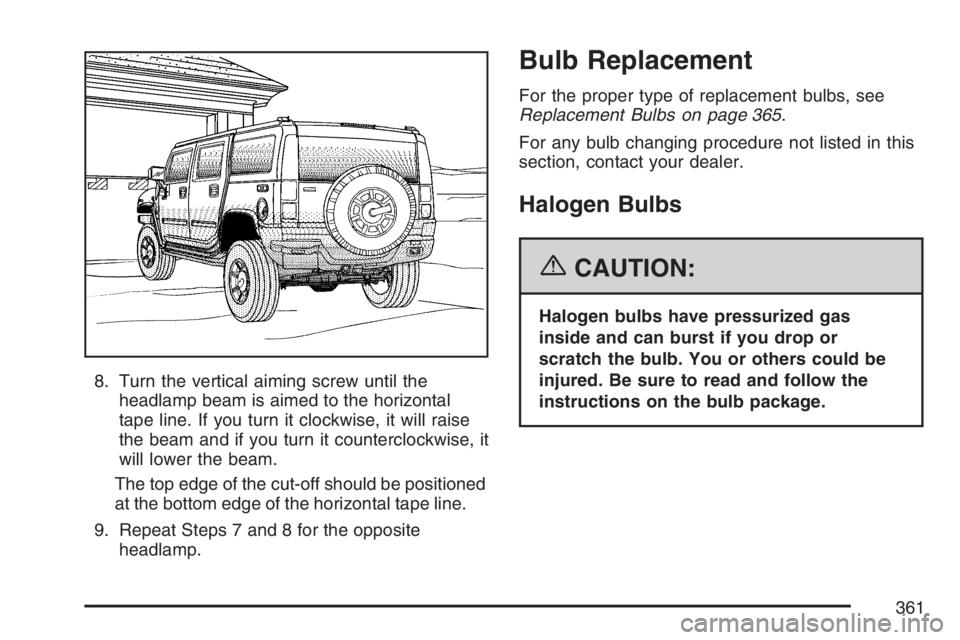
8. Turn the vertical aiming screw until the
headlamp beam is aimed to the horizontal
tape line. If you turn it clockwise, it will raise
the beam and if you turn it counterclockwise, it
will lower the beam.
The top edge of the cut-off should be positioned
at the bottom edge of the horizontal tape line.
9. Repeat Steps 7 and 8 for the opposite
headlamp.
Bulb Replacement
For the proper type of replacement bulbs, see
Replacement Bulbs on page 365.
For any bulb changing procedure not listed in this
section, contact your dealer.
Halogen Bulbs
{CAUTION:
Halogen bulbs have pressurized gas
inside and can burst if you drop or
scratch the bulb. You or others could be
injured. Be sure to read and follow the
instructions on the bulb package.
361
Page 362 of 480
Headlamps
To replace a headlamp bulb, do the following:
1. Open the hood. SeeHood Release on
page 321for more information.
2. Reach in and access the headlamp bulb
socket from inside the engine compartment.
3. Turn the bulb socket counterclockwise to
remove it from the headlamp assembly
and pull it straight out.4. Unplug the electrical connector by pushing
the release tab and pulling the bulb
socket out.
5. Replace with a new bulb socket.
6. Reinstall the electrical connector.
7. Reinstall the new bulb socket into the
headlamp assembly and turn it clockwise
to secure.
8. Close the hood.
362