2007 HONDA PILOT wheel
[x] Cancel search: wheelPage 224 of 319

When driving down hills, reduce
your speed and shift down to D . Do
not ‘‘ride’’ the brakes.
If you must stop when facing uphill,
use the foot brake or parking brake.
Do not try to hold the vehicle in
placebypressingontheaccelerator,
as this can cause the automatic
transmission to overheat.
Crosswinds and air turbulen ce
caused by passing trucks can disrupt
your steering and cause trailer to
sway. When being passed by a large
vehicle, keep a constant speed, and
steer straight ahead. Do not try to
make quick steering or braking
corrections. Al
ways drive slowly and have
someone guide you when backing up.
Grip the of the steering
wheel; then turn the wheel to the left
to get the trailer to move to the left,
andturnthewheel righttomovethe
trailer to the right.
Follow all norm al precau tions when
parking, including putting the
transmission in Park and firmly
setting the parking brake. Also, place
wheel chocks at each of the trailer’s
tires.
If the vehicle’s tires slip when
retr ieving a boat from the water,
shift to first gear, and turn on VTM-4
lock (see page ). Disengage
VTM-4 lock as soon as the boat is
out of the water to prevent damage
to the VTM-4 system. Your
vehicle is not designed to be
towed behind a motor home. If your
vehicle needs to be towed in an
emergency, see page .
204 279
3
bottom
Remember, it
takes longer to slow down and
stop when towing a trailer. Towing Your Vehicle
Handling Crosswinds and Buf f et ingBacking Up
ParkingRet rieving a Boat
T railer Driving T ips, T owing Your Vehicle Behind a Motorhome
Driving
221
Page 226 of 319

Before you leave the pavement, be
sure to do all scheduled maintenance
and service, and inspect your vehicle
f or any problems. Pay special
attention to the condition of the tires,
and check the tire pressures.
After you return to the pavement,
caref ully inspect your vehicle to
make sure there is no damage that
could make driving it unsaf e.
Recheck the condition of the tires
and the tire pressures.
The route presents limits (too steep
or bumpy roads). You have limits
(driving skill and comfort). And your
vehicle has limits (traction, stability,
and power).
Driving of f -highway can be
hazardous if you f ail to recognize
limits and take the proper
precautions.Forbettertractiononallsurfaces,
accelerate slowly and gradually build
up speed. If you try to start too fast
on wet soil, mud, snow, or ice, you
might not have enough traction to
get underway, and you may dig
yourself a hole. Starting with the
shif t lever in second (2) gear will
help you have a smoother start on
snow or ice.
Debris in the road can damage your
suspension or other components.
Because your vehicle has a high
center of gravity, driving over a large
obstacle, or allowing a wheel to drop
into a deep hole can cause your
vehicle to tip or roll over.
If you can’t clearly see all conditions
or obstacles on a slope, walk the
slope bef ore you drive on it. If you
have any doubt whether or not you
can saf ely drive on the slope, don’t
do it. Find another route.
If you are driving up a hill and f ind
that you cannot continue,
. Your vehicle could roll
over. Slowly back down the hill,
f ollowing the same route you took up
the hill.
Keep in mind that you will usually
need more time and distance to
brake to a stop on unpaved surf aces.
Avoid hard braking. Do not ‘‘pump’’
the brakes; let the anti-lock braking
system pump them f or you.
do not try to
turn around
Check Out Your Vehicle
Remember A ccelerating and Braking A voiding Obstacles
Driving on Slopes
Of f -Highway Driving Guidelines
Driving
223
Page 227 of 319

If you get stuck, engage the VTM-4
Lock (see page ). Carefully try to
go in the direction (f orward or
reverse) that you think will get you
unstuck. Do not spin the tires at high
speeds. It will not help you get out
and may cause damage to the
transmission or VTM-4 system.
If you are still unable to f ree yourself ,
your vehicle is equipped with f ront
and rear tow hooks designed f or this
purpose.
Bef ore driving through water, stop,
get out if necessary, and make sure
that:
The water is not deep enough to
cover your wheel hubs, axles, or
exhaust pipe. You could stall and
not be able to restart your engine.
The water can also damage
important vehicle components.
The banks are sloped so you can
drive out.
The water is not f lowing too f ast.
Deep rushing water can sweep you
downstream. Even very shallow
rushingwatercanwashthe
ground f rom under your tires and
cause you to lose traction and
possibly roll over.
The banks and surf ace under the
water provide good traction. The
water may hide hazards such as
rocks, holes, or mud. If you decide it is saf e to drive
through water, choose a suitable
speed and engage the VTM-4 Lock.
Proceed without shif ting or changing
speeds, and do not stop the vehicle
or shut of f the engine.
After driving through water, test
your brakes. If they got wet, gently
‘‘pump’’ them while driving slowly
until they operate normally.
If the water is deeper than the wheel
hubs, some additional service may
be required. This service is not
covered by your warranties.
Use a nylon strap to attach your
vehicle to the recovery vehicle, and
caref ully take out the slack in the
strap. Once the strap is tight, the
recovery vehicle should apply f orce.
Remember that the recovery vehicle
needs good traction to avoid
becoming stuck, too.204
If You Get Stuck
Crossing a Stream
Of f -Highway Driving Guidelines
224
Page 230 of 319

If you have the skills and tools to
perform more complex maintenance
tasks on your vehicle, you may want
to purchase the service manual. See
page f or inf ormation on how to
obtain a copy, or see your dealer. This section also includes
instructions on how to read the
maintenance messages in the
inf ormation display, a maintenance
record, and instructions f or simple
maintenance tasks you may want to
take care of yourself . This section explains why it is
important to keep your vehicle well
maintained and how to f ollow basic
maintenance saf ety precautions. ......................
Maintenance Saf ety .228
....................
Maintenance Minder .229
....................
Maintenance Record .236
..............................
Fluid Locations .238
........................
Adding Engine Oil .239
.........
Changing the Oil and Filter .240
..............................
Engine Coolant .242
....................
Windshield Washers .243
....
Automatic Transmission Fluid .244
..............................
Dif f erential Oil .245
....................................
Timing Belt .245
....................................
Brake Fluid .246
....................
Power Steering Fluid .247
.............................................
Lights .248
.....................................
Floor Mats .254
.......................
Cleaning Seat Belts .254
.................................
Wiper Blades .255
...........................................
Wheels .257
...............................................
Tires .257
...................
Checking the Battery .262
.............................
Vehicle Storage .263
305
Maintenance
Maint enance
227
Page 250 of 319

Check the level on the side of the
reservoir when the engine is cold.
The f luid should be between the
UPPER LEVEL and LOWER LEVEL.
If not add power steering f luid to the
UPPER LEVEL mark.A
low power steering
f
luid level can
indicate a leak in the system. Check
the f luid level f requently, and have
the system inspected as soon as
possible.
Brake Fluid, Power Steering Fluid
Maint enance
247
UPPER LEVEL
LOWER LEVEL
Turning the steering wheel to f ull lef t
or right lock and holding it there can
damage the power steering pump.
Always use Honda Power Steering
F
luid. You may use a
not
her power
steering f luid as an emergency
replacement, but have the power
steering system f lushed and ref illed
with Honda PSF as soon as possible. Pour the f luid slowly and caref ully so
you do not spill any. Clean up any
spill immediately; it could damage
components in the engine
compartment.
The f luid level should be between
theMINandMAXmarksontheside
of the reservoir. If the level is at or
below the MIN mark, your brake
system needs attention. Have the
brake system inspected f or leaks or
worn brake pads.
MIN
MAX
Power Steering Fluid
Page 253 of 319

If you are changing the bulb on
the driver’s side, start the engine,
turn the steering wheel all the way
to the left, and turn off the engine.
If you are changing the bulb on
the passenger’s side, turn the
steering wheel to the right.
Use a f lat-tipped screwdriver to
remove the three holding clips
f rom the inner f ender.Pull the inner f ender cover away
f rom the f ender.
Remove the socket from the turn
signal assembly by turning it one-
quarter turn counterclockwise.Pull the burned out bulb straight
out of its socket.
Push the new bulb straight into
the socket until it bottoms.
Insert the socket back into the
turn signal assembly. Turn it
clockwise to lock it in place.
Turn on the lights to make sure
the new bulb is working.
Put the inner f ender cover in place.
Install the three holding clips.
Lock each clip in place by pushing
on the center.
1.
4.5.
3.
2. 6.
7.
8.
Lights
Replacing a Side Turn Signal Bulb
250
SOCKET
BULB
Page 260 of 319

Keeping the tires properly inflated
provides the best combination of
handling, tread life, and riding
comfort.
Underinflated tires wear unevenly,
adversely affect handling and fuel
economy, and are more likely to
fail from being overheated.
Overinflated tires can make your
vehicleridemoreharshly,are
more prone to damage from road
hazards, and wear unevenly.
The tire pressure monitoring system
(TPMS) will warn you when tire
pressu re is low. See page for
info rmation on the TPMS.
To
safely operate your vehicle, your
ti res must be the proper type and
size, in good condition with adequate
tread, and correctly inf lated.
The f ollowing pages give more
detailed inf ormation on how to take
care of your tires and what to do
when they need to be replaced.
Clean the wheels as you would the
rest of the exterior. Wash them with
thesamesolution,andrinsethem
thoroughly.
Aluminum alloy wheels have a
protective clear-coat that keeps the
aluminum f rom corroding and
tarnishing. Cleaning the wheels with
harsh chemicals (including some
commercial wheel cleaners) or a stif f
brush can damage the clear-coat. To
clean the wheels, use a mild
detergent and a sof t brush or sponge.
205
CONT INUED
Inf lation Guidelines
Tires
Wheels
Wheels, Tires
Maint enance
257
Using tires that are excessively
worn or improperly inflated can
cause a crash in which you can
be seriously hurt or killed.
Follow all instructions in this
owner’s manual regarding tire
inflation and maintenance.
Page 262 of 319
In addition to proper inf lation,
correct wheel alignment helps to
decrease tire wear. If you f ind a tire
is worn unevenly, have your dealer
check the wheel alignment.
Have your dealer check the tires if
you f eel a consistent vibration while
driving. A tire should always be
rebalanced if it is removed f rom the
wheel. When you have new tires
installed, make sure they are
balanced. This increases riding
comf ort and tire lif e. For best results,
have the installer perform a dynamic
balance.
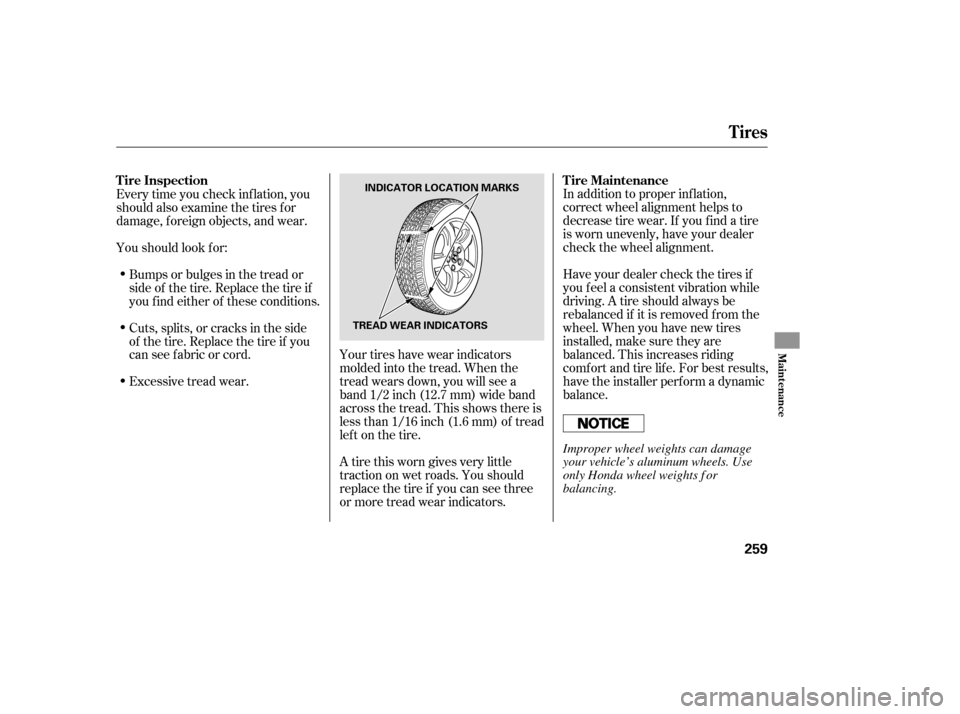
Your tires have wear indicators
molded into the tread. When the
tread wears down, you will see a
band 1/2 inch (12.7 mm) wide band
across the tread. This shows there is
less than 1/16 inch (1.6 mm) of tread
lef t on the tire.
A tire this worn gives very little
traction on wet roads. You should
replace the tire if you can see three
or more tread wear indicators.
Every time you check inf lation, you
should also examine the tires f or
damage, f oreign objects, and wear.
Youshouldlookfor:
Bumps or bulges in the tread or
side of the tire. Replace the tire if
youfindeitherof theseconditions.
Cuts, splits, or cracks in the side
of the tire. Replace the tire if you
can see f abric or cord.
Excessive tread wear.
Tires
T ire Maintenance
Tire Inspection
Maint enance
259
INDICATOR LOCATION MARKS
TREAD WEAR INDICATORS
Improper wheel weights can damage
your vehicle’s aluminum wheels. Use
only Honda wheel weights f or
balancing.