Page 84 of 319

�µ�µ
�µ
�µ
The ignition switch has f our
positions: LOCK (0), ACCESSORY
(I), ON (II), and START (III). You can insert or
remove the key only in this position.
To turn the key, the shift lever must
be in Park, and you must push the
key in slightly. You can
operate the audio system and the
accessory power sockets in this
position. If the f ront wheels are turned, the
anti-theft lock may make it difficult
to turn the key. Firmly turn the
steering wheel to the lef t or right as
you turn the key.
Use this position
only to start the engine. The switch
returns to the ON (II) position when
you let go of the key. You will hear a reminder beeper if
you leave the key in the LOCK (0) or
the ACCESSORY (I) position and
open the driver’s door. Remove the
key to turn of f the beeper.
TheshiftlevermustbeinPark
bef ore you can remove the key f rom
the ignition switch.
This is the normal key
position when driving. Several of the
indicators on the instrument panel
come on as a test when you turn the
ignition switch f rom the
ACCESSORY (I) to the ON (II)
position.
LOCK (0) A CCESSORY (I)
ST A RT (III) ON (II)
Ignition Switch
Inst rument s and Cont rols
81
Page 114 of 319

When you switch to , f romor , the A/C stays on.
This helps prevent the windows f rom
rapidly f ogging up when the air is
suddenly routed away f rom the
windshield. If you want to turn the
A/C off, press and release the A/C
button until the indicator in the
buttoncomesonandthengoesoff.
When you press again or the
MODE button, the A/C returns to its
original setting, either on or of f , as
displayed by the A/C ON or A/C
OFF indicator. If the original setting
is A/C OFF, the system switches to
AUTO. Select . The system
automatically switches to f resh air
mode and turns on the A/C. The
A/C indicator (LX model) or the
A/C ON indicator in the display
(EX and EX-L models) will not be
displayed if it was previously of f .
Select .
Set the f an and temperature
controls to maximum level.
For your saf ety, make sure you have
a clear view through all the windows
bef ore driving.
To clear the windows f aster, you can
close the dashboard corner vents by
rotating the wheel below it. This will
send more warm air to the
windshield def roster vents.
Continuous use of the recirculation
mode can cause humidity to build up
inside the vehicle. Once the
windshield is clear, select the f resh
air mode to avoid fogging the
windows. 1.
2.
3.
On LX models
On EX and EX-L models
Vents, Heating, and A/C
T o Remove Exterior Frost or Ice
From the Windows
Features
111
Page 141 of 319
If you are playing a CD
If you are listening to the radio
On EX and EX-L models,usetheCH
buttontoskiptothebeginningof the
next track. You will see the CD and
track number in the display.
,usethe
CHbuttontogotothenextpreset
station. You will see the number of
the preset button in the display. To
change bands, press the AM/FM
button.
The MODE button changes the
audio mode between FM1, FM2, AM,
XM, CD, and DVD/AUX (if a disc is
inserted). The CH button has three functions,
depending on whether you are
listening to the radio, or playing a
CD. The middle button adjusts the
volume. Press the top or bottom of
the button and hold it until the
desired volume is reached, then
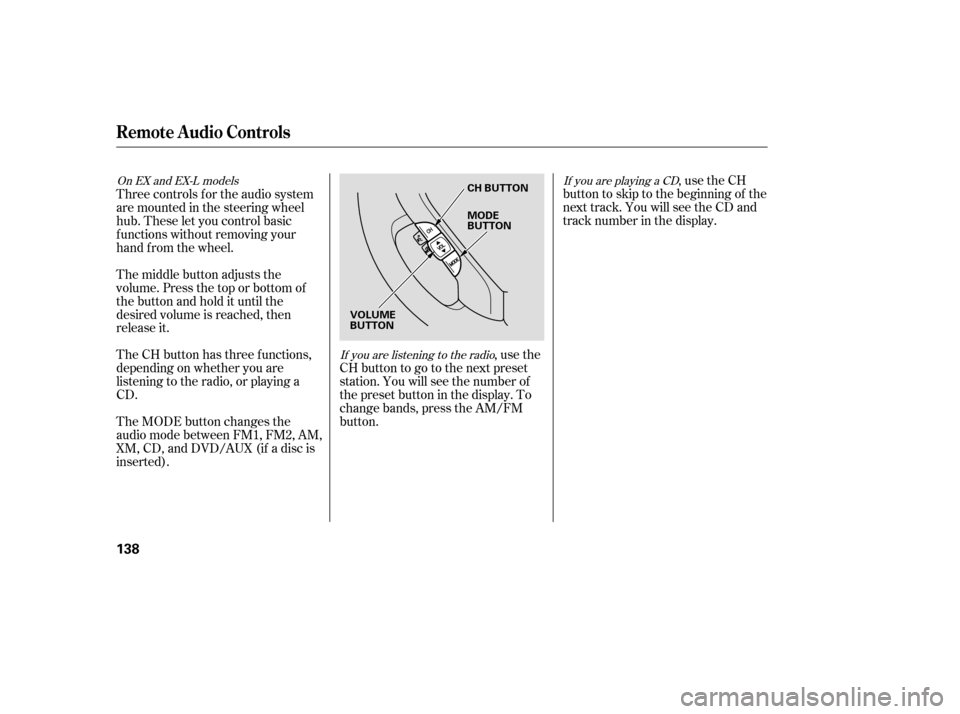
release it. Three controls f or the audio system
are mounted in the steering wheel
hub. These let you control basic
f unctions without removing your
hand f rom the wheel.
Remote Audio Controls
138
CH BUTTON
VOLUME
BUTTON MODE
BUTTON
Page 178 of 319
Cruise control allows you to maintain
asetspeedabove25mph(40km/h)
without keeping your f oot on the
accelerator pedal. It should be used
f or cruising on straight, open
highways. It is not recommended f or
city driving, winding roads, slippery
roads, heavy rain, or bad weather.Accelerate to the desired cruising
speedabove25mph(40km/h).
Press and release the SET/
DECELbuttononthesteering
wheel. The indicator on the
instrument panel comes on to
show the system is now activated. Push in the cruise control master
button. The indicator on the
instrument panel will come on.Cruise control may not hold the set
speed when you are going up and
down hills. If your speed increases
going down a hill, use the brakes to
slow down. This will cancel cruise
control. To resume the set speed,
press the RES/ACCEL button. The
indicator on the instrument panel will
come back on.
1.
2.
3. Using the Cruise Control
Cruise Control
Features
175
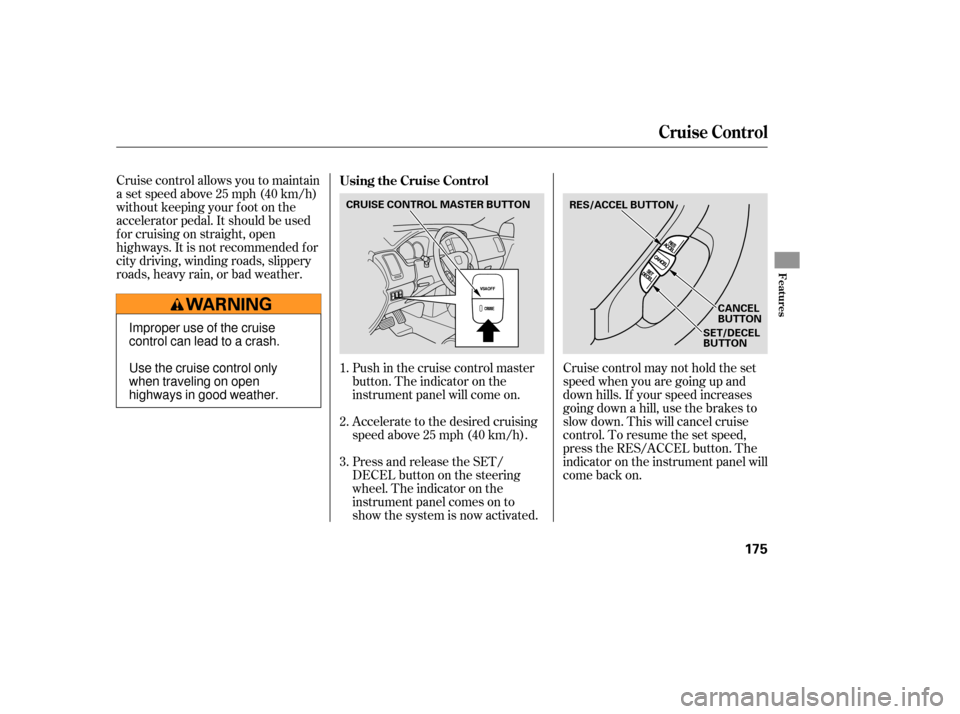
CRUISE CONTROL MASTER BUTTON
CANCEL
BUTTON
SET/DECEL
BUTTON
RES/ACCEL BUTTON
Improper use of the cruise
control can lead to a crash.
Use the cruise control only
when traveling on open
highways in good weather.
Page 179 of 319

You can increase the set cruising
speed in any of these ways:Push on the accelerator pedal.
Accelerate to the desired cruising
speed, then press the SET/
DECEL button.
You can decrease the set cruising
speed in any of these ways: Press and hold the SET/DECEL
button. Release the button when
you reach the desired speed. To slow down in very small
amounts, tap the SET/DECEL
button. Each time you do this,
your vehicle will slow down about
1 mph (1.6 km/h).
Tap the brake pedal lightly with
your f oot. The CRUISE
CONTROL indicator on the
instrument panel will go out.
When the vehicle slows to the
desired speed, press the SET/
DECEL button.
Even with the cruise control turned
on, you can still use the accelerator
pedal to speed up f or passing. Af ter
completing the pass, take your foot
of f the accelerator pedal. The vehicle
will return to the set cruising speed.
Resting your f oot on the brake pedal
causes cruise control to cancel. You can cancel cruise control in any
of these ways:
Tap the brake pedal.
Push the CANCEL button on the
steering wheel.
Pushthecruisecontrolmaster
button.
To increase the speed in very
small amounts, tap the RES/
ACCEL button. Each time you do
this, your vehicle will speed up
about 1 mph (1.6 km/h). When you push the CANCEL button
or tap on the brake pedal, the system
will remember the previously set
cruising speed. To return to that
speed, accelerate to above 25 mph
(40 km/h) and then press and
release the RES/ACCEL button. The
CRUISE CONTROL indicator comes
on. The vehicle will accelerate to the
same cruising speed as bef ore.
Pressingthecruisecontrolmaster
button turns the system off and
erases the previous cruising speed.
Press and hold the RES/ACCEL
button. When you reach the
desired cruising speed, release the
button.
Changing the Set Speed Canceling Cruise Control
Resuming the Set Speed
Cruise Control
176
Page 195 of 319

Removing parts f rom your vehicle,
or replacing components with
non-Honda components could
seriously af f ect your vehicle’s
handling, stability, and reliability.Raising your vehicle with a
non-Honda suspension kit can
af f ect the handling and stability.
Herearesomeexamples:
Lowering your vehicle with a
non-Honda suspension kit that
signif icantly reduces ground
clearance can allow the
undercarriage to hit speed bumps
or other raised objects, which
could cause the airbags to deploy. If you plan to modif y your vehicle,
consult your dealer.Modif ying your steering wheel or
any other part of your vehicle’s
safety features can make the
systems inef f ective. Larger or smaller wheels and tires
can interf ere with the operation of
your vehicle’s anti-lock brakes and
other systems. Non-Honda wheels, because they
are a universal design, can cause
excessive stress on suspension
components and will not be
compatible with the tire pressure
monitoring system (TPMS).
Modif ying Your Vehicle
A ccessories and Modif ications
192
Page 201 of 319

Your vehicle has a higher ground
clearance that allows you to travel
over bumps, obstacles, and rough
terrain. It also provides good
visibility so you can anticipate
problems earlier.
Because your vehicle rides higher
off the ground, it has a high center
of gravity that can cause it to roll
over if you make abrupt turns. Utility
vehicl es have a signifi cantly higher
roll over rate than other types of
ve hicles.
To prevent rollovers or loss of
control:
Take corners at slower speeds
than you would with a passenger
vehicle.
Avoid sharp turns and abrupt
maneuvers whenever possible. Do
not carry heavy cargo on the
roof. Do not modify your vehicle in any
way that would raise the center of
gravity.
Check the adjustment of the
inside and outside mirrors (see
page ).
Check
the seat adjustment (see
page ).
Check
that any items you may be
carrying are stored properly or
fastened down securely.
Youshoulddothefollowingchecks
and
adjustmen ts before you drive
your vehicle.
Make sure all windows, mirrors,
and outside lights are clean and
unobstructed. Remove frost, snow,
or ice.
Vi sually check the tires. If a tire
looks low, use a gauge to check its
pressure (see page ).
Your
vehicle is equipped with a four-
wheel drive (4WD) system. When
the system senses a loss of front-
wheel traction, it automatically
transfers some power to the rear
wh eels. This gives you better
traction and mobility.
You still need to exercise the same
care when accelerating, steering, and
brakingthatyouwouldinatwo-
wheel drive vehicle. 3. 2. 1.
4.
5.
87
92 258
Four-wheel drive models
See page f or additional driving of f -highway guidelines. 222
Driving Guidelines
Preparing to Drive
198
Page 202 of 319

If the engine does not start within
15 seconds, or starts but stalls
right away, repeat step 4 with the
accelerator pedal pressed halfway
down. If the engine starts, release
pressu re on the accelerator pedal
so the engine does not race.
If the engine fails to start, press
the accelerator pedal all the way
down, and hold it there while
starting to clear flooding. If the
engine still does not start, return
to step 5.
Check
the steering wheel
ad justment (see page ).
Make sure the doors and the
tailgate are secu rely closed and
locked.
Fasten your seat belt. Check that
your passengers have fastened
their seat belts (see page ).
Wh en you start the engine, check
the gauges and indicato rs in the
instrument panel (see page ). Without
touching the accelerator
pedal, turn the ignition key to the
START (III) position. Do not hold
the key in the START (III)
position for more than 15 seconds
at a time. If the engine does not
start right away, pause for at least
10 seconds before trying again.
Make
sure the shift lever is in
Park. Press on the brake pedal.
In
cold weather, turn off all
electrical accessories to reduce
the drain on the battery.
Apply
the parking brake. 5.
6.
1.
2.
3.
4.
78
61
15
6.
7.
8.
9.
79
Driving
Guidelines, Starting the Engine
Starting theEngine
Driving
199
The engine is harder to start in cold
weather. Also, the thinner air found at
altitudes above 8,000 feet (2,400
meters) adds to this problem.
The immobilizer system protects your
veh icle from theft. If an improperly-
coded key (or other device) is used, the
engine’s f uel system is disabled. For
more inf ormation, see page .