Page 406 of 674

You will need a well-charged battery to restart the
vehicle, and possibly for signaling later on with
your headlamps. Let the heater run for a while.
Then, shut the engine off and close the window
almost all the way to preserve the heat. Start
the engine again and repeat this only when you
feel really uncomfortable from the cold. But do it as
little as possible. Preserve the fuel as long as
you can. To help keep warm, you can get out of
the vehicle and do some fairly vigorous exercises
every half hour or so until help comes.If Your Vehicle is Stuck in Sand,
Mud, Ice, or Snow
In order to free your vehicle when it is stuck,
you will need to spin the wheels, but you do not
want to spin your wheels too fast. The method
known as rocking can help you get out when you
are stuck, but you must use caution.
{CAUTION:
If you let your vehicle’s tires spin at high
speed, they can explode, and you or others
could be injured. And, the transmission or
other parts of the vehicle can overheat.
That could cause an engine compartment
re or other damage. When you are stuck,
spin the wheels as little as possible. Do not
spin the wheels above 35 mph (55 km/h) as
shown on the speedometer.
406
Page 456 of 674
Maintenance When Trailer Towing
Your vehicle will need service more often when
you’re pulling a trailer. SeeScheduled
Maintenance (Gasoline Engine) on page 617for
more information. Things that are especially
important in trailer operation are automatic
transmission uid (don’t overll), engine oil, axle
lubricant, belt, cooling system and brake system.
Each of these is covered in this manual, and
the Index will help you nd them quickly. If you’re
trailering, it’s a good idea to review these
sections before you start your trip.
Check periodically to see that all hitch nuts and
bolts are tight.
Trailer Wiring Harness
Your vehicle is equipped with one of the following
wiring harnesses for towing a trailer or hauling
a slide-in camper.
Basic Trailer Wiring
All regular, extended cab and crew cab pickups
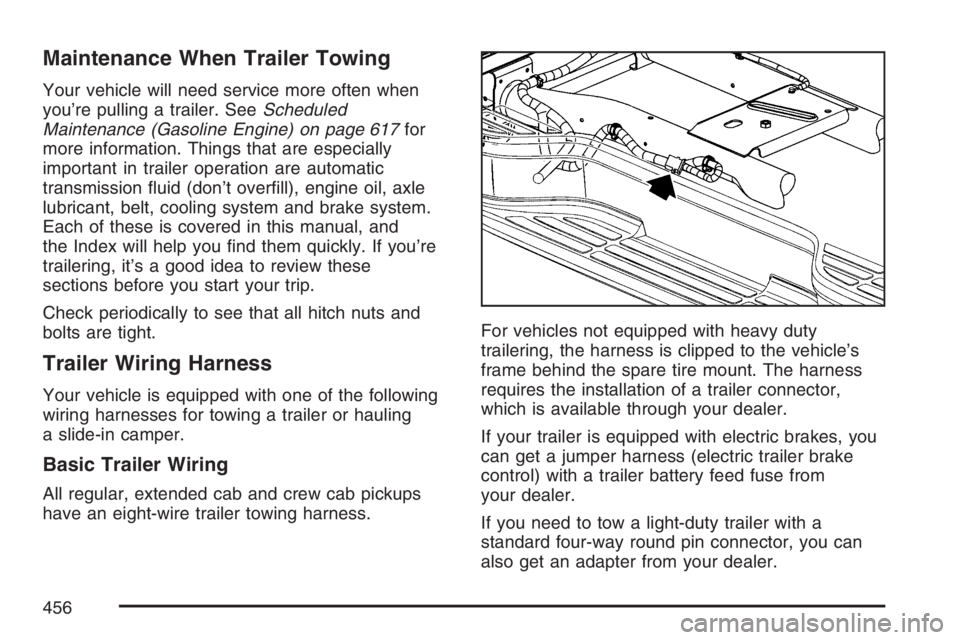
have an eight-wire trailer towing harness.For vehicles not equipped with heavy duty
trailering, the harness is clipped to the vehicle’s
frame behind the spare tire mount. The harness
requires the installation of a trailer connector,
which is available through your dealer.
If your trailer is equipped with electric brakes, you
can get a jumper harness (electric trailer brake
control) with a trailer battery feed fuse from
your dealer.
If you need to tow a light-duty trailer with a
standard four-way round pin connector, you can
also get an adapter from your dealer.
456
Page 457 of 674
Heavy-DutyTrailer Wiring Harness
Package
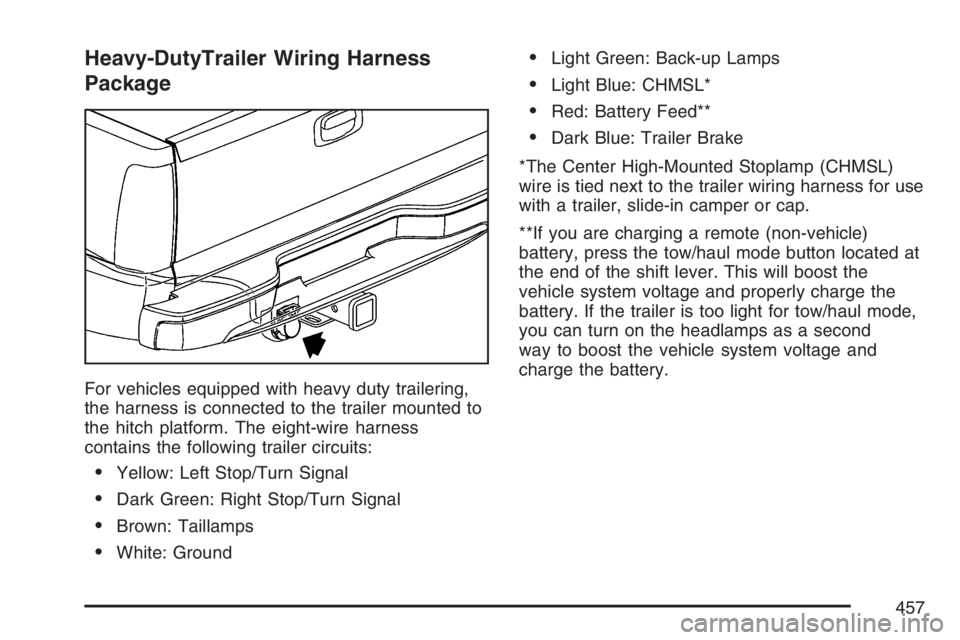
For vehicles equipped with heavy duty trailering,
the harness is connected to the trailer mounted to
the hitch platform. The eight-wire harness
contains the following trailer circuits:
Yellow: Left Stop/Turn Signal
Dark Green: Right Stop/Turn Signal
Brown: Taillamps
White: Ground
Light Green: Back-up Lamps
Light Blue: CHMSL*
Red: Battery Feed**
Dark Blue: Trailer Brake
*The Center High-Mounted Stoplamp (CHMSL)
wire is tied next to the trailer wiring harness for use
with a trailer, slide-in camper or cap.
**If you are charging a remote (non-vehicle)
battery, press the tow/haul mode button located at
the end of the shift lever. This will boost the
vehicle system voltage and properly charge the
battery. If the trailer is too light for tow/haul mode,
you can turn on the headlamps as a second
way to boost the vehicle system voltage and
charge the battery.
457
Page 458 of 674
Camper/Fifth-Wheel Trailer Wiring Package
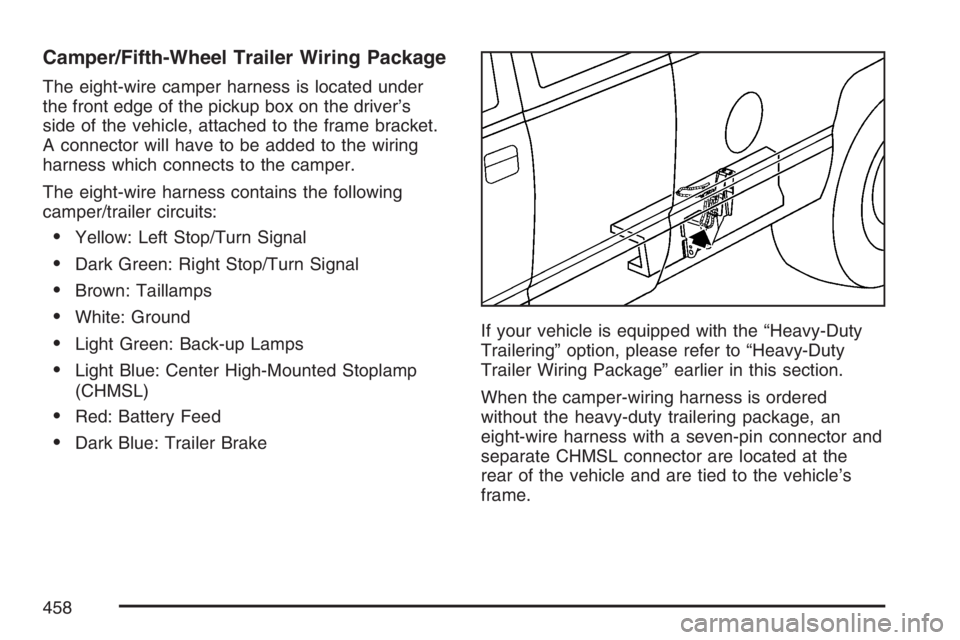
The eight-wire camper harness is located under
the front edge of the pickup box on the driver’s
side of the vehicle, attached to the frame bracket.
A connector will have to be added to the wiring
harness which connects to the camper.
The eight-wire harness contains the following
camper/trailer circuits:
Yellow: Left Stop/Turn Signal
Dark Green: Right Stop/Turn Signal
Brown: Taillamps
White: Ground
Light Green: Back-up Lamps
Light Blue: Center High-Mounted Stoplamp
(CHMSL)
Red: Battery Feed
Dark Blue: Trailer BrakeIf your vehicle is equipped with the “Heavy-Duty
Trailering” option, please refer to “Heavy-Duty
Trailer Wiring Package” earlier in this section.
When the camper-wiring harness is ordered
without the heavy-duty trailering package, an
eight-wire harness with a seven-pin connector and
separate CHMSL connector are located at the
rear of the vehicle and are tied to the vehicle’s
frame.
458
Page 459 of 674
Electric Brake Control Jumper
{CAUTION:
Be sure to use only the correct trailer
brake harness, the one intended for use
on your vehicle. If you use some other
trailer brake harness, even if it seems to
t, your trailer brakes may not work at all.
You could have a crash in which you or
others could be injured. Use only the
trailer brake harness intended for your
vehicle. If it is no longer available to you,
be sure to get a proper replacement from
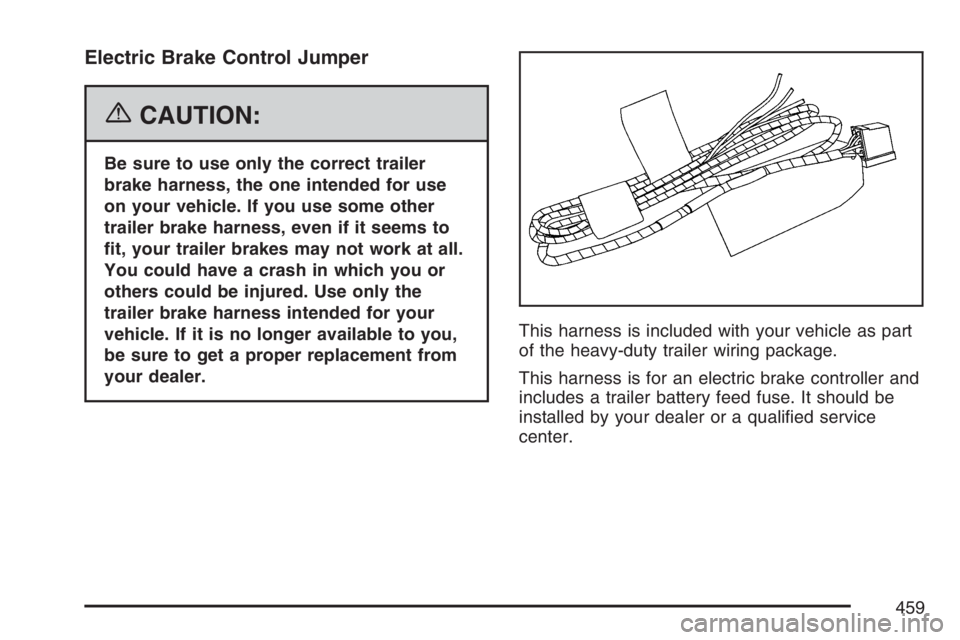
your dealer.This harness is included with your vehicle as part
of the heavy-duty trailer wiring package.
This harness is for an electric brake controller and
includes a trailer battery feed fuse. It should be
installed by your dealer or a qualied service
center.
459
Page 460 of 674

Auxiliary Battery
The auxiliary battery provision can be used to
supply electrical power to additional equipment that
you may choose to add, such as a slide-in camper.
If your vehicle has this
provision, this relay will
be located on the
passenger’s side of the
vehicle, next to the
auxiliary battery.
When using this provision, connection should only
be made to the upper stud (A) of the relay. Do not
make connections to the lower stud (B) of the relay.
The auxiliary battery circuit is protected by a
megafuse located behind the auxiliary battery.
Be sure to follow the proper installation instructions
that are included with any electrical equipment
that you install.Notice:Leaving electrical equipment on for
extended periods will drain the battery. Always
turn off electrical equipment when not in
use and do not use equipment that exceeds
the maximum amperage rating for the auxiliary
battery provision.
Power Winches
If you wish to use a power winch on your vehicle,
only use it when your vehicle is stationary or
anchored.
Trailer Recommendations
You must subtract your hitch loads from the CWR
for your vehicle. Weigh your vehicle with the
trailer attached, so that you won’t go over
the GVWR or GAWR. If you are using a
weight-distributing hitch, weigh the vehicle without
the spring bars in place.
You’ll get the best performance if you spread out
the weight of your load the right way, and if
you choose the correct hitch and trailer brakes.
For more information, seeTowing a Trailer
on page 429.
460
Page 465 of 674

Service........................................................ 468
Accessories and Modications................... 468
California Proposition 65 Warning.............. 469
Doing Your Own Service Work.................. 469
Adding Equipment to the Outside of
Your Vehicle.......................................... 470
Fuel............................................................. 470
Gasoline Octane........................................ 470
Gasoline Specications.............................. 471
California Fuel........................................... 471
Additives................................................... 472
Fuel E85 (85% Ethanol)............................ 473
Fuels in Foreign Countries........................ 474
Filling the Tank......................................... 474
Filling a Portable Fuel Container............... 477
Checking Things Under the Hood.............. 478
Hood Release........................................... 479
Engine Compartment Overview.................. 480
Engine Oil (Gasoline Engine).................... 486
Engine Oil Life System
(Gasoline Engine).................................. 489
Engine Air Cleaner/Filter
(Gasoline Engines)................................. 491Automatic Transmission Fluid
(Allison Transmission®) .......................... 494
Automatic Transmission Fluid
(Except Allison Transmission
®) ............... 497
Manual Transmission Fluid........................ 500
Hydraulic Clutch........................................ 501
Engine Coolant.......................................... 502
Coolant Surge Tank Pressure Cap............ 505
Engine Overheating................................... 505
Overheated Engine Protection
Operating Mode (V8 Engines Only)........ 508
Cooling System......................................... 508
Engine Fan Noise..................................... 514
Power Steering Fluid ................................. 515
Windshield Washer Fluid........................... 516
Brakes...................................................... 517
Battery...................................................... 520
Jump Starting............................................ 521
Rear Axle.................................................... 527
Four-Wheel Drive........................................ 528
Front Axle................................................... 529
Section 5 Service and Appearance Care
465
Page 481 of 674

A. Engine Air Cleaner/Filter. SeeEngine Air
Cleaner/Filter (Gasoline Engines) on page 491.
B. Coolant Surge Tank and Pressure Cap. See
Engine Coolant on page 502andCoolant
Surge Tank Pressure Cap on page 505.
C. Air Filter Restriction Indicator (If Equipped).
SeeEngine Air Cleaner/Filter (Gasoline
Engines) on page 491.
D. Engine Oil Dipstick. See “Checking Engine Oil”
underEngine Oil (Gasoline Engine) on
page 486.
E. Automatic Transmission Fluid Dipstick
(If Equipped). See “Checking the Fluid Level”
underAutomatic Transmission Fluid (Allison
Transmission
®) on page 494orAutomatic
Transmission Fluid (Except Allison
Transmission
®) on page 497.
F. Engine Cooling Fan. SeeCooling System on
page 508.G. Engine Oil Fill Cap. See “When to Add Engine
Oil” underEngine Oil (Gasoline Engine) on
page 486.
H. Power Steering Fluid Reservoir. SeePower
Steering Fluid on page 515.
I. Remote Negative (−) Terminal (GND). See
Jump Starting on page 521.
J. Remote Positive (+) Terminal. SeeJump
Starting on page 521.
K. Brake Fluid Reservoir. See “Brake Fluid” under
Brakes on page 517.
L. Clutch Fluid Reservoir (If Equipped). See
Hydraulic Clutch on page 501.
M. Underhood Fuse Block. SeeUnderhood Fuse
Block on page 603.
N. Battery. SeeBattery on page 520.
O. Windshield Washer Fluid Reservoir. See
“Adding Washer Fluid” underWindshield
Washer Fluid on page 516.
481