Page 383 of 492

Federal Communications Commission
(FCC) and Industry and Science Canada
The Tire Pressure Monitor System (TPMS)
operates on a radio frequency and complies with
Part 15 of the FCC Rules. Operation is subject
to the following two conditions:
1. This device may not cause harmful
interference.
2. This device must accept any interference
received, including interference that may
cause undesired operation.
The Tire Pressure Monitor System (TPMS)
operates on a radio frequency and complies with
RSS-210 of Industry and Science Canada.
Operation is subject to the following two
conditions:
1. This device may not cause interference.
2. This device must accept any interference
received, including interference that may
cause undesired operation of the device.
Changes or modications to this system by other
than an authorized service facility could void
authorization to use this equipment.
Tire Inspection and Rotation
Tires should be rotated every 5,000 to 8,000 miles
(8 000 to 13 000 km).
Any time you notice unusual wear, rotate your
tires as soon as possible and check wheel
alignment. Also check for damaged tires or wheels.
SeeWhen It Is Time for New Tires on page 385
andWheel Replacement on page 390for
more information.
Make sure the spare tire is stored securely. Push,
pull, and then try to rotate or turn the tire. If it
moves, use the wheel wrench to tighten the cable.
SeeChanging a Flat Tire on page 394.
The purpose of regular rotation is to achieve more
uniform wear for all tires on the vehicle. The
rst rotation is the most important, seeScheduled
Maintenance on page 437.
383
Page 392 of 492
Tire Chains
{CAUTION:
If your vehicle has P225/75R15,
P265/75R15, P235/75R15, or P235/50R18
size tires, do not use tire chains. They can
damage your vehicle because there is not
enough clearance. Tire chains used on a
vehicle without the proper amount of
clearance can cause damage to the
brakes, suspension, or other vehicle
parts. The area damaged by the tire
chains could cause you to lose control of
your vehicle and you or others may be
injured in a crash.
Use another type of traction device only if
its manufacturer recommends it for use
on your vehicle and tire size combination
and road conditions.
CAUTION: (Continued)
CAUTION: (Continued)
Follow that manufacturer’s instructions.
To help avoid damage to your vehicle,
drive slowly, readjust, or remove the
device if it is contacting your vehicle.
Do not spin the vehicle’s wheels.
If you do nd traction devices that will
t, install them on the rear tires.
Notice:If your vehicle has a tire size other
than P225/75R15, P265/75R15, P235/75R15 or
P235/50R18 use tire chains only where
legal and only when you must. Use chains that
are the proper size for your tires. Install
them on the tires of the rear axle. Do not use
chains on the tires of the front axle. Tighten
them as tightly as possible with the ends
securely fastened. Drive slowly and follow the
chain manufacturer’s instructions. If you
can hear the chains contacting your vehicle,
stop and retighten them. If the contact
continues, slow down until it stops. Driving
too fast or spinning the wheels with chains on
will damage your vehicle.
392
Page 396 of 492
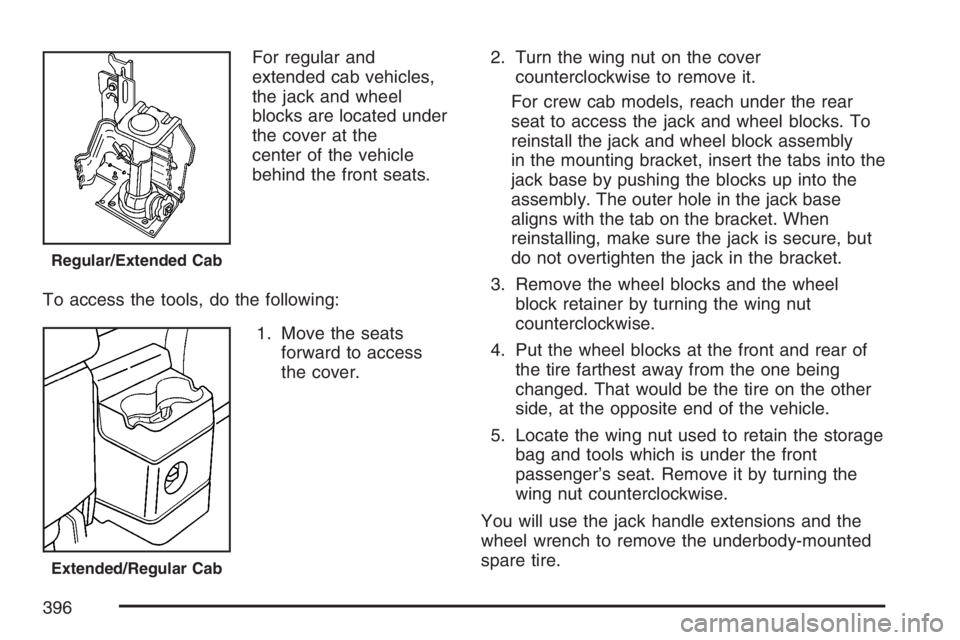
For regular and
extended cab vehicles,
the jack and wheel
blocks are located under
the cover at the
center of the vehicle
behind the front seats.
To access the tools, do the following:
1. Move the seats
forward to access
the cover.2. Turn the wing nut on the cover
counterclockwise to remove it.
For crew cab models, reach under the rear
seat to access the jack and wheel blocks. To
reinstall the jack and wheel block assembly
in the mounting bracket, insert the tabs into the
jack base by pushing the blocks up into the
assembly. The outer hole in the jack base
aligns with the tab on the bracket. When
reinstalling, make sure the jack is secure, but
do not overtighten the jack in the bracket.
3. Remove the wheel blocks and the wheel
block retainer by turning the wing nut
counterclockwise.
4. Put the wheel blocks at the front and rear of
the tire farthest away from the one being
changed. That would be the tire on the other
side, at the opposite end of the vehicle.
5. Locate the wing nut used to retain the storage
bag and tools which is under the front
passenger’s seat. Remove it by turning the
wing nut counterclockwise.
You will use the jack handle extensions and the
wheel wrench to remove the underbody-mounted
spare tire.
Regular/Extended Cab
Extended/Regular Cab
396
Page 401 of 492
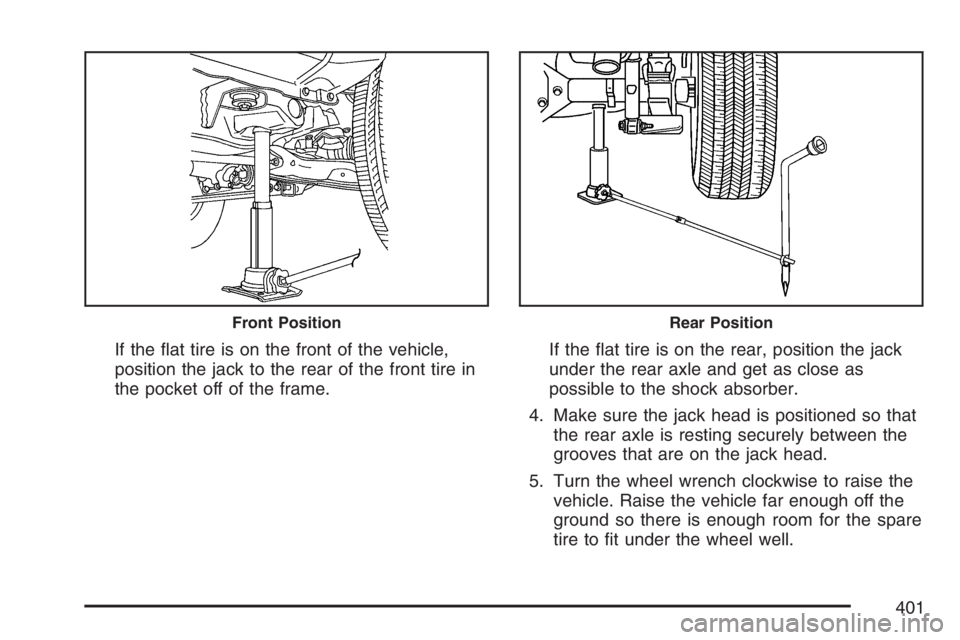
If the at tire is on the front of the vehicle,
position the jack to the rear of the front tire in
the pocket off of the frame.If the at tire is on the rear, position the jack
under the rear axle and get as close as
possible to the shock absorber.
4. Make sure the jack head is positioned so that
the rear axle is resting securely between the
grooves that are on the jack head.
5. Turn the wheel wrench clockwise to raise the
vehicle. Raise the vehicle far enough off the
ground so there is enough room for the spare
tire to t under the wheel well.
Front PositionRear Position
401
Page 407 of 492
4. Repeat this procedure at least two times. If
the spare tire lowers to the ground, continue
with Step 5 underRemoving the Spare
Tire and Tools on page 395.
5. Turn the wrench counterclockwise until
approximately 6 inches (15 cm) of cable
is exposed.
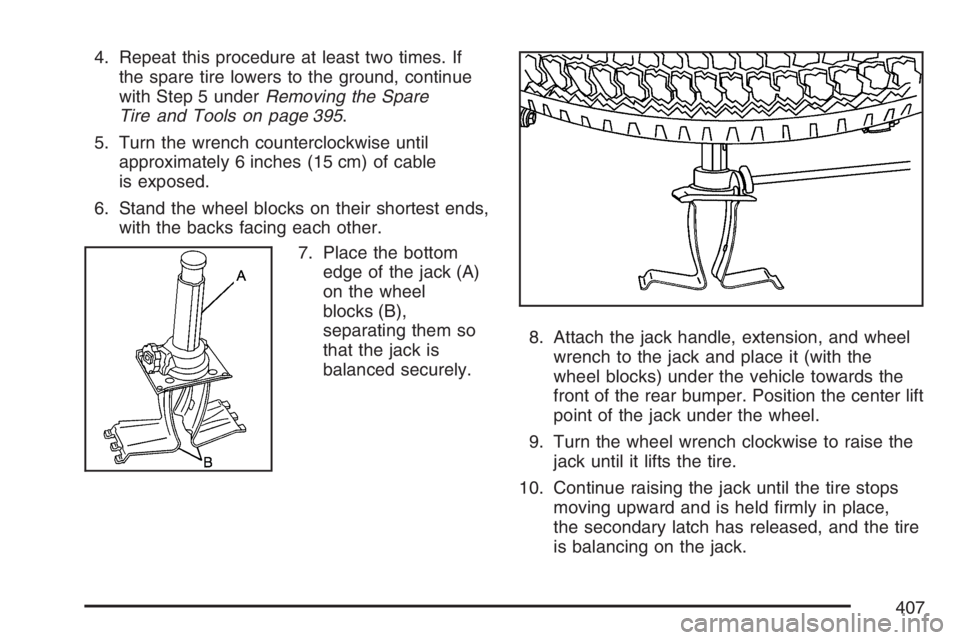
6. Stand the wheel blocks on their shortest ends,
with the backs facing each other.
7. Place the bottom
edge of the jack (A)
on the wheel
blocks (B),
separating them so
that the jack is
balanced securely.8. Attach the jack handle, extension, and wheel
wrench to the jack and place it (with the
wheel blocks) under the vehicle towards the
front of the rear bumper. Position the center lift
point of the jack under the wheel.
9. Turn the wheel wrench clockwise to raise the
jack until it lifts the tire.
10. Continue raising the jack until the tire stops
moving upward and is held rmly in place,
the secondary latch has released, and the tire
is balancing on the jack.
407
Page 412 of 492
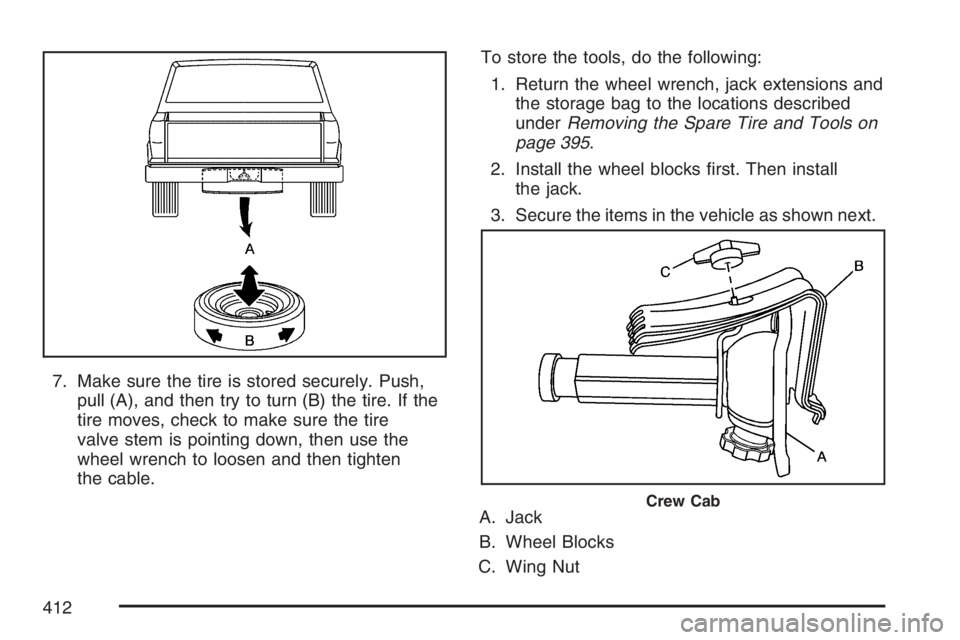
7. Make sure the tire is stored securely. Push,
pull (A), and then try to turn (B) the tire. If the
tire moves, check to make sure the tire
valve stem is pointing down, then use the
wheel wrench to loosen and then tighten
the cable.To store the tools, do the following:
1. Return the wheel wrench, jack extensions and
the storage bag to the locations described
underRemoving the Spare Tire and Tools on
page 395.
2. Install the wheel blocks rst. Then install
the jack.
3. Secure the items in the vehicle as shown next.
A. Jack
B. Wheel Blocks
C. Wing Nut
Crew Cab
412
Page 443 of 492

At Each Fuel Fill
It is important to perform these underhood
checks at each fuel ll.
Engine Oil Level Check
Check the engine oil level and add the proper
oil if necessary. SeeEngine Oil on page 325
for further details.
Notice:It is important to check your oil
regularly and keep it at the proper level.
Failure to keep your engine oil at the proper
level can cause damage to your engine
not covered by your warranty.
Engine Coolant Level Check
Check the engine coolant level and add
DEX-COOL®coolant mixture if necessary. See
Engine Coolant on page 337for further details.
Windshield Washer Fluid Level Check
Check the windshield washer uid level in
the windshield washer uid reservoir and add
the proper uid if necessary.
At Least Once a Month
Tire Ination Check
Visually inspect your vehicle’s tires and make
sure they are inated to the correct pressures.
Do not forget to check the spare tire. See
Ination - Tire Pressure on page 377. Check to
make sure the spare tire is stored securely.
SeeChanging a Flat Tire on page 394.
Tire Wear Inspection
Tire rotation may be required for high mileage
highway drivers prior to the Engine Oil Life System
service notication. Check the tires for wear
and, if necessary, rotate the tires. SeeTire
Inspection and Rotation on page 383.
443
Page 462 of 492
Roadside Assistance Program
In the U.S. call,1-800-GMC-8782
(1-800-462-8782)
In Canada, call1-800-268-6800
Service available 24 hours a day, 365 days a year
As the owner of a new GMC vehicle, you are
automatically enrolled in the GMC Roadside
Assistance program. This value-added service is
intended to provide you with peace of mind as you
drive in the city or travel the open road.
Who is Covered?
Roadside Assistance coverage is for the vehicle
operator, regardless of ownership. A person driving
this vehicle without the consent of the owner is
not eligible for coverage.The following services are provided in the U.S.
during the Bumper-to-Bumper warranty period and,
in Canada, during the Base Warranty coverage
period of the New Vehicle Limited Warranty, up to
a maximum coverage of $100.
Fuel Delivery:Delivery of enough fuel for the
customer to get to the nearest service station
(approximately $5 in the U.S. and 10 litres
in Canada). Service to provide diesel may be
restricted. For safety reasons, propane
and other alternative fuels will not be provided
through this service.
Lock-out Service:To ensure security, the
driver must present the vehicle registration and
personal ID before lock-out service is provided.
Lock-out service will be covered at no charge if
you are unable to gain entry into your vehicle.
If your vehicle will not start, Roadside
Assistance will arrange to have your vehicle
towed to the nearest authorized dealership.
In the U.S., replacement keys made at the
customer’s expense will be covered within
10 miles (16 km).
462