Page 308 of 492
Your trailer’s brake system can tap into the
vehicle’s hydraulic brake system only if:
The trailer parts can withstand 3,000 psi
(20 650 kPa) of pressure.
The trailer’s brake system will use less than
0.02 cubic inch (0.3 cc) of uid from your
vehicle’s master cylinder. Otherwise,
both braking systems won’t work well. You
could even lose your brakes.
If everything checks out this far, then make the
brake uid tap at the port on the master cylinder
that sends uid to the rear brakes. But don’t
use copper tubing for this. If you do, it will bend
and nally break off. Use steel brake tubing.
Driving with a Trailer
Towing a trailer requires a certain amount of
experience. Before setting out for the open road,
you’ll want to get to know your rig. Acquaint
yourself with the feel of handling and braking with
the added weight of the trailer. And always
keep in mind that the vehicle you are driving is
now a good deal longer and not nearly as
responsive as your vehicle is by itself.Before you start, check all trailer hitch parts and
attachments, safety chains, electrical connector,
lamps, tires and mirror adjustment. If the trailer has
electric brakes, start your vehicle and trailer
moving and then apply the trailer brake controller
by hand to be sure the brakes are working.
This lets you check your electrical connection at
the same time.
During your trip, check occasionally to be sure
that the load is secure, and that the lamps and any
trailer brakes are still working.
Following Distance
Stay at least twice as far behind the vehicle ahead
as you would when driving your vehicle without
a trailer. This can help you avoid situations
that require heavy braking and sudden turns.
Passing
You’ll need more passing distance up ahead when
you’re towing a trailer. And, because you’re a
good deal longer, you’ll need to go much farther
beyond the passed vehicle before you can
return to your lane.
308
Page 340 of 492
Radiator Pressure Cap
Notice:If the pressure cap is not tightly
installed, coolant loss and possible engine
damage may occur. Be sure the cap is properly
and tightly secured.
SeeEngine Compartment Overview on page 324
for more information on location.
Engine Overheating
A coolant temperature gage is on the instrument
panel. SeeEngine Coolant Temperature Gage
on page 187.
The air conditioning might stop working if the
engine is too hot. This is normal and helps cool
the engine.
If Steam Is Coming From Your Engine
{CAUTION:
Steam from an overheated engine can
burn you badly, even if you just open the
hood. Stay away from the engine if you
see or hear steam coming from it. Just
turn it off and get everyone away from the
vehicle until it cools down. Wait until
there is no sign of steam or coolant
before you open the hood.
If you keep driving when your engine is
overheated, the liquids in it can catch re.
You or others could be badly burned.
Stop your engine if it overheats, and get
out of the vehicle until the engine is cool.
Notice:If your engine catches re because
you keep driving with no coolant, your vehicle
can be badly damaged. The costly repairs
would not be covered by your warranty.
340
Page 347 of 492
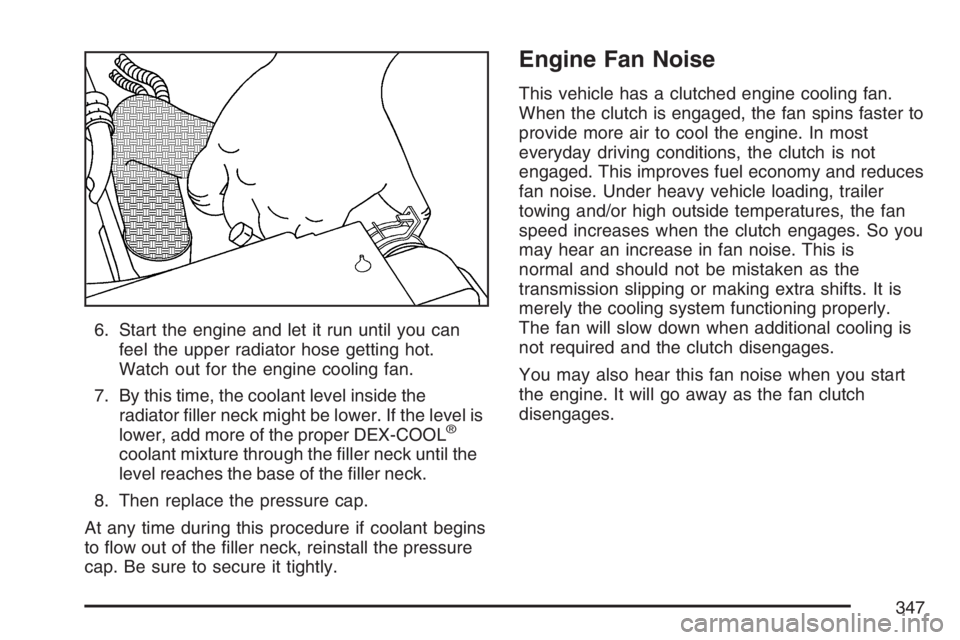
6. Start the engine and let it run until you can
feel the upper radiator hose getting hot.
Watch out for the engine cooling fan.
7. By this time, the coolant level inside the
radiator ller neck might be lower. If the level is
lower, add more of the proper DEX-COOL
®
coolant mixture through the ller neck until the
level reaches the base of the ller neck.
8. Then replace the pressure cap.
At any time during this procedure if coolant begins
to ow out of the ller neck, reinstall the pressure
cap. Be sure to secure it tightly.
Engine Fan Noise
This vehicle has a clutched engine cooling fan.
When the clutch is engaged, the fan spins faster to
provide more air to cool the engine. In most
everyday driving conditions, the clutch is not
engaged. This improves fuel economy and reduces
fan noise. Under heavy vehicle loading, trailer
towing and/or high outside temperatures, the fan
speed increases when the clutch engages. So you
may hear an increase in fan noise. This is
normal and should not be mistaken as the
transmission slipping or making extra shifts. It is
merely the cooling system functioning properly.
The fan will slow down when additional cooling is
not required and the clutch disengages.
You may also hear this fan noise when you start
the engine. It will go away as the fan clutch
disengages.
347
Page 362 of 492
Headlamps
A. Low-Beam Headlamp/Daytime Running
Lamps (DRL)
B. High-Beam Headlamp
To replace one of these bulbs, do the following:
1. Open the hood. SeeHood Release on
page 323for more information.
2. Reach in and access the bulb sockets from
inside the engine compartment.3. Turn the bulb socket counterclockwise to
remove it from the headlamp assembly
and pull it straight out.
4. Unplug the electrical connector from the old
bulb by releasing the clips on the bulb
socket.
5. Replace with a new bulb socket.
6. Plug in the electrical connector to the new
bulb socket.
7. Reinstall the new bulb socket into the
headlamp assembly and turn it clockwise to
secure.
8. Close the hood.
362
Page 363 of 492
Front Turn Signal, Parking and
Daytime Running Lamps (DRL)
To replace one of these bulbs, do the following:
1. Open the hood. SeeHood Release on
page 323for more information.
2. Reach in to access either one of the bulb
sockets in the engine compartment.3. Turn the bulb socket counterclockwise and
remove it from the lamp assembly.
4. Holding the socket, pull the old bulb to
release it from the bulb socket.
5. Push the new bulb into the socket until it
clicks.
6. Insert the bulb socket into the lamp assembly
and turn it clockwise to secure.
7. Close the hood.
363
Page 364 of 492
Center High-Mounted Stoplamp
(CHMSL)
To replace the CHMSL bulb, do the following:
1. Remove the two screws and lift off the lamp
assembly from the vehicle.
2. Turn the bulb socket counterclockwise and
remove it from the lamp assembly.
3. Holding the socket, pull the bulb to release it
from the socket.
4. Push the new bulb into the socket until it
clicks.
5. Insert the bulb socket into the lamp assembly
and turn it clockwise to secure.
6. Reinstall the lamp assembly and tighten the
screws.
Taillamps, Turn Signal, Stoplamps
and Back-up Lamps
A. Stoplamp/Taillamp
B. Turn Signal/Taillamp
C. Back-up Lamp
364
Page 365 of 492
To replace one of these bulbs, do the following:
1. Open the tailgate. SeeTailgate on page 108
for more information.
2. Remove the two
rear lamp assembly
screws near the
tailgate latch.3. Pull the lamp assembly away from the
vehicle.
4. Turn the bulb socket counterclockwise to
remove it from the taillamp assembly.
5. Holding the socket, pull the old bulb to
release it from the socket.
6. Push the new bulb into the socket until it
clicks.
7. Insert the bulb socket into the taillamp
assembly and turn it clockwise to secure.
8. Reinstall the taillamp assembly and tighten
the screws.
9. Close the tailgate.
365
Page 366 of 492
License Plate Lamp
To replace one of these bulbs, do the following:
1. Reach under the rear bumper for the bulb
socket.
2. Turn the bulb socket counterclockwise and
pull the bulb socket out of the connector.
3. Pull the old bulb straight out from the bulb
socket.
4. Push the new bulb straight in until it clicks to
secure it.
5. Reverse Steps 1 through 3 to reinstall the
license plate lamp.
Replacement Bulbs
Exterior Lamp Bulb Number
Center High-Mounted
Stoplamp (CHMSL)912
License Plate Bulb W5W
Headlamps
High-beam 9005
Low-beam/Daytime Running
Lamp (DRL)9006
Parking/Front Turn Signal 3757KA
Parking Lamp (Inboard) 3157A
Stoplamp, Rear Turn Signal,
Taillamp, and Back-up Lamp3057
For replacement bulbs not listed here, contact
your dealer.
366


