Page 344 of 554
Check your vehicle’s mirrors, glance over your
shoulder, and start your left lane change
signal before moving out of the right lane to
pass. When you are far enough ahead of
the passed vehicle to see its front in your
vehicle’s inside mirror, activate the right lane
change signal and move back into the
right lane. Remember that an outside convex
mirror makes the vehicle you just passed
seem farther away from you than it really is.
Try not to pass more than one vehicle
at a time on two-lane roads. Reconsider before
passing the next vehicle.
Do not overtake a slowly moving vehicle too
rapidly. Even though the brake lamps are
not ashing, it might be slowing down
or starting to turn.
If you are being passed, make it easy for the
following driver to get ahead of you. Perhaps
you can ease a little to the right.
Loss of Control
Let us review what driving experts say about what
happens when the three control systems — brakes,
steering, and acceleration — do not have enough
friction where the tires meet the road to do what the
driver has asked.
In any emergency, do not give up. Keep trying to
steer and constantly seek an escape route or
area of less danger.
Skidding
In a skid, a driver can lose control of the vehicle.
Defensive drivers avoid most skids by taking
reasonable care suited to existing conditions, and
by not overdriving those conditions. But skids
are always possible.
344
Page 350 of 554
Some Other Rainy Weather Tips
Besides slowing down, allow some extra
following distance. And be especially
careful when you pass another vehicle.
Allow yourself more clear room ahead, and
be prepared to have your view restricted
by road spray.
Have good tires with proper tread depth.
SeeTires on page 435.
City Driving
One of the biggest problems with city streets is
the amount of traffic on them. Watch out for what
the other drivers are doing and pay attention
to traffic signals.
Here are ways to increase your safety in city
driving:
Know the best way to get to where you are
going. Get a city map and plan your trip
into an unknown part of the city just as you
would for a cross-country trip.
Try to use the freeways that rim and crisscross
most large cities. You will save time and
energy. SeeFreeway Driving on page 351.
Treat a green light as a warning signal.
A traffic light is there because the corner is
busy enough to need it. When a light
turns green, and just before you start to move,
check both ways for vehicles that have not
cleared the intersection or may be running the
red light.
350
Page 351 of 554
Freeway Driving
Mile for mile, freeways — also called thruways,
parkways, expressways, turnpikes, or
superhighways — are the safest of all roads.
But they have their own special rules.
The most important advice on freeway driving
is: Keep up with traffic and keep to the right. Drive
at the same speed most of the other drivers are
driving. Too-fast or too-slow driving breaks a
smooth traffic ow. Treat the left lane on a freeway
as a passing lane.
At the entrance, there is usually a ramp that leads
to the freeway. If you have a clear view of the
freeway as you drive along the entrance ramp,
you should begin to check traffic. Try to determine
where you expect to blend with the ow. Try to
merge into the gap at close to the prevailing
speed. Switch on the turn signal, check the
mirrors, and glance over your shoulder as often
as necessary. Try to blend smoothly with the
traffic ow.Once you are on the freeway, adjust your speed
to the posted limit or to the prevailing rate if it
is slower. Stay in the right lane unless you want
to pass.
Before changing lanes, check the mirrors. Then,
use the turn signal.
Just before you leave the lane, glance quickly
over your shoulder to make sure there is not
another vehicle in your blind spot.
Once you are moving on the freeway, make sure
you allow a reasonable following distance.
Expect to move slightly slower at night.
When you want to leave the freeway, move to the
proper lane well in advance. If you miss your
exit, do not, under any circumstances, stop and
back up. Drive on to the next exit.
The exit ramp can be curved, sometimes quite
sharply. The exit speed is usually posted. Reduce
your speed according to the speedometer, not
to your sense of motion. After driving for any
distance at higher speeds, you might tend to think
you are going slower than you actually are.
351
Page 379 of 554
Passing
You’ll need more passing distance up ahead when
you’re towing a trailer. And, because you’re a
good deal longer, you’ll need to go much farther
beyond the passed vehicle before you can
return to your lane.
Backing Up
Hold the bottom of the steering wheel with
one hand. Then, to move the trailer to the left,
just move that hand to the left. To move the trailer
to the right, move your hand to the right. Always
back up slowly and, if possible, have someone
guide you.
Making Turns
Notice:Making very sharp turns while
trailering could cause the trailer to come in
contact with the vehicle. Your vehicle could
be damaged. Avoid making very sharp turns
while trailering.When you’re turning with a trailer, make wider
turns than normal. Do this so your trailer
won’t strike soft shoulders, curbs, road signs,
trees or other objects. Avoid jerky or sudden
maneuvers. Signal well in advance.
Turn Signals When Towing a Trailer
When you tow a trailer, your vehicle may need a
different turn signal asher and/or extra wiring.
Check with your dealer/retailer. The arrows
on your instrument panel will ash whenever you
signal a turn or lane change. Properly hooked
up, the trailer lamps will also ash, telling other
drivers you’re about to turn, change lanes or stop.
When towing a trailer, the arrows on your
instrument panel will ash for turns even if the
bulbs on the trailer are burned out. Thus, you may
think drivers behind you are seeing your signal
when they are not. It’s important to check
occasionally to be sure the trailer bulbs are
still working.
379
Page 382 of 554

Trailer Wiring Harness
Your vehicle is equipped with the following wiring
harness for towing a trailer.
Basic Trailer Wiring
The trailer wiring harness, with a seven-pin
connector, is located at the rear of the vehicle
and is tied to the vehicle’s frame. The harness
connector can be plugged into a seven-pin
universal heavy-duty trailer connector available
through your dealer/retailer.
The seven-wire harness contains the following
trailer circuits:
Yellow: Left Stop/Turn Signal
Dark Green: Right Stop/Turn Signal
Brown: Taillamps
White: Ground
Light Green: Back-up Lamps
Red: Battery Feed*
Dark Blue: Trailer Brake*
*The fuses for these two circuits are installed in
the underhood electrical center, but the wires
are not connected. They should be connected by
your dealer/retailer or a qualied service center.
If you are charging a remote (non-vehicle) battery,
press the tow/haul mode button located at the
end of the shift lever. This will boost the vehicle
system voltage and properly charge the battery.
If the trailer is too light for tow/haul mode, you can
turn on the headlamps (Non-HID only) as a
second way to boost the vehicle system and
charge the battery.
Engine Cooling When Trailer Towing
Your cooling system may temporarily overheat
during severe operating conditions. SeeEngine
Overheating on page 410.
382
Page 447 of 554

The TPMS sensor matching process is outlined
below:
1. Set the parking brake.
2. Turn the ignition switch to ON with the
engine off.
3. Using the DIC, press the vehicle information
button until the PRESS
VTO RELEARN TIRE
POSITIONS message displays. If your vehicle
does not have the DIC buttons, press the trip
odometer reset stem located on the instrument
panel cluster until the RELEARN TIRE
POSITIONS message displays.
4. If your vehicle has the DIC buttons, press the
set/reset button. The horn sounds twice to
indicate the TPMS receiver is ready, and the
TIRE LEARNING ACTIVE message
displays. If your vehicle does not have the
DIC buttons, press and hold the trip odometer
reset stem until the horn chirps twice and
the TIRE LEARNING ACTIVE message
is displayed.
5. Start with the driver side front tire. The driver
side front turn signal lamp is on.6. Remove the valve cap from the valve stem.
Activate the TPMS sensor by increasing
or decreasing the tire’s air pressure for
ve seconds, or until a horn chirp sounds.
The horn chirp, which may take up to
30 seconds to sound, conrms that the sensor
identication code has been matched to this
tire and wheel position.
7. Proceed to the passenger side front tire.
The passenger side front turn signal lamp is on.
Repeat the procedure in Step 6.
8. Proceed to the passenger side rear tire.
The passenger side rear turn signal lamp is on.
Repeat the procedure in Step 6.
9. Proceed to the driver side rear tire. The driver
side rear turn signal lamp is on. Repeat the
procedure in Step 6. Instead of a single horn
chirp a double horn chirp signals the TPMS
sensor has been matched to this tire and wheel
position and the matching process is no longer
active.
10. Turn the ignition switch to OFF.
11. Set all four tires to the recommended air
pressure level as indicated on the Tire and
Loading Information label.
12. Put the valve caps back on the valve stems.
447
Page 491 of 554
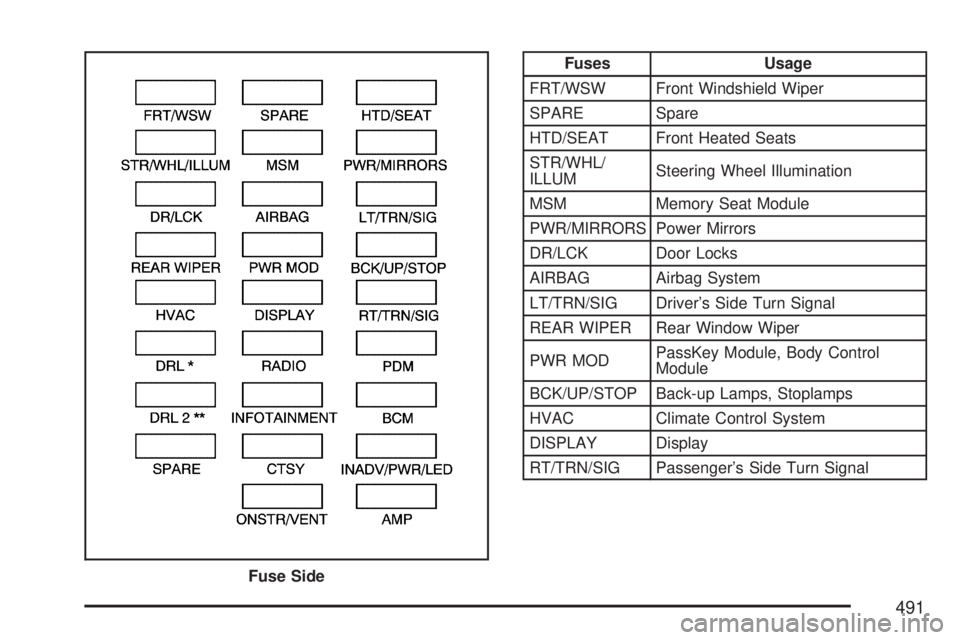
Fuses Usage
FRT/WSW Front Windshield Wiper
SPARE Spare
HTD/SEAT Front Heated Seats
STR/WHL/
ILLUMSteering Wheel Illumination
MSM Memory Seat Module
PWR/MIRRORS Power Mirrors
DR/LCK Door Locks
AIRBAG Airbag System
LT/TRN/SIG Driver’s Side Turn Signal
REAR WIPER Rear Window Wiper
PWR MODPassKey Module, Body Control
Module
BCK/UP/STOP Back-up Lamps, Stoplamps
HVAC Climate Control System
DISPLAY Display
RT/TRN/SIG Passenger’s Side Turn Signal
Fuse Side
491
Page 495 of 554

Fuses Usage
LT PRK Left Parking Lamp
RT PRK Right Parking Lamp
TRLR PRK
LAMPTrailer Parking Lamps
AIRBAG Airbag System
PCM IGN Powertrain Control Module Ignition
AFS Adaptive Forward Lighting System
TRANS Transmission
REAR
CAMERARear Camera
EMISSION 1 Anti-lock Brakes System 2
TRLR BRK Trailer Brake
AWD All-Wheel-Drive System
TRLR PWR Trailer Power
EVEN COILS Even Injector Coils
RR HVAC Rear Climate Control System
SPARE Spare
ODD COILS Odd Injector Coils
SPARE Spare
LT HI BEAM Left High-Beam Headlamp
SPARE Spare
LT TRLR
STOP/TRNTrailer Left Stoplamp and Turn
Signal
EMISSION 2 Emission 2Fuses Usage
ECM Engine Control Module
RT HI BEAM Right High-Beam Headlamp
RVC SNSR Regulated Voltage Control Sensor
RT TRLR
STOP/TRNTrailer Right Stoplamp and Turn
Signal
ECM 1 Engine Control Module 1
SPARE Spare
WPR/WSW Windshield Wiper/Washer
SPARE Spare
PWR OUTLET Power Outlet
AUX POWER Auxiliary Power
RT LO BEAM Right Low-Beam Headlamp
RR APO Rear Accessory Power Outlet
LT LO BEAM Left Low-Beam Headlamp
TCM Transmission Control Module
TRLR BCK/UP Trailer Back-up Lamps
HTD MIR Heated Outside Rearview Mirror
ABS MTR Anti-lock Brake System Motor
FOG LAMP Fog Lamps
HORN Horn
A/C CLTCH Air Conditioning Clutch
FUEL PUMP Fuel Pump
SPARE Spare
495