2007 GMC ACADIA heating
[x] Cancel search: heatingPage 254 of 554

TIRE LEARNING ACTIVE
This message displays when the Tire Pressure
Monitor (TPM) system is re-learning the tire
positions on your vehicle. SeeDIC Operation and
Displays (With DIC Buttons) on page 233orDIC
Operation and Displays (Without DIC Buttons) on
page 239for more information. The tire positions
must be re-learned after rotating the tires or after
replacing a tire or sensor. SeeTire Inspection and
Rotation on page 448,Tire Pressure Monitor
System on page 444, andInflation - Tire Pressure
on page 442for more information.
TRACTION CONTROL OFF
This message displays when the Traction Control
System (TCS) is turned off. Adjust your driving
accordingly. SeeStabiliTrak
®System on page 337
for more information. This message clears itself
after 10 seconds.
TRANSMISSION HOT IDLE ENGINE
Notice:If you drive your vehicle while the
transmission uid is overheating and the
transmission temperature warning is displayed
on the instrument panel cluster and/or DIC, you
can damage the transmission. This could lead
to costly repairs that would not be covered by
your warranty. Do not drive your vehicle with
overheated transmission uid or while the
transmission temperature warning is displayed.
This message displays along with a continuous
chime if the transmission uid in the vehicle
gets hot. Driving with the transmission uid
temperature high can cause damage to the
vehicle. Stop the vehicle and let it idle to allow
the transmission to cool. This message clears
and the chime stops when the uid temperature
reaches a safe level.
254
Page 380 of 554

Driving on Grades
Your vehicle is designed primarily as a passenger
and load carrying vehicle. If you tow a trailer,
your vehicle will require more frequent
maintenance due to the additional load. Because
of the added load of the trailer, your vehicle’s
engine may overheat on hot days, when going up
a long or steep grade with a trailer. If the engine
coolant temperature gage indicates overheating,
turn off the air conditioning to reduce engine load,
pull off the road and stop in a safe spot.
Reduce speed and shift to a lower gear before
you start down a long or steep downgrade. If you
don’t shift down, you might have to use your
brakes so much that they would get hot and no
longer work well.
On a long uphill grade, shift down and reduce
your speed to around 55 mph (88 km/h) to reduce
the possibility of the engine and the transmission
overheating.
Parking on Hills
{CAUTION:
You really should not park your vehicle,
with a trailer attached, on a hill.
If something goes wrong, your rig could
start to move. People can be injured, and
both your vehicle and the trailer can be
damaged.
But if you ever have to park your rig on a hill,
here’s how to do it:
1. Apply your regular brakes, but don’t shift
into PARK (P).
When parking uphill, turn your wheels away
from the curb. When parking downhill,
turn your wheels into the curb.
2. Have someone place chocks behind the
trailer wheels.
380
Page 382 of 554

Trailer Wiring Harness
Your vehicle is equipped with the following wiring
harness for towing a trailer.
Basic Trailer Wiring
The trailer wiring harness, with a seven-pin
connector, is located at the rear of the vehicle
and is tied to the vehicle’s frame. The harness
connector can be plugged into a seven-pin
universal heavy-duty trailer connector available
through your dealer/retailer.
The seven-wire harness contains the following
trailer circuits:
Yellow: Left Stop/Turn Signal
Dark Green: Right Stop/Turn Signal
Brown: Taillamps
White: Ground
Light Green: Back-up Lamps
Red: Battery Feed*
Dark Blue: Trailer Brake*
*The fuses for these two circuits are installed in
the underhood electrical center, but the wires
are not connected. They should be connected by
your dealer/retailer or a qualied service center.
If you are charging a remote (non-vehicle) battery,
press the tow/haul mode button located at the
end of the shift lever. This will boost the vehicle
system voltage and properly charge the battery.
If the trailer is too light for tow/haul mode, you can
turn on the headlamps (Non-HID only) as a
second way to boost the vehicle system and
charge the battery.
Engine Cooling When Trailer Towing
Your cooling system may temporarily overheat
during severe operating conditions. SeeEngine
Overheating on page 410.
382
Page 383 of 554
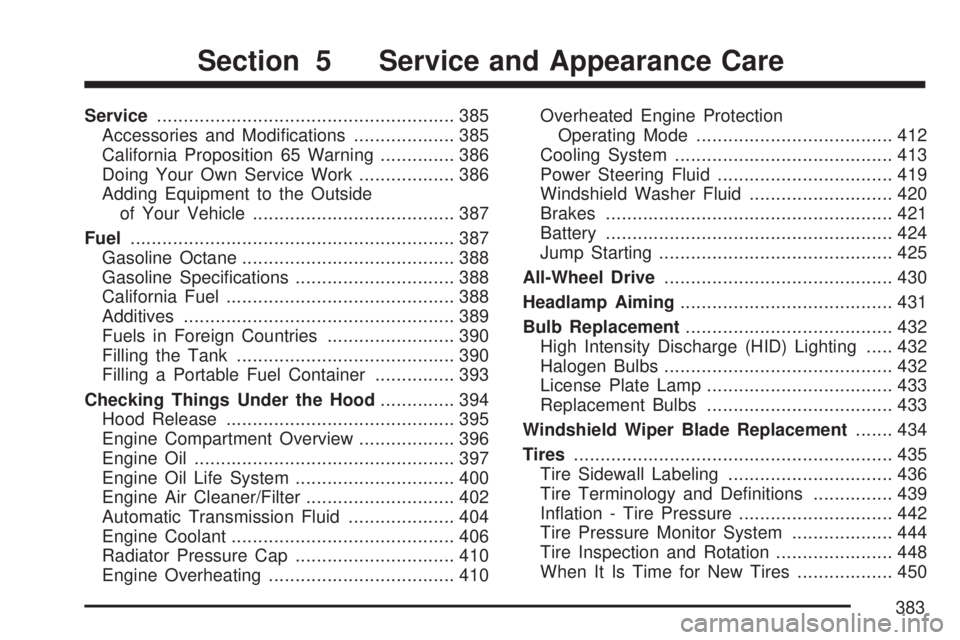
Service........................................................ 385
Accessories and Modications................... 385
California Proposition 65 Warning.............. 386
Doing Your Own Service Work.................. 386
Adding Equipment to the Outside
of Your Vehicle...................................... 387
Fuel............................................................. 387
Gasoline Octane........................................ 388
Gasoline Specications.............................. 388
California Fuel........................................... 388
Additives................................................... 389
Fuels in Foreign Countries........................ 390
Filling the Tank......................................... 390
Filling a Portable Fuel Container............... 393
Checking Things Under the Hood.............. 394
Hood Release........................................... 395
Engine Compartment Overview.................. 396
Engine Oil................................................. 397
Engine Oil Life System.............................. 400
Engine Air Cleaner/Filter............................ 402
Automatic Transmission Fluid.................... 404
Engine Coolant.......................................... 406
Radiator Pressure Cap.............................. 410
Engine Overheating................................... 410Overheated Engine Protection
Operating Mode..................................... 412
Cooling System......................................... 413
Power Steering Fluid................................. 419
Windshield Washer Fluid........................... 420
Brakes...................................................... 421
Battery...................................................... 424
Jump Starting............................................ 425
All-Wheel Drive........................................... 430
Headlamp Aiming........................................ 431
Bulb Replacement....................................... 432
High Intensity Discharge (HID) Lighting..... 432
Halogen Bulbs........................................... 432
License Plate Lamp................................... 433
Replacement Bulbs................................... 433
Windshield Wiper Blade Replacement....... 434
Tires............................................................ 435
Tire Sidewall Labeling............................... 436
Tire Terminology and Denitions............... 439
Ination - Tire Pressure............................. 442
Tire Pressure Monitor System................... 444
Tire Inspection and Rotation...................... 448
When It Is Time for New Tires.................. 450
Section 5 Service and Appearance Care
383
Page 406 of 554

How to Add Automatic Transmission
Fluid
Refer to the Maintenance Schedule to determine
what kind of transmission uid to use. See
Recommended Fluids and Lubricants on page 511.
If the uid level is low, add only enough of the
proper uid to bring the level into the crosshatched
area on the dipstick.
1. Remove the dipstick.
2. Using a long-neck funnel, add enough uid at
the dipstick hole to bring it to the proper level.
It does not take much uid, generally
less than one half of a pint (0.25 L).
Do not overll.
Notice:Use of the incorrect automatic
transmission uid may damage your vehicle,
and the damages may not be covered by
your warranty. Always use the automatic
transmission uid listed inRecommended
Fluids and Lubricants on page 511.
3. After adding uid, recheck the uid level as
described under “How to Check Automatic
Transmission Fluid,” earlier in this section.
4. When the correct uid level is obtained,
twist & lock dipstick cap in place.
Engine Coolant
The cooling system in your vehicle is lled with
DEX-COOL®engine coolant. This coolant is
designed to remain in your vehicle for ve years or
150,000 miles (240 000 km), whichever occurs
rst, if you add only DEX-COOL
®extended
life coolant.
The following explains your cooling system and
how to add coolant when it is low. If you have
a problem with engine overheating or if you need
to add coolant to the radiator, seeEngine
Overheating on page 410.
A 50/50 mixture of clean, drinkable water and
DEX-COOL
®coolant will:
Give freezing protection down to
−34°F (−37°C).
Give boiling protection up to 265°F (129°C).
Protect against rust and corrosion.
Help keep the proper engine temperature.
Let the warning lights and gages work as
they should.
406
Page 409 of 554

Adding Coolant
If more coolant is needed, add the proper
DEX-COOL®coolant mixture at the coolant
recovery tank, but be careful not to spill it.
If the coolant recovery tank is completely empty,
add coolant to the radiator. SeeEngine
Overheating on page 410.
{CAUTION:
Turning the radiator pressure cap
when the engine and radiator are hot can
allow steam and scalding liquids to blow
out and burn you badly. With the coolant
recovery tank, you will almost never have
to add coolant at the radiator. Never
turn the radiator pressure cap — even a
little — when the engine and radiator
are hot.
{CAUTION:
You can be burned if you spill coolant on
hot engine parts. Coolant contains
ethylene glycol, and it will burn if the
engine parts are hot enough. Do not spill
coolant on a hot engine.
Occasionally check the coolant level in the
radiator. For information on how to add coolant to
the radiator, seeCooling System on page 413.
409
Page 410 of 554

Radiator Pressure Cap
Notice:If the pressure cap is not tightly
installed, coolant loss and possible engine
damage may occur. Be sure the cap is properly
and tightly secured.
SeeEngine Compartment Overview on page 396
for more information on location.
Engine Overheating
There is an engine coolant temperature gage on
your vehicle’s instrument panel. SeeEngine
Coolant Temperature Gage on page 225.
Your vehicle may also have an ENGINE
OVERHEATED IDLE ENGINE and ENGINE
OVERHEATED STOP ENGINE message
displayed in the Driver Information Center (DIC).
SeeDIC Warnings and Messages on page 244.
If Steam Is Coming From Your Engine
{CAUTION:
Steam from an overheated engine can
burn you badly, even if you just open the
hood. Stay away from the engine if you
see or hear steam coming from it. Turn it
off and get everyone away from the
vehicle until it cools down. Wait until
there is no sign of steam or coolant
before you open the hood.
CAUTION: (Continued)
410
Page 414 of 554
When the engine is cold, the coolant level should
be at least up to the FULL COLD mark. If it is not,
you may have a leak at the pressure cap or in the
radiator hoses, heater hoses, radiator, water pump
or somewhere else in the cooling system.
{CAUTION:
Heater and radiator hoses, and other
engine parts, can be very hot. Do not touch
them. If you do, you can be burned.
Do not run the engine if there is a leak.
If you run the engine, it could lose all
coolant. That could cause an engine re,
and you could be burned. Get any leak
xed before you drive the vehicle.If there seems to be no leak, with the engine on,
check to see if the electric engine cooling fans are
running. If the engine is overheating, both fans
should be running. If they are not, your vehicle
needs service.
Notice:Engine damage from running your
engine without coolant is not covered by your
warranty.
Notice:Using coolant other than DEX-COOL®
may cause premature engine, heater core, or
radiator corrosion. In addition, the engine
coolant could require changing sooner, at
30,000 miles (50 000 km) or 24 months,
whichever occurs rst. Any repairs would not
be covered by your warranty. Always use
DEX-COOL
®(silicate-free) coolant in your
vehicle.
414