2007 FORD FIESTA body
[x] Cancel search: bodyPage 999 of 1226

Automatic Transmission/Transaxle -
Vehicles With: 4-Speed Automatic
307-01 -39 Transmission (AW81-40) 307-01 -39
DESCRIPTION AND OPERATION
TFT sensor Overdrive switch
The TFT sensor is located in the oil pan on the
main control body and is part of the transmission
wiring harness.
It measures the current transmission fluid
temperature and sends the signal to the
transmission control unit.
The transmission control unit uses this signal for:
Cold start mode,
Engagement of the TCC,
Shift timing adaptation during upshifts,
' , Shift timing adaptation during shifts from 3rd to
4th gear,
Shift timing adaptation during shifts from 4th to
3rd gear,
Overheating protection mode.
Consequences of signal failure:
NoTCC,
no shift timing adaptation,
no 4th gear. The overdrive switch
is located on the selector
lever.
It allows the driver to suppress or enable gearshifts
into 4th gear when
"D" is selected.
The signal from the overdrive switch is transmitted
to the transmission control unit.
When gearshifts into 4th gear are suppressed, the
transmission control unit sends a corresponding
signal via the CAN
databus to the instrument
cluster. The instrument cluster then actuates the
overdrive indicator lamp.
Consequences of signal failure:
no suppression of gearshifts into 4th gear.
2006.0 Fiesta 1212006 G380530en
procarmanuals.com
Page 1001 of 1226
Automatic Transmission/Transaxle -
Vehicles With: 4-Speed Automatic
307-01
-41 Transmission (AW81-40) 307-01 -41
DESCRIPTION AND OPERATION
The SSA and SSB shift solenoid valves are used In
their currentless state they are open.
to switch the different hydraulic paths in the main
Consequences of signal failure: control body. hydraulic emergency running mode.
They are actuated by the transmission control unit
according to the required gear.
Actuation of the SSA and SSB shift solenoid valves
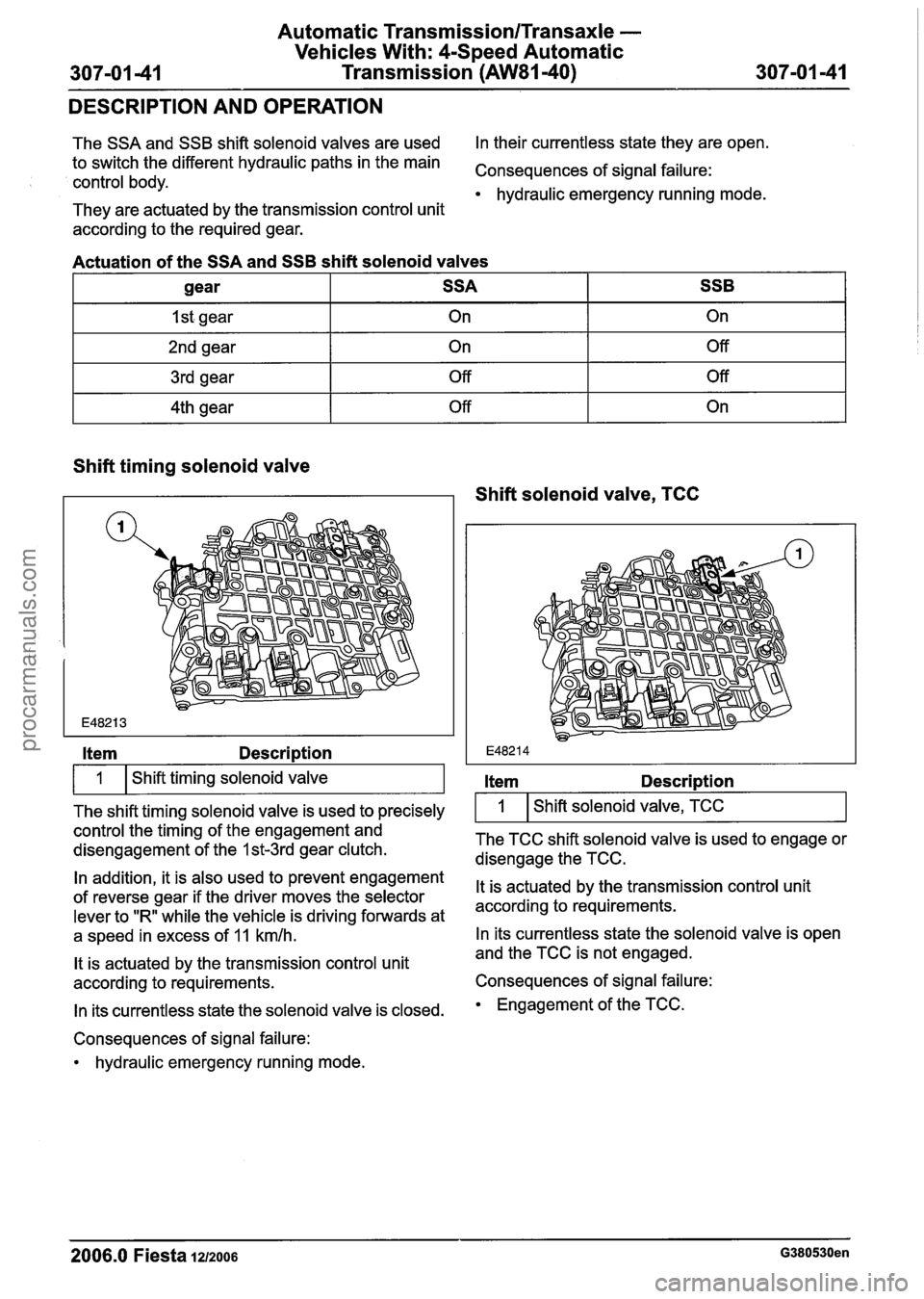
Shift timing solenoid valve
gear
I st gear
2nd gear
3rd gear
4th gear
kern Descri~tion
I 1 I Shift timing solenoid valve I
SSA On
On Off
Off
The shift timing solenoid valve is used to precisely SSB
On Off
Off
On
control the timing of the engagement and
disengagement of the
I st3rd gear clutch.
In addition, it is also used to prevent engagement
of reverse gear if the driver moves the selector
lever to "R" while the vehicle is driving forwards at
a speed in excess of
11 kmlh.
It is actuated by the transmission control unit
according to requirements.
In its currentless state the solenoid valve is closed.
Consequences of signal failure: hydraulic emergency running mode.
Shift solenoid valve, TCC
Item Description
I 1 I Shift solenoid valve, TCC I
The TCC shift solenoid valve is used to engage or
disengage the TCC.
It is actuated by the transmission control unit
according to requirements.
In its currentless state the solenoid valve is open
and the TCC is not engaged.
Consequences of signal failure:
Engagement of the TCC.
2006.0 Fiesta 1212006 G380530en
procarmanuals.com
Page 1016 of 1226
Automatic Transmission/Transaxle -
Vehicles With: 4Speed Automatic
307-01 -56 Transmission (AW81-40) 307-01 -56
IN-VEHICLE REPAIR
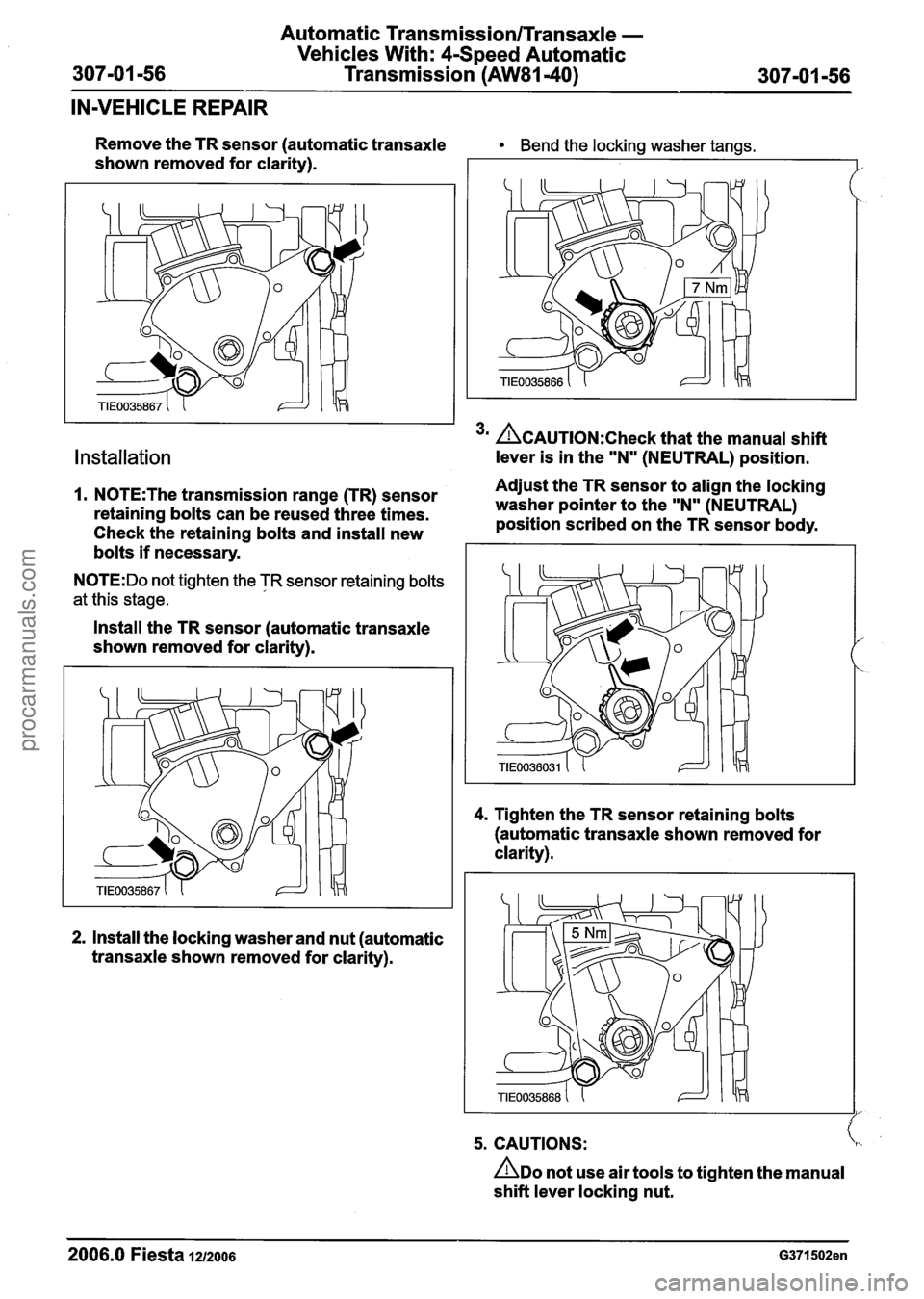
Remove the TR sensor (automatic transaxle Bend the locking washer tangs.
shown removed for clarity).
Installation
3m &LCAUTION:C~~~~ that the manual shift
lever is in the "N" (NEUTRAL) position.
1. N0TE:The transmission range (TR) sensor Adjust
the TR sensor to align the locking
retaining bolts can be reused three times. washer
pointer to the "N" (NEUTRAL)
Check the retaining bolts and install new position scribed on the
TR sensor body.
bolts
if necessary.
N0TE:Do not tighten the TR sensor retaining bolts
at this stage.
Install the TR sensor (automatic transaxle
shown removed for clarity).
4. Tighten the TR sensor retaining bolts
(automatic transaxle shown removed for
clarity).
2. Install the locking washer and nut (automatic
transaxle shown removed for clarity).
I
5. CAUTIONS:
ADO not use air tools to tighten the manual
shift lever locking nut.
--
2006.0 Fiesta 1212006 G371502en
procarmanuals.com
Page 1049 of 1226
Automatic Transmission/Transaxle External
Controls -Vehicles With: 4-Speed Automatic
307-05-5 Transmission (AW81-40) 307-05-5
GENERAL PROCEDURES
Selector Lever Cable Adjustment
Adjustment Move the transaxle selector lever to the "D"
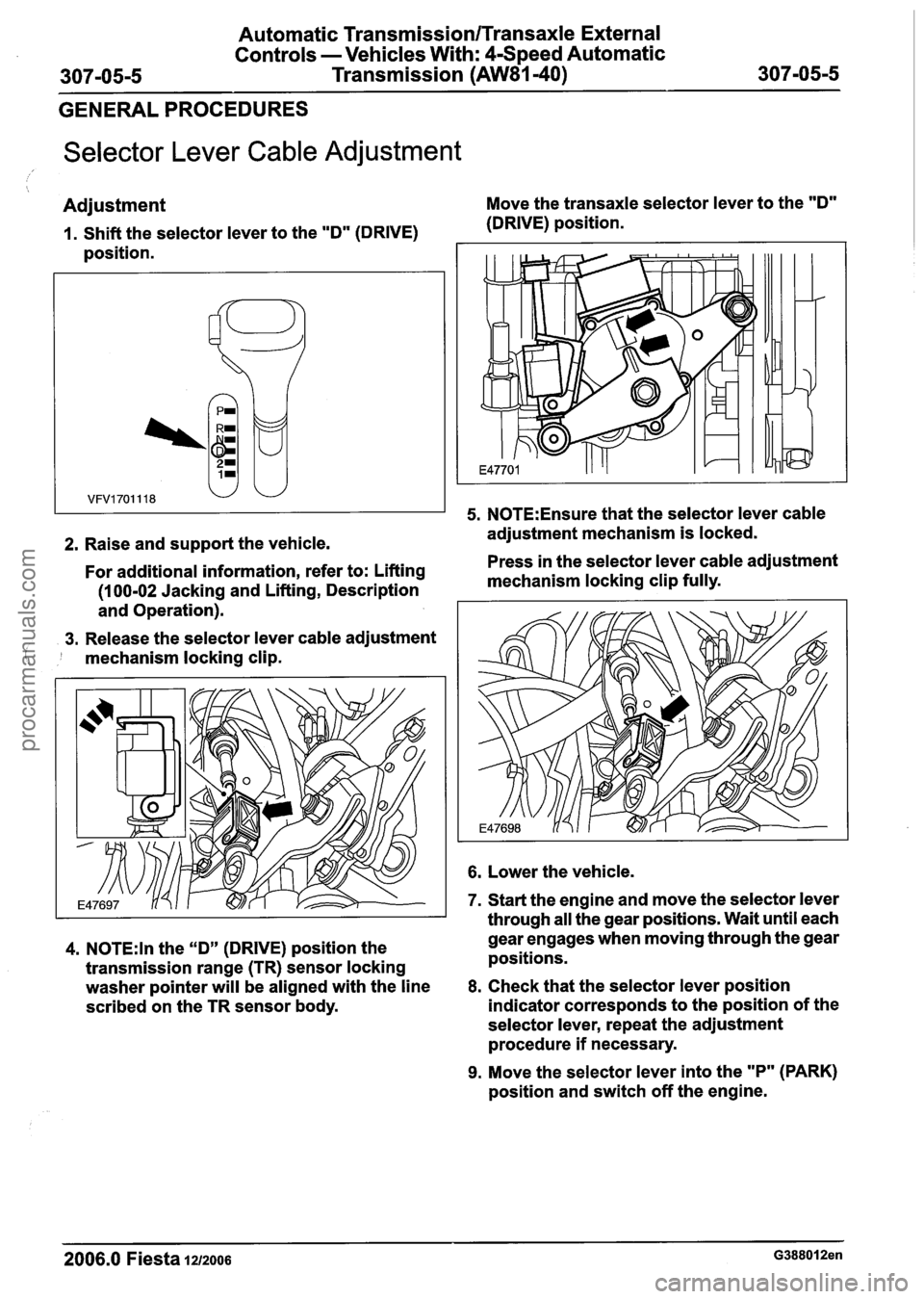
1. Shift the selector lever to the "D" (DRIVE) (DRIVE) position.
position.
2. Raise and support the vehicle.
5. N0TE:Ensure that the selector lever cable
adjustment mechanism is locked.
- -
For additional information, refer to: Lifting Press
in the selector lever cable adjustment
(1 00-02 Jacking and Lifting, Description mechanism
locking clip fully.
and Operation).
3. Release the selector lever cable adjustment
1, ' mechanism locking clip.
6. Lower the vehicle.
7. Start the engine and move the selector lever
through all the gear positions. Wait until each
4. N0TE:ln the "D" (DRIVE) position the gear engages
when moving through the gear
transmission range (TR) sensor locking positions.
washer pointer will be aligned with the line
8. Check that the selector lever position
scribed on the TR sensor body. indicator corresponds to the position of the
selector lever, repeat the adjustment
procedure if necessary.
9. Move the selector lever into the "P" (PARK)
position and switch off the engine.
2006.0 Fiesta 1212006 G388012en
procarmanuals.com
Page 1061 of 1226
Manual Transmission/Transaxle and Clutch -
308-00-3 General Information 308-00-3
DIAGNOSIS AND TESTING
Manual Transaxle and Clutch
lnspection and Verification
General Equipment selected with the engine running and the parking
brake applied, without any concerns, the clutch
2. If the gear@) cannot be selected, REFER to
Symptom Chart.
Ultraviolet
fluid leak detection equipment
1. Verify the customer concern.
Transaxle noise concerns
2. Visually inspect for obvious signs of mechanical is
OK.
damage. 1. Check the engine and transaxle support for
Oil leaks.
Visibly damaged or worn components.
Visual lnspection Chart insufficient gap between the transaxle and the
body.
REFER to:
RoadlRoller Testing (1 00-00 General
Information, Description and Operation).
Mechanical 2. Road test the vehicle.
4. If the cause is not evident, verify the symptom
and REFER to Symptom Chart.
Oil leakage concerns
Loose or missing nuts or bolts.
( I The following checks should be carried out before
repairing or installing a new transaxle. 1.
Check the transaxle fluid level. If necessary,
3. If a noise occurs in various gears at the same
- - drain off any excess fluid.
The inspection and verification of manual transaxle
concerns can be considered in three main areas. 2. Clean the transaxle and the adjacent areas
carefully and road test the vehicle.
engine speed,
check if the noise also occurs in
3. If an obvious cause for an observed or reported the neutral position.
If it does, the noise is not
concern is found, correct the cause (if possible) caused
by the transaxle.
before proceeding to the next step. 4.
REFER to Symptom Chart.
Gear shifting concerns REFER to: RoadlRoller Testing (1 00-00 General
Information, Description and Operation).
1, Check the operation of the clutch: Lay a block 3. U~ing suitable ultraviolet fluid leak detection
of wood approximately
25 mm thick under the equipment, locate
the leak and check whether
clutch pedal and depress the clutch pedal as the leaking fluid
is transaxle fluid, brake fluid
far as the stop. If first or second gear can be (from the hydraulically operated clutch)
or
engine oil.
4. REFER to Symptom Chart.
Symptom Chart
Symptom Possible Sources Action
I
Clutch slippage Clutch master
cylinder.
Clutch slave cylinder.
Clutch pressure plate.
Clutch disc.
Engine or transaxle housing oil
or fluid
leak@).
GO to Pinpoint Test A.
Clutch chatter or shudder Engine and transaxle
mounts. REFER to:
Noise, Vibration and
Harshness (NVH) (1 00-04,
Diagnosis and Testing).
Clutch pressure plate.
Clutch disc.
Flywheel.
--
GO to Pinpoint Test B.
- -
2006.0 Fiesta 1212006 G25629en
procarmanuals.com
Page 1063 of 1226
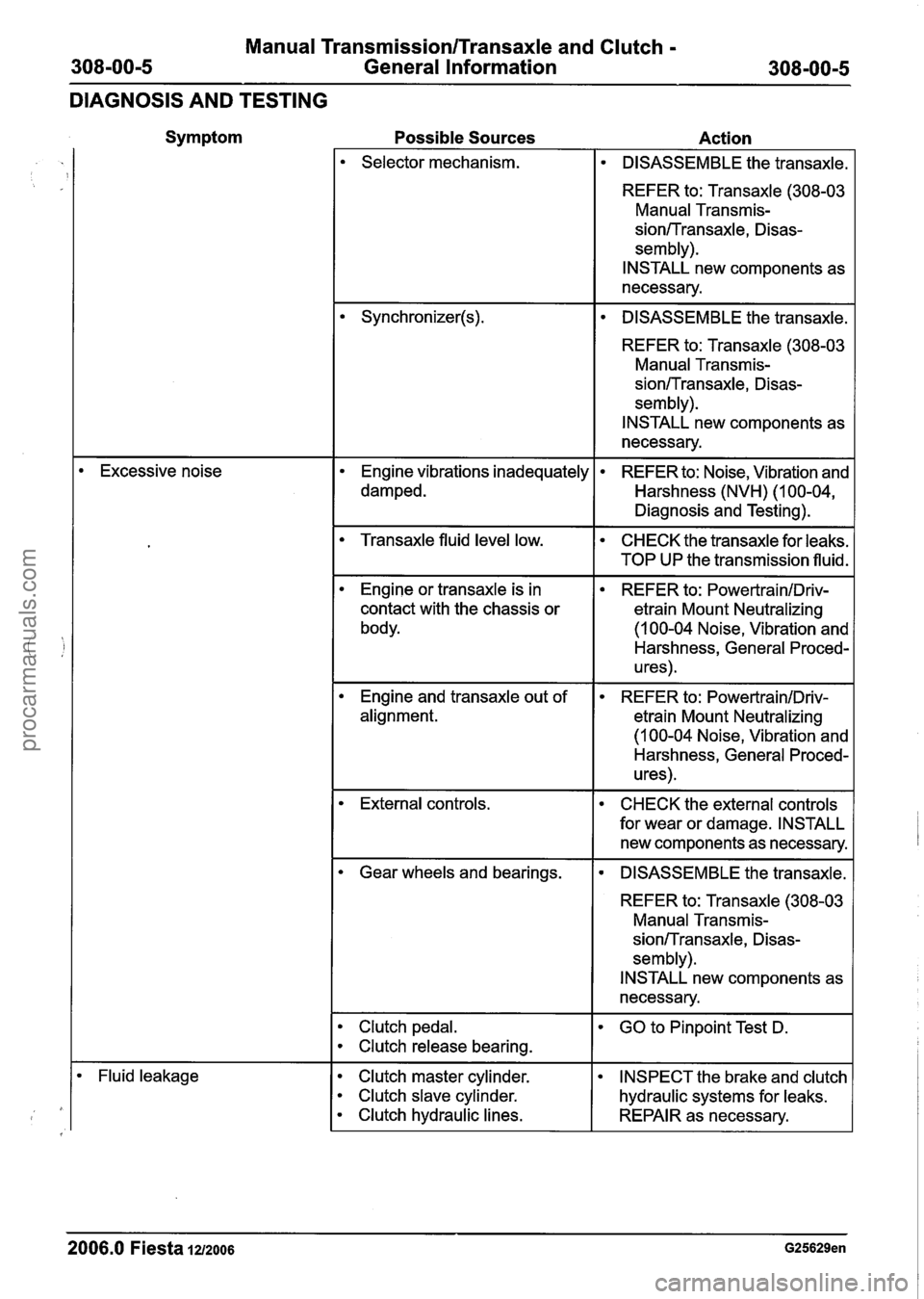
Manual Transmission/Transaxle and Clutch -
308-00-5 General Information 308-00-5
DIAGNOSIS AND TESTING
Symptom
Excessive noise Possible Sources
Action
Selector mechanism.
DISASSEMBLE the transaxle.
REFER to: Transaxle (308-03 Manual Transmis-
sionITransaxle, Disas-
sem bly).
INSTALL new components as
necessary.
DISASSEMBLE the transaxle.
REFER to: Transaxle (308-03 Manual Transmis-
sionITransaxle, Disas-
sem bly).
INSTALL new components as
necessary.
Engine vibrations inadequately
damped.
REFER to: Noise, Vibration and
Harshness (NVH) (1 00-04,
Diagnosis and Testing).
Transaxle fluid level low. CHECK the transaxle for leaks.
I TOP UP the transmission fluid.
Engine or transaxle is in
contact with the chassis or
body. REFER
to:
PowertrainIDriv-
etrain Mount Neutralizing
(1 00-04 Noise, Vibration and
Harshness, General Proced-
u res)
.
Engine and transaxle out of
alignment. REFER
to: PowertrainIDriv-
etrain Mount Neutralizing
(I 00-04 Noise, Vibration and
Harshness, General Proced-
u res)
.
External controls. CHECK the external controls
for wear or damage. INSTALL
new components as necessary.
Gear wheels and bearings.
DISASSEMBLE the transaxle.
REFER to: Transaxle (308-03
Manual Transmis-
sion/-rransaxle, Disas-
sem bly).
INSTALL new components as
necessary.
Clutch pedal. I GO to Pinpoint Test D.
Clutch release bearing.
Fluid leakage Clutch master cylinder.
Clutch slave cylinder.
Clutch hydraulic lines.
INSPECT the brake and clutch
hydraulic systems for leaks.
REPAIR as necessary.
2006.0 Fiesta 1212006 G25629en
procarmanuals.com
Page 1168 of 1226
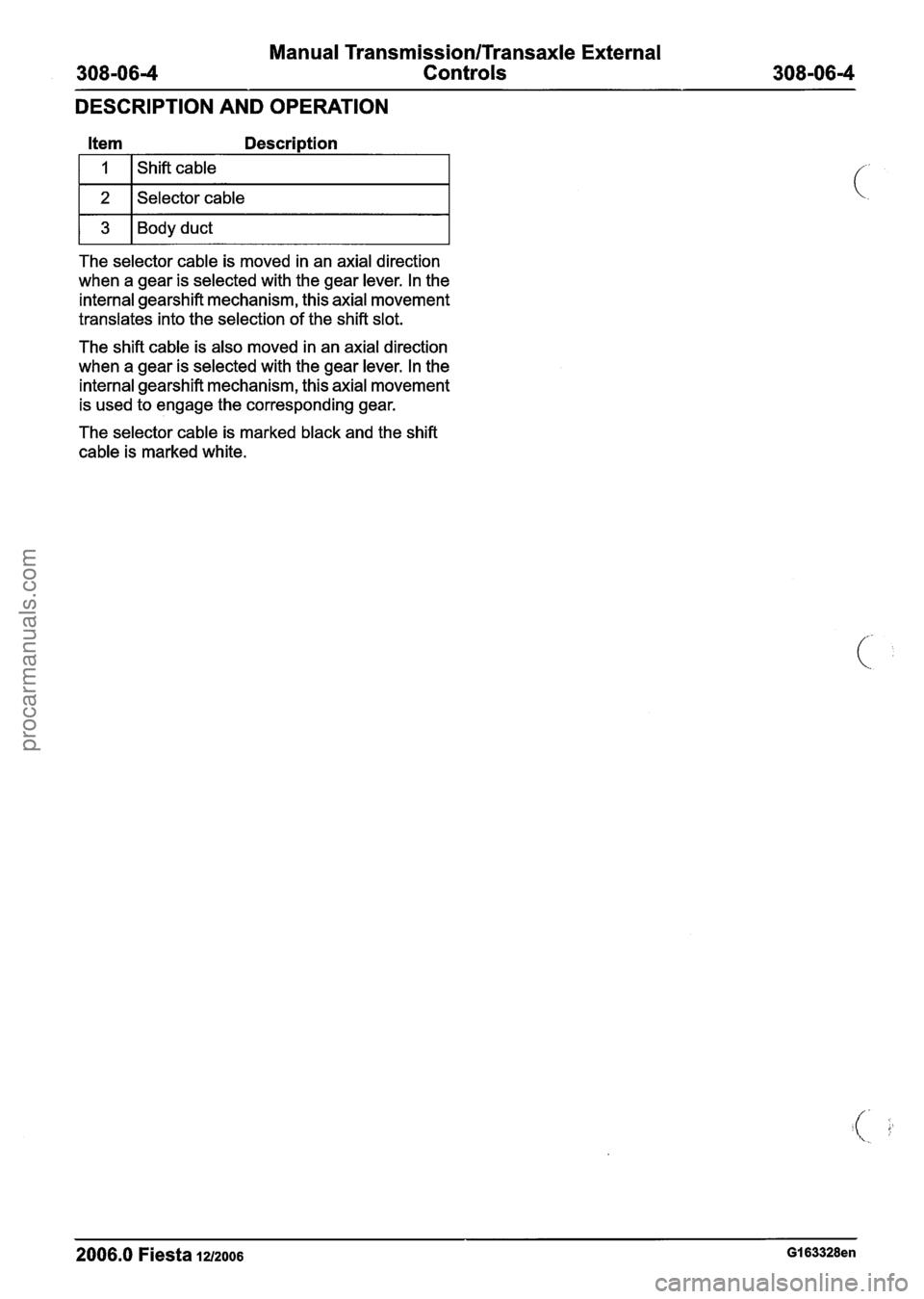
Manual Transmission/Transaxle External
308-0614 Controls 308-06-4
DESCRIPTION AND OPERATION
Item Description
1 2 1 Selector cable I
1 3 1 Body duct I
The selector cable is moved in an axial direction
when a gear is selected with the gear lever. In the
internal gearshift mechanism, this axial movement
translates into the selection of the shift slot.
The shift cable is also moved in an axial direction
when a gear is selected with the gear lever. In the
internal gearshift mechanism, this axial movement
is used to engage the corresponding gear.
The selector cable is marked black and the shift
cable is marked white.
2006.0 Fiesta 1212006 GI 63328en
procarmanuals.com
Page 1193 of 1226
31 0-00-7 Fuel System - General Information 31 0-00-7
GENERAL PROCEDURES
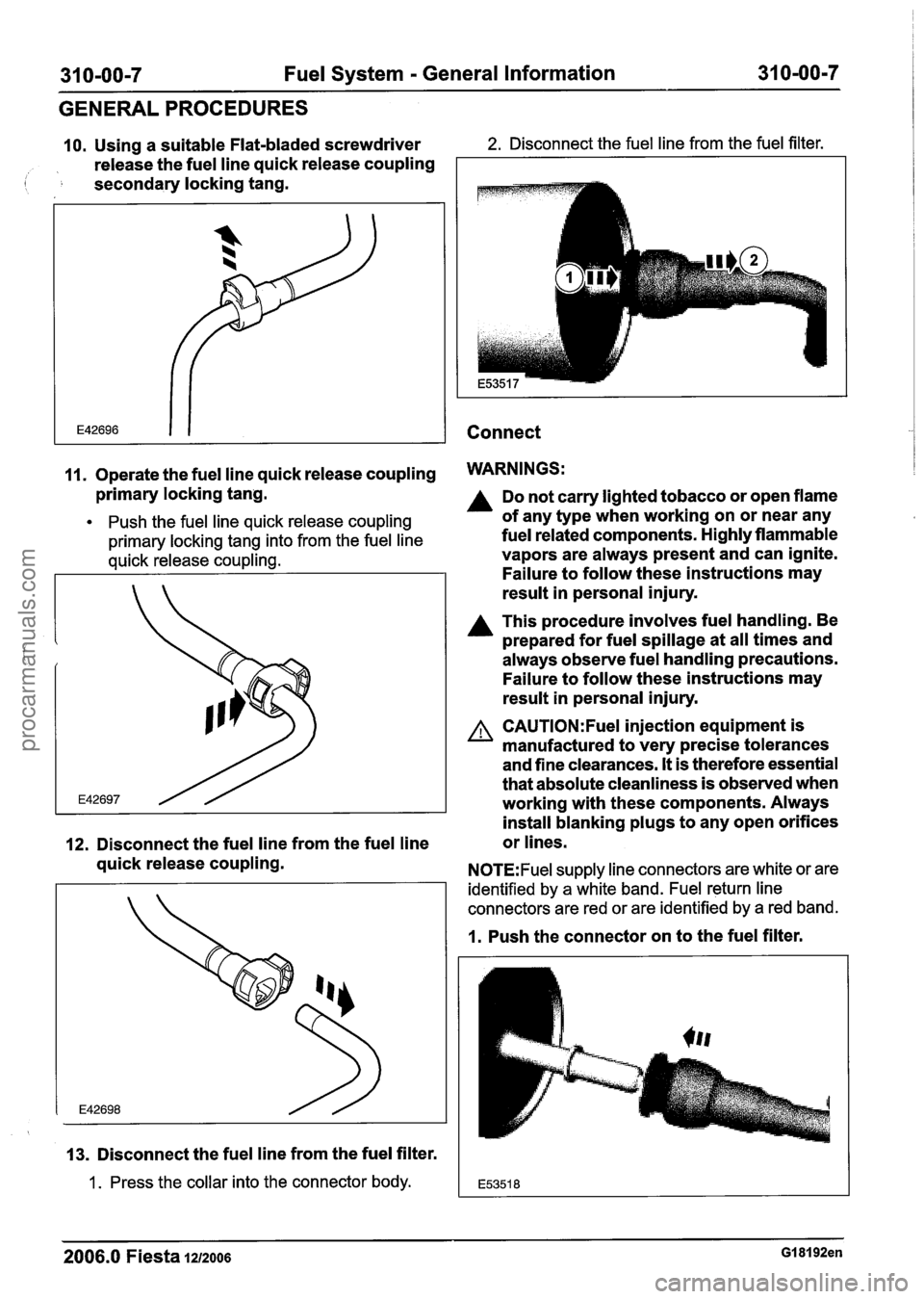
10. Using a suitable Flat-bladed screwdriver 2. Disconnect the fuel line from the fuel filter.
release the fuel line quick release coupling
( secondary locking tang.
Connect
11. Operate the fuel line quick release coupling WARNINGS:
primary locking tang.
Push the fuel line quick release coupling
primary locking tang into from the fuel line
quick release coupling.
12. Disconnect the fuel line from the fuel line
quick release coupling.
13. Disconnect the fuel line from the fuel filter.
1 . Press the collar into the connector body.
Do not carry lighted tobacco or open flame
of any type when working on or near any
fuel related components. Highly flammable
vapors are always present and can ignite.
Failure to follow these instructions may
result in personal injury.
A This procedure involves fuel handling. Be
prepared for fuel spillage at all times and
always observe fuel handling precautions.
Failure to follow these instructions may
result in personal injury.
A CAUTI0N:Fuel injection equipment is
manufactured to very precise tolerances
and fine clearances.
It is therefore essential
that absolute cleanliness is observed when
working with these components. Always
install blanking plugs to any open orifices
or lines.
N0TE:Fuel supply line connectors are white or are
identified by a white band. Fuel return line
connectors are red or are identified by a red band.
1. Push the connector on to the fuel filter.
2006.0 Fiesta 1212006 GI 81 92en
procarmanuals.com