Page 71 of 1226

100-04-15 Noise, Vibration and Harshness 100-04-15
DIAGNOSIS AND TESTING
Power Steering Grinding Noise 1. Slowly turn the steering wheel from lock to lock.
Test Condition
Action
Certain amount of noise level
acceptable, not a safety critical
item.
Symptom
Power steering system toc-toc
noise - a metallic noise created
when changing direction of
steering wheel rotation during
parking manoeuvre or at stand-
still.
2. Tilt and extend the steering column in various
positions and slowly turn the steering wheel
Possible Sources
gear (design tolerance
in steering rack).
Listen for steering grinding noise with the engine from lock to lock.
speed at idle and the vehicle parked, automatic
transmission in "P" (PARK) or manual transmission
in neutral and the windows closed.
Power Steering Zip Noise
Symptom Possible Sources Action
Power steering system grinding
noise
- an abrasive noise (like
sand paper rubbing against wood)
occurs between moving compon-
ents such as steering wheel and
the steering column shroud.
2006.0 Fiesta 1212006 G37349en
Steering wheel to shroud interfer-
ence.
Steering column bearing.
Foreign material in contact with
the steering column
shaft.
Clockspring.
Action
Certain amount of noise level
acceptable, not a safety critical item.
BLEED the power steering
system.
REFER
to: Power Steering
System Bleeding
(21 1-00
Steering System
- General
Information, General Proced-
ures).
Symptom
Power steering system zip noise
- occurs when hydraulic fluid
does not flow freely through the
power steering pump supply hose
from steering fluid reservoir to
power steering
pump causing
cavitation
at the pump. Zip is
primarily a cold weather start-up
phenomenon (below -1 0°C). Certain amount
of noise level
acceptable, not a safety critical
item.
Certain amount of noise level
acceptable, not a safety critical
item.
CHECK if floor covering is
obstructing the steering gear
pinion.
CHECK the installation of the floor
seal.
CHECK the clockspring and
secure if necessary.
REFER to: Clockspring (501
-208,
Removal and Installation).
Possible Sources
steering
Aeration of the power steering
fluid.
procarmanuals.com
Page 110 of 1226
204-01 -1 2 Front Suspension 204-01 -1 2 ---- - -
REMOVAL AND INSTALLATION
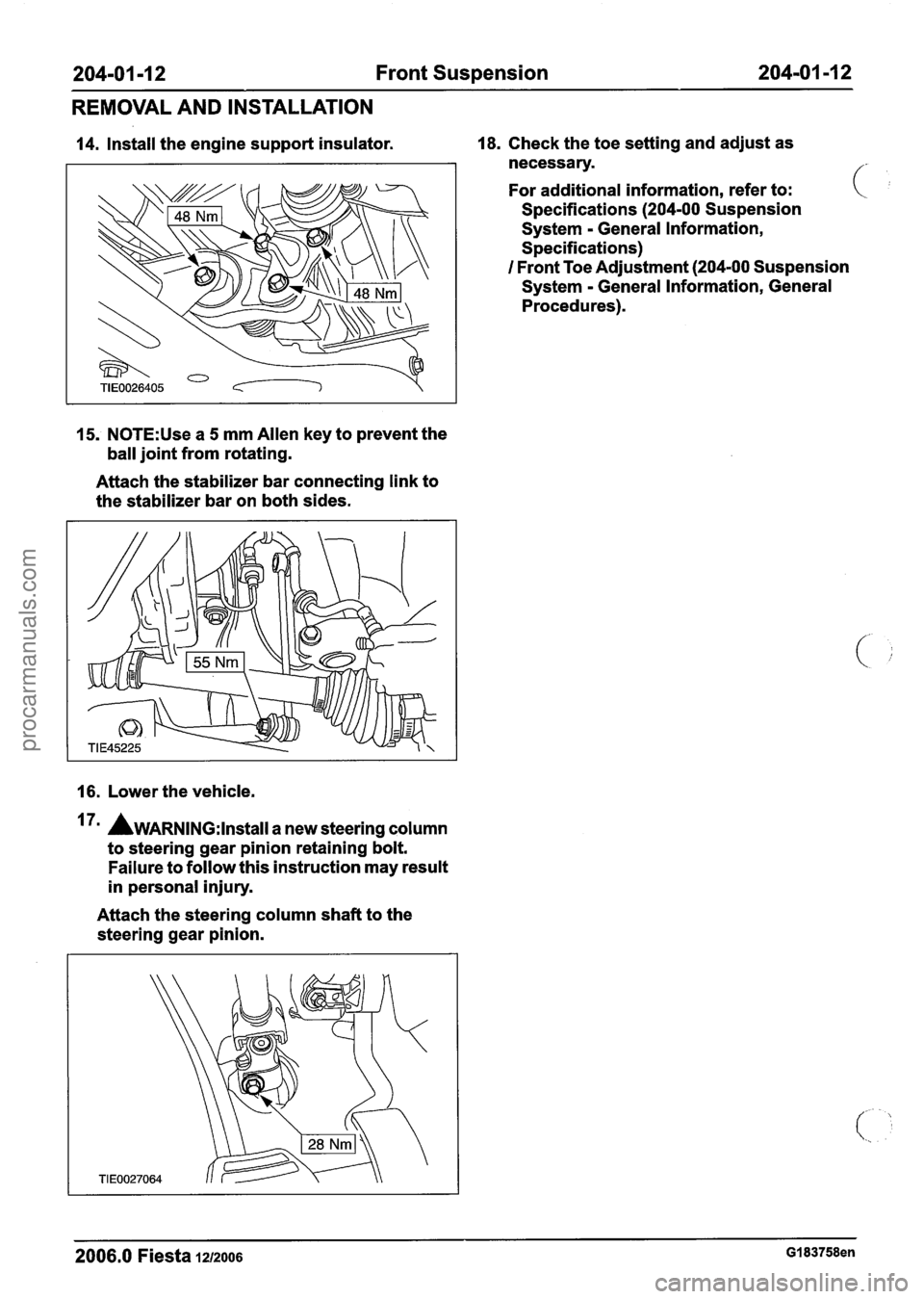
14. Install the engine support insulator. 18. Check the toe setting and adjust as
necessary.
For additional information, refer to:
Specifications
(204-00 Suspension
System
- General Information,
Specifications)
I Front Toe Adjustment (204-00 Suspension
System
- General Information, General
Procedures).
15. N0TE:Use a 5 mm Allen key to prevent the
ball joint from rotating.
Attach the stabilizer bar connecting link to
the stabilizer bar on both sides.
16. Lower the vehicle.
7m AWARNING:I~~~~II a new steering column
to steering gear pinion retaining bolt.
Failure to follow this instruction may result
in personal injury.
Attach the steering column shaft to the
steering gear pinion.
2006.0 Fiesta 1212006 GI 83758en
procarmanuals.com
Page 148 of 1226

204-0414 Wheels and Tires 204-04-4
DIAGNOSIS AND TESTING
Engine Speed Sensitive A thumping noise usually means that the tire is flat
or has soft spots making a noise as they slap the
This means that the vibration occurs at varying
roadway. Tire whine can be distinguished from axle
vehicle speeds when a different transmission gear
noise. Tire whine remains the same over a range
is selected. It can sometimes be isolated by
of speeds.
increasing Or decreasing engine with the A complete road test procedure is described in transmission in NEUTRAL or by stall testing with Section the transmission in gear. If the condition is engine
speed sensitive, the-cause is probably not related
REFER to: Noise, Vibration and Harshness (NVH)
to the tires. (1
00-04 Noise, Vibration and Harshness,
If the road test indicates that there is tire whine, Diagnosis and
Testing).
but no shake or vibration, the noise originates with
the contact between the tire and the road surface.
Symptom Chart
Symptom Possible Sources Action
Tire(s) show excess wear on
edge of tread
I Vehicle overloaded. I CORRECT as necessary. I
Tire(s) under-inflated.
lncorrect wheel alignment. ADJUST the tire pressure(s).
ADJUST the wheel alignment.
REFER to: (204-00 Suspension
System
- General Information)
Specifications (Specifications), Front Toe Adjustment (General
Procedures).
Tire(s) show excess wear in Tire(s) over-inflated.
I I
ADJUST the tire pressure(s).
I center of tread
Other excessive tire wear Incorrect tire pressure(s).
concerns
need rotating.
ADJUST the tire pressure(s).
ROTATE the wheel and tire
assemblies.
lncorrect wheel alignment. ADJUST the wheel alignment.
REFER to: (204-00 Suspension
System
- General Information)
Specifications (Specifications), Front Toe Adjustment (General
Procedures).
I Vehicle overloaded.
Loose or leaking front strut and
spring assembly. CORRECT as necessary.
I
2006.0 Fiesta 1212006 G25362en
TIGHTEN
or INSTALL new
suspension components as
necessary.
REFER to: Shock Absorber
and Spring Assembly (204-01
,
Front Suspension, Removal
and Installation).
procarmanuals.com
Page 157 of 1226
205-04-5 Front Drive Halfshafts 205-04-5
DIAGNOSIS AND TESTING
Possible Sources Action
Halfshaft Joint Pullout Outer front drive halfshaft INSPECT
and REPAIR or
retainer circlip missing or not
I I INSTALL new as necessary.
Front suspension components
worn or damaged.
correctly seated differential
side. CHECK
for worn bushings or
bent components (front stabil-
izer bar, front suspension lower
arm). REPAIR or INSTALL new
as necessary. REFER to
Section
204-01 [Front
Suspension]. REFER to Halfshaft
LH
-
1 Halfshaft RH - in this section.
Engineltransaxle assembly
misalignment. CHECK engine mounts for
damage or wear. REPAIR or
INSTALL new as necessary.
Frame rail or strut tower out of
position or damaged. CHECK underbody dimen-
sions. REFER to Section
501 -
00 [Body System - General
Information].
-- - --
2006.0 Fiesta 1212006 G25403en
procarmanuals.com
Page 174 of 1226

206-00-2 Brake System - General Information 206-00-2
DESCRIPTION AND OPERATION
Brake System
Overview
A Brake system without Anti-lock
Brake
I I system (ABS)
I B I Brake system with ABS I
I 1 I Brake master cylinder I -
1 2 1 Reservoir I
1 4 1 Brake pedal I
1 5 1 Brake pressure reduction valve I
1 6 1 Rear drum brake I
171t disk brake I
8 ABS hydraulic unit with integrated control
1 1 unit
1 9 I Wheel speed sensors I
Vehicles without ABS are equipped with brake
pressure reduction valves for the rear wheel
brakes. They are located in the corresponding
brake circuits at the brake master cylinder.
Vehicles with ABS do not need brake pressure
reduction valves because they are equipped with
electronic brake distribution (EBD).
The handbrake is cable operated on the rear
brakes.
On vehicles with a petrol engine the necessary
vacuum for the brake booster is generated by the
intake manifold.
On vehicles with a diesel engine, a vacuum pump
driven by the engine provides the necessary
vacuum for the brake booster.
2006.0 Fiesta lu2006 G281357en
procarmanuals.com
Page 196 of 1226

206-00-24 Brake System - General Information 206-00-24
DIAGNOSIS AND TESTING
TEST CONDITIONS DETAILSIRESU LTSIACTIONS
12: ROAD TEST THE VEHICLE
rn Road test the vehicle and apply the brakes.
Are the brakes functioning correctly?
-+ Yes
Vehicle OK.
+ No
INSPECT individual wheel cylinders or
calipers for binding or sticking components.
INSTALL new components as necessary.
BLEED the brake system. REFER to: (206-00
Brake System
- General Information)
Brake System Bleeding (General Procedures),
Brake System Pressure Bleeding (General Procedures).
TEST the system for normal operation.
PINPOINT TEST J
: EXCESSIVE BRAKE PEDAL EFFORT
TEST CONDITIONS
DETAILSIRESULTSIACTIONS
J1: CHECK BRAKE APPLICATION
With the engine off, apply and release the brake
pedal five times to deplete all vacuum from the
brake booster. Apply the brake pedal, hold with
light pressure. Start the engine.
Does the brake pedal hold?
+ Yes
GO to J2.
+ No
GO to J6.
52: CHECK BRAKE BOOSTER FOR LEAKS
rn Run the engine at medium idle, release the
accelerator pedal and turn the engine off. Wait
90 seconds and apply the brakes. Two or more
brake applications should be power assisted.
Does the brake booster work?
+ Yes
Vehicle OK.
-+ No
GO to
J3.
2006.0 Fiesta 1212006 G28494en
procarmanuals.com
Page 197 of 1226

206-00-25 Brake System - General Information 206-00-25
DIAGNOSIS AND TESTING
TEST CONDITIONS
53: CHECK BRAKE BOOSTER CHECK VALVE
rn Disconnect the vacuum hose, for the brake
booster check valve at the intake manifold. Blow
into the hose attached to the brake booster
check valve.
Does air pass through the valve?
+ Yes
INSTALL a new brake booster check valve.
TEST the system for normal operation.
+ No
GO to J4.
54: CHECK BRAKE BOOSTER CHECK VALVE VACUUM
rn Disconnect the vacuum hose from the brake
booster check valve. Run the engine at idle.
Check the supply with a vacuum gauge.
Is the vacuum pressure above 40.5 kPa (12
in-Hg) with the brake booster non-operational?
+ Yes
GO to J5.
+ No
REPAIR or INSTALL a new vacuum hose and
fittings. TEST the system for normal operation.
55: CHECK BRAKE BOOSTER
rn Check the brake booster. GO to the component
test procedure in this section.
Is the brake booster OK?
+ Yes
GO to J6.
+ No
INSTALL a new brake booster. REFER to:
(206-07 Power Brake Actuation)
Brake Booster
- LHD (Removal and lnstallation),
Brake Booster
- RHD (Removal and lnstallation).
TEST the system for normal operation.
2006.0 Fiesta 1212006 G28494en
procarmanuals.com
Page 199 of 1226

206-00-27 Brake System - General Information 206-00-27
DIAGNOSIS AND TESTING
PINPOINT TEST K : BRAKE NOISE
TEST CONDITIONS
DETAILSIRESU LTSIACTIONS
K1: CHECK FOR PEDAL NOISE
Inspect the brake pads and brake shoes for
excessive wear.
- Run the engine at idle for 10 seconds or
longer. Apply the brake pedal and listen for
noise. Compare results with a known good
system.
Was a noise present?
-+ Yes
GO to K2.
-+ No
Vehicle OK.
K2: CHECK PUSH ROD ALIGNMENT
Check the brake booster push rod alignment
and travel.
Is the push rod OK?
-+ Yes
BLEED the brake system. REFER to: (206-00
Brake System
- General Information)
Brake System Bleeding (General Procedures),
Brake System Pressure Bleeding (General
Procedures). TEST the system for normal operation.
-+ No
INSTALL a new brake booster. REFER to:
(206-07 Power Brake Actuation)
Brake Booster
- LHD (Removal and lnstallation),
Brake Booster
- RHD (Removal and Installation).
TEST the system for normal operation.
2006.0 Fiesta 1212006 G28494en
procarmanuals.com