2007 FORD FIESTA transmission cover
[x] Cancel search: transmission coverPage 36 of 1226

100-00-20 General Information 100-00-20
DESCRIPTION AND OPERATION
Towing the Vehicle
an instance, the discharged battery must
be recharged immediately after jump
A WARN1NG:When the vehicle is being starting
to avoid permanent damage. ( towed, the ignition switch must be in - Always make sure that the jumper cables are
position ll (steering lock released and adequate for the task. Heavy duty cables must
warning lamps illuminated). Only then will be used.
the turn signal lamps, horn and - Always make sure that the slave battery is of stop lamps be operational. Failure to follow the same voltage as the vehicle battery. The these instructions may result in personal batteries must be connected in parallel. injury. - Always make sure that switched electric circuits
N0TE:The removable towing eye (if equipped),
are switched off before connecting jumper
has a left-hand thread and must be fully tightened cables. This reduces the risk of arcing occurring
before towing can commence.
when the final connection is made.
When towing is necessary, the vehicle towing eyes
should be used. The rope must be securely
fastened to the towing eyes and must also be
attached to the other vehicle such that the rope will
not foul the bodywork.
When a vehicle with automatic transmission is
towed, the gear selector must be in position
N
(Neutral). Never tow a vehicle with automatic
transmission at a speed greater than 30 mph (50
kmlh) or for a distance greater than 30 miles (50
km). If it is necessary to tow the vehicle a greater
distance, the drive wheels must be lifted clear off
the ground.
I A WARN1NG:Make sure that the ends of the Alternatively the vehicle can be transported on a jumper cables do not touch each other or low loader or a trailer. ground against the vehicle body at any
time while the cables are attached to the
Connectin a Slave Battery Using
73
battery. A fully charged battery, if shorted
Jumper Ca les through jumper cables, can discharge at
a rate well above
I000 amps causing
A WARNING:H the slave battery has recently violent arcing
and very rapid heating of the
been charged and is gassing, cover the jumper cables and
terminals, and can even
vent plugs or covers with a damp cloth to cause
the battery to explode. Failure to
reduce the risk of explosion should arcing follow
these instructions may result in
occur when connecting the jumper cables. personal injury.
Failure to follow these instructions may
Always connect the jumper cables in the following
result in personal injury. sequence:
CAUTIONS:
A A discharged battery condition may have
been caused by an electrical short circuit.
If this condition exists there will be an
apparently live circuit on the vehicle even
when all normal circuits are switched off.
This can cause arcing when the jumper
cables are connected.
A While it is not recommended that the
vehicle is jump started,
it is recognized
that this may occasionally be the only
practical way to mobilize a vehicle. In such
- Slave battery positive first and then vehicle
battery positive.
- Slave battery negative next and then vehicle
ground at least
12 inches (300 mm) from the
battery terminal, for example engine lifting eye.
Always reduce the engine speed to idle before
disconnecting the jumper cables.
Before removing the jumper cables from the vehicle
-
heater blower (high) or the heated rear window, to
that
had the discharged battery, switch on the
reduce the voltage peak when the cables are
removed.
2006.0 Fiesta 1~12006 GI 7373en
procarmanuals.com
Page 58 of 1226
100-04-2 Noise, Vibration and Harshness 100-04-2
DESCRIPTION AND OPERATION
Noise, Vibration and Harshness (NVH)
Noise, vibration and harshness (NVH) is becoming
more important as vehicles become more '
Know the History of the Condition
sophisticated and passenger comfort levels
increase. This section is designed to aid in the
- Did it start suddenly or appear gradually?
diagnosis and testing and repair of NVH concerns.
- Was it related to some other occurrence such
- Noise is defined as sounds not associated with
as a collision or previous part replacement?
the operation of passenger compartment
- Know how the condition made itself known; it
equipment that interface with customer
may be an important clue to the cause.
satisfaction.
- Vibration is defined as impulses felt by the
customer that are not caused by road surface Know the Probability of Certain
changes. Conditions Develop~ng
- Harshness is a ride quality issue where the - Look for the simple rather than the complex.
customer feels that the vehicle response to the
road surface is sharply transmitted to the
- For example:
customer.
- Electrical conditions usually occur at
connections rather than components.
Diagnostic Theory - An engine no-start is more likely to be caused
by a loose wire or small adjustment rather
than a sheared-off
camshafi. Diagnosis is more than just following a series of
interrelated steps in order to find the solution to the - Know the difference between impossible and
specific condition. It is a way of looking at systems improbable. Certain failures
in a system can be
that are not functioning the way they should and improbable
but still happen.
finding out why. Also it is knowing how the system
- New parts are just that, new. It does not mean
should work and whether it is working correctly. they are always
good functioning parts.
There are basic rules for diagnosis. If these rules
are followed, the cause of the condition is usually
Do Not Cure the Symptom and Leave
found the first time through the system. the Cause
Know the System
- Know how the parts go together. Lowering
the pressure in a front tire may correct
the condition of a vehicle leaning to one side, but
it does not correct the original condition.
- Know how the system operates as well as its
limits and what happens when the system goes
Be Positive the Cause is Found
wrong.
- Sometimes this means checking the system - Double check findings.
against one that is known to be working
- What caused a worn component?
correctly.
- A loose transmission or engine mount could
indicate that other mounts are also loose.
Know the History of the System
Diagnostic Charts
A clue in any one of these areas may save time:
- How old or new is the system? Charts are a simple
way of expressing the
relationship between basic logic and a physical
- What kind of treatment has it had?
system of components. They help discover the ,.
- Has it been serviced in the past in such a
cause of a condition in the least time. Diagnostic (,-
manner that might relate to the present
charts combine many areas of diagnosis into one
condition? visual display:
- What is the service history?
2006.0 Fiesta 12/2006 G28448en
procarmanuals.com
Page 71 of 1226

100-04-15 Noise, Vibration and Harshness 100-04-15
DIAGNOSIS AND TESTING
Power Steering Grinding Noise 1. Slowly turn the steering wheel from lock to lock.
Test Condition
Action
Certain amount of noise level
acceptable, not a safety critical
item.
Symptom
Power steering system toc-toc
noise - a metallic noise created
when changing direction of
steering wheel rotation during
parking manoeuvre or at stand-
still.
2. Tilt and extend the steering column in various
positions and slowly turn the steering wheel
Possible Sources
gear (design tolerance
in steering rack).
Listen for steering grinding noise with the engine from lock to lock.
speed at idle and the vehicle parked, automatic
transmission in "P" (PARK) or manual transmission
in neutral and the windows closed.
Power Steering Zip Noise
Symptom Possible Sources Action
Power steering system grinding
noise
- an abrasive noise (like
sand paper rubbing against wood)
occurs between moving compon-
ents such as steering wheel and
the steering column shroud.
2006.0 Fiesta 1212006 G37349en
Steering wheel to shroud interfer-
ence.
Steering column bearing.
Foreign material in contact with
the steering column
shaft.
Clockspring.
Action
Certain amount of noise level
acceptable, not a safety critical item.
BLEED the power steering
system.
REFER
to: Power Steering
System Bleeding
(21 1-00
Steering System
- General
Information, General Proced-
ures).
Symptom
Power steering system zip noise
- occurs when hydraulic fluid
does not flow freely through the
power steering pump supply hose
from steering fluid reservoir to
power steering
pump causing
cavitation
at the pump. Zip is
primarily a cold weather start-up
phenomenon (below -1 0°C). Certain amount
of noise level
acceptable, not a safety critical
item.
Certain amount of noise level
acceptable, not a safety critical
item.
CHECK if floor covering is
obstructing the steering gear
pinion.
CHECK the installation of the floor
seal.
CHECK the clockspring and
secure if necessary.
REFER to: Clockspring (501
-208,
Removal and Installation).
Possible Sources
steering
Aeration of the power steering
fluid.
procarmanuals.com
Page 1003 of 1226
Automatic Transmission/Transaxle -
Vehicles With: 4-Speed Automatic
307-01 -43 Transmission (AW81-40) 307-01 -43
DESCRIPTION AND OPERATION
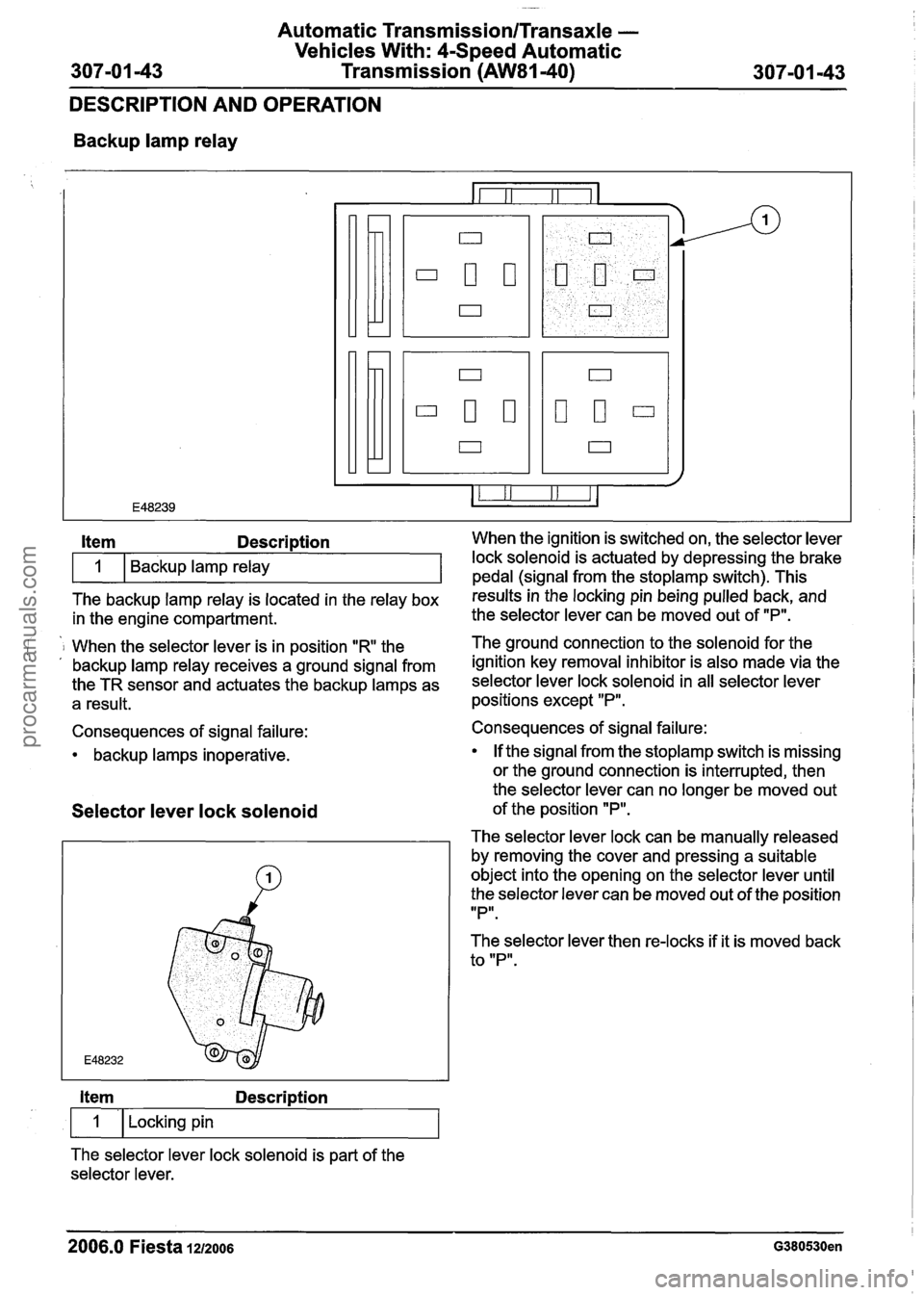
Backup lamp relay
The backup lamp relay is located in the relay box results inthe locking pin being pulled back, and
in the engine compartment. the
selector lever can be moved out of "P".
Item Description When the ignition is switched on, the selector lever
i 1 When the selector lever is in position "R the The ground connection to the solenoid for
the . , backup lamp relay receives a ground signal from ignition key removal inhibitor is also made via the
the TR sensor and actuates the backup lamps as selector lever lock solenoid in all selector lever
a result. positions except "P".
1
Consequences of signal failure:
backup lamps inoperative. Backup lamp relay
Selector
lever lock solenoid
lock solenoid is actuated by depressing the brake
pedal (sianal from the stoplamp switch). This
Item Description
1 I Locking pin
The selector lever lock solenoid is part of the
selector lever. Consequences of signal failure:
If the signal from the
stoplamp switch is missing
or the ground connection is interrupted, then
the selector lever can no longer be moved out
of the position
"P".
The selector lever lock can be manually released
by removing the cover and pressing a suitable
object into the opening on the selector lever until
the selector lever can be moved out of the position
IIPlr.
The selector lever then re-locks if it is moved back
to "P".
2006.0 Fiesta 1212006 G380530en
procarmanuals.com
Page 1025 of 1226
Automatic Transmission/Transaxle -
Vehicles With: 4-Speed Automatic
Transmission (AW81-40)
REMOVAL AND INSTALLATION
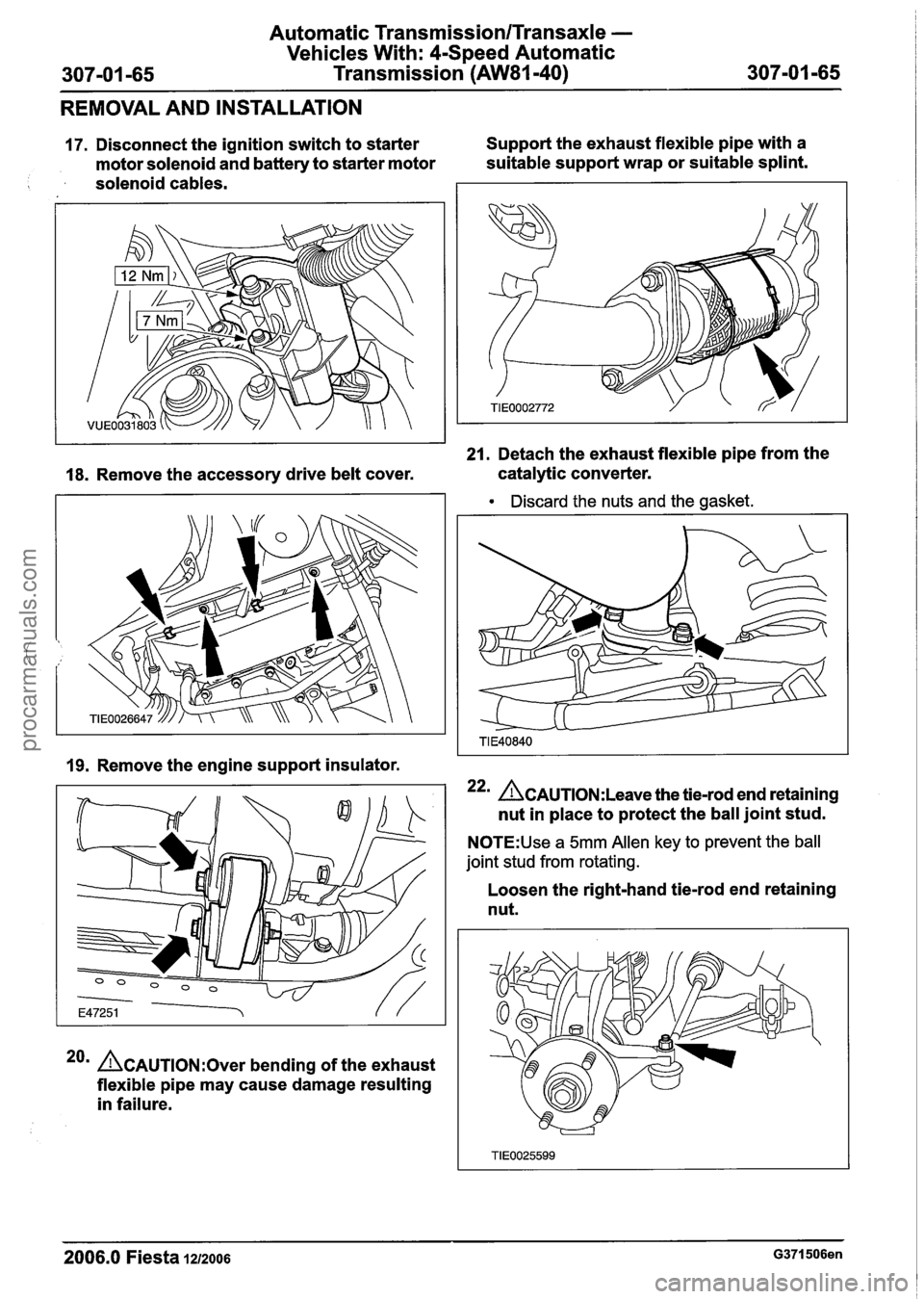
17. Disconnect the ignition switch to starter Support
the exhaust flexible pipe with a
motor solenoid and battery to starter motor suitable
support wrap or suitable splint.
solenoid cables.
21. Detach the exhaust flexible pipe from the
18. Remove the accessory drive belt cover. catalytic
converter.
Discard the nuts and the gasket.
19. Remove the engine support insulator.
22m &AUTION:L~~~~ the tie-rod end retaining
nut in place to protect the ball joint stud.
N0TE:Use a 5mm Allen key to prevent the ball
joint stud from rotating.
20m ACAUTION:~~~~ bending of the exhaust
flexible pipe may cause damage resulting
in failure. Loosen
the right-hand tie-rod end retaining
nut.
2006.0 Fiesta 1212006 G371506en
procarmanuals.com
Page 1033 of 1226
Automatic Transmission/Transaxle -
Vehicles With: 4-Speed Automatic
Transmission (AW81-40)
REMOVAL AND INSTALLATION
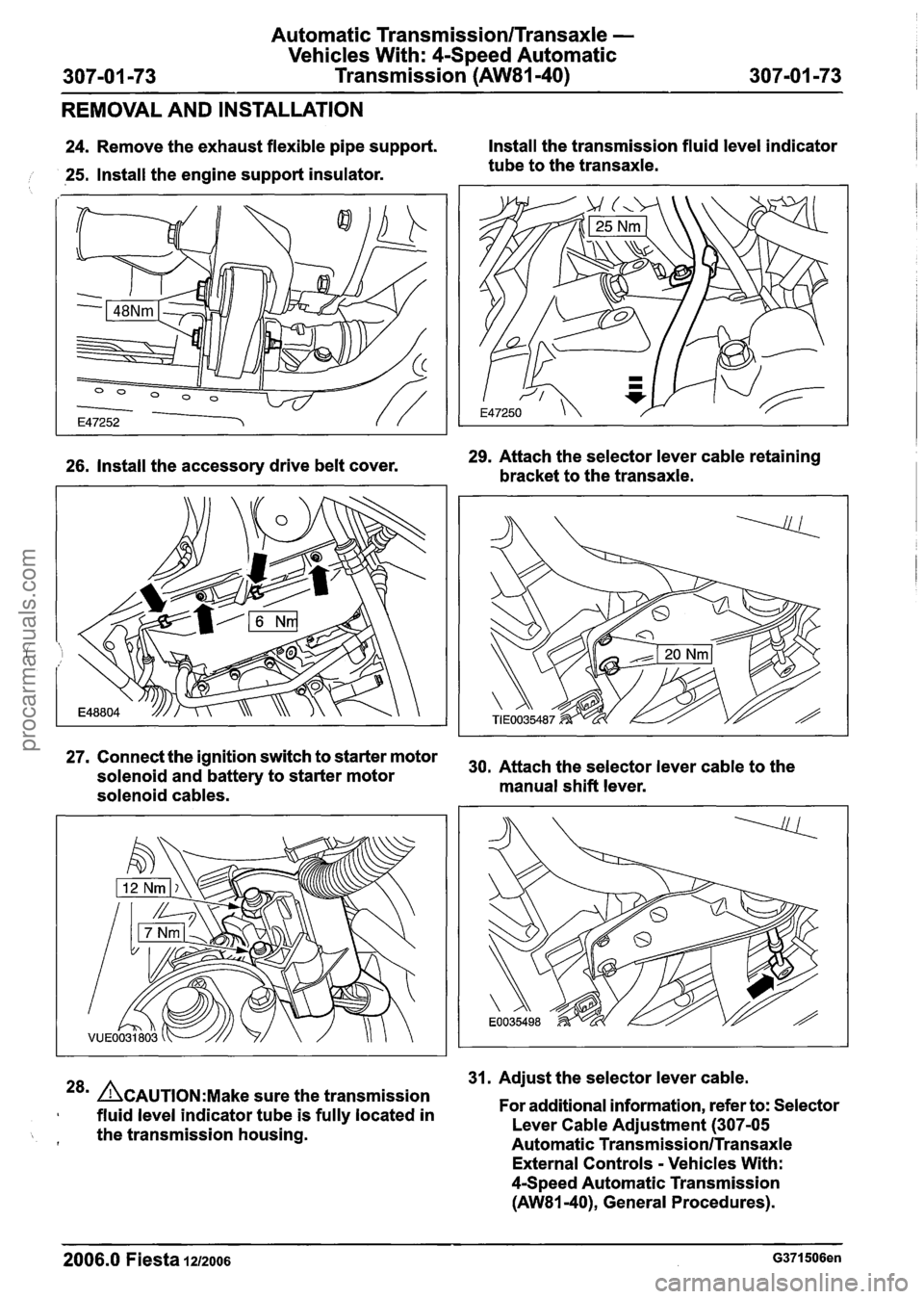
24. Remove the exhaust flexible pipe support. Install
the transmission fluid level indicator
, 25. Install the engine support insulator. tube
to the transaxle.
26. Install the accessory drive belt cover. 29.
Attach the selector lever cable retaining
bracket to the transaxle.
27. Connect the ignition switch to starter motor
30, Attach the selector lever cable to the solenoid and battery to starter motor
solenoid cables. manual
shift lever.
31. Adjust the selector lever cable.
28m ACAUTION:M~~~ sure the transmission
fluid level indicator tube is fully located in For
additional information, refer to: Selector
the transmission housing. Lever Cable
Adjustment (307-05 f Automatic Transmission/Transaxle
External Controls - Vehicles With:
4Speed Automatic Transmission
(AW81-40), General Procedures).
2006.0 Fiesta 1212006 G371506en
procarmanuals.com
Page 1040 of 1226
TransmissionlTransaxle Cooling - Vehicles
With: 4-Speed Automatic Transmission
307-0214 (AW81-40) 307-02-4
REMOVAL AND INSTALLATION
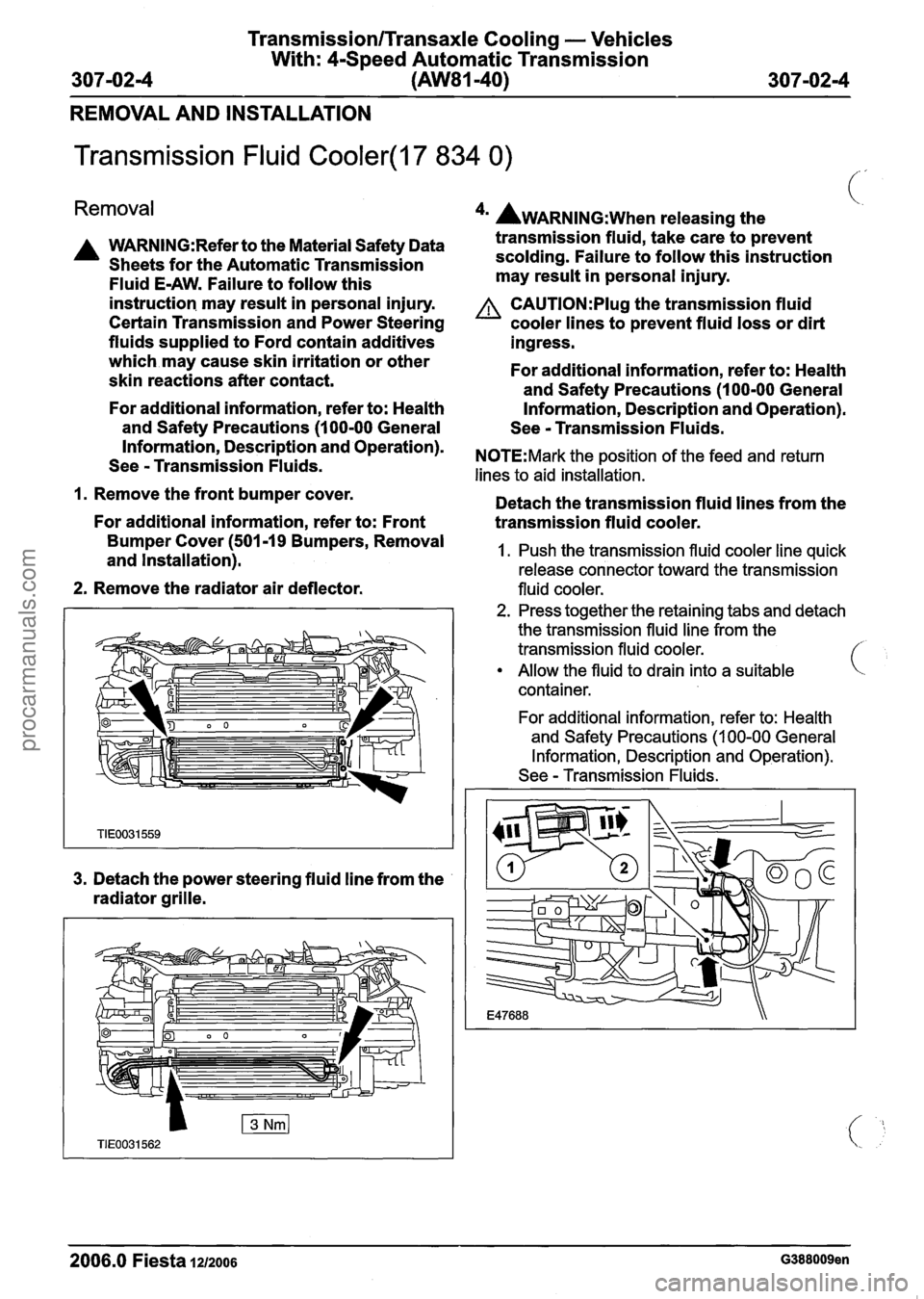
Transmission Fluid Cooler(l7 834 0)
Removal
A WARN1NG:Refer to the Material Safety Data
Sheets for the Automatic Transmission
Fluid E-AW. Failure to follow this
instruction. may result in personal injury.
Certain Transmission and Power Steering
fluids supplied to Ford contain additives
which may cause skin irritation or other
skin reactions after contact.
For additional information, refer to: Health
and Safety Precautions (1 00-00 General
4m AWARNING:~~~~ releasing the
transmission fluid, take care to prevent
scolding. Failure to follow this instruction
may result in personal injury.
A CAUTI0N:PIug the transmission fluid
cooler lines to prevent fluid loss or dirt
ingress.
For additional information, refer to: Health
and Safety Precautions (1 00-00 General
Information, Description and Operation).
See
- Transmission Fluids.
Information, and Operation)' NOTE:Mark the position of the feed and return See - Transmission Fluids. lines to aid installation.
1. Remove the front bumper cover.
Detach the transmission fluid lines from the
For additional information, refer to: Front
transmission fluid cooler.
Bumper Cover (501-19 Removal 1. Push the transmission fluid cooler line quick and Installation). release connector toward the transmission
2. Remove the radiator air deflector. fluid cooler.
3. Detach the power steering fluid line from the
radiator grille.
2. Press together the retaining tabs and detach
the transmission fluid line from the
transmission fluid cooler.
Allow the fluid to drain into a suitable
container.
For additional information, refer to: Health
and Safety Precautions
(1 00-00 General
Information, Description and Operation).
See
- Transmission Fluids.
2006.0 Fiesta 1~12006 G388009en
procarmanuals.com
Page 1069 of 1226
Manual Transmission/Transaxle and Clutch -
308-00-1 1 General Information 308-00-1 I
GENERAL PROCEDURES
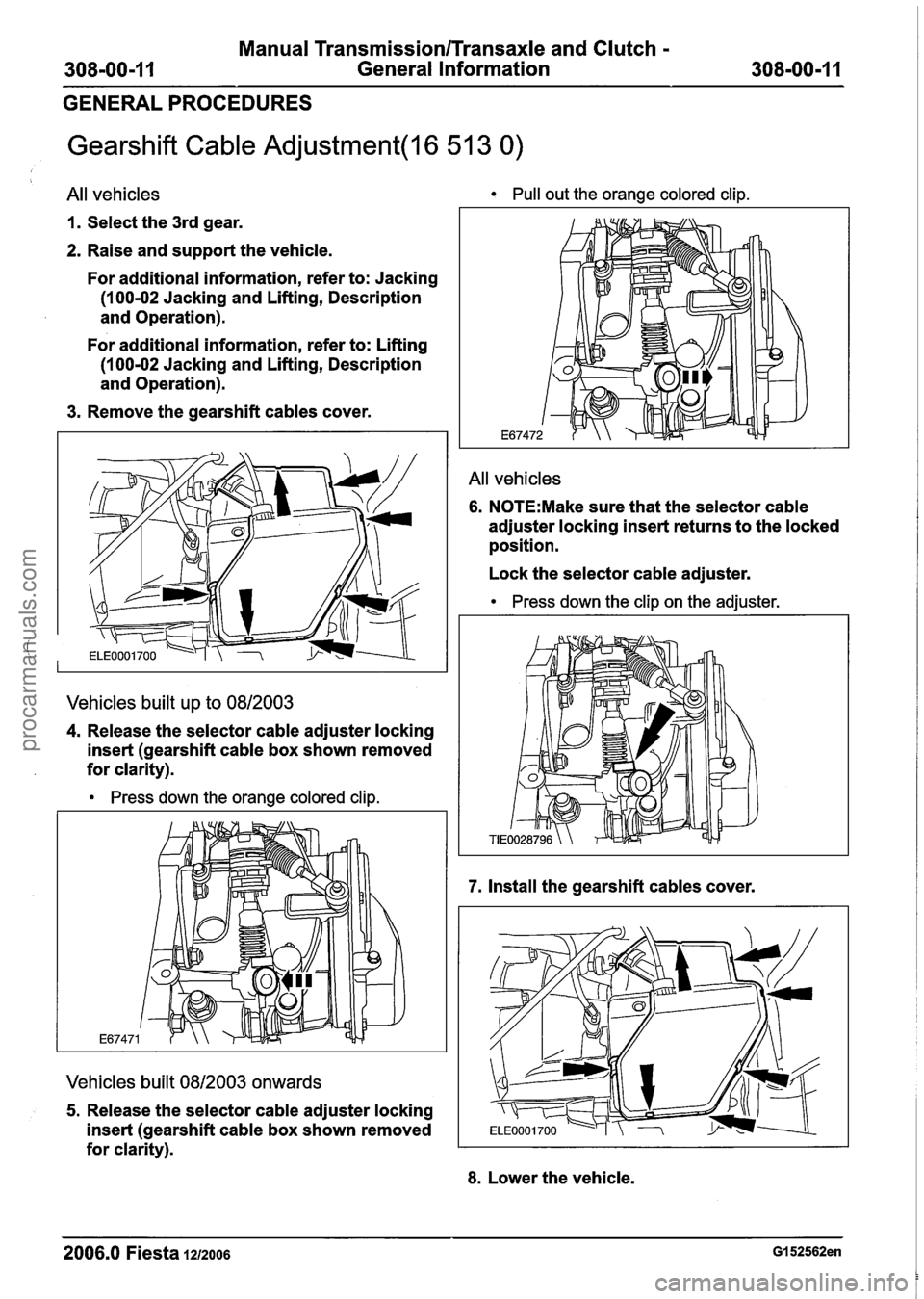
Gearshift Cable Adjustment(l6 51 3 0)
All vehicles
1. Select the 3rd gear.
2. Raise and support the vehicle.
For additional information, refer to: Jacking
(1
00-02 Jacking and Lifting, Description
and Operation).
For additional information, refer to: Lifting
(1
00-02 Jacking and Lifting, Description
and Operation).
3. Remove the gearshift cables cover.
Vehicles built up to 0812003
4. Release the selector cable adjuster locking
insert (gearshift cable box shown removed
for clarity).
Press down the orange colored clip.
Vehicles built 0812003 onwards
5. Release the selector cable adjuster locking
insert (gearshift cable box shown removed
for clarity).
Pull out the orange colored clip.
All vehicles
6. N0TE:Make sure that the selector cable
adjuster locking insert returns to the locked
position.
Lock the selector cable adjuster.
Press down the clip on the adjuster.
7. Install the gearshift cables cover.
8. Lower the vehicle.
2006.0 Fiesta 1212006 GI 52562en
procarmanuals.com