2007 DODGE SPRINTER window
[x] Cancel search: windowPage 135 of 393

134 Controls in detailTempmatic
3
\1To switch off: press theÄ switch
again.
The indicator lamp in the switch goes
out.
The engine stores residual heat after long
periods of driving. You can use the residual
heat of the engine to heat the stationary
vehicle for a further 30 minutes.\1To switch on: turn key to position 0 in
the ignition lock (\2page 67) or re-
move it.
\1Set as required:
\4temperature (\2page 132)
\4air distribution (\2page 133)
\4the air vents (\2page 129)
\1Press the° switch (\2page 131).
The indicator lamp in the switch comes
on.
\1To switch off: press ° switch
again (\2page 131).
The indicator lamp in the switch goes
out.The reheat function quickly ensures de-
frosted windows and dehumidification in
the vehicle interior.
\1To switch on: press theÅ switch
(\2page 131).
The indicator lamp in the switch comes
on.
\1To switch on: press theÅ switch
(\2page 131).
\1The indicator lamp in the switch goes
out.
Fogged-up windows
\1If necessary, switch off air-recirculation
mode by pressing theÄ switch
(\2page 131).
The indicator lamp in the switch goes
out. Fresh air is supplied to the interior.
\1Switch on the reheat function using
theÅ switch (\2page 131).
iAir-recirculation mode is automatically
switched off after about 10 to 30 min-
utes, depending on the outside temper-
ature.Residual heat mode iThe heating period depends on:
\4the coolant temperature
\4the interior temperature selected
\4the on-board voltage
The blower runs at speed1 regardless
of the position of the airflow control.
iResidual heat switches off automati-
cally:
\4after about 30 minutes
\4when you switch on the ignition
\4if the battery’s voltage drops
Reheat function (dehumidification)Special settingsiOnly use special settings briefly.
\2\2
Page 136 of 393
135 Controls in detail
Tempmatic
3
The indicator lamp in the switch comes
on.
\1Turn airflow control2 (\2page 131)
to a higher blower speed, but do not
turn the control below second speed.
\1Turn temperature selector control1
(\2page 131) to a higher temperature.
\1Turn air distribution control5
to‚P.
\1Close the center air vents and the air
outlets for the head area and the rear
compartment.
\1Open the side air vents and direct them
at the side windows.
\1If the windshield is fogged up on the
outside, switch on the windshield wip-
ers (\2page 126).Defrosting
The following settings can be used to clear
the windshield and the side windows, e.g.
if covered with frost.
\1Set temperature selector control 1 to
P.
\1Turn airflow control2 to fourth speed.
\1Turn air distribution control5
to‚P.
\1Close the center air vents and the air
vents for the head area and the rear
compartment.
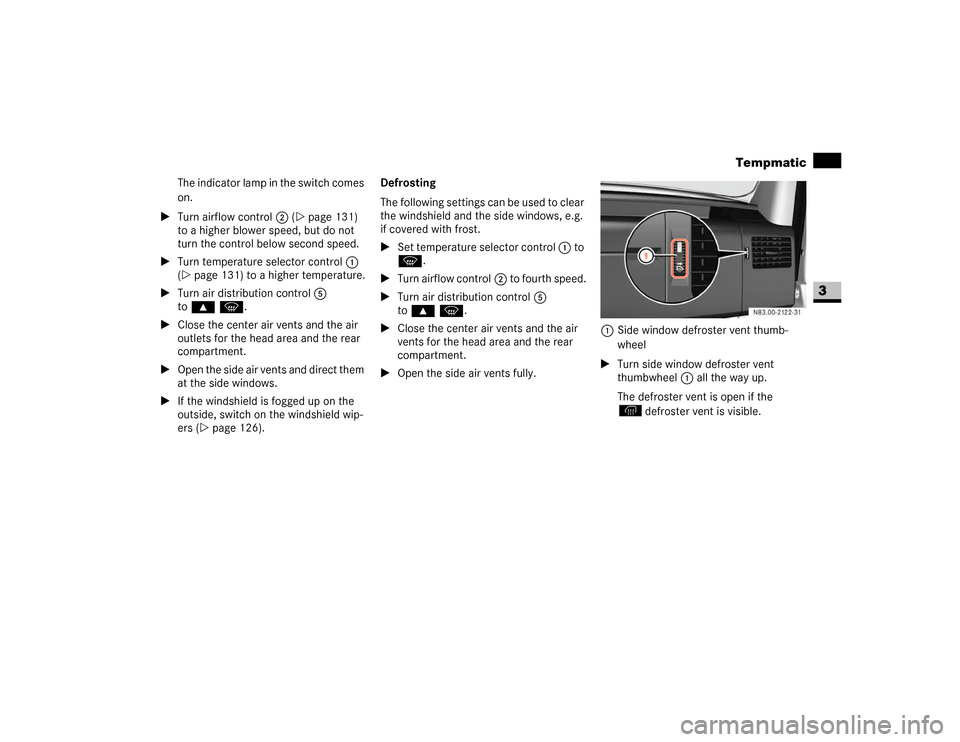
\1Open the side air vents fully.1Side window defroster vent thumb-
wheel
\1Turn side window defroster vent
thumbwheel1 all the way up.
The defroster vent is open if the
defroster vent is visible.
Page 140 of 393

139 Controls in detail
Auxiliary heating/ventilation*
3
\3 Auxiliary heating/ventilation*The auxiliary heating heats or ventilates
the interior to a temperature that you have
set. The auxiliary heating can be operated
with the engine switched on or off.
The auxiliary heating is equipped with a
water heater.
The auxiliary heating heats the coolant and
the vehicle interior and is therefore more
favorable to the engine and consumes less
fuel. The fuel tank must be at least a quar-
ter full to ensure that the auxiliary heating/
ventilation operates correctly.
The maximum heating period is
60 minutes.You can use the auxiliary heating / ventila-
tion to:
\4ventilate or preheat the vehicle interior
and to de-ice the windows
\4start the engine better in cold weather
\4support the vehicle’s heating system
while the engine is running and outside
temperatures are low (heater booster
function) (\2page 137)
You can use the operating system to define
up to three switch-on times, one of which
can be selected to switch on the auxiliary
heating / ventilation (\2page 142). Warning
G
Exhaust fumes are produced while the auxilia-
ry heating is in operation. For this reason,
switch off the auxiliary heating in enclosed
spaces without an extraction system, e.g. a
garage.
Operation of the auxiliary heating system is
prohibited at gas stations or when refueling
your vehicle. The auxiliary heating must there-
fore be switched off at refueling stations.
Warning
G
Observe the relevant safety regulations in the
case of vehicles used for the transport of haz-
ardous goods.
Aerosols, gas cartridges and other pressur-
ized containers transported in the vehicle may
be highly flammable and could explode when
heated.
Make sure that the containers described are
kept away from the flow of hot air from the
auxiliary heating.
Otherwise, you could endanger yourself and
others.
iThe auxiliary heating automatically
switches to heater booster mode after
the engine is started.
Page 145 of 393

144 Controls in detailOpen air
3
\3 Open airYou can open and close the side windows
electrically.
The switches for all side windows are locat-
ed on the door control panel.
Power window switches (driver’s side)1Power window, left
2Power window, right
\1Switch on the ignition (\2page 67).
\1To open: press and hold switch1
or2 until the window has reached the
desired position.\1To close: pull and hold switch1 or2
until the window has reached the de-
sired position.
Resetting the side windows
The side windows must be reset if the bat-
tery has been disconnected:
\1Pull the two power window switches
until the side windows are closed.
\1Hold the switches in this position for
about 1 second.
The side windows are reset.
Side windowsWarning
G
Make sure that nobody can become trapped
as you close a side window.
Remove the key from the ignition lock even
if you are only leaving the vehicle for a short
time.
Never leave children unsupervised in the ve-
hicle.
iThe window opens automatically when
you press the switch beyond the pres-
sure point and then release it.
To stop the window, pull or press the
switch again.
Page 180 of 393

179 Operation
Driving tips
4
Always secure items in the trailer to pre-
vent load shifts while driving.
Take into consideration that when towing a
trailer, the handling characteristics are dif-
ferent and less stable from those when op-
erating the vehicle without a trailer. It is
important to avoid sudden maneuvers.
The vehicle and trailer combination is
heavier, and therefore is limited in acceler-
ation and climbing ability, and requires
longer stopping distances. It is more prone
to reacting to side wind gusts, and requires
more sensitive steering input.
In order to gain skill and an understanding
of the vehicle’s behavior, you should prac-
tice turning , st opping and backing up in a n
area which is free from traffic.
If possible, do not brake abruptly, but rath-
er engage the brake slightly at first to per-
mit the trailer to activate its brake. Then
increase the braking force.
Warning
G
Take into consideration that when towing a
trailer, the handling characteristics are dif-
ferent and less stable from those when op-
erating the vehicle without a trailer.
It is important to avoid sudden maneuvers.
Sudden maneuvers may lead to loss of con-
trol over the vehicle-trailer combination.
This could cause an accident resulting in
property damage or injury to you or others.!
CAUTION
If the transmission hunts between
gears on inclines, manually shift to a
lower gear (select
"4", "3", "2" or
"1").
A lower gear and reduction of speed re-
duces the chance of the engine over-
loading and / or overheating.
When going down a long hill, shift into
a lower gear and use the engine’s brak-
ing effect. Avoid riding the brakes, thus
overheating the vehicle and trailer
brakes.
If the engine coolant rises to an ex-
tremely high temperature (coolant tem-
perature needle approaching the red
zone) when the air conditioner is on,
turn off the air conditioner. Engine
coolant heat can be additionally vented
by opening the windows, switching the
climate control fan speed to high and
setting the temperature control to the
maximum hot position.
Extreme care must be exercised since
your vehicle with a trailer will require
additional passing distance ahead than
when driving without a trailer. Because
your vehicle and trailer is longer than
your vehicle alone, you will also need to
go much farther ahead of the passed
vehicle before you can return to your
lane.
Page 183 of 393

182 OperationDriving tips
4
Certain systems of the engine serve to
keep the toxic components of the exhaust
gases within permissible limits required by
law.
These systems, of course, will function
properly only when maintained strictly ac-
cording to factory specifications. Any ad-
justments to the engine should therefore
be carried out only by an authorized Sprint-
er Dealer.
Engine adjustments should not be altered
in any way. Moreover, the specified service
jobs must be carried out regularly accord-
ing to the manufacturer’s servicing re-
quirements. For details refer to the Service
Booklet.Emission control
Warning
G
Inhalation of exhaust gas is hazardous to
your health. All exhaust gas contains carbon
monoxide (CO), and inhaling it can cause un-
consciousness and lead to death.
Do not run the engine in confined areas
(such as a garage) which are not properly
ventilated. If you think that exhaust gas
fumes are entering the vehicle while driving,
have the cause determined and corrected
immediately. If you must drive under these
conditions, drive with at least one window
fully open at all times.
Page 229 of 393

228 OperationTires and wheels
4
1Plies in side wall
2Plies under tread
This marking tells you about the type of
cord and number of plies in the side wall
and under the tread.Accessory weight
The combined weight (in excess of those
standard items which may be replaced) of
automatic transmission, power steering,
power brakes, power windows, power
seats, radio, and heater, to the extent that
these items are available as factory-in-
stalled equipment (whether installed or
not).
Air pressure
The amount of air inside the tire pressing
outward on each square inch of the tire.
Air pressure is expressed in pounds per
square inch (psi), or kilopascal (kPa) or
bars.
Aspect ratio
Dimensional relationship between the tire
section height and the section width ex-
pressed in percentage.Bar
Another metric unit for air pressure. There
are 14.5038 pounds per square inch (psi)
to 1 bar; there are 100 kilopascals (kPa)
to 1 bar.
Bead
The tire bead contains steel wires wrapped
by steel cords that hold the tire onto the
rim.
Cold tire inflation pressure
Tire inflation pressure when your vehicle
has been sitting for at least 3 hours or driv-
en no more than 1 mile (1.6 km).
Curb weight
The weight of a motor vehicle with stan-
dard equipment including the maximum
capacity of fuel, oil, and coolant, and, if so
equipped, air conditioning and additional
optional equipment, but without passen-
gers and cargo.Tire ply materialiFor illustrative purposes only. The actu-
al data on tires is specific to each vehi-
cle and may vary from the data shown
in the above illustration.
Tire and loading terminology
Page 245 of 393

244 OperationCleaning and care of the vehicle
4
Windows
Headlamps
\1Wipe the headlamp lenses with a damp
sponge.Parktronic sensors*
The sensors are located in the front and
rear bumpers.
\1Clean the sensors in the bumpers using
water, shampoo and a soft cloth.
!
Do not use dry, coarse or hard cloths
and do not scrub. You will otherwise
scratch or damage the sensors.
If you clean the sensors with a high-pressu-
re cleaner or steam cleaner, observe the
information provided by the manufacturer
regarding the distance to be maintained
between the vehicle and the nozzle of the
high-pressure cleaner.
Rear view camera lens*
The rear view camera is located in the cen-
ter of the roof above the third brake lamp.
Rear view camera
!
CAUTION
Do not use a dry cloth, abrasive materi-
al, solvent or solvent-based cleaning
agent to clean the inside of the win-
dows. Clean the inside of the windows
with a damp cloth or a commercially
available glass cleaner. Do not touch
the inside of the rear and side windows
with hard objects, such as an ice scrap-
er or a ring. You could otherwise dam-
age the windows or the rear window
heating.
!
CAUTION
Only use washer fluid which is suitable
for plastic lamp lenses.
Unsuitable washer fluid may damage
the plastic headlamp lenses.
For this reason, do not use a dry cloth,
abrasive material, solvent or solvent-
based cleaning agent. You could other-
wise scratch or damage the lens sur-
face.
1Parktronic sensors
1Camera lens
2Microphone openings