2007 DODGE SPRINTER tow
[x] Cancel search: towPage 152 of 393

151 Controls in detail
Driving systems
3
Front sensors
Rear sensors
Minimum distance
If an obstacle is within this range, all seg-
ments of the warning displays light up and
you will hear an audible warning tone. The
distance may no longer be displayed if you
drive the vehicle closer to the obstacle
than the minimum distance.Warning displays
The warning displays indicate the distance
between the sensor and the obstacle.
The warning display for the front area is
located on the middle of the dashboard
above the center console.
Front area warning display1Left-hand side of vehicle
2Right-hand side of vehicle
3Indicator segments
Center
about 39 in (100 cm)
Corners
about 26 in (65 cm)
Center
about 71 in (180 cm)
Corners
about 39 in (100 cm)
Center
about 12 in (30 cm)
Corners, front
about 10 in (25 cm)
Corners, rear
about 12 in (30 cm)
!
CAUTION
Pay particular attention to obstacles
above or below the sensors when park-
ing, such as flower pots or trailer tow-
bars.
Parktronic does not detect such ob-
jects in the immediate vicinity. You
could damage the vehicle or objects.
Parktronic can malfunction as a conse-
quence of:
\4ultrasonic sources such as a truck’s
compressed-air brakes, an auto-
matic car wash or a pneumatic drill
\4attachments to the vehicle, e.g.
load-bearing implements or trailer
couplings
\4number plates (vehicle license
plates) that are not affixed flat
against the bumper
\4dirty or icy sensors
N54.65-2074-31
Page 154 of 393

153 Controls in detail
Driving systems
3
Switching Parktronic on/off
You can switch Parktronic on and off man-
ually.
The switch is located on the center con-
sole.
1To switch Parktronic on/off
\1To switch off: press upper part 1 of
the switch.
The indicator lamp in the switch comes
on.
\1To switch on: press upper part 1 of
the switch again.
The indicator lamp in the switch goes
out.Trailer towing
If you attach a trailer, Parktronic is deacti-
vated for the rear area as soon as you
make the electrical connection between
your vehicle and the trailer.
On vehicles with a reverse warning feature,
a warning signal sounds when reverse gear
is engaged to alert other road users.
The volume of the warning signal can be
reduced for night-time operation.
Reducing the volume of the warning
signal
\1Select reverse gear twice in quick
succession.
The warning signal sounds more
quietly. N54.25-2922-31
Reverse warning feature*Warning
G
The reverse warning feature signal could be
ignored by other road users. For this reason,
the reverse warning feature cannot guaran-
tee that there are no people or objects be-
hind your vehicle.
The reverse warning feature is a system
which helps you ensure the safety of other
road users. However, it does not relieve you
in any way from the responsibility of person-
ally ensuring that there are no people or ob-
jects behind your vehicle when reversing.
For this reason, always observe the road and
traffic conditions with due caution. Make
sure that there are no people or objects be-
hind your vehicle when reversing, in order to
avoid injuring people or damaging property.
If necessary, ask someone to direct you
when maneuvering.iThe warning signal always sounds at
normal volume and must be turned
down again every time reverse gear
is engaged.
Page 162 of 393
161 Controls in detail
Transporting
3
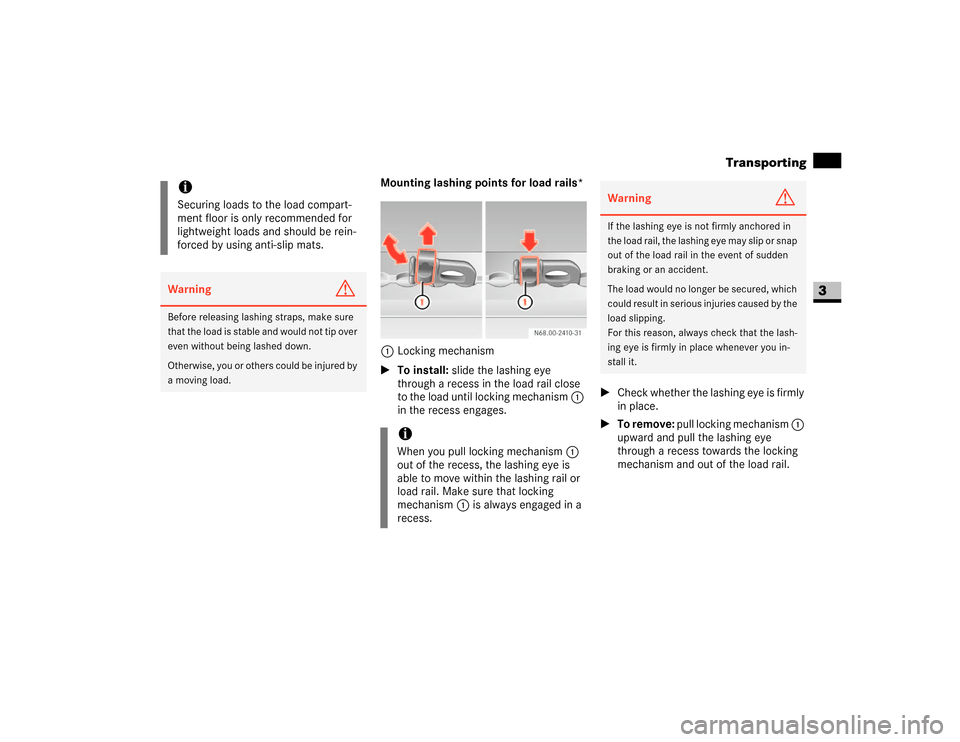
Mounting lashing points for load rails*
1Locking mechanism
\1To install: slide the lashing eye
through a recess in the load rail close
to the load until locking mechanism 1
in the recess engages.\1Check whether the lashing eye is firmly
in place.
\1To remove: pull locking mechanism 1
upward and pull the lashing eye
through a recess towards the locking
mechanism and out of the load rail.
iSecuring loads to the load compart-
ment floor is only recommended for
lightweight loads and should be rein-
forced by using anti-slip mats.Warning
G
Before releasing lashing straps, make sure
that the load is stable and would not tip over
even without being lashed down.
Otherwise, you or others could be injured by
a moving load.
iWhen you pull locking mechanism1
out of the recess, the lashing eye is
able to move within the lashing rail or
load rail. Make sure that locking
mechanism1 is always engaged in a
recess.
Warning
G
If the lashing eye is not firmly anchored in
the load rail, the lashing eye may slip or snap
out of the load rail in the event of sudden
braking or an accident.
The load would no longer be secured, which
could result in serious injuries caused by the
load slipping.
For this reason, always check that the lash-
ing eye is firmly in place whenever you in-
stall it.
Page 164 of 393
163 Controls in detail
Transporting
3
Observe the instructions in the “Opera-
tion” section (\2page 175).
!
CAUTION
If you wish to retrofit securing rails,
have them installed at a qualified spe-
cialist workshop which has the neces-
sary specialist knowledge and tools to
carry out the work required. You could
otherwise damage the vehicle.
The manufacturer recommends that
you use an authorized Sprinter Dealer
for this purpose.
Trailer towing
Page 176 of 393

175 Operation
Driving tips
4
\3 Driving tipsInformation is available about driving in
winter and with snow chains
(\2page 236).
Transporting your vehicle by rail may be
subject to certain restrictions or require
special measures to be taken in some
countries due to varying tunnel heights
and loading standards.
You can obtain information at any
authorized Sprinter Dealer.Trailer hitches*
Only install a trailer hitch receiver ap-
proved for your vehicle. For information on
availability and installation, please see
your authorized Sprinter Dealer.
The bumpers on your vehicle are not de-
signed for use with clamp-type hitches. Do
not attach rental hitches or other bumper-
type hitches to them.
To reduce the possibility of damage, re-
move the hitch ball adaptor from the re-
ceiver when not in use.Electrical connections*
The Sprinter is available with a variety of
pre-installed conditions (lines and turn sig-
nal indicator and brake module installed
and / or not installed). Make sure that the
correct trailer hitch receiver kit is used. For
further information, please see your autho-
rized Sprinter Dealer.
In order to prevent possible damage to the
vehicle’s electrical system by incorrectly
installing the trailer wiring plug, we recom-
mend having the harness connected at an
authorized Sprinter Dealer.Rail transportTrailer towingWarning
G
Failure to use proper equipment and driving
technique can result in a loss of vehicle con-
trol when towing a trailer.
Improper towing or failure to follow the in-
structions contained in this guide can result
in serious injury.
Follow the guidelines below carefully to as-
sure safe trailer operation.
Ask your authorized Sprinter Dealer if you
require an explanation of information con-
tained in this guide.
Page 177 of 393

176 OperationDriving tips
4
Vehicle and trailer weights and ratings
Gross Vehicle Weight Rating (GVWR) is the
maximum permissible vehicle weight:
\48550 lbs (3880 kg) for vehicle model
type 2500
\49990 lbs (4530 kg), or 11030 lbs
(5003 kg) for vehicle model type 3500
GVWR (G
ross V
ehicle W
eight R
ating)
The total allowable weight of the vehicle.
All occupants, all cargo, and the trailer
tongue load must never exceed the GVWR.
GAWR (G
ross A
xle W
eight R
ating)
The total allowable weight that can be
carried by a single axle (front (FA) or rear
(RA)).
GCWR (G
ross C
ombination W
eight
R
ating)
The total allowable weight of vehicle and
trailer when weighed in combination inclu-
ding a 150 lbs (68 kg) allowance for the
presence of a driver.GTW (G
ross T
railer W
eight)
The maximum permissible trailer weight to
be towed.
TWR (T
railer Tongue W
eight R
ating)
The maximum permissible weight of the
trailer tongue (limit for Sprinter approved
hitch receiver).
For the permissible weights and ratings,
refer to the following table.
Trailer towing
!
CAUTION
Cargo vans with a long wheelbase of
170.3 in (4325 mm) and an overall
vehicle length of 289.1 in (7344 mm)
have a reduced GTW and TWR.
iThe GVWR and the front/rear GAWR of
your vehicle are indicated on the
certification label.!
CAUTION
For vehicle model type 3500, the allow-
able GCWR is less than the combined
maximum weight of the GVWR and the
GTW. Exceeding the GCWR can cause
damage to the drive train, the transmis-
sion, or the trailer hitch*.
Thus, the permissible values for GVWR
and/or the GTW are reduced when
either the trailer or the vehicle is fully
laden. you may therefore only partly
load the vehicle and/or the trailer.
Page 178 of 393

177 Operation
Driving tips
4
1Cargo vans with a long wheelbase of 170.3in (4325 mm) and an overall vehicle length of 289.1 in (7344 mm) only.
*optional equipmentWhen loading the vehicle and/or a trailer,
you should observe that the GCWR of your
vehicle is not exceeded.
You must distribute total weight between
the vehicle and the trailer such that neither
the permissible GTW, nor the GVWR and
front/rear GAWR , nor the TWR are
exceeded.The tongue weight at the hitch ball must be
added to the GVWR to prevent exceeding
your Sprinter tow vehicle’s rear GAWR.
Maximum permissible values are listed in
the table above and on the safety compli-
ance certification labels for the vehicle and
for the trailer to be towed. The lowest value
listed must be selected when determining
how the vehicle and trailer are loaded.To assure that the vehicle and trailer are in
compliance with the maximum permissible
weight limits, and to know the actual
weights, have the loaded vehicle-trailer
combination (tow vehicle including driver,
passengers and cargo, trailer fully loaded)
weighed on a commercial scale.Sprinter type
GVWR
GAWR (FA)
GAWR (RA)
GCWR
GTW
TWR
2500
8550 lbs (3878 kg)
3970 lbs (1801 kg)
5360 lbs (2431 kg)
13550 lbs (6146 kg)
5000 lbs (2268 kg)
500 lbs (227 kg)
3500
9990 lbs (4531 kg)
4080 lbs (1851 kg)
7060 lbs (3202 kg)
15250 lbs (6917 kg)
7500 lbs (3402 kg) or
5000 lbs (2268 kg)
1
750 lbs (340 kg) or
500 lbs (227 kg)
1
4410 lbs (2000 kg)*
3500
11030 lbs (5003 kg)
4080 lbs (1851 kg)
7720 lbs (3502 kg)
15250 lbs (6917 kg)
7500 lbs (3402 kg) or
5000 lbs (2268 kg)
1
750 lbs (340 kg) or
500 lbs (227 kg)
1
4410 lbs (2000 kg)*
Loading the vehicle and/or a trailer
Page 179 of 393

178 OperationDriving tips
4
Attaching a trailer
Please observe the maximum permitted
trailer dimensions (width and length).
Most states and all Canadian provinces re-
quire safety chains between your tow vehi-
cle and the trailer. The chains should be
crisscrossed under the trailer tongue. They
must be attached to the hitch receiver, and
not to the vehicle’s bumper or axle. Be sure
to leave enough slack in the chains to per-
mit turning corners.Towing a trailer
There are many different laws, including
speed limit restrictions, having to do with
trailer towing. Make sure that your vehicle-
trailer combination will be legal, not only
for where you reside, but also for where
you will be driving. A good source for this
information can be the police or local au-
thorities.
Before you start driving with the trailer,
check the trailer hitch, break-away switch,
safety chains, electrical connections, light-
ing and tires. Also adjust the mirrors to
permit an unobstructed view beyond the
rear of the trailer.
If the trailer has electric brakes, start your
vehicle and trailer moving slowly, and then
apply only the trailer brake controller by
hand to be sure that the brakes are work-
ing properly.
When towing a trailer, check occasionally
to be sure that the load is secure, and that
lighting and trailer brakes (if so equipped)
are functioning properly.
iMost states and all Canadian provinces
require a separate brake system at var-
ious trailer weights.
Warning
G
Do not connect a trailer brake system (if
trailer is so equipped) directly to the vehi-
cle’s hydraulic brake system as your vehicle
is equipped with antilock brakes. If you do,
neither the vehicle’s brakes nor the trailer’s
brakes will function properly. This could
cause an accident resulting in property dam-
age, injury or death to you or others.
The provided vehicle electrical wiring har-
ness for trailer towing has a brake signal
wire for hook-up to a brake controller.
Most states and all Canadian provinces re-
quire a break-away switch on trailers with a
separate brake system. The switch activates
the trailer brakes in the possible event that
the trailer might separate from the tow vehi-
cle.
You should consider using a trailer sway
control system. For further information, see
your authorized Sprinter Dealer.