2007 DODGE SPRINTER tow
[x] Cancel search: towPage 180 of 393

179 Operation
Driving tips
4
Always secure items in the trailer to pre-
vent load shifts while driving.
Take into consideration that when towing a
trailer, the handling characteristics are dif-
ferent and less stable from those when op-
erating the vehicle without a trailer. It is
important to avoid sudden maneuvers.
The vehicle and trailer combination is
heavier, and therefore is limited in acceler-
ation and climbing ability, and requires
longer stopping distances. It is more prone
to reacting to side wind gusts, and requires
more sensitive steering input.
In order to gain skill and an understanding
of the vehicle’s behavior, you should prac-
tice turning , st opping and backing up in a n
area which is free from traffic.
If possible, do not brake abruptly, but rath-
er engage the brake slightly at first to per-
mit the trailer to activate its brake. Then
increase the braking force.
Warning
G
Take into consideration that when towing a
trailer, the handling characteristics are dif-
ferent and less stable from those when op-
erating the vehicle without a trailer.
It is important to avoid sudden maneuvers.
Sudden maneuvers may lead to loss of con-
trol over the vehicle-trailer combination.
This could cause an accident resulting in
property damage or injury to you or others.!
CAUTION
If the transmission hunts between
gears on inclines, manually shift to a
lower gear (select
"4", "3", "2" or
"1").
A lower gear and reduction of speed re-
duces the chance of the engine over-
loading and / or overheating.
When going down a long hill, shift into
a lower gear and use the engine’s brak-
ing effect. Avoid riding the brakes, thus
overheating the vehicle and trailer
brakes.
If the engine coolant rises to an ex-
tremely high temperature (coolant tem-
perature needle approaching the red
zone) when the air conditioner is on,
turn off the air conditioner. Engine
coolant heat can be additionally vented
by opening the windows, switching the
climate control fan speed to high and
setting the temperature control to the
maximum hot position.
Extreme care must be exercised since
your vehicle with a trailer will require
additional passing distance ahead than
when driving without a trailer. Because
your vehicle and trailer is longer than
your vehicle alone, you will also need to
go much farther ahead of the passed
vehicle before you can return to your
lane.
Page 208 of 393

207 Operation
Tires and wheels
4
Step 1
\1Locate the statement “The combined
weight of occupants and cargo should
never exceed XXX kg or XXX lbs.” on
your vehicle’s placard.
Step 2
\1Determine the combined weight of the
driver and passengers that will be
riding in your vehicle.
Step 3
\1Subtract the combined weight of the
driver and passengers from
XXX kilograms or XXX lbs.Step 4
\1The resulting figure equals the avail-
able amount of cargo and luggage load
capacity. For example, if the “XXX”
amount equals 1400 lbs and there will
be five 150 lbs passengers in your vehi-
cle, the amount of available cargo and
luggage load capacity is 650 lbs (1400-
750 (5 x150) = 650 lbs).
Step 5
\1Determine the combined weight of lug-
gage and cargo being loaded on the ve-
hicle. That weight may not safely
exceed the available cargo and luggage
load capacity calculated in step 4.Step 6 (if applicable)
\1If your vehicle will be towing a trailer,
load from your trailer will be trans-
ferred to your vehicle. Consult this
manual to determine how this reduces
the available cargo and luggage load
capacity of your vehicle.
The following table shows examples on
how to calculate total load, cargo load and
towing capacities with varying seating con-
figurations and number and size of occu-
pants. The following examples use a load
limit of 1500 lbs. This is for illustrative
purposes only. Make sure you are using
the actual load limit for your vehicle stated
on the vehicle’s tire and loading informa-
tion placard (\2page 206).
The higher the weight of all occupants, the
less cargo and luggage load capacity is
available.
Page 211 of 393
210 OperationTires and wheels
4
To assure that your vehicle does not ex-
ceed the maximum permissible weight lim-
its (GVWR and GAWR for front and rear
axle), have the loaded vehicle (including
driver, passengers and all cargo and, if ap-
plicable, trailer fully loaded) weighed on a
suitable commercial scale.
Trailer tongue load
The tongue load (tongue weight at the
hitch ball) of any trailer is an important
weight to measure because it affects the
load you can carry in your vehicle. If a trail-
er is towed, the tongue load must be added
to the weight of all occupants riding and
any cargo you are carrying in the vehicle to
prevent exceeding your Sprinter tow vehi-
cle’s rear GAWR. The tongue load typically
is between 10% and 15% of the trailer
weight and everything loaded in it.
For example, if the trailer tongue load
equals 1 40 lbs and the determined avail-
able cargo/luggage and trailer tongue
weight equals 750 lbs, the amount of avail-
able cargo and luggage load capacity is
610 lbs. (750 – 140 = 610 lbs.)For further information on vehicle and trail-
er weights and ratings, loading a trailer and
trailer towing, see “Trailer towing”
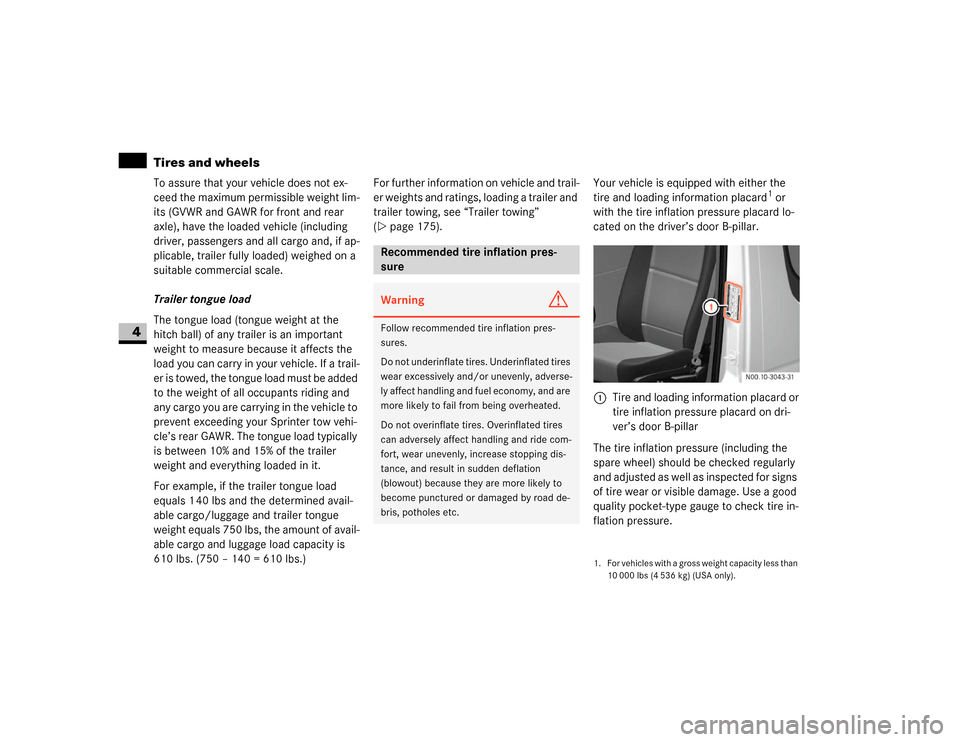
(\2page 175).Your vehicle is equipped with either the
tire and loading information placard
1 or
with the tire inflation pressure placard lo-
cated on the driver’s door B-pillar.
The tire inflation pressure (including the
spare wheel) should be checked regularly
and adjusted as well as inspected for signs
of tire wear or visible damage. Use a good
quality pocket-type gauge to check tire in-
flation pressure.
Recommended tire inflation pres-
sureWarning
G
Follow recommended tire inflation pres-
sures.
Do not underinflate tires. Underinflated tires
wear excessively and/or unevenly, adverse-
ly affect handling and fuel economy, and are
more likely to fail from being overheated.
Do not overinflate tires. Overinflated tires
can adversely affect handling and ride com-
fort, wear unevenly, increase stopping dis-
tance, and result in sudden deflation
(blowout) because they are more likely to
become punctured or damaged by road de-
bris, potholes etc.
1. For vehicles with a gross weight capacity less than
10 000 lbs (4 536 kg) (USA only).1Tire and loading information placard or
tire inflation pressure placard on dri-
ver’s door B-pillar
Page 242 of 393

241 Operation
Cleaning and care of the vehicle
4
\3 Cleaning and care of the vehicleRegular and proper care will help to main-
tain the value of your vehicle. The best way
to protect your vehicle from harmful envi-
ronmental influences is to wash it and use
protective treatments regularly.
Scratches, corrosive deposits, areas af-
fected by corrosion and damage caused by
neglect or inadequate care cannot always
be completely remedied. In such cases,
visit an authorized Sprinter Dealer.Repair damage caused by loose chippings
and remove the following substances im-
mediately:
\4Insect remains
\4Bird droppings
\4Tree resin
\4Oils and grease
\4Fuel
\4Tar stains
Wash the vehicle more frequently in winter
to remove salt residue.
iIt is recommended that you use Mopar
care products. These have been spe-
cially adapted to Sprinter vehicles and
are state of the art. Mopar care prod-
ucts are available from any authorized
Sprinter Dealer.
Warning
G
Always follow the instructions for using the
care products.
Always keep care products sealed and out
of the reach of children.
Do not use fuel as a cleaning agent. Fuel is
flammable and constitutes a health hazard.
Environmental note
H
Only clean the vehicle in a suitable place for
washing vehicles. Dispose of empty contain-
ers and used cleaning materials in an envi-
ronmentally responsible manner.iIf you need to clean the areas towards
the top of the vehicle, always use
\4suitable ladders
\4secure steps!
CAUTION
Under no circumstances should you af-
fix unsuitable stickers, films, magnets
or similar to painted surfaces. You
could otherwise damage the paint-
work.
Page 250 of 393

249
5 Practical hints
What to do if ... ......... 250
Display messages ......... 281
Where will I find...? ......... 299
Changing bulbs ......... 306
Changing the batteries ......... 315
Fuel system ......... 317
Replacing the wiper blades ......... 319
Flat tire ......... 320
Battery ......... 335
Jump-starting ......... 340
Towing ......... 342
Fuses ......... 345
Page 261 of 393

260 Practical hintsWhat to do if ...
5
It is no longer possible to lock or unlock the
vehicle using the remote control.
The remote control batteries are weak or dis-
charged.
\1Point the remote control towards the
driver’s door handle at close range
and try again.
If this does not work:
\1Lock or unlock the vehicle using the
key (\2page 54).
\1Check the batteries of the remote
control (\2page 53). Change the
batteries if necessary (\2page 315).
The remote control is malfunctioning.
\1Lock or unlock the vehicle using the
key (\2page 54).
\1Have the remote control checked at
an authorized Sprinter Dealer.
The battery check lamp on the remote con-
trol does not light up briefly when a button
is pressed.
The remote control batteries are discharged.
\1Change the batteries (\2page 315).
You have lost a remote control.
\1Have the remote control canceled at
an authorized Sprinter Dealer.
\1Report the loss immediately to the
vehicle insurers.
Your authorized Sprinter Dealer will be
happy to obtain a replacement for you.
Problem
Possible cause / result
Suggested solutions
Page 270 of 393

269 Practical hints
What to do if ...
5
#
-
k
6
The yellow ESP
®, ABS, ASR/BAS
indicator lamps and the red
brake system indicator lamp are
lit while the engine is running.
WARNING
G
EBV has been deactivated due to undervolt-
age.
The battery may not be being charged.
The rear wheels could lock up sooner than
expected when you apply the brakes.
\1Also observe the messages in the dis-
play on vehicles with steering wheel
buttons (\2page 284).
\1Stop your vehicle as soon as it is safe
to do so.
\1Do not drive any further.
\1Consult an authorized Sprinter Dealer.
6
The red brake system indicator
lamp is lit while the engine is run-
ning.
A signal also sounds.
WARNING
G
There is insufficient brake fluid in the fluid
reservoir.
\1Also observe the messages in the dis-
play on vehicles with steering wheel
buttons (\2page 284).
\1Do not add brake fluid under any cir-
cumstances. This will not solve the
problem.
\1Do not drive any further.
\1Consult an authorized Sprinter Dealer.
6
When towing a trailer:
The red brake system indicator
lamp is lit while the engine is run-
ning.
A signal also sounds.
WARNING
G
The trailer's brake booster is malfunctioning.
The vehicle's driving and braking characteris-
tics may change. There is a risk of the trailer
overbraking.
\1Also observe the messages in the dis-
play on vehicles with steering wheel
buttons (\2page 284).
\1Stop your vehicle as soon as it is safe
to do so.
\1Do not drive any further.
\1Consult an authorized Sprinter Dealer.
Problem
Possible cause / result
Suggested solutions
Page 275 of 393

274 Practical hintsWhat to do if ...
5
:
The yellow engine oil level warning
lamp flashes after the engine is
started or while the vehicle is in
motion.
The engine oil level has dropped to the min-
imum level. If the engine oil level falls any
further, the indicator lamp will light up con-
tinuously.
\1Check the engine oil level and add en-
gine oil at the nearest refueling sta-
tion (\2page 190).
\1If there is visible oil loss from the
engine, have the fault rectified imme-
diately at an authorized Sprinter Deal-
er.
:
The yellow engine oil level warning
lamp lights up, the
-2.0 l
engine
oil level message appears in the
display and the warning buzzer
sounds after the engine is started
or while the vehicle is in motion.
There is insufficient or no oil in the engine.
There is a risk of engine damage.
\1Stop your vehicle as soon as it is safe
to do so.
\1Switch off the engine.
\1Check the engine oil level using the
dipstick (\2page 190).
\1If the oil level is correct, have the mal-
function rectified immediately at an
authorized Sprinter Dealer.
\1If there is insufficient or no oil in the
engine, have the vehicle towed to an
authorized Sprinter Dealer.
Problem
Possible cause / result
Suggested solutions