Page 298 of 400

Change Engine Oil
Road conditions and your style of driving affect the
interval at which your oil should be changed. Check the
following to determine ifANYapply to you:
•Day or night temperatures are below 32°F (0°C).
•Stop and Go driving.
•Extensive engine idling.
•Driving in dusty conditions.
•Short trips of less than 10 miles (16.2 km).
•More than 50% of your driving is at sustained high
speeds during hot weather, above 90°F (32°C).
•Trailer towing, Taxi, Police or delivery service (com-
mercial service).
•Off-Road or desert operation.
•If equipped for and operating with E-85 (ethanol)
fuel.
NOTE:IfANYof these apply to you then change your
engine oil every 3,000 miles (5 000 km) or 3 months,
whichever comes first and follow schedule “B” of the
�Maintenance Schedules�section of this manual.
IfNONEof these apply to you, then change your engine
oil every 6,000 miles (10 000 km) or 6 months, whichever
comes first and follow schedule�A�of the�Maintenance
Schedules�section of this manual.
NOTE:Under no circumstances should oil change in-
tervals exceed 6,000 miles (10 000 km) or 6 months
whichever comes first.
4x4 Models, If Used Primarily For Off-Road Operation
Every 50 hours of use.
298 MAINTAINING YOUR VEHICLE
Page 299 of 400

Dusty Conditions
Driving through dust-laden air increases the problems of
keeping abrasive materials out of the engine. Under these
conditions, special attention should be given to the
engine air cleaner. The crankcase ventilation system
should also be checked periodically. Make sure that these
units are always clean. This will tend to reduce to a
minimum the amount of abrasive material that may enter
the engine.
Engine Oil Selection
For best performance and maximum protection under all
types of operating conditions, the manufacture only
recommends engine oils that are API certified and meet
the requirements of DaimlerChrysler Material Standard
MS-6395.
American Petroleum Institute (API) Engine Oil
Identification Symbol
This symbol means that the oil has
been certified by the American
Petroleum Institute (API). The
manufacture only recommends
API Certified engine oils.
Engine Oil Viscosity (SAE Grade)
SAE 5W-20 engine oil is recommended for all operating
temperatures. This engine oil improves low tempera-
ture starting and vehicle fuel economy. Your engine oil
filler cap also shows the recommended engine oil
viscosity for your vehicle.
For information on engine oil filler cap location, see the
Engine Compartment illustration in this section.
MAINTAINING YOUR VEHICLE 299
7
Page 302 of 400

Engine Air Cleaner Filter
Under normal driving conditions, replace the air filter at
the intervals shown on Schedule “A”. If, however, you
drive the vehicle frequently under dusty or severe con-
ditions, the filter element should be inspected periodi-
cally and replaced if necessary at the intervals shown on
Schedule “B”.
WARNING!
The air cleaner can provide a measure of protection
in the case of engine backfire. Do not remove the air
cleaner unless such removal is necessary for repair or
maintenance. Make sure that no one is near the
engine compartment before starting the vehicle with
the air cleaner removed. Failure to do so can result in
serious personal injury.
Engine Fuel Filter
A plugged fuel filter can cause stalling, limit the speed at
which a vehicle can be driven or cause hard starting.
Should an excessive amount of dirt accumulate in the
fuel tank, frequent filter replacement may be necessary.
Catalytic Converter
The catalytic converter requires the use of unleaded fuel
only. Leaded gasoline will destroy the effectiveness of the
catalyst as an emission control device.
Under normal operating conditions, the catalytic con-
verter will not require maintenance. However, it is im-
portant to keep the engine properly tuned to assure
proper catalyst operation and prevent possible catalyst
damage.
302 MAINTAINING YOUR VEHICLE
Page 315 of 400

•Do not change the thermostat for summer or winter
operation. If replacement is ever necessary, install
ONLY the correct type thermostat. Other designs may
result in unsatisfactory coolant performance, poor gas
mileage, and increased emissions.
Emission Related Components
Fuel System Hoses And Vapor/Vacuum Harnesses
When the vehicle is serviced for scheduled maintenance,
inspect surface of hoses and nylon tubing for evidence of
heat and mechanical damage. Hard and brittle rubber,
cracking, checking, tears, cuts, abrasions, and excessive
swelling suggest deterioration of the rubber. Particular
attention should be given to examining hose surfaces
nearest to high heat sources, such as the exhaust mani-
fold.
Insure nylon tubing in these areas has not melted or
collapsed.Inspect all hose clamps and couplings to make sure they
are secure and no leaks are present.
You are urged to use only the manufacturer’s specified
hoses and clamps, or their equivalent in material and
specification, in any fuel system servicing. It is manda-
tory to replace all clamps that have been loosened or
removed during service. Care should be taken in install-
ing new clamps to insure they are properly torqued.
Positive Crankcase Ventilation (PCV) Valve
Proper operation of the crankcase ventilation system
requires that the PCV valve be free of sticking or plug-
ging because of deposits. Deposits can accumulate in the
PCV valve and passage with increasing mileage. Have
the PCV valve, hoses, and passages checked for proper
operation at the intervals specified. If the valve is
plugged or sticking, replace with a new valve –Do not
MAINTAINING YOUR VEHICLE 315
7
Page 328 of 400
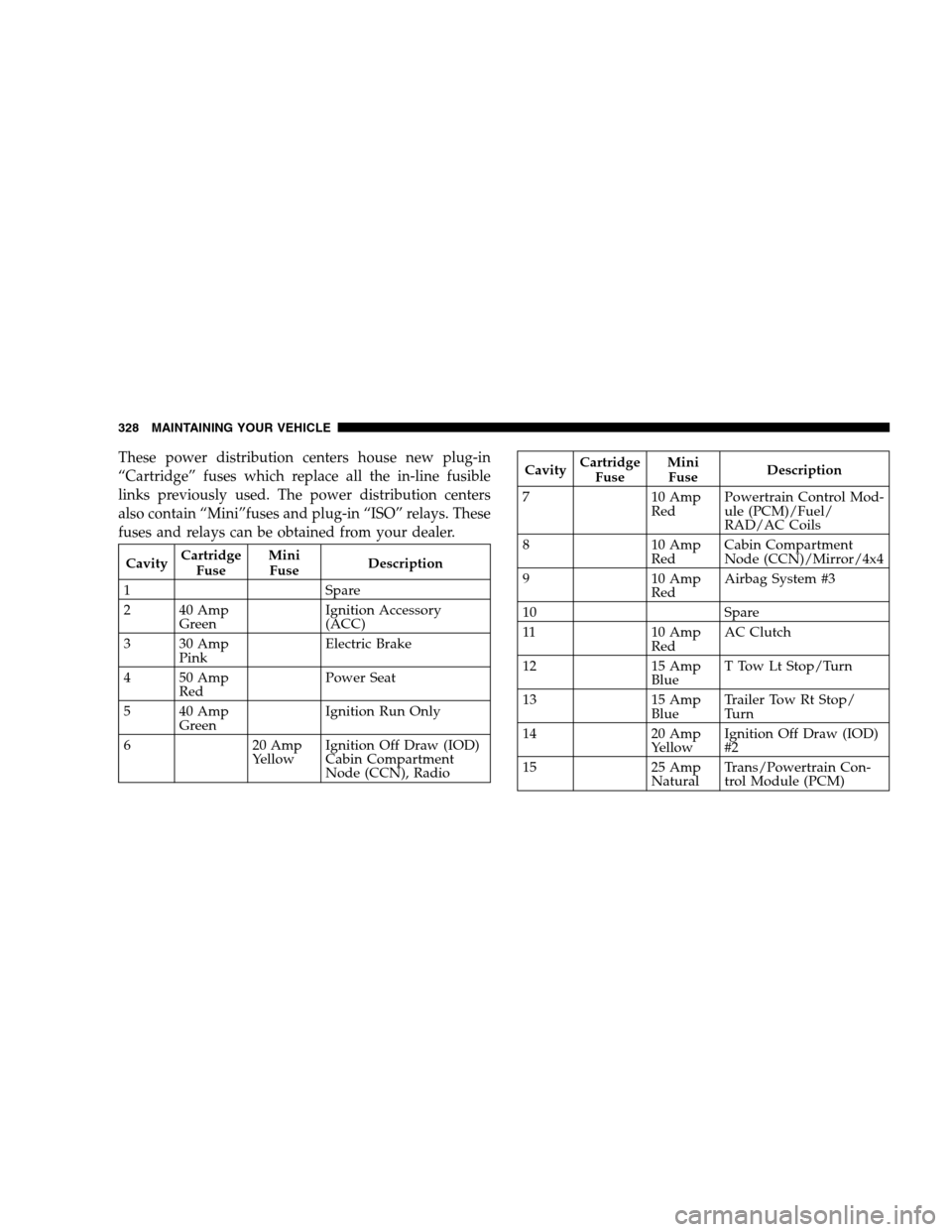
These power distribution centers house new plug-in
“Cartridge” fuses which replace all the in-line fusible
links previously used. The power distribution centers
also contain “Mini”fuses and plug-in “ISO” relays. These
fuses and relays can be obtained from your dealer.
CavityCartridge
FuseMini
FuseDescription
1 Spare
2 40 Amp
GreenIgnition Accessory
(ACC)
3 30 Amp
PinkElectric Brake
4 50 Amp
RedPower Seat
5 40 Amp
GreenIgnition Run Only
6 20 Amp
YellowIgnition Off Draw (IOD)
Cabin Compartment
Node (CCN), Radio
CavityCartridge
FuseMini
FuseDescription
7 10 Amp
RedPowertrain Control Mod-
ule (PCM)/Fuel/
RAD/AC Coils
8 10 Amp
RedCabin Compartment
Node (CCN)/Mirror/4x4
9 10 Amp
RedAirbag System #3
10 Spare
11 10 Amp
RedAC Clutch
12 15 Amp
BlueT Tow Lt Stop/Turn
13 15 Amp
BlueTrailer Tow Rt Stop/
Turn
14 20 Amp
YellowIgnition Off Draw (IOD)
#2
15 25 Amp
NaturalTrans/Powertrain Con-
trol Module (PCM)
328 MAINTAINING YOUR VEHICLE
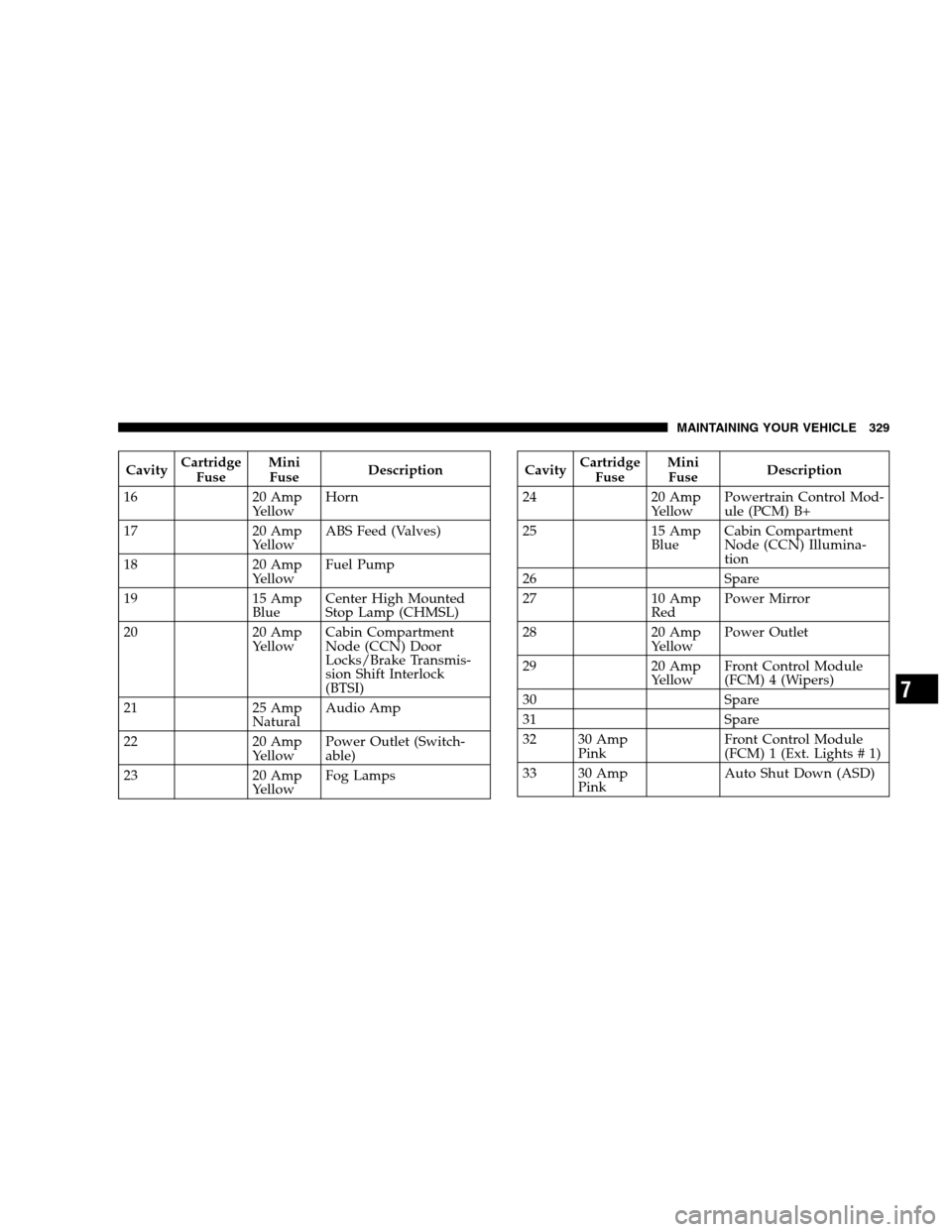
Page 329 of 400
CavityCartridge
FuseMini
FuseDescription
16 20 Amp
YellowHorn
17 20 Amp
YellowABS Feed (Valves)
18 20 Amp
YellowFuel Pump
19 15 Amp
BlueCenter High Mounted
Stop Lamp (CHMSL)
20 20 Amp
YellowCabin Compartment
Node (CCN) Door
Locks/Brake Transmis-
sion Shift Interlock
(BTSI)
21 25 Amp
NaturalAudio Amp
22 20 Amp
YellowPower Outlet (Switch-
able)
23 20 Amp
YellowFog LampsCavityCartridge
FuseMini
FuseDescription
24 20 Amp
YellowPowertrain Control Mod-
ule (PCM) B+
25 15 Amp
BlueCabin Compartment
Node (CCN) Illumina-
tion
26 Spare
27 10 Amp
RedPower Mirror
28 20 Amp
YellowPower Outlet
29 20 Amp
YellowFront Control Module
(FCM) 4 (Wipers)
30 Spare
31 Spare
32 30 Amp
PinkFront Control Module
(FCM) 1 (Ext. Lights # 1)
33 30 Amp
PinkAuto Shut Down (ASD)
MAINTAINING YOUR VEHICLE 329
7
Page 345 of 400
Fog Lamps
1. Disconnect connector from fog lamp by raising wire
harness lock tab and pulling on wire harness connector.2. Rotate fog lamp bulb 1/4 turn counterclockwise and
pull to remove from fog lamp housing.
3. Reverse Procedure to install.
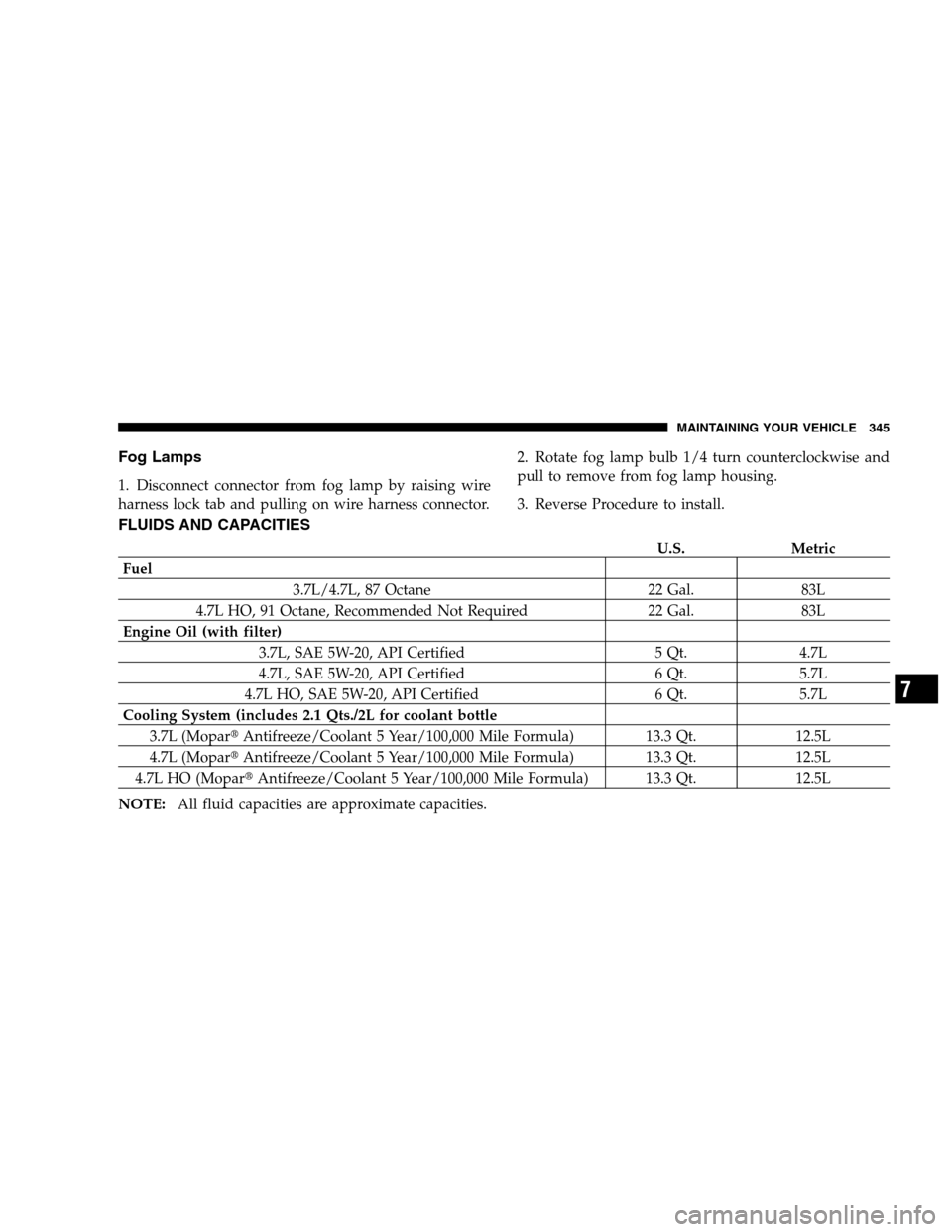
FLUIDS AND CAPACITIES
U.S. Metric
Fuel
3.7L/4.7L, 87 Octane 22 Gal. 83L
4.7L HO, 91 Octane, Recommended Not Required 22 Gal. 83L
Engine Oil (with filter)
3.7L, SAE 5W-20, API Certified 5 Qt. 4.7L
4.7L, SAE 5W-20, API Certified 6 Qt. 5.7L
4.7L HO, SAE 5W-20, API Certified 6 Qt. 5.7L
Cooling System (includes 2.1 Qts./2L for coolant bottle
3.7L (Mopar�Antifreeze/Coolant 5 Year/100,000 Mile Formula) 13.3 Qt. 12.5L
4.7L (Mopar�Antifreeze/Coolant 5 Year/100,000 Mile Formula) 13.3 Qt. 12.5L
4.7L HO (Mopar�Antifreeze/Coolant 5 Year/100,000 Mile Formula) 13.3 Qt. 12.5L
NOTE:All fluid capacities are approximate capacities.
MAINTAINING YOUR VEHICLE 345
7
Page 346 of 400
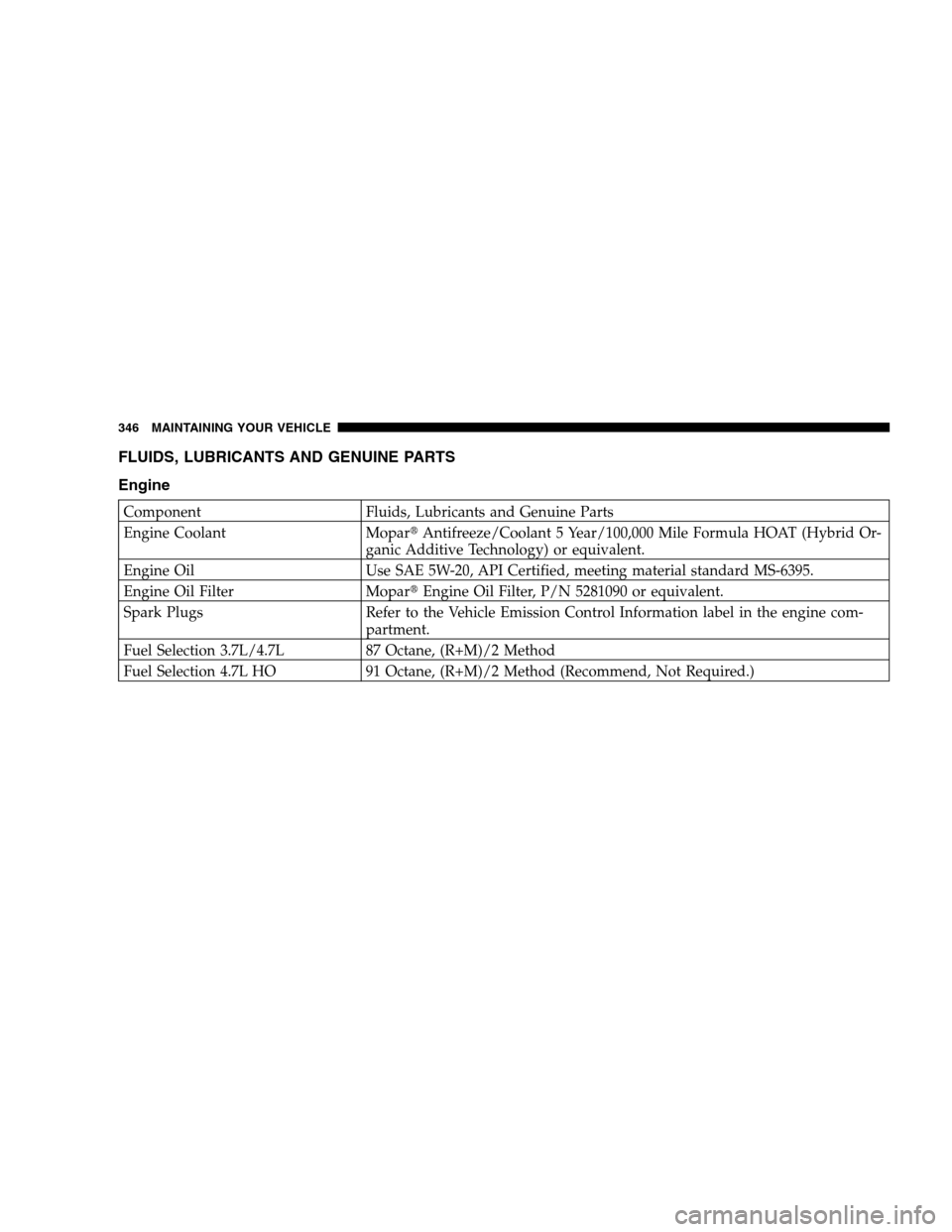
FLUIDS, LUBRICANTS AND GENUINE PARTS
Engine
Component Fluids, Lubricants and Genuine Parts
Engine Coolant Mopar�Antifreeze/Coolant 5 Year/100,000 Mile Formula HOAT (Hybrid Or-
ganic Additive Technology) or equivalent.
Engine Oil Use SAE 5W-20, API Certified, meeting material standard MS-6395.
Engine Oil Filter Mopar�Engine Oil Filter, P/N 5281090 or equivalent.
Spark Plugs Refer to the Vehicle Emission Control Information label in the engine com-
partment.
Fuel Selection 3.7L/4.7L 87 Octane, (R+M)/2 Method
Fuel Selection 4.7L HO 91 Octane, (R+M)/2 Method (Recommend, Not Required.)
346 MAINTAINING YOUR VEHICLE