Page 142 of 400

21. Malfunction Indicator Light
This light is part of an onboard diagnostic system
which monitors the emissions and engine control
system. If the vehicle is ready for emissions
testing the light will come on when the ignition is first
turned on and remain on, as a bulb check, until the
engine is started. If the vehicle is not ready for emissions
testing the light will come on when the ignition is first
turned on and remain on for 15 seconds, then blink for 5
seconds, and remain on until the vehicle is started. If the
bulb does not come on during starting, have the condi-
tion investigated promptly.
If this light comes on and remains on while driving, it
suggests a potential engine control problem and the need
for system service.
Although your vehicle will usually be drivable and not
need towing, see your dealer for service as soon as
possible.CAUTION!
Prolonged driving with the MIL on could cause
damage to the engine control system. It also could
affect fuel economy and driveability.
If the MIL is flashing, severe catalytic converter
damage and power loss will soon occur. Immediate
service is required.
22. Airbag Indicator
The indicator lights and remains lit for 6 to 8
seconds when the ignition is first turned ON. If
the light does not come on when the ignition is
first turned on, or the light stays on or comes
on while driving, have the airbag system checked by an
authorized dealer.
23. 4WD Indicator
Indicates when transfer case is in 4WD position.
142 INSTRUMENT PANEL AND CONTROLS
Page 176 of 400

at the top of the snowflake button shows that the air
conditioning is on. Press the button a second time to turn
the air conditioning off.
Slight changes in engine speed or power may be noticed
when the air conditioning compressor is on. This is a
normal occurrence as the compressor will cycle on and
off to maintain comfort and increase fuel economy.
The mode control (at the right of the
control panel) can be set in any of the
following positions:
NOTE:To improve your selection choices, the system
allows you to operate at intermediate positions between
the major modes. These intermediate positions are iden-
tified by the small dots.Recirculation Modes (Panel or Bi-Level )
Select the recirculation modes when
the outside air contains dust, odors,
high humidity, or if rapid cooling is
desired. This feature allows for recir-
culation of interior air only. Air flows
through either the panel outlets or
both the panel and floor outlets, to-
gether, depending wich recirculation mode is selected.
Panel (Fresh Air Modes)
Outside air flows through the outlets located in the
instrument panel.
Bi-Level
Outside air flows through the outlets located in the
instrument panel and at the floor.
Floor
Outside air flows primarily through the floor out-
lets located under the instrument panel.
Mode Control
176 INSTRUMENT PANEL AND CONTROLS
Page 185 of 400

▫Alignment And Balance.................234
�Supplemental Tire Pressure Information – If
Equipped............................235
�Tire Chains...........................235
�Snow Tires...........................237
�Tire Rotation Recommendations............237
�Fuel Requirements......................238
▫Reformulated Gasoline.................239
▫Gasoline/Oxygenate Blends..............239
▫MMT In Gasoline.....................240
▫Materials Added To Fuel................241
▫Fuel System Cautions..................241
▫Carbon Monoxide Warnings..............242�Adding Fuel..........................243
▫Fuel Filler Cap (Gas Cap)...............244
�Flexible Fuel— If Equipped................245
▫E-85 General Information................245
▫Ethanol Fuel (E-85)....................245
▫Fuel Requirements....................245
▫Selection Of Engine Oil For Flexible Fuel Vehicles
(E-85) And Gasoline Vehicles.............246
▫Starting............................246
▫Cruising Range.......................247
▫Replacement Parts.....................247
▫Maintenance.........................247
�Vehicle Loading........................247
STARTING AND OPERATING 185
5
Page 188 of 400
Normal Starting
Normal starting of either a warm or cold engine is
obtained without pumping or depressing the accelerator
pedal. Turn the key to the START position and release
when the engine starts. If the engine fails to start within
10 seconds, turn the key to the OFF position, wait 5
seconds, then repeat the starting procedure.
NOTE: This vehicle is equipped with a transmission
shift interlocking system. The brake pedal must be
depressed to shift out of Park (P).
If Engine Fails To Start
If the engine fails to start after you have followed the
normal starting procedure, it may be flooded. Push the
accelerator pedal all the way to the floor and hold it there
while cranking the engine. This should clear any excess
fuel in case the engine is flooded.
CAUTION!
To prevent damage to the starter, do not crank the
engine for more than 15 seconds at a time. Wait 10 to
15 seconds before trying again.
WARNING!
Never pour fuel or other flammable liquids into the
throttle body air inlet opening in an attempt to start
the vehicle. This could result in a flash fire causing
serious personal injury.
188 STARTING AND OPERATING
Page 189 of 400
WARNING!
Do not attempt to push or tow your vehicle to get it
started. Vehicles equipped with an automatic trans-
mission cannot be started this way. Unburned fuel
could enter the catalytic converter and once the
engine has started, ignite and damage the converter
and vehicle. If the vehicle has a discharged battery,
booster cables may be used to obtain a start from a
booster battery or the battery in another vehicle. This
type of start can be dangerous if done improperly.
See section 6 of this manual for the proper jump
starting procedures and follow them carefully.
If the engine has been flooded, it may start to run, but not
have enough power to continue running when the key isreleased. If this occurs, continue cranking with the accel-
erator pedal pushed all the way to the floor. Release the
accelerator pedal and the key once the engine is running
smoothly.
If the engine shows no sign of starting after two 15
second periods of cranking with the accelerator pedal
held to the floor, the normal starting procedure should be
repeated.
After Starting
The idle speed is automatically controlled and will de-
crease as the engine warms up.
Engine Block Heater — If Equipped
The engine block heater warms engine coolant and
permits quicker starts in cold weather. Connect the cord
to a standard 110-115 volt AC electrical outlet with a
grounded, three wire extension cord.
STARTING AND OPERATING 189
5
Page 195 of 400

performance and reduce the potential for transmission
overheating or failure due to excessive shifting. When
operating in “TOW/HAUL” mode, 5th gear (if
equipped) is disabled and 2-3 and 3-4 shift patterns are
modified. Shifts into Overdrive (4th gear) are allowed
during steady cruise (for improved fuel economy) and
automatic closed-throttle downshifts to 3rd gear (for
improved braking) will occur during steady braking.
The “TOW/HAUL” light will illuminate in the instru-
ment cluster to indicate when the switch has been
activated. Pressing the switch a second time restores
normal operation. If the “TOW/HAUL” mode is desired,
the button must be pressed each time the engine is
started.
Torque Converter Clutch
A feature designed to improve fuel economy is included
in all automatic transmissions. A clutch within the torque
converter engages automatically at a calibrated speed atlight throttle. It engages at higher speeds under heavier
acceleration. This may result in a slightly different feeling
or response during normal operation in high gear. When
the vehicle speed drops below a calibrated speed, or
during acceleration, the clutch automatically and
smoothly disengages. The feature is operational in Over-
drive and in Drive.
NOTE:The torque converter clutch will not engage
until the transmission fluid and engine coolant are warm
[usually after 1-3 miles (1.6 - 4.8 km) of driving]. Because
the engine speed is higher when the torque converter
clutch is not engaged, it may seem as if the transmission
is not shifting into Overdrive when cold. This is normal.
Pressing the�TOW/HAUL�button, when the transmis-
sion is sufficiently warm, will demonstrate that the
transmission is able to shift into and out of Overdrive.
NOTE:If the vehicle has not been driven in several
days, the first few seconds of operation after shifting the
STARTING AND OPERATING 195
5
Page 197 of 400
To shift into Reverse, come to a complete stop. Depress
the clutch and pause briefly to allow the gear train to
stop. Reverse has a�crash-through�lockout feature. In
order to get into the reverse gate you should start in
neutral 3/4 and move rapidly into the reverse gate in one
swift motion. If you move slowly toward reverse you will
encounter a very high load which makes it difficult to
enter the gate.
Never drive with your foot resting on the clutch pedal, or
attempt to hold the vehicle on a hill with the clutch pedal
partially engaged, as this will cause abnormal wear on
the clutch.
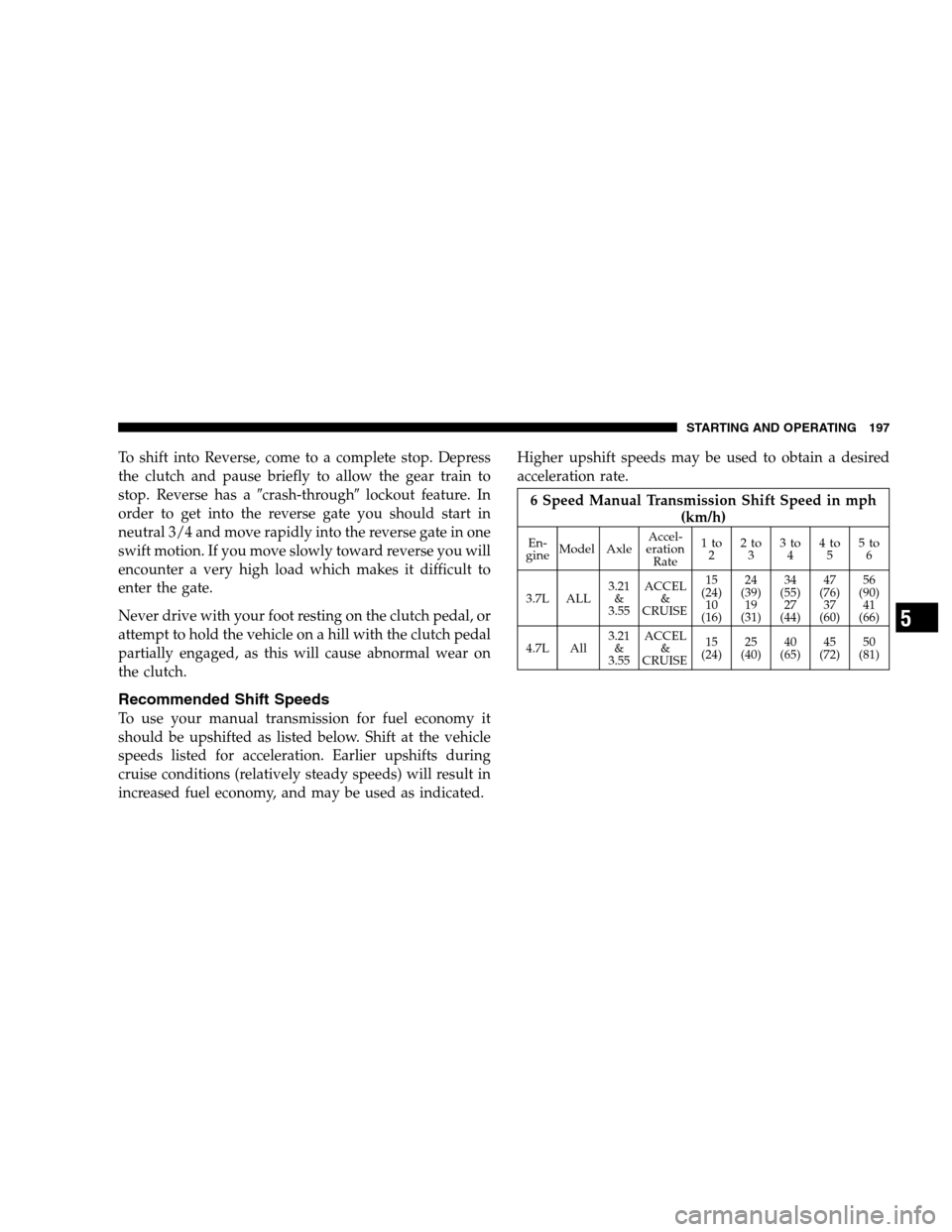
Recommended Shift Speeds
To use your manual transmission for fuel economy it
should be upshifted as listed below. Shift at the vehicle
speeds listed for acceleration. Earlier upshifts during
cruise conditions (relatively steady speeds) will result in
increased fuel economy, and may be used as indicated.Higher upshift speeds may be used to obtain a desired
acceleration rate.
6 Speed Manual Transmission Shift Speed in mph
(km/h)
En-
gineModel AxleAccel-
eration
Rate1to
22to
33to
44to
55to
6
3.7L ALL3.21
&
3.55ACCEL
&
CRUISE15
(24)
10
(16)24
(39)
19
(31)34
(55)
27
(44)47
(76)
37
(60)56
(90)
41
(66)
4.7L All3.21
&
3.55ACCEL
&
CRUISE15
(24)25
(40)40
(65)45
(72)50
(81) STARTING AND OPERATING 197
5
Page 227 of 400

2. Economy—
Improper inflation pressures can cause uneven wear
patterns to develop across the tire tread. These abnormal
wear patterns will reduce tread life resulting in a need for
earlier tire replacement. Under inflation, also increases
tire rolling resistance and results in higher fuel consump-
tion.
3. Ride Comfort and Vehicle Stability—
Proper tire inflation contributes to a comfortable ride.
Over inflation produces a jarring and uncomfortable ride.
Tire Inflation Pressures
The proper cold tire inflation pressure is listed either on
the face of the driver’s door or on the driver’s side “B”
pillar.
Some vehicles may have Supplemental Tire Pressure
Information for vehicle loads that are less than themaximum loaded vehicle condition. These pressure con-
ditions will be found in the “Supplemental Tire Pressure
Information” section of this manual.
The pressure should be checked and adjusted as well as
inspecting for signs of tire wear or visible damage at least
once a month. Use a good quality pocket-type gauge to
Tire Placard Location
STARTING AND OPERATING 227
5