Page 315 of 464

NOTE:A low spare tire will not cause the Tire Pressure
Monitoring System Telltale Lamp to illuminate or the
chime to sound.
Should a low tire condition occur on any of the four
active road tire(s), you should stop as soon as possible,
and inflate the low tire(s) that is/are flashing on the
graphic display to the vehicle’s recommended cold plac-
ard pressure value. The system will automatically up-
date, the graphic display of the pressure value(s) will
stop flashing, and the Tire Pressure Monitoring System
Lamp will extinguish once the updated tire pressure(s)
have been received.
NOTE:The vehicle may need to be driven for up to 10
minuets above 15 mph (25 km/h) to receive this infor-
mation.Service Tire System Soon
The Tire Pressure Monitoring Telltale Lamp will flash on
and off for 60 seconds in the instrument cluster, and an
audible chime when a system fault is detected. The flash
cycle will repeat every 10 minutes, without an audible
chime, until the fault condition not longer exists.
In addition the Electronic Vehicle Information Center
(EVIC) will display a“SERVICE TIRE SYSTEM SOON”
text message for 3 seconds. This text message is then
followed by “— —”, for the pressure value indicating
which of the Tire Pressure Monitoring Sensor(s) is not
being received.
If the ignition key is cycled, this sequence will repeat,
providing the system fault still exists. Iff the system fault
no longer exists, the Tire Pressure Monitoring System
Telltale Lamp will no longer flash, the“SERVICE TIRE
SYSTEM SOON”text message will no longer display,
and a pressure value will be displayed instead of dashes.
STARTING AND OPERATING 315
5
Page 316 of 464

NOTE:Your vehicle is equipped with a compact spare
wheel and tire assembly that does not have a tire pressure
monitoring sensor. Therefore, it will not be monitored by
the Tire Pressure Monitoring System. In the event that a
compact spare tire is used to replace a low pressure road
tire, the next ignition key cycle will still show the Tire
Pressure Monitoring Lamp to be ON, a Chime will
sound, and the Electronic Vehicle Information Center
(EVIC) will still show the low tire pressure value flashing
on the graphic display. This sequence will repeat for
every key cycle until the original Tire Pressure Monitor-
ing System (TPMS) tire has been properly repaired (or
replaced) and put back on the vehicle in place of the
compact spare tire.CAUTION!
The Tire Pressure Monitoring System (TPMS) has
been optimized for the original equipment tires and
wheels. TPMS pressures have been established for
the tire size equipped on your vehicle. Undesirable
system operation or sensor damage may result when
using replacement equipment that is not of the same
size, type, and/or style. After-market wheels can
cause sensor damage. Do not use tire sealant from a
can, or balance beads if your vehicle is equipped
with a TPMS, as damage to the sensors may result.
316 STARTING AND OPERATING
Page 343 of 464
WHAT TO DO IN EMERGENCIES
CONTENTS
�Hazard Warning Flasher..................344
�If Your Engine Overheats.................345
�Jacking And Tire Changing................346
▫Jack Location........................346
▫Spare Tire Stowage....................348
▫Preparations For Jacking................349
▫Jacking Instructions....................350
�Jump-Starting Procedure..................354�Freeing A Stuck Vehicle..................356
�Towing A Disabled Vehicle................357
▫With Ignition Key.....................357
▫Without The Ignition Key...............358
▫Towing This Vehicle Behind Another Vehicle
(Flat Towing With All Four Wheels On The
Ground)............................358
▫Towing This Vehicle Behind Another Vehicle
With A Tow Dolly.....................359
6
Page 357 of 464
WARNING!
Fast spinning tires can be dangerous. Forces gener-
ated by excessive wheel speeds may cause tire dam-
age or failure. A tire could explode and injure
someone. Do not spin your vehicle’s wheels faster
than 35 mph (55 km/h) when you are stuck. And
don’t let anyone near a spinning wheel, no matter
what the speed.
CAUTION!
Racing the engine or spinning the wheels too fast
may lead to transmission overheating and failure. It
can also damage the tires. Do not spin the wheels
above 35 mph (55 km/h).
TOWING A DISABLED VEHICLE
With Ignition Key
Front Wheel Drive
Your vehicle may be towed under the following condi-
tions: The gear selector must be in NEUTRAL, the
distance to be traveled must not exceed 100 miles (160
km), the towing speed must not exceed 44 mph (72
km/h), and both front and rear wheels must be on the
ground. Exceeding these towing limits may cause a
transmission geartrain failure. If the transmission is not
operative, or if the vehicle is to be towed more than 100
miles (160 km), the vehicle must be towed with the front
wheels off the ground.
All Wheel Drive
Your vehicle may be towed under the following conditions:
The gear selector must be in NEUTRAL, the distance to be
traveled must not exceed 100 miles (160 km), the towing
speed must not exceed 44 mph (72 km/h), and both front
WHAT TO DO IN EMERGENCIES 357
6
Page 358 of 464
and rear wheels must be on the ground. If your vehicle
must be towed farther or at a higher rate of speed, it must
be transported on a flat bed truck.
All Transmissions
CAUTION!
•Do not attempt to tow this vehicle from the front
with sling type towing equipment. Damage to the
front fascia will result.
•Always use wheel lift equipment when towing
from the front. The only other approved method
of towing is with a flat bed truck.
•Do not tow the vehicle from the rear. Damage to
the rear sheet metal, liftgate and fascia will occur.
•Do not push or tow this vehicle with another
vehicle as damage to the bumper fascia and trans-
mission may result.
If it is necessary to use the accessories while being towed
(wipers, defrosters, etc.), the key must be in the ON
position, not the ACCESSORY position. Make certain the
transmission remains in NEUTRAL.
Without The Ignition Key
Special care must be taken when the vehicle is towed
with the ignition in the LOCK position. The only ap-
proved method of towing with out the ignition key is
with a flat bed truck. Proper towing equipment is neces-
sary to prevent damage to the vehicle.
TOWING THIS VEHICLE BEHIND ANOTHER
VEHICLE (Flat towing with all four wheels on the
ground)
Flat towing of vehicles equipped with an automatic
transmission, is only permitted within the limitations
described in this section.
358 WHAT TO DO IN EMERGENCIES
Page 367 of 464
cap until a�clicking�sound is heard. This is an indication
that the gas cap is properly tightened. Press the odometer
reset button to turn the message off. If the problem
persists, the message will appear the next time the
vehicle is started. This might indicate a damaged cap. If
the problem is detected twice in a row, the system will
turn on the Malfunction Indicator Light (MIL). Resolving
the problem will turn the MIL light off.
EMISSIONS INSPECTION AND MAINTENANCE
PROGRAMS
In some localities, it may be a legal requirement to pass
an inspection of your vehicle’s emissions control system.
Failure to pass could prevent vehicle registration.
For states, which have an I/M (Inspection and
Maintenance) requirement, this check verifies the
following: the MIL (Malfunction Indicator Lamp)is functioning and is not on when the engine is running,
and that the OBD (On Board Diagnostic) system is ready
for testing.
Normally, the OBD system will be ready. The OBD
system maynotbe ready if your vehicle was recently
serviced, if you recently had a dead battery, or a battery
replacement. If the OBD system should be determined
not ready for the I/M test, your vehicle may fail the test.
Your vehicle has a simple ignition key actuated test,
which you can use prior to going to the test station. To
check if your vehicle’s OBD system is ready, you must do
the following:
1. Insert your ignition key into the ignition switch.
2. Turn the ignition to the ON position, but do not crank
or start the engine.
3. If you crank or start the engine, you will have to start
this test over.
MAINTAINING YOUR VEHICLE 367
7
Page 368 of 464
4. As soon as you turn your key to the ON position, you
will see your MIL symbol come on as part of a normal
bulb check.
5. Approximately 15 seconds later, one of two things will
happen:
a. The MIL will flash for about 10 seconds and then
return to being fully illuminated until you turn off the
ignition key or start the engine. This means that your
vehicle’s OBD system isnot readyand you shouldnot
proceed to the I/M station.
b. The MIL will not flash at all and will remain fully
illuminated until you turn off the ignition key or start
the engine. This means that your vehicle’s OBD system
isreadyand you can proceed to the I/M station.
If your OBD system isnot ready,you should see your
authorized dealer or repair facility. If your vehicle was
recently serviced or had a battery failure or replacement,you may need to do nothing more than drive your
vehicle as you normally would in order for your OBD
system to update. A recheck with the above test routine
may then indicate that the system is now ready.
Regardless of whether your vehicle’s OBD system is
ready or not ready, if the MIL symbol is illuminated
during normal vehicle operation, you should have your
vehicle serviced before going to the I/M station. The I/M
station can fail your vehicle because the MIL symbol is on
with the engine running.
REPLACEMENT PARTS
Use of genuine Mopar�parts for normal/scheduled
maintenance and repairs is highly recommended to in-
sure the designed performance. Damage or failures
caused by the use of non-Mopar�parts for maintenance
and repairs will not be covered by the manufacturer’s
warranty.
368 MAINTAINING YOUR VEHICLE
Page 407 of 464
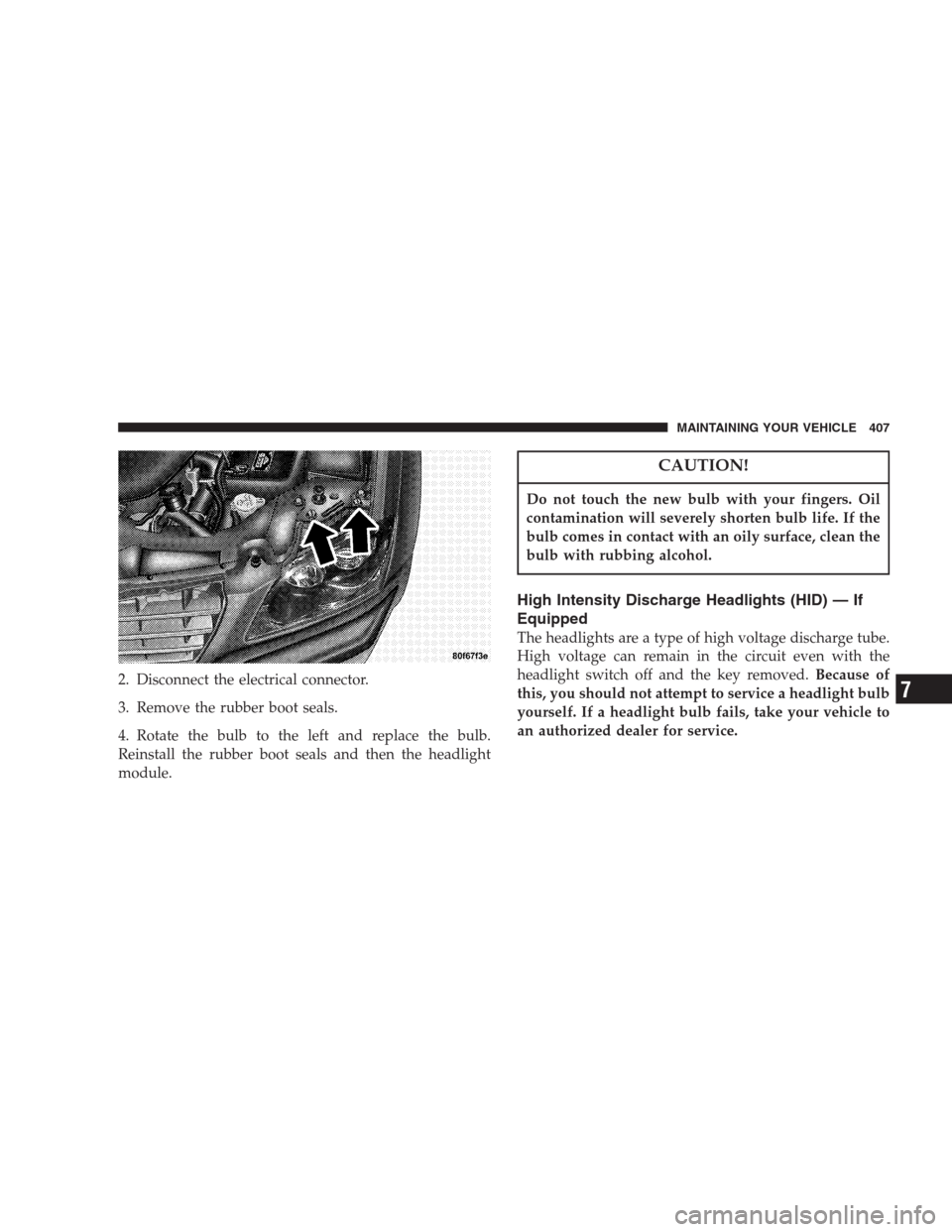
2. Disconnect the electrical connector.
3. Remove the rubber boot seals.
4. Rotate the bulb to the left and replace the bulb.
Reinstall the rubber boot seals and then the headlight
module.
CAUTION!
Do not touch the new bulb with your fingers. Oil
contamination will severely shorten bulb life. If the
bulb comes in contact with an oily surface, clean the
bulb with rubbing alcohol.
High Intensity Discharge Headlights (HID) — If
Equipped
The headlights are a type of high voltage discharge tube.
High voltage can remain in the circuit even with the
headlight switch off and the key removed.Because of
this, you should not attempt to service a headlight bulb
yourself. If a headlight bulb fails, take your vehicle to
an authorized dealer for service.
MAINTAINING YOUR VEHICLE 407
7